
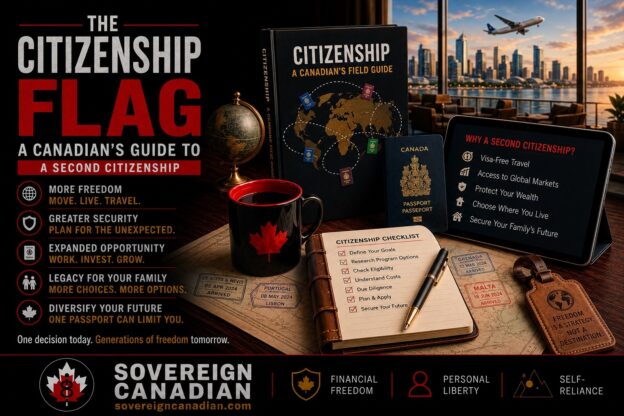
This is the first deep dive in my flag theory series. If you haven’t read the overview yet, start there — it explains what planting flags means and why our residency-based tax system gives Canadians an edge Americans have to fight for. New to the series? Read the Flag Theory introduction first — it lays out the full six-flag framework.
Here we’re taking apart flag one: citizenship. And I’ll be honest up front, because most content on second citizenship is written by people selling one. A second citizenship is the slowest, least urgent flag on the board. It’s also the one I’d start positioning for earliest — and those two things aren’t a contradiction.
What the citizenship flag actually is
Your citizenship is your baseline legal identity. It sets where you can travel without asking permission, where you have an unconditional right to live and work, and which government treats you as one of its own no matter what.
Most people hold exactly one. Flag theory just asks whether that’s a choice or an accident. For nearly everyone, it’s an accident — you got the passport you were born with. A second citizenship turns that accident into a decision.
The good news for us: Canada is a strong starting hand. The passport ranks among the best in the world for visa-free travel, and — this is the part that matters — Canada doesn’t tax you for holding it. Adding a second citizenship on top is pure optionality, not a way out of a trap.
What a second citizenship actually buys you
Three things, mainly.
First, a right to live somewhere else, permanently, without a visa that can be revoked. That’s the difference between visiting a country and belonging to it.
Second, a backstop. Citizenship is the one flag no government can quietly cancel on a policy whim the way a visa or residency permit can. It’s the flag that stays planted when the others get complicated.
Third — and this is the one people underrate — it’s generational. A second citizenship you secure today can pass to your kids, and to theirs. You’re not just buying yourself an option. You’re buying it for a family tree.
What it does not buy you
Here’s where I part ways with the marketing.
A second citizenship, by itself, does almost nothing to your Canadian tax bill. Remember flag two: Canada taxes on residency, not citizenship. Picking up a second passport while you keep living in Ontario changes your tax situation by exactly zero. (Residency flag deep dive — coming soon.)
So if someone pitches a second citizenship as a tax play on its own, they’ve skipped a step. Citizenship is the foundationthat makes other flags easier to plant. It is not the tax event. Conflating the two is the single most common mistake I see.
The four ways to get one
Broadly, there are four doors.
Descent. The cheapest and cleanest, if you qualify. Many countries grant citizenship to the children and grandchildren of their citizens. If you have Italian, Irish, Polish, or Portuguese roots — among many others — you may already be eligible and not know it.
One caution, and it’s a live one: these rules tighten, and 2025 was a brutal reminder. Italy, long the most generous of them, changed its law that year to limit descent claims to people with a parent or grandparent born in Italy — cutting off the great-grandparent and great-great-grandparent claims that used to be the whole appeal, and raising the application fee on top. So check the current rules for your specific bloodline, not the version a forum post described three years ago. The door that was wide open when you bookmarked the idea may be half-closed by the time you get to it.
Still, if the door’s open, descent is the best-value flag in the entire framework. It’s the first thing I’d check for myself and my kids.
Naturalization. You become a resident, you stay long enough, you qualify. This is the slow, organic path, and it overlaps directly with the residency and playground flags. A reconnaissance year abroad can be the first step on a naturalization clock. (The reconnaissance year — coming soon.)
Marriage. A faster naturalization track in many countries if you’re married to a citizen. Not a strategy you plan around, but worth knowing if it already applies to you.
Investment (CBI). Citizenship by investment — you qualify through a qualifying investment or contribution. It’s the fastest door and the most expensive one, and the programs shift constantly as countries add and drop them. It’s a real option for the right situation, but it’s the last one I’d look at, not the first.
The honest trade-offs
A second citizenship isn’t free of friction.
Canada permits dual citizenship, so you generally don’t have to give up your Canadian one — that’s a relief many countries don’t offer. But the other country’s rules matter. Some require you to renounce a prior citizenship. Some impose their own obligations on their citizens.
There’s due diligence, too. Investment programs run background checks, and reputable ones should — you want to be in a program that screens people, not one that doesn’t. Budget for that process being slow and document-heavy.
And there’s the reputational side of the passport itself. Not every second citizenship is equally useful. A weak passport you paid a lot for is a poor flag. The value is in what doors it opens, not in the number of passports in a drawer.
The Canadian starting position
Worth repeating, because it reframes the whole exercise: you’re adding to a strong hand, not escaping a weak one.
You keep the Canadian passport. You keep the right to come home. And because Canada doesn’t chase you for tax on citizenship alone, your second citizenship can sit quietly as pure optionality until the day you actually want to use it — whether that’s a residency move, a place for the kids to land, or simply a backup you hope you never need.
What I’d Actually Do
If I were planting this flag from zero, here’s my order.
I’d start with descent, immediately, because it’s free to check and it’s the best-value citizenship there is. I’d trace both sides of the family tree and find out exactly which countries my kids and I might already qualify for. That’s a weekend of research that could be worth a generation of optionality.
If descent were a dead end, I’d treat naturalization as the real path and let it ride on top of the residency and playground flags — meaning I’d earn the citizenship by actually living somewhere, not by shortcutting it.
I’d look at citizenship by investment last, and only if the first two doors were closed and the option genuinely mattered to me.
And I would not — ever — treat a second passport as a tax strategy on its own. It’s the foundation. The tax lever is residency, and that’s the next post in this series. (Residency flag deep dive — coming soon.)
This post is personal documentation of how I think about my own situation. It is not tax, legal, immigration, or financial advice. Citizenship and immigration rules change constantly and apply differently to every case — confirm anything here with a qualified professional before you act.