Author Archives: Andrew

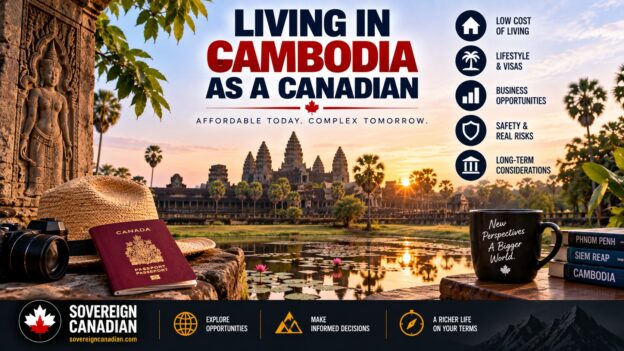
Living in Cambodia as a Canadian with Angkor Wat, Canadian passport and Cambodian tropical landscape

Living in Cambodia as a Canadian

Cambodia has never been on my radar. I have looked seriously at Thailand, Malaysia, Vietnam, Indonesia, the Philippines, and Singapore. Cambodia never made the list, and I never asked myself why not. That omission is the actual starting point for this piece, because an omission that goes unexamined for years is either a very good instinct or a very lazy one, and I wanted to find out which.

The honest answer, after several weeks of research, is that it is a bit of both. Cambodia has real, documented reasons an affluent Canadian would rationally rank it behind Thailand and Malaysia for almost every serious use case. It also has a genuine, underrated case as a place to watch, and in a couple of narrow respects, a place to use right now. What it does not have is the thing that would justify treating it as a final answer rather than a chapter.

Continue reading
Mortgage Prepayment vs Corporate Investing: Should a Business Owner Leave Money in the Company or Pay Down the House?

The previous articles in this series compared mortgage prepayment with a TFSARRSPnon-registered investing and an RESP. Corporate investing is a different problem because the money may not start on the personal side of the balance sheet at all.

Suppose I own a profitable Canadian corporation. The company earns more than I currently need to fund its operations or my lifestyle, and I still have a mortgage on my house. I could retain the money inside the corporate structure and use it to grow the operating business, fund an acquisition or build an investment portfolio. Alternatively, I could extract additional money personally, pay whatever tax applies to that extraction, and use the remainder to reduce my mortgage.

Continue reading
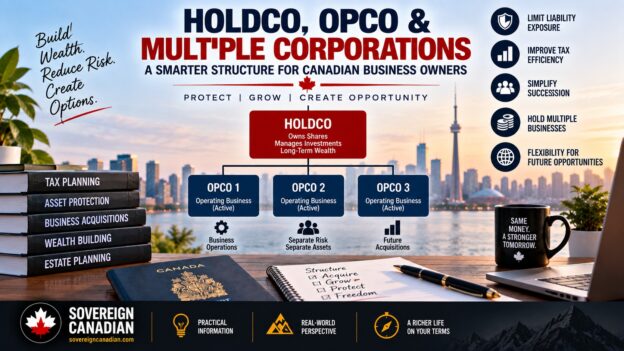
Canadian HoldCo and OpCo structure showing a holding company owning multiple separate operating corporations

HoldCo, OpCo & Multiple Corporations: When Does a Canadian Business Need More Than One Company?

I do not own an incorporated business yet. That is actually one of the reasons I have been thinking about corporate structure now rather than after the fact.

If I acquire a business, the first question is relatively straightforward: what corporation buys and operates it? The more interesting question comes next. What happens if that business succeeds, starts accumulating cash, and I eventually want to buy another one? Does the first corporation buy the second business? Do I own two corporations personally? Should there be a holding company above both? Where should accumulated cash and investments sit? And if one of the businesses gets sued, how much of everything else have I unnecessarily exposed?

Continue reading
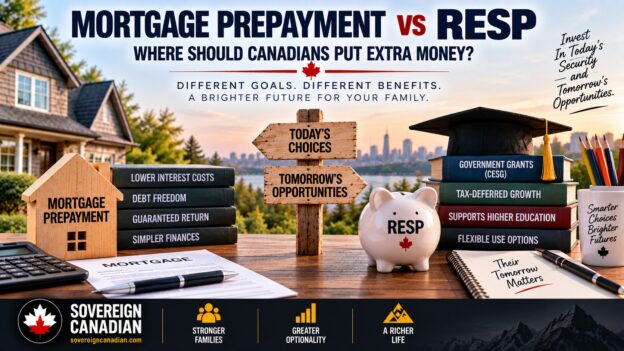
Mortgage prepayment versus RESP in Canada comparing debt reduction with education savings and CESG grants

Mortgage Prepayment vs RESP: Should You Pay Down the Mortgage or Save for Your Kids?

The previous articles in this series compared mortgage prepayment with investing inside a TFSA, an RRSP, and a non-registered investment account. The RESP creates a different decision because there are really two RESP comparisons hiding inside the same account.

The first is whether I should contribute enough to receive the available Canada Education Savings Grant or put that money against the mortgage instead. The second is what I should do after I have already captured the grant. Should another dollar go into the RESP without receiving any additional CESG, into my TFSA if I still have room, or against the mortgage?

Continue reading
Mortgage prepayment versus non-registered investing in Canada comparing debt reduction with taxable investment returns

Mortgage Prepayment vs Non-Registered Investing: Where Should a Canadian Put Their Extra Money?

The first two articles in this series compared mortgage prepayment with investing inside a TFSA and an RRSP. The TFSA comparison was relatively clean because both sides could be considered largely on an after-tax basis: paying down a non-deductible mortgage avoids an after-tax borrowing cost, while investment growth inside a TFSA is generally tax-free. The RRSP complicated the comparison because the contribution can generate a valuable tax deduction today while withdrawals become taxable income later.

Non-registered investing creates a third version of the same decision, and in some ways it is the hardest one.

Continue reading
Living in Singapore as a Canadian with Marina Bay skyline, Singapore flag and Canadian passport

Living in Singapore as a Canadian: Excellence Without Access

Every country in this series so far has sold some version of the same trade. You get access, and you give up certainty. Thailand lets you stay for years on a chain of visas that never quite becomes permanence. Vietnam gives you presence without the paperwork to make it stick. Malaysia formalizes the temporariness so cleanly that it becomes its own kind of stability. The Philippines hands out durable permission but keeps dependability conditional. Indonesia is the purest version of the trade: extraordinary attachment to a place, with almost no institutional tenure underneath it.

Singapore does something none of the other five do. It does not ask you to trade certainty for access. It gives you the certainty, in full, and then makes access the scarce resource instead.

Continue reading
Mortgage prepayment versus RRSP in Canada comparing debt reduction with tax-deferred retirement investing

Mortgage Prepayment vs RRSP: Where Should a Canadian Put Their Extra Money?

The mortgage-versus-TFSA decision is relatively clean. If I have $25,000 available, I can use it to reduce a non-deductible mortgage or invest it inside an account where future growth is generally tax-free. The mortgage gives me something economically close to a guaranteed after-tax return equal to the interest I avoid. The TFSA gives me an uncertain investment return, but if that return materializes, I generally keep all of it.

Replace the TFSA with an RRSP and the comparison gets considerably more interesting.

Continue reading
RRSP versus TFSA in Canada comparing tax deferral, tax-free growth and different life stages

RRSP vs TFSA: The Decision Changes as Your Income Rises

RRSP versus TFSA is one of those Canadian personal-finance questions that seems to have acquired a standard answer: use the RRSP when your income is high and the TFSA when your income is low. That is basically correct, but it is not especially useful until we define what high and low actually mean.

I have thought about this more as my own income has risen. The RRSP contribution I made earlier in my career is fundamentally the same product as the RRSP contribution I make today, but the tax value of the deduction can be dramatically different. That immediately raises another question. If someone earns $80,000 today and reasonably expects to earn $160,000 five years from now, should they use all of their available RRSP room now simply because they have it? What about someone already earning $250,000? What changes if there is a pension waiting in retirement, or if the plan is to retire at 55 and deliberately spend down the RRSP before CPP and OAS arrive?

Continue reading
Mortgage prepayment versus TFSA investing in Canada, comparing debt reduction with tax-free investment growth

Mortgage Prepayment vs TFSA: Where Should a Canadian Put Their Extra Money?

I have faced a version of this decision myself. There is some extra money available, unused TFSA room waiting to be filled, and a mortgage balance that could be knocked down. The money has to go somewhere. Do I put another $25,000 into investments, or send it against the house?

At first, this looks like one of the simpler decisions in personal finance. Compare the mortgage rate to the expected investment return. If the investments should earn more, invest. If the mortgage costs more, pay it down. It is an attractive rule because it fits in one sentence, but the more I thought about the decision, the less useful that sentence became.

Continue reading
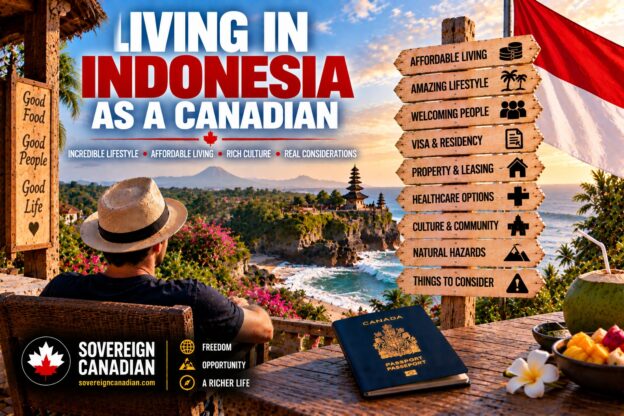
Living in Indonesia as a Canadian with a Bali temple, tropical coastline, Indonesian flag and Canadian passport

Living in Indonesia as a Canadian: Attachment Without Tenure

Every country in this series eventually reveals a single sentence that explains it. Thailand offers dependability without belonging. Vietnam offers presence without permanence. Malaysia offers a formalized temporariness that is honest about what it is. The Philippines, to my surprise, turned out to offer durable legal permission over a life whose dependability you have to build privately. Indonesia is the hardest of the group to reduce to a sentence, because it does something none of the others quite manage: it makes you feel at home almost immediately, and then, the more seriously you try to make that feeling permanent, the more expensive and structurally awkward the whole thing becomes.

Continue reading