
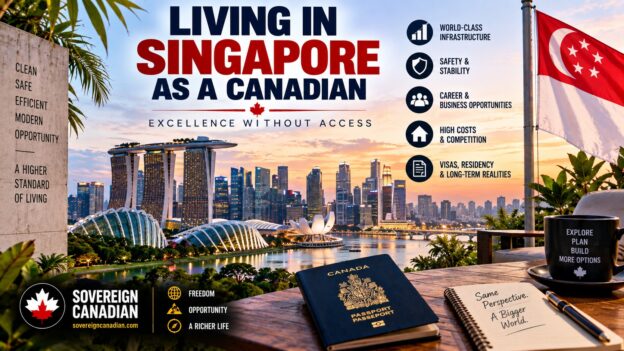
Every country in this series so far has sold some version of the same trade. You get access, and you give up certainty. Thailand lets you stay for years on a chain of visas that never quite becomes permanence. Vietnam gives you presence without the paperwork to make it stick. Malaysia formalizes the temporariness so cleanly that it becomes its own kind of stability. The Philippines hands out durable permission but keeps dependability conditional. Indonesia is the purest version of the trade: extraordinary attachment to a place, with almost no institutional tenure underneath it.
Singapore does something none of the other five do. It does not ask you to trade certainty for access. It gives you the certainty, in full, and then makes access the scarce resource instead.
That single reversal is the entire article. Everything else, the tax code, the property market, the healthcare system, the work passes, the car quotas, is a downstream consequence of one design choice: Singapore built one of the most dependable, well-governed, and quietly wealthy small countries on earth, and then made durable access to it selective rather than universal. Employment can open the door. Entrepreneurship can open it. Family can open it. At the extreme end, qualifying investment can open it too. But passive wealth alone usually cannot, and that is the single fact that separates Singapore from every other country a financially independent Canadian might consider.
Expat Living for Canadians: Why Live Abroad, and Should You?
Reconnaissance: Sampling Singapore Without Settling
Before any of the harder questions, there is a simpler one: can a Canadian even try Singapore out without committing to anything?
Yes, more easily than almost anywhere else in the series, for a visit of a few weeks or a couple of months. What you actually get on arrival is a Short-Term Visit Pass, or STVP, and both the fact of entry and the length of stay granted are assessed independently by the immigration officer at the checkpoint each time, not guaranteed in advance and not created by any prior visit. Canadian passport holders are not on Singapore’s visa-required list, but visa-free entry does not itself guarantee either admission or a particular stay. The duration granted appears on the electronic Visit Pass issued at entry, and extensions can be requested online before it expires, according to ICA’s own entry requirements.
What Singapore does not offer is a way to manufacture a long pseudo-residence out of repeated tourist entries. Each entry stands on its own, and exiting to Johor Bahru and coming back does not reset a clock or create any renewable residence mechanism; it simply triggers a fresh, independent assessment that may grant a shorter stay than the one before it. That puts Singapore at the opposite end of the reconnaissance spectrum from Indonesia’s C1 arrangement, which through extensions can support something close to 180 continuous days and is genuinely well suited to a long seasonal test. Singapore is excellent for a short, serious look. It is not the country in this series for trying to stretch tourism into something resembling residence.
The catch on even a short stay is tax residency, and it is a real one. Cross 183 days of physical presence in a calendar year and IRAS will generally treat you as a tax resident regardless of your immigration status, which means a long reconnaissance trip can quietly convert into a Singapore tax year if you are not counting carefully. IRAS’s own guidance on tax residency also applies administrative concessions beyond the simple annual count, including treating a foreigner as a tax resident across two calendar years where continuous employment straddles them, or across three consecutive years where physical presence and employment together span that period, and separately treating a foreigner issued a work pass valid for at least one year as a tax resident from the outset, subject to review at tax clearance if the employment ends early. The practical residency test is somewhat broader than the headline 183-day rule suggests.
The Immigration Question: Can You Actually Move There
This is the section that decides the whole article, so it’s worth being precise rather than encouraging.
Singapore’s work pass system is a ladder, and every rung on it is tied to employment. The Employment Pass, the standard route for foreign professionals, currently requires a minimum fixed monthly salary of SGD 5,600 for general sectors, climbing progressively with age to SGD 10,700 at 45 and above, and SGD 6,200 for financial services, climbing to SGD 11,800 at 45 and above, per MOM’s published EP eligibility criteria. From January 2027, those minimums rise to SGD 6,000 general and SGD 6,600 financial services, climbing to SGD 11,500 and SGD 12,700 respectively at the top of the age scale. Salary alone is not sufficient either: most EP applicants must also clear COMPASS, Singapore’s points-based Complementarity Assessment Framework, which scores factors including salary relative to local benchmarks, qualifications, workforce diversity, and the employer’s proportion of local hiring. The S Pass, aimed at mid-skilled workers, currently sits at SGD 3,300 general and SGD 3,800 financial services, rising to SGD 3,600 and SGD 4,000 from 2027, and is additionally capped by employer quota. Both passes are employer-sponsored. Lose the job, and in most cases the pass unwinds on a short clock.
Above these sits the Overseas Networks and Expertise Pass, or ONE Pass, introduced in 2023 for genuinely top-tier talent. It requires a fixed monthly salary of at least SGD 30,000, benchmarked to roughly the top five percent of Employment Pass holders, or a qualifying record of outstanding achievement in business, the arts, sports, science, or academia. Unlike the EP, the ONE Pass attaches to the person rather than a single employer, runs for five years, and allows multiple simultaneous employers or ventures. It is a genuinely elegant pass. It is also entirely irrelevant to a Canadian who has already made their money and wants to stop working, because it still assumes you are earning, or have very recently earned, an extraordinary salary.
There is an EntrePass for entrepreneurs, but it is not a generic small-business visa with a capital threshold to clear. It targets serial entrepreneurs, high-calibre innovators, and experienced investors whose Singapore company is venture-backed or owns innovative technologies, with Enterprise Singapore working alongside the Ministry of Manpower in evaluating applications. Where the Singapore company is already incorporated, the applicant must hold at least 30 percent of it. It is a business-building visa, not a lifestyle visa, and Singapore’s assessors are reasonably good at telling the difference between an operating business with real backing and a shell built to hold a pass.
Now run the test this article set out to run. Imagine a financially independent Canadian, somewhere between CAD 5 million and CAD 10 million net worth, who does not need a job, does not want to run a business day to day, and simply wants to live in Singapore. Walk that person through every route above. The Employment Pass requires an employer and a salary. The S Pass requires the same, at a lower tier. The ONE Pass requires either a recent SGD 30,000 monthly salary or outstanding public achievement, neither of which retirement satisfies. The EntrePass requires an operating business, not a portfolio. There is no retirement visa. There is no digital nomad visa. There is no passive-income residence route of the kind Malaysia, Portugal, Panama, or a dozen other countries offer as a matter of course. Being rich, on its own, does not get a Canadian into Singapore to live.
There is exactly one route built for money without employment, and it deserves its own section, because it is more restrictive than most people assume.
Living in Malaysia as a Canadian: A Second Base That Doesn’t Need to Become Home
The Global Investor Programme: Money, But Not Passive Money
The Global Investor Programme, run by Singapore’s Economic Development Board, is the country’s answer to the wealthy-foreigner residence schemes that have become common elsewhere. It grants permanent residence, not a temporary pass, to the main applicant and to a spouse and unmarried children under 21. On paper it looks like exactly what the hypothetical wealthy Canadian needs.
In practice it is not an ordinary wealth visa, and the distinction matters more than it first appears. ICA confirms the applicant must choose one of three investment options: at least SGD 10 million to start or meaningfully expand an operating business in Singapore, backed by a detailed five-year business plan in an approved industry; at least SGD 25 million into a GIP-select fund that itself invests in Singapore-based companies; or a single-family office in Singapore managing at least SGD 200 million in assets, with at least SGD 50 million of that actively deployed into designated local investment categories. The middle option, the fund route, can genuinely be passive at the level of the investment itself; a Canadian putting SGD 25 million into an approved fund is not required to run anything day to day.
The real gate sits one step earlier than the investment itself. GIP is not open to anyone who can wire SGD 25 million into a fund. It is designed for qualifying global investors and entrepreneurs with a substantial business track record, generally an established operating company, a demonstrated record of building and running businesses, or a comparable entrepreneurial history, and the Economic Development Board assesses the applicant’s profile before the investment route even becomes available to them. A person does not qualify merely by having the money sitting in a brokerage account with no business history behind it. Singapore does have a route where capital can buy permanent residence, but the applicant has to be the kind of entrepreneur or investor Singapore is trying to attract first, and only then does the investment become the mechanism.
It is worth separating three versions of “rich” here, because Singapore treats them very differently and this article will otherwise blur them the way casual conversation usually does. There is the affluent Canadian investor, somewhere in the CAD 5 million to CAD 10 million range, financially independent and with no interest in operating a company day to day. There is the successful entrepreneur or operator, someone with a substantial company and a real commercial track record behind them, whether or not their personal net worth is dramatically higher than the first group’s. And there is the ultra-high-net-worth family principal, genuinely capable of clearing GIP or family-office scale on their own. A Canadian in the first category can feel extraordinarily wealthy by the standards of almost every other country in this series and still find that Singapore’s immigration system does not consider that wealth, on its own, particularly relevant.
So the hypothetical CAD 5 million to CAD 10 million Canadian, comfortably wealthy by Canadian standards but without a substantial operating-business track record behind that wealth, sits below even the lowest GIP investment quantum in the first place, and would face the entrepreneurial-profile gate on top of it regardless. This is the finding that should reframe how a Canadian reader thinks about Singapore. In most of the countries in this series, a wealthy Canadian’s problem is bureaucratic friction. In Singapore, it is a double eligibility wall, one of scale and one of profile, that passive wealth alone does not clear.
Permanent Residence: Eligible to Apply Is Not the Same as Likely to Receive
Outside the GIP, the ordinary route to PR runs through the Professionals/Technical Personnel and Skilled Workers scheme. ICA confirms that Employment Pass and S Pass holders fall within the eligible categories who may apply, but eligibility to apply is a very different thing from having a strong likelihood of approval. Singapore does not publish a points system or a transparent scoring rubric the way Canada’s own economic immigration streams do. Applications are assessed holistically, and publicly known factors include employment history and salary, age, family situation and whether a spouse or children are already settled in Singapore, educational qualifications, length of time already spent working in the country, and a general sense of economic contribution and integration.
The honest way to describe this for a Canadian reader is that PR in Singapore is a reward for having already built a working life there, not a standalone application a newcomer files. There is no published minimum salary or minimum years that guarantees approval, and immigration lawyers who work this system consistently describe it as discretionary rather than formulaic. Being technically eligible to apply as an EP or S Pass holder is meaningfully different from having a strong chance of approval, which depends on a case officer’s read of how anchored and how valuable you are to Singapore specifically. A Canadian who arrives on an Employment Pass at 45, works for three years, and then wants to retire in place should not assume PR is coming. It is assessed, not earned by tenure alone.
Citizenship: The Binary Choice
Singapore does not permit adult dual citizenship, full stop. A foreigner who naturalizes must renounce their prior citizenship, generally within a set period after being granted Singapore citizenship, and Singapore citizens who acquire another country’s citizenship as adults are required to renounce Singapore citizenship in turn, per ICA’s own citizenship guidance. There is no dual-nationality carve-out for wealthy investors, no golden-passport shortcut, and no ambiguity to exploit. National Service obligations attach specifically to male Singapore citizens and, in many though not all cases, male PRs and certain second-generation male dependants, and the details vary enough by individual circumstance that a family weighing this should treat it as a specific question to resolve for each male family member rather than a blanket rule applying identically to every case.
This is worth putting next to the countries already covered in this series. Indonesia’s dual-citizenship problem is really a problem of Indonesia refusing to let a Canadian keep both passports as an adult resident. Malaysia’s permanence is formalized but temporary. Singapore doesn’t blur the line at all: at citizenship, you choose, and for a Canadian that choice means surrendering the Canadian passport and the unconditional right it carries to enter, live, and work in Canada. That is a far larger decision than simply changing tax residence, and it should be treated as one of the genuine costs of the deepest version of Singapore’s promise, not a footnote.
Living in Indonesia as a Canadian: Attachment Without Tenure
Tax: The Best Residence You May Never Legally Hold
Here is where Singapore’s case gets genuinely compelling, and where the contradiction at the heart of this article becomes sharpest.
IRAS treats an individual as a tax resident for a given Year of Assessment if they are a Singapore citizen, a PR with a permanent home in Singapore, or a foreigner who has stayed or worked in Singapore for at least 183 days in the preceding year, with additional administrative concessions for employment that straddles two calendar years or continues for three consecutive years. Resident tax rates are progressive, starting at zero and topping out at 24 percent on chargeable income above SGD 1,000,000. Non-residents are generally taxed at a flat rate, commonly 15 to 24 percent depending on income type, without access to personal reliefs.
Singapore levies no capital gains tax and no estate or inheritance tax. Foreign-sourced income received in Singapore by an individual is generally not taxable, with IRAS carving out specific exceptions such as income received through a Singapore partnership or foreign employment income that is incidental to a Singapore employment. That is a meaningfully narrower and more precise statement than a blanket territorial exemption, but it still means a Canadian living genuinely in Singapore, drawing investment income from outside the country, faces a strikingly light domestic tax burden compared to almost anywhere in the Western world. There is no wealth tax. Property tax exists but is modest relative to the value it’s levied on.
Canada and Singapore have had an income tax treaty since 1976, updated by protocol in 2011 and 2012, which allocates taxing rights between the two countries and contains the standard mechanisms for relieving double taxation, alongside reduced withholding rates on cross-border dividends, interest, and royalties. The Canadian this article is modelling is becoming a non-resident of Canada for tax purposes, so the relevant question is not how a Canadian resident credits foreign tax paid, but how much of their Canadian-source income Canada retains the right to tax after they leave. Canadian-source income can remain subject to Canadian non-resident tax even once Singapore residency begins, and the treaty’s job is to say which country taxes what, not to eliminate Canada’s claim outright. Canadian departure tax applies on ceasing Canadian tax residency in the ordinary way, and readers weighing a genuine move should read that alongside this piece rather than treat it as a separate problem.
Pensions specifically deserve their own explanation, because two separate Canada-Singapore issues get conflated easily and shouldn’t be. The first is the income tax treaty itself. Under Article XVII, pensions and annuities arising in one country and paid to a resident of the other are generally taxable only in the source country, which for a Canadian pension paid to a Singapore resident means Canada retains the taxing right and Singapore generally does not tax it. That sounds favourable, but there’s a catch specific to this particular treaty: unlike many of Canada’s newer tax treaties, the Canada-Singapore convention does not provide the common 15 percent ceiling on periodic pension payments. That means Canada’s domestic Part XIII withholding, commonly the default 25 percent, can remain the operative rate on CPP and OAS payments to a Singapore resident, depending on the specific income type and subject to whatever relief might be available through section 217 election or an NR5 application in a given year. A retiree modelling their numbers around Singapore residency should build that withholding in as the base case rather than assume treaty relief brings it down.
The second, entirely separate issue is the absence of a Canada-Singapore social security agreement, and this matters most for OAS rather than CPP. Without a totalization agreement, a Canadian generally needs 20 years of Canadian residence after age 18 to keep receiving OAS indefinitely while living abroad; falling short of that threshold can cut off payments after six months outside Canada, since there is no agreement here allowing years of residence in Singapore to be added to the Canadian count the way there would be with a treaty partner. CPP is a different animal, since it is a contributory plan rather than a residence-based one, and CPP benefits already earned generally continue to be paid abroad regardless of whether a social security agreement exists.
Now the three models this article promised. A modest pension retiree, drawing mainly CPP and OAS with a small RRIF, gains surprisingly little from Singapore’s tax system. Much of that income remains Canadian-source, while the Canada-Singapore treaty lacks the 15 percent periodic-pension withholding ceiling found in many of Canada’s newer treaties. The retiree therefore has far less Singapore-tax arbitrage to exploit than the portfolio-funded investor does, and Singapore has no capital gains or dividend income of theirs to shelter in the meantime. An affluent pension retiree, with meaningful RRIF and non-registered investment income on top of government pensions, starts to benefit modestly, since Singapore generally will not add local tax to Canadian RRIF income received by the individual, while Canada retains its source-country taxing right and continues to withhold accordingly, and any foreign investment income earned outside Canada or Singapore lands largely untaxed locally. A wealthy, portfolio-funded Canadian, drawing primarily from a non-registered global portfolio with modest or no Canadian pension income, is the profile Singapore actually rewards: no capital gains tax on portfolio growth, no dividend tax on most foreign dividends received locally, no estate tax on the eventual transfer, and a personal top rate that caps out well below what that same income would face at Canadian marginal rates.
Which brings the contradiction back around. That third Canadian, the one Singapore’s tax code rewards most, is also the one who has the hardest time actually getting a legal status that lets them live there long enough to benefit. Being independently wealthy is precisely the profile the GIP does not serve on its own, and it is not the profile any work pass is built for either. Singapore may be one of the strongest tax residences in Southeast Asia for a Canadian investor, and that advantage is close to moot if the same Canadian cannot secure a durable right to actually be there.
Real Estate: Why Would a Canadian Buy
Sovereign Canadian does not yet have a dedicated Singapore real estate piece, so this section carries more weight than the property section of a typical country guide in this series.
Start with what a foreigner can buy without approval. Private condominiums and apartments, regardless of building height, are open to any foreign buyer, no prior approval required, and this is genuinely the segment Singapore’s residential market is built around for non-citizens. Strata-landed houses inside approved condominium developments are similarly open. What remains restricted under the Residential Property Act is landed residential property in the traditional sense: terrace houses, semi-detached houses, detached bungalows, vacant residential land, and landed homes in non-condominium strata developments. A foreigner who wants one of these must apply to the Singapore Land Authority’s Land Dealings Unit. SLA’s published criteria say an applicant should have been a Singapore PR for at least five years and must make an exceptional economic contribution to Singapore, assessed using factors such as taxable employment income. The one meaningful exception is Sentosa Cove, a small, purpose-built enclave where non-PR foreigners can apply to buy landed property, with a comparatively faster approval process given the area’s deliberate positioning for international buyers. Executive condominiums, a hybrid public-private housing type, carry their own resale-eligibility waiting periods and are generally not a first-purchase option for foreigners. HDB public housing is not an ordinary purchase option for a foreign Canadian. Singapore PRs can become eligible under specific HDB schemes and conditions, but that is a different market from the private condominium segment relevant to a newly arrived Canadian.
Now the tax that actually decides the question. Every residential purchase in Singapore carries Buyer’s Stamp Duty on a marginal schedule: 1 percent on the first SGD 180,000 of value, 2 percent on the next SGD 180,000, 3 percent on the next SGD 640,000, 4 percent on the next SGD 500,000, 5 percent on the next SGD 1.5 million, and 6 percent on anything above SGD 3 million. On top of that sits Additional Buyer’s Stamp Duty, and this is where Singapore separates itself from every other market in this series. A foreign individual buying any residential property, regardless of whether it’s their first purchase, pays a flat 60 percent ABSD, a rate that was doubled from 30 percent in April 2023 specifically to dampen foreign investment demand. Singapore citizens buying a second property pay 20 percent, and PRs buying their first property pay a comparatively gentle 5 percent, which underlines how sharply the system is designed around citizenship and residency status rather than around the property itself.
Crucially for a Canadian reader, there is no relief available. Only two of Singapore’s free trade agreements carry a “national treatment” obligation broad enough to touch stamp duty: the US-Singapore FTA, which extends Singaporean-equivalent tax treatment to US nationals, and the Singapore-European Free Trade Association agreement, which does the same for nationals and permanent residents of Iceland, Liechtenstein, Norway, and Switzerland. The CPTPP, which Canada joined in 2018 and which does meaningful work lowering tariffs and improving investment protections between the two countries, contains no equivalent stamp duty carve-out. An American buying a Singapore condominium today pays the same ABSD as a Singaporean citizen. A Canadian, doing the identical transaction, pays 60 percent.
Run the numbers on a straightforward example: a Canadian considers a SGD 2,000,000 private condominium. Buyer’s Stamp Duty on that purchase comes to roughly SGD 69,600. Additional Buyer’s Stamp Duty at 60 percent adds SGD 1,200,000. Total stamp duty alone is approximately SGD 1,269,600, or about 63.5 percent of the purchase price, before legal fees, agent commissions, or the property’s own price. Financing does not solve the ABSD problem. The duties themselves have to be funded largely in cash regardless of what a bank will lend against the property, and foreign borrowers may additionally face tougher underwriting of overseas income, assets, and creditworthiness than a citizen or PR would, which pushes most foreign buyers toward substantial cash positions on top of whatever mortgage they can arrange.
That is not a market inefficiency. It is a deliberate policy outcome. The honest question for a Canadian reader is not whether they can buy Singapore real estate. They can, in the unrestricted condominium segment. It’s why they would, at a 63 percent upfront tax load, when renting an equivalent unit carries none of that cost and preserves the flexibility to leave. For the ordinary Canadian in this series’s audience, even a wealthy one, the rational answer is to rent, and to treat that answer as the default rather than a failure to find a workaround.
For someone expecting PR or citizenship, the rational strategy is generally to wait until status changes before buying. For everyone else, the 60 percent ABSD is difficult to justify as an investment cost; an ultra-wealthy buyer may consciously absorb it as the price of owning a particular home, but that is a consumption decision rather than a compelling property-investment thesis. Singapore is an excellent place to hold financial capital and a poor place to acquire residential property as a foreigner, and that contrast, rather than the property market itself, is the useful takeaway.
Cost of Living: Two Singapores
Numbeo rankings that place Singapore among the most expensive cities on earth are not wrong, but they obscure a distinction that matters enormously for a Canadian reader: there is a cost of living for people plugged into Singapore’s citizen-and-PR infrastructure, and a materially higher one for foreigners who are not.
A single foreign professional renting a one-bedroom condominium in a decent district, eating out regularly, and using public transit can expect a comfortable but not extravagant monthly budget running well into the mid-thousands of Canadian dollars once rent is included, with rent alone for a modest one-bedroom condo commonly running from roughly CAD 2,500 to CAD 4,000 or more depending on district. A Canadian couple wanting a two-bedroom condominium in a family-friendly area, still without children, sits meaningfully higher. A family with two children shifts the budget dramatically upward, driven almost entirely by two line items: housing large enough for a family, and schooling, which for a family that goes the international school route commonly runs from roughly CAD 25,000 to CAD 45,000 per child per year, before enrollment and capital fees that can themselves run into five figures. A family that successfully places children in the local public system through AEIS avoids most of that specific cost, which is one of the more significant, and more overlooked, variables in whether a Singapore posting is actually affordable for a given family.
Groceries and hawker-centre food remain genuinely inexpensive by Western standards, which is part of why local cost-of-living data can look deceptively moderate. But locals and PRs have much easier access to the housing and schooling structures that make Singapore’s domestic cost model work. A foreign family relying on private housing and international schooling occupies a materially different cost structure. A Canadian family living like an affluent expatriate, in private housing, sending children to international school, running a car, is paying for an entirely different Singapore than the one Numbeo’s broader averages describe.
Cars and the COE: A Sacrifice That Barely Matters
Singapore’s Certificate of Entitlement system is worth explaining precisely because it is so extreme it becomes almost comic, and because it changes how a Canadian should think about daily life there. Before a car can even be registered, a buyer must win a COE at auction, essentially a ten-year right to put a vehicle on the road at all. Through 2026, Category A COEs, covering smaller and electric vehicles, have traded in the range of roughly SGD 110,000 to SGD 130,000, with Category B, covering larger and more powerful vehicles, running comparably high or higher. That is the cost of the certificate alone, before the car. A mainstream family sedan that would cost the equivalent of CAD 30,000 to CAD 40,000 in Canada can retail well past CAD 150,000 in Singapore once COE, taxes, and registration fees are layered on.
The practical response for most Canadians moving to Singapore, even comfortably wealthy ones, is simply to not own a car, and this is far less of a sacrifice than it would be almost anywhere in Canada. Singapore’s MRT and bus network is dense, reliable, air-conditioned, and covers the country thoroughly enough that car-free living is the norm rather than the exception even among affluent residents. Taxis and ride-hailing fill the remaining gaps cheaply relative to car ownership. A Canadian used to needing a car for basic mobility should expect the adjustment to be smaller than it sounds and, for most households, to actually improve day-to-day convenience rather than diminish it.
Families and Schools: Excellence at a Price
Local Singaporean public schools are not automatically closed to foreign children, but admission is meaningfully less certain and more administratively involved than it is for citizens and PRs. At Primary 1, international students go through a separate Phase 3 process only after citizen and PR placement is complete, and for Primary 2 through 5 and Secondary 1 through 3, international students can seek admission through the AEIS or S-AEIS testing system, subject to available vacancies and passing the placement test. Some Canadian families do successfully place children in the local system this way, at a fraction of international school cost, though later and with less certainty than a citizen or PR family would face. For families who don’t want to plan around that uncertainty, or whose children arrive at ages the AEIS window doesn’t suit, the international school system is the fallback, and it is not automatically the only realistic route the way it is in some other countries in this series. Singapore’s international schools, several of which rank among the strongest in Asia by any conventional academic metric, deliver a genuinely excellent education, but at the fee levels described above, and typically with long waitlists at the most sought-after schools that require planning well before a move.
The lifestyle trade-off is real and worth stating plainly rather than resolving with a ranking. Singapore offers exceptional safety, clean and reliable public infrastructure, and a genuinely international peer group for children. It also comes with a well-documented academic intensity, both in the local system Canadian children mostly won’t touch and, to a real degree, in the competitive culture of the international school scene itself. Singapore is not short on greenery in the public sense; its parks, park connectors, and nature reserves are extensive and genuinely well built for a dense city. What it lacks, compared to suburban or semi-rural Canada, is private space and wilderness-scale freedom, the kind of unsupervised backyard or bush-and-lake access many Canadian childhoods take for granted, rather than any shortage of public outdoor infrastructure. Compared to raising the same two children for five years in Kuala Lumpur, Bangkok, or Bali, Singapore wins decisively on safety, healthcare access, and school quality, and loses decisively on cost and, for many families, on the kind of loose, low-supervision childhood that some of the cheaper Southeast Asian bases still offer. Compared to Canada itself, Singapore trades away extended family, familiar language and culture, and free public schooling, in exchange for safety and academic intensity that few Canadian cities can match. There is no universal answer here, and a family genuinely weighing this should test schools directly rather than rely on rankings, but the honest framing is a trade between cost and intensity on one side and safety and rigour on the other, not a simple upgrade.
Healthcare: The System That Isn’t the Problem
Singapore’s healthcare reputation is earned. The public and private hospital systems are both genuinely excellent by global standards, specialist and tertiary care, including complex cardiac, cancer, and neurosurgical treatment, is available domestically at a level that removes most of the medical-evacuation anxiety that runs through other articles in this series.
The catch for a Canadian is that almost none of the subsidized side of this system is available to foreigners. MediSave, MediShield Life, and MediFund, the three pillars of Singapore’s public health financing, are restricted to citizens and PRs, who fund them through mandatory Central Provident Fund contributions that foreigners on work passes are exempt from and therefore do not build up. A foreigner in Singapore, including a Canadian on an Employment Pass, needs private or international health insurance as a practical necessity, not an optional upgrade, and premiums for comprehensive private coverage rise meaningfully with age, which matters directly for the age-75 test this series runs on every country.
Run that test here. An affluent Canadian couple moving to Singapore at 60, hoping to stay through 85, will not find the healthcare system itself the constraint. Private coverage can become increasingly expensive with age, and entry ages, renewability terms, exclusions, and pre-existing-condition rules vary enough by insurer and product that they become critical variables rather than footnotes, particularly for a couple trying to plan coverage a full 25 years out. That is a real financial planning problem, but it is a problem of cost and insurability rather than a fundamentally different curve than the one private insurance follows anywhere. What actually breaks first is almost certainly immigration status. A retired 60-year-old Canadian couple has no obvious route to a status durable enough to still be valid at 85 unless they arrived decades earlier on work passes, secured PR, and ideally naturalized well before retirement. Long-term nursing and dementia care exist in Singapore’s private sector at a high standard and a correspondingly high price, and domestic foreign-worker help, common among Singaporean families for eldercare, is genuinely accessible to foreign residents too. Singapore produces close to the opposite finding from Indonesia in this series: the clinical system can carry you reliably into old age, but the legal right to be there to receive it is the fragile part, not the medicine.
Banking, Capital, and the Singapore Flag
This is the section where Singapore’s case stops being complicated and starts being simply strong.
Opening a personal bank account in Singapore as a foreign resident is straightforward with the right documentation. Some Singapore institutions will also onboard non-residents, particularly affluent or private-banking clients, but eligibility, minimum asset thresholds, and documentary requirements vary materially by institution and should not be assumed to be routine. The major local banks, DBS, OCBC, and UOB, are well-capitalized, conservatively regulated, and backed by a government-run deposit insurance scheme, and the Singapore dollar has been a genuinely stable currency for decades, managed within a policy band rather than left to float freely, which gives it a different risk character than most emerging-market currencies a Canadian might otherwise consider for diversification. There are no capital controls restricting inbound or outbound movement of funds. The brokerage, custody, and private banking ecosystem is deep, with private banking and wealth management available at minimums that scale from the comfortably affluent up to the ultra-high-net-worth family office tier the GIP is built around.
None of this is secrecy, and it shouldn’t be marketed as such. Singapore is a full participant in the Common Reporting Standard, exchanging financial account information with Canada and dozens of other jurisdictions automatically, so a Canadian moving assets to Singapore gains currency and jurisdictional diversification, not privacy from the CRA. That distinction matters and should never be blurred.
Put simply: Singapore may be one of the best places in the world for a Canadian to hold part of their financial life, entirely independent of whether they ever live there. Compared to Malaysia’s comparatively less internationally battle-tested banking sector, or to concentrating everything at home in Canada, Singapore offers a genuinely differentiated, stable, well-regulated capital flag. This is arguably the strongest, least contradicted finding in the entire article, and it exists almost entirely apart from the residence question that dominates everything else here.
Flag Theory for Canadians: An Introduction to Planting Flags The Residency Flag: How Canadian Tax Residency Actually Works
Business: Where Singapore Actually Earns Its Reputation
Company incorporation through ACRA is fast, and a Singapore private limited company can be foreign-owned without requiring a Singaporean shareholder. It does, however, need at least one director who is ordinarily resident in Singapore, alongside the other normal corporate-office requirements, which is a useful distinction on its own: foreign ownership of a Singapore company is easy, while personally acquiring the right to live in Singapore and operate it is a separate question entirely, and one this article has already spent several sections on. The flat 17 percent corporate tax rate, alongside various startup and sector-specific incentives, remains genuinely competitive by developed-economy standards. Singapore’s real commercial advantage for a Canadian operator, though, is not tax rate alone. It’s regional headquarters function: proximity to and genuine commercial access into the rest of ASEAN, deep logistics and maritime infrastructure that comes from being one of the world’s busiest ports, a sophisticated professional services and banking ecosystem, and rule of law that Canadian directors and counterparties can rely on in a way that isn’t automatic elsewhere in Southeast Asia.
The Canadian business types that gain a genuine, not merely tax-motivated, advantage from a Singapore presence tend to share a common feature: they need physical or commercial proximity to Southeast Asia itself. Regional distribution and trading businesses, logistics and maritime services, technology companies building an Asia-Pacific customer base, and financial or professional services firms serving regional clients all benefit from being physically anchored in a jurisdiction ASEAN counterparties already trust. A Canadian founder on an Employment Pass or EntrePass, or eventually a ONE Pass if their own profile qualifies, can build something real here. What doesn’t hold up as well is the pure holding-company or IP-structure play with no actual Singapore operations behind it, since Singapore’s substance requirements and its own increasing scrutiny of shell arrangements have made that version of the offshore playbook considerably harder to run cleanly than it once was.
Remote Work: Superb Infrastructure, No Legal Door
Singapore has some of the best physical and digital infrastructure on earth for remote work: reliable high-speed internet nearly everywhere, excellent coworking space, and a business culture fluent in English. What it does not have is a digital nomad or passive remote-work residence route for a Canadian who simply wants to relocate while continuing to work for a Canadian employer. There is no equivalent to Indonesia’s E33G, Thailand’s DTV, Malaysia’s DE Rantau, or the Philippines’ newer digital nomad visa framework.
A Short-Term Visit Pass should not be treated as that solution. ICA expressly states that STVP holders may not engage in employment, business, a profession, or an occupation in Singapore unless separately authorized or performing a recognized work-pass-exempt activity. Singapore does make distinctions for foreigners who already hold other legitimate stay statuses, MOM, for example, permits certain stay-pass holders to work for overseas-based organisations without a separate work pass, but that does not convert tourist entry into a long-term remote-work route.
The practical conclusion is simpler than the legal nuances: a Canadian whose entire plan is to keep a Canadian job and live in Singapore has no dedicated immigration category designed for that purpose. Thailand, Malaysia, and Indonesia all offer much cleaner structures for exactly that profile. Among the countries in this series, Singapore therefore combines some of the best infrastructure for remote work with one of the least accommodating immigration frameworks for building a long-term remote-work life around it.
Living in Vietnam as a Canadian: Why a Country This Easy to Live In Is So Hard to Formalize Living in the Philippines as a Canadian
Safety, Law, and Personal Freedom
Singapore’s low violent crime and low petty theft rates are genuinely exceptional and not exaggerated, a picture consistent with the Government of Canada’s own travel advisory, which places Singapore at its lowest risk tier, and most Canadians moving there will notice the day-to-day sense of physical safety almost immediately, particularly in comparison to any major Canadian city at night. That safety comes bundled with a regulatory environment that is genuinely stricter than Canada’s in specific, noticeable ways. Drug laws are severe by Western standards, with trafficking-related offences carrying the death penalty and even personal possession treated far more seriously than in Canada; this is not a country where any assumption about cannabis or recreational drug tolerance imported from Canadian experience should be tested. Vaping is banned outright, not merely regulated, and enforcement is real. Public order laws around littering, jaywalking, and various minor civic infractions are enforced with fines in a way that feels heavier-handed than Canadian norms, though rarely arbitrary.
On the social and legal environment for LGBT residents, the relevant law changed meaningfully in late 2022, when Parliament repealed Section 377A, the colonial-era provision criminalizing sex between men, while simultaneously amending the constitution to foreclose any future court challenge extending marriage beyond a man and a woman. The practical result for a Canadian resident is a country where private life is not criminalized the way it once technically was, but where full legal recognition, including marriage, adoption, and housing policies built around the traditional definition of marriage, remains unavailable and is not moving in the near term. Surveillance in the ordinary sense a Canadian might picture, cameras and civic monitoring, is more extensive than in most Canadian cities, though it functions primarily as a component of the low-crime environment rather than as active political monitoring of foreign residents going about ordinary life. The honest summary for a Canadian weighing daily life here: neither “authoritarian” nor “free because safe” captures it well. What an ordinary Canadian resident actually notices is a country with genuinely low tolerance for disorder in any form, applied evenly and predictably, which most people experience as safety rather than restriction, alongside specific legal red lines, drugs chief among them, that carry consequences far more severe than anything comparable in Canada.
Geography: Diversification That Concentrates Risk
Singapore sits almost exactly on the equator, hot and humid year-round with essentially no seasonal variation, and periodic regional haze from agricultural burning elsewhere in the region can affect air quality for stretches of the year. As a low-lying island city-state with essentially no domestic agricultural base, it is structurally dependent on imported food and water, a vulnerability the government manages with unusual competence through desalination, reclaimed water, and diversified import relationships, but a vulnerability nonetheless. Its physical footprint is tiny, smaller than most Canadian mid-sized cities in land area, and its economic and political fortunes remain closely tied to broader Southeast Asian and Chinese regional stability even as its own governance is unusually stable in isolation.
The honest way to frame this for a Canadian thinking about geographic diversification, a recurring concern in this series, is that Singapore genuinely diversifies political risk, currency risk, and financial-system risk away from Canada, all real and valuable. It does the opposite for pure physical and geographic risk, concentrating a Canadian’s life into one of the smallest, most physically exposed footprints available anywhere in this series. A Canadian who wants both financial diversification and genuine geographic redundancy, a real second physical base rather than just a second flag, should recognize that Singapore delivers strongly on the former and not at all on the latter.
Integration: Multicultural, Not Necessarily Belonging
English is Singapore’s working language, and daily life for a Canadian requires no language transition at all, a genuinely rare and valuable feature this series has not found often. The country’s multicultural composition, with English, Mandarin, Malay, and Tamil all constitutionally recognized, means a Canadian arrives into a society already built around multiple linguistic and cultural communities coexisting, which makes surface-level social integration unusually easy.
Whether that integration extends to actual belonging is a separate and harder question. Singapore draws sharp, functional distinctions between citizens, permanent residents, and foreign work-pass holders in housing policy, school admission priority, healthcare subsidy, and CPF-linked benefits, distinctions that are legally and administratively real rather than merely social. Long-term expatriates in Singapore commonly describe a society that is genuinely welcoming and easy to live inside, while remaining clear, in policy if not always in personal warmth, about where citizenship-based membership begins and ends. Compare this to Indonesia’s version of “comfortable foreignness,” where a Canadian can live for years feeling genuinely at home while never approaching legal tenure. Singapore’s version is not quite the same: the social experience is arguably warmer and less isolating day to day, but the institutional line between resident and citizen is drawn more explicitly, not less. Singapore integrates foreigners socially with unusual ease while reserving full institutional membership more carefully than the friendliness of daily life might suggest.
Neighbourhoods by Use Case
Singapore is a city-state, so this isn’t a “best cities” exercise the way it might be in Vietnam or the Philippines. It’s a question of which pocket of one compact city actually suits a given Canadian’s life.
A family prioritizing established international schools and green, low-density surroundings tends to gravitate toward Bukit Timah or Holland Village, both known for larger homes, good school proximity, and a genuinely leafy, suburban feel unusual for such a dense country. A single professional wanting walkable nightlife, restaurants, and easy access to the central business district generally lands in Orchard, River Valley, or Robertson Quay, all central, expensive, and built for exactly that lifestyle. An entrepreneur or business owner who wants proximity to the financial and commercial core while still living somewhere pleasant often chooses Tanglin or the eastern fringe of the CBD. A family or affluent second-base resident drawn to a beachier, more relaxed pace, without leaving central Singapore, tends toward East Coast and Katong, historically Peranakan neighbourhoods with a slower, more residential character and genuine coastline access. A value-conscious long-term resident, PR-track or otherwise, willing to trade some prestige for space and cost, often ends up in Tiong Bahru for its walkable, low-rise character at a somewhat gentler price point than the core, or in Woodlands, in the north near the Causeway, which carries the specific advantage of easy access into Johor Bahru, a point the next section makes directly relevant. Sentosa Cove sits in its own category entirely: the notable landed-property exception where a non-PR foreigner can realistically seek approval to buy, though approval under the Residential Property Act is still required rather than automatic, and it is priced accordingly for that scarcity.
The Johor Bahru Question
No honest article about Singapore for a financially independent Canadian can avoid this comparison, because the two places sit close enough together that ignoring one distorts the picture of the other.
Johor Bahru, across the Causeway in Malaysia, offers a cost of living a fraction of Singapore’s for housing, food, and domestic help, with genuine access to Singapore’s job market, healthcare system, and social life via a daily commute that hundreds of thousands of people already make. The catch has always been the commute itself: Causeway congestion at peak hours is genuinely brutal, often stretching a short physical distance into an hour or more each way, and land-checkpoint crossings during holiday periods can be worse still. The Johor Bahru-Singapore Rapid Transit System Link, a dedicated four-kilometre light rail connection between Woodlands North and Bukit Chagar with co-located Singapore and Malaysia immigration clearance on both sides, had long been officially targeted by Singapore’s Ministry of Transport and the Land Transport Authority for passenger service by the end of 2026, with a published design capacity of up to 10,000 passengers per hour in each direction and a roughly five-minute train journey between stations. That timeline has since slipped: on September 4, 2026, LTA’s own channels described the newly completed Woodlands North station as slated for opening in 2027 rather than end-2026. As of this writing it is not yet operating, so no relocation plan should assume actual service quality, frequency, or reliability until it does, and the opening date itself should be treated as fluid rather than fixed. It is also worth being precise about what the five-minute figure actually covers: that is the train ride itself, not the full door-to-door commute, which still requires getting to Bukit Chagar, clearing customs, immigration, and quarantine, riding the RTS, and then travelling onward from Woodlands North to wherever the destination in Singapore actually is. The RTS Link makes Johor meaningfully more interesting as a base. It does not turn Johor into a Singapore suburb overnight.
For immigration purposes, living in Johor Bahru means living entirely under Malaysian rules, including Malaysia’s own residence pathways, most notably MM2H. This point needs to be made carefully, because it is easy to overstate. Malaysian residence under MM2H is not a back door into Singapore. It gives a Canadian a legal right to live in Johor Bahru, with no employment or business activity required, but every single crossing into Singapore, whether for a day trip or a longer visit, remains subject to Singapore’s own immigration rules and whatever Short-Term Visit Pass an officer grants at that particular crossing, entirely independent of the Malaysian status. A financially independent Canadian cannot use MM2H as a substitute for Singapore residence while functionally treating Singapore as a place to live day to day; Johor Bahru is the residence, and Singapore remains a place visited under its own separate rules each time.
The current federal MM2H Silver tier requires a fixed deposit of USD 150,000 alongside a compulsory residence purchase of at least RM 600,000, held for a minimum period, with the pass renewable every five years. A minimum stay requirement of roughly 90 cumulative days a year applies to principal applicants aged 25 to 49, which can also be satisfied through a qualifying dependant’s presence, while applicants aged 50 and above are not subject to a minimum-stay requirement at all. Tax residency, schooling, and healthcare all shift to a Malaysian framework under this arrangement, which is a real trade, not a loophole, and needs to be modelled as its own decision. The honest framing is that Johor Bahru becomes a genuine Malaysian residence base with unusually convenient access to Singapore, not a way of legally living in Singapore without Singapore’s own permission.
Living in Malaysia as a Canadian: A Second Base That Doesn’t Need to Become Home
This produces one of the more genuinely useful findings in the entire piece. A financially independent Canadian who wants convenient, frequent access to Singapore’s healthcare, banking, and lifestyle, without needing Singapore’s job market or a Singapore immigration status at all, has a real option in building a genuine Malaysian residence in Johor Bahru under MM2H and simply visiting Singapore as often as Singapore’s own entry rules allow. Singapore may, for exactly this kind of Canadian, be more valuable as the city you access from a Malaysian base than the country you try to reside in directly, and the RTS Link, once it actually opens and proves itself in daily operation, will only strengthen that case.
Use-Case Verdicts
A one-year family posting works well if it’s employer-sponsored, since the Employment Pass handles the legal mechanics cleanly and a single year absorbs the cost of international schooling without requiring a multi-year financial commitment to it.
A three-to-five-year family posting is the profile Singapore is actually built for among expatriate families, provided the employer is funding housing and school fees, since the cost structure becomes far harder to justify once a Canadian family is paying those costs entirely out of pocket for half a decade.
A corporate professional on an Employment Pass, single or with a working spouse, gets excellent value: strong salary, low personal tax, genuine career capital, and a real shot at PR if the stay extends long enough and the case is strong.
An entrepreneur or business operator building something genuinely regional does well here, provided the business itself needs Southeast Asian proximity, since Singapore’s EntrePass and eventual ONE Pass routes reward exactly that kind of founder.
A remote worker for a Canadian employer, wanting to live in Singapore long-term without local employment, has essentially no legal path here and should look elsewhere in this series instead.
A healthy retiree at 60 without an existing PR or employment history has no straightforward legal route to reside in Singapore at all, GIP’s business-investment requirement notwithstanding, and this verdict does not soften with wealth alone.
A retiree at 75 or older faces the same immigration wall as the 60-year-old, compounded by rising private insurance costs, though the clinical care itself would be excellent if the legal right to receive it existed.
An affluent, portfolio-funded Canadian, the archetype this article tested most directly, gets Singapore’s best tax treatment and its hardest immigration door simultaneously, and should treat Singapore primarily as a banking and diversification flag rather than a residence plan, unless prepared to build an active GIP-qualifying business or family office.
A seasonal Canadian, wanting a few months a year without formal residence, is well served by the relatively generous Social Visit Pass regime, provided the 183-day tax threshold is tracked carefully.
A second-base or Flag Theory Canadian, seeking banking, currency, and jurisdictional diversification without necessarily living there full time, gets genuine, differentiated value from Singapore’s financial system, independent of whether residence ever follows.
Flag Theory Scorecard
Reconnaissance flag: B-plus. Genuinely easy to sample, undermined only by the 183-day tax trap and the discretionary nature of the visit pass length.
Residence flag, career track: A-minus. Employment Pass and S Pass holders have a genuine, well-worn route into the country and a real shot at PR if the case is strong. Residence flag, passive or financially independent track: D. No route exists for a Canadian without employment, an operating business, or family ties, regardless of wealth.
Tax-residence flag: A-minus. Excellent code, marked down only because so few readers can legally access it long-term.
Lifestyle flag: B-plus for singles and professionals, B-minus for families once cost, private living space and the international-school question are weighed in.
Family flag: B. Exceptional safety and school quality, held back by cost and uncertainty around affordable school access for foreign families.
Healthcare flag: A-minus. World-class care, marked down only because access requires private insurance with no local subsidy.
Banking and capital flag: A. One of the strongest, most differentiated findings in this article.
Business flag: B-plus. Excellent for regionally-oriented operators, unremarkable for anyone chasing tax alone.
Property flag: D-plus. Legally accessible in the unrestricted segment, economically irrational for most, given a 60 percent ABSD with no Canadian relief.
Geographic-diversification flag: C. Strong on political and financial diversification, weak on physical and climate diversification.
Permanent-residence flag: C-minus. Technically attainable, practically discretionary and slow, with no guarantee regardless of merit.
Citizenship and passport flag: C. A strong passport at the end of a narrow road, and one that costs a Canadian their existing citizenship to obtain.
Retirement flag: D. The clearest failing grade in this scorecard, for the exact reason the GIP section explained.
Remote-work flag: D-plus. The best infrastructure in this series paired with no legal mechanism to use it long-term.
Second-base flag, capital and banking: A. Second-base flag, physical residential base: C-minus. The gap between these two grades is the article’s whole argument in miniature, and conflating them is the single most common mistake a reader could make from this piece.
Singapore Against the Series
Thailand offers dependability without belonging. Vietnam offers presence without permanence. Malaysia offers formalized temporariness. The Philippines offers durable permission with conditional dependability. Indonesia offers attachment without tenure. Singapore offers excellence without access.
The most useful comparison in the entire series is Malaysia, and it deserves a direct answer rather than a gesture toward it. For a financially independent Canadian who does not need a Singapore job, Malaysia offers much of Singapore’s English usability, a genuinely strong and improving healthcare system, meaningfully favourable tax treatment for foreign-sourced income, and, crucially, an actual passive residence route through MM2H, all at a fraction of Singapore’s cost. Singapore wins over Malaysia on exactly three things, and they are not small: raw institutional depth and predictability at the very top end, a banking and capital ecosystem genuinely a tier above Malaysia’s, and healthcare that, while excellent in both countries, edges ahead in Singapore for the most complex tertiary cases. For a Canadian who needs none of that ceiling, and most retirees and remote workers do not, Kuala Lumpur or Penang under MM2H delivers most of the functional benefit Singapore offers, without the immigration wall, at meaningfully lower cost. Singapore does not win the comparison on prestige. It wins it, for a narrower set of readers than its reputation suggests, on the specific things money and dependability alone cannot substitute for.
What Eventually Makes the Rational Canadian Leave
For Indonesia, this series found the answer in the collision between aging and the absence of institutional tenure. Singapore’s version is different, and in some ways more clarifying.
The Canadian who genuinely likes Singapore, who is not leaving out of boredom or disappointment, runs into a fork that depends entirely on whether PR was ever secured. For the Canadian who never obtains PR, the immigration wall itself does the work: an Employment Pass holder whose employer relationship ends, or who simply ages out of active employment without ever converting to PR or citizenship, has no long-term legal path to stay, no matter how much they’ve come to value the place. Failure to secure PR forces the departure question rather than merely raising it.
For the Canadian who does secure PR, that forcing mechanism disappears, and the question changes shape entirely. It stops being about whether Singapore will let them stay and becomes a straightforward economic comparison: what is Singapore’s institutional premium actually worth to this household relative to Kuala Lumpur or a Johor Bahru base with RTS-Link access to Singapore itself. A corporate executive, regional operator, finance professional, or anyone genuinely embedded in Singapore’s economy and social life may rationally decide that premium is worth paying indefinitely, and plenty do. A retired or financially independent Canadian who has secured PR but no longer needs Singapore’s labour market is the profile most likely to eventually conclude that Malaysia delivers enough of the healthcare, English usability, safety, services, and Singapore proximity at a fraction of the cost, and to make that switch as a considered financial decision rather than as an immigration forced move. The distinction worth holding onto is this: failure to obtain PR can force a Canadian out of Singapore. Obtaining PR removes that risk entirely and turns the eventual decision to leave, if it ever comes, into a choice rather than a consequence.
What I’d Actually Do
If I were the financially independent Canadian this article kept testing, here is what I’d actually do, in order.
- Scout first, seriously, using the generous visit-pass window this article opened with, and track the 183-day tax threshold carefully rather than letting a long trip accidentally convert into a Singapore tax year.
- Rule out residence before falling in love with the lifestyle. If there’s no employer, no operating business plan that could realistically clear an EntrePass or eventual ONE Pass, and no appetite for a genuine GIP-scale investment, accept early that Singapore is not going to be a residence, and plan accordingly rather than hoping wealth alone will eventually open a door it structurally cannot.
- Separate the banking decision from the residence decision entirely. A Singapore banking or brokerage relationship may be valuable as a capital-diversification flag even if residence never happens, but whether it is worth pursuing depends on account eligibility, minimum assets, fees, and what genuine diversification it adds to the portfolio.
- Rent, don’t buy as a foreigner. If PR or citizenship is realistically approaching, wait until the status change and reassess the purchase then.
- Compare seriously against Kuala Lumpur, Penang, and Johor Bahru under MM2H before committing to Singapore specifically, because for most readers of this series that comparison, done honestly, tips toward Malaysia.
- If children are involved, test actual schools in person rather than relying on rankings, and build the full multi-year international school cost into the plan before signing a lease, not after.
- If the plan is genuinely a Singapore-anchored business rather than a lifestyle move, structure the EntrePass or Employment Pass application around a business that would exist and make sense even without the visa attached to it, since Singapore’s assessors are good at spotting the difference.
- Maintain full Canadian optionality throughout. Don’t let excitement about Singapore’s institutional polish tempt an early decision on citizenship, which is irreversible here in a way it isn’t in most other countries in this series.
- If Johor Bahru is genuinely on the table, wait to see whether the RTS Link actually opens on schedule before betting a relocation plan on a five-minute commute that, as of this writing, still exists mostly on paper.
Singapore is not a bad answer to the question this series keeps asking. It’s a narrow one. The institutions are as good as advertised. The door is smaller than the reputation suggests, and no amount of money, on its own, makes it wider.
Most Popular Expat Destinations for Canadians: Where Canadians Actually Go
This article is for general informational purposes only and does not constitute legal, tax, immigration, or financial advice. Singapore immigration policy, tax rates, and property regulations are subject to change, and individual circumstances vary significantly. Canadians considering a move to Singapore should consult a qualified cross-border tax professional and a licensed Singapore immigration advisor before making any decisions.