Category Archives: Travel

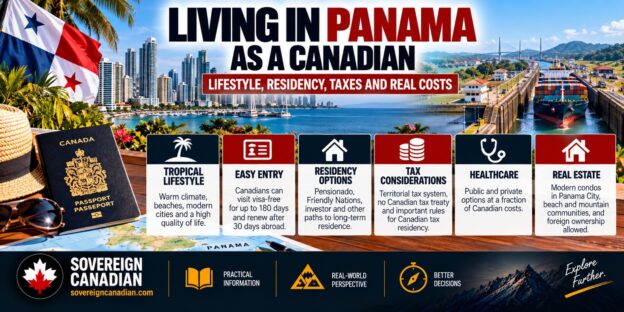
Living in Panama as a Canadian showing Panama City, the Panama Canal, Canadian passport, residency, taxes, healthcare and real estate

Living in Panama as a Canadian: Is Panama Actually a Good Place to Live?

Panama can be remarkably good at receiving wealth. It is much less obviously good at creating tax-free active income, and your age on arrival decides how much of the healthcare advantage is still available to you.

A Canadian retiree living in Panama on a portfolio built abroad may find that Panama barely taxes the income paying for the lifestyle. His 35-year-old daughter can move into the same building, work remotely for Canadian clients, and face a very different tax question.

Same country. Same territorial tax system. Very different result.

That gap is the real subject of this article.

Panama does have meaningful advantages for a Canadian: a US dollar economy, one of the busiest air and shipping hubs in the Americas, residence programmes with paths to permanent status, private hospitals with international affiliations, and a tropical location outside the main Caribbean hurricane belt.

Continue reading →
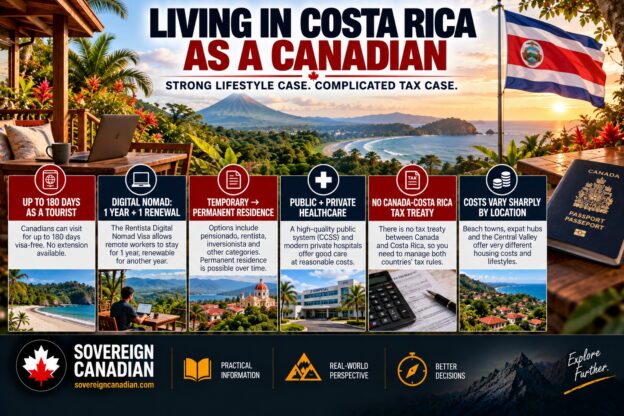
Living in Costa Rica as a Canadian with tropical coastline, Costa Rican flag and Canadian passport highlighting residency, healthcare and tax considerations

Living in Costa Rica as a Canadian: Is Costa Rica Actually a Good Place to Live?

Costa Rica has been sold to Canadians for a generation as a four-part package: tropical weather, cheap living, easy residency and a tax system that supposedly ignores foreign income. In 2026 each of those four parts needs a footnote, and the footnotes are not the same size. The weather is what it always was. The residency routes exist and are easier to understand than most. The “cheap” part now depends on where you live and what you buy. The tax part is the one that breaks down once you read it from a Canadian rather than an American or European point of view.

The reason is structural. Canada and Costa Rica have no income-tax treaty, no social-security agreement and no treaty rule for deciding which country gets to call you a resident. Costa Rica’s territorial tax system is real, but a Canadian who moves there is not entering a tax-free zone. They are entering a gap between two systems that were never negotiated against each other. CPP, OAS and RRIF payments default to a 25% Canadian withholding rate. Leaving Canada triggers its own tax event. The widely repeated claim that a remote worker can sit in Escazú, bill Canadian clients and owe nothing locally is, at best, unresolved. Costa Rica went to the trouble of writing a special exemption for digital nomads, which is a good clue that ordinary residents may not enjoy the same treatment.

Continue reading →
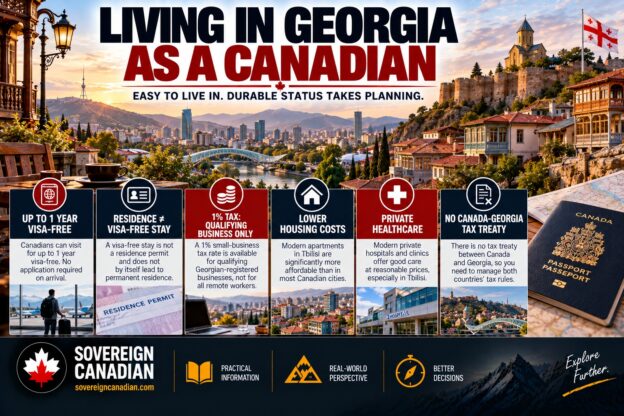
Living in Georgia as a Canadian with Tbilisi skyline, Georgian flag and Canadian passport highlighting visa-free stays, residence and taxes

Living in Georgia as a Canadian: Is Georgia Actually a Good Place to Live?

Picture a 35-year-old Canadian consultant who lands in Tbilisi with a laptop and a one-way ticket. Canadians can stay in Georgia visa-free for a year, so there is no application to file at the airport. The consultant rents a modern apartment in Saburtalo, signs up for fibre internet, learns the Metro and the Bolt app, and keeps working for Canadian and American clients exactly as before. Within a few weeks there is a favourite cafe, a gym, a bank card and a routine. By any ordinary measure, this person has moved to Georgia.

Legally, something quieter has happened. The visa-free stay is not a residence permit. Nothing about it starts the clock that eventually leads to permanent residence. The consultant’s Georgian life can look far more permanent than their Georgian status is, and, separately, nothing in that arrival has told the Canada Revenue Agency that this person stopped being a Canadian tax resident.

Continue reading →
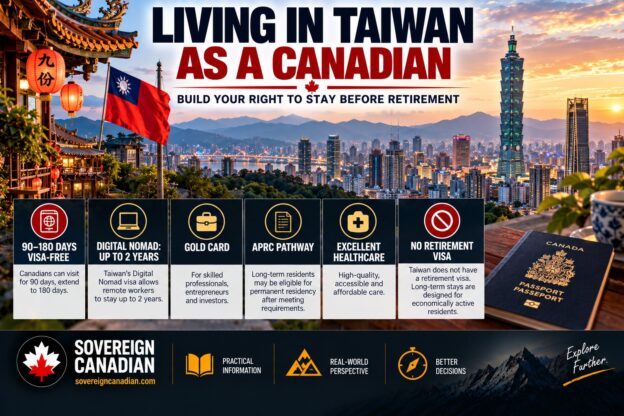
Living in Taiwan as a Canadian with Taipei skyline, Taiwan flag and Canadian passport highlighting Gold Card and permanent residency pathways

Living in Taiwan as a Canadian: Is Taiwan Actually a Good Place to Live?

Picture two Canadians who both decide, at different points in their lives, that they want to retire in Taiwan.

The first moves at 45. She’s a product manager clearing a strong salary, and Taiwan’s Employment Gold Card lets her get a resident permit without a Taiwanese employer sponsoring her. She spends the next several years actually living there — building a career, paying Taiwanese tax, learning the neighbourhoods — and eventually converts that residency into permanent status. By the time she’s ready to slow down, Taiwan isn’t a retirement plan. It’s just where she lives.

The second Canadian spends his career in Canada, retires comfortably at 65, and only then decides Taiwan looks like exactly the kind of place he’d like to spend his later years — safe, walkable, cheap food, excellent hospitals, a short flight from the rest of Asia. He has the same net worth as the first Canadian. Possibly more.

Taiwan’s immigration system treats these two people completely differently. The first one built her right to be there while she still had something Taiwan’s system was designed to reward: an income, a skill set, an employer relationship, a professional category. The second one shows up with money and time and discovers that neither, on its own, is a currency Taiwan’s immigration architecture accepts.

Continue reading →
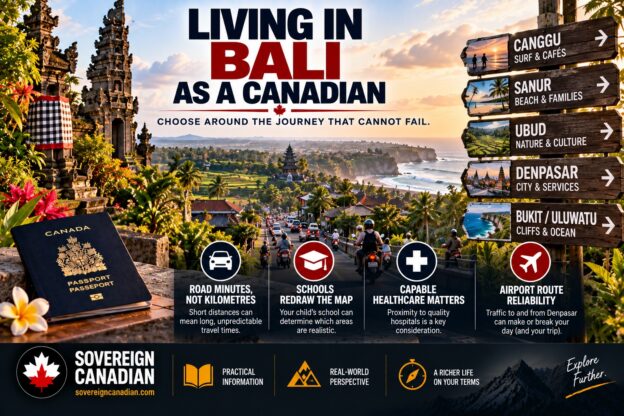
Living in Bali as a Canadian with signs for Canggu, Sanur, Ubud, Denpasar and Uluwatu highlighting schools, healthcare and airport access

Living in Bali as a Canadian: Where on the Island Should You Actually Build Your Life?

Bali is not physically large. On a normal map, Canggu, Sanur, Ubud, Jimbaran and Denpasar look almost absurdly close together, a cluster of names you could imagine strolling between over a long weekend. Read the map that way and choosing a base becomes a lifestyle question: do I want the surf-and-café scene, the rice terraces, the calm beachfront, the cliffs?

That map is misleading. Twenty kilometres in Bali does not mean twenty minutes. A house that appears perfectly placed can put you on the wrong side of the island’s road network from the school, hospital or airport your life actually depends on. And the failure is rarely a steady, predictable slowness. It is variance: the same trip that takes a comfortable half hour on a good afternoon becomes an hour and a half on a bad one, and you find out on the day it matters.

So I want to start from a different question. Not “Where in Bali would I most like to live?” but “Which journey in my life cannot afford to fail?” The answer changes with your age, your work, whether you have children, and how your health is holding up. It determines which parts of Bali are options for you and which are traps that look like options.

Continue reading →
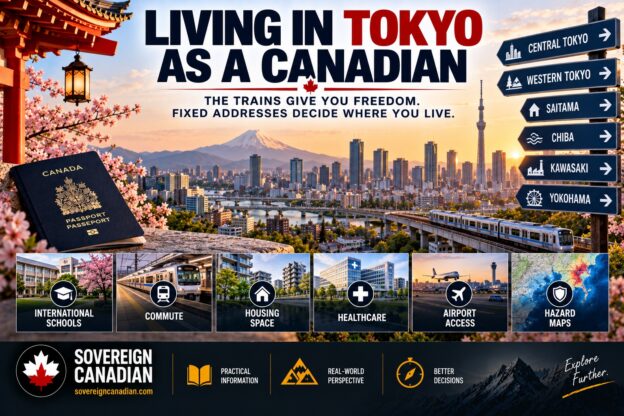
Living in Tokyo as a Canadian with Greater Tokyo trains, housing, schools and signs for Tokyo, Yokohama, Kawasaki, Saitama and Chiba

Living in Tokyo as a Canadian: Where in Greater Tokyo Should You Actually Build Your Life?

Tokyo has, by most honest measures, the most extraordinary urban railway system on earth. Someone living in a different prefecture, an hour’s drive from the Imperial Palace on a map, can step onto a platform and be standing in Marunouchi before a typical Torontonian has cleared the Don Valley Parkway. A Canadian moving to Greater Tokyo could, in principle, live in Kanagawa, Saitama or Chiba and still reach central Tokyo faster than they reached their own downtown back home.

That fact creates a seductive impression. If the trains are that good, does it even matter where you actually live?

Continue reading →
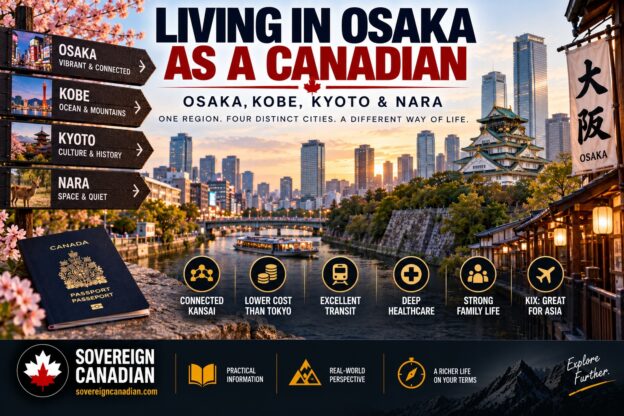
Living in Osaka as a Canadian with Osaka Castle and signs for Osaka, Kobe, Kyoto and Nara

Living in Osaka as a Canadian: Is Kansai a Better Place to Live Than Tokyo?

A Canadian decides Japan works. I have already made that case at length in Living in Japan as a Canadian, so I am not reopening it here. The visas, the tax residency ladder, the schooling trade-offs, the safety and the hazards all still apply exactly as I described them there. Nothing about choosing Osaka instead of Tokyo changes a single national rule.

But once Japan clears that first test, a second question arrives fast: Tokyo or Osaka. I went into this research expecting to answer that question. I came out of it thinking the question itself is slightly wrong.

Here is why. Someone can live in Kobe and be standing on the platform at Osaka Station about twenty minutes later. Someone can live in Nara and reach Namba in well under forty. Kyoto and Osaka are connected by a train fast enough that a Canadian used to commuting across the Greater Toronto Area would barely register the distance as remarkable. Osaka, Kobe, Kyoto and Nara are not four cities that happen to be near each other. They function, for a lot of daily life, as one interconnected region with several downtowns.

Continue reading →
Living in South Korea as a Canadian with Seoul skyline, traditional Korean architecture and a Canadian passport

Living in South Korea as a Canadian: Is It Actually a Good Expat Destination?

South Korea is one of the most technologically advanced, safest, most convenient, and clinically capable countries a Canadian could reasonably consider living in. Its trains run on time to the minute. Its broadband is faster than almost anything in North America. Its hospitals are excellent. Its cities feel orderly, humane, and extraordinarily easy to move through. And Canadians can walk into the country for up to six months without a visa at all.

That last part sounds almost absurdly easy. It is easy. But the question this article actually asks is a different one: does a country being exceptionally good at running itself mean it is exceptionally good at absorbing you into it? Those are not the same question, and the gap between them is where most expat regret lives.

Continue reading →
Living in Cambodia as a Canadian with Angkor Wat, Canadian passport and Cambodian tropical landscape

Living in Cambodia as a Canadian

Cambodia has never been on my radar. I have looked seriously at Thailand, Malaysia, Vietnam, Indonesia, the Philippines, and Singapore. Cambodia never made the list, and I never asked myself why not. That omission is the actual starting point for this piece, because an omission that goes unexamined for years is either a very good instinct or a very lazy one, and I wanted to find out which.

The honest answer, after several weeks of research, is that it is a bit of both. Cambodia has real, documented reasons an affluent Canadian would rationally rank it behind Thailand and Malaysia for almost every serious use case. It also has a genuine, underrated case as a place to watch, and in a couple of narrow respects, a place to use right now. What it does not have is the thing that would justify treating it as a final answer rather than a chapter.

Continue reading →
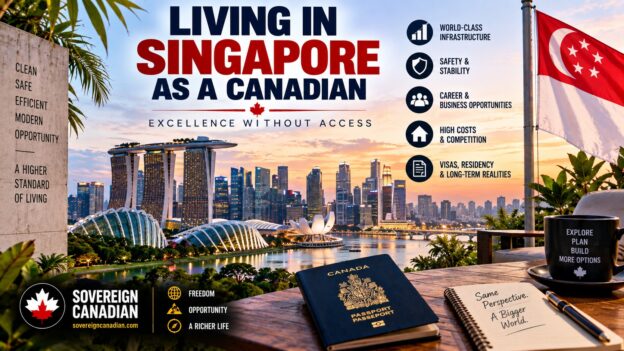
Living in Singapore as a Canadian with Marina Bay skyline, Singapore flag and Canadian passport

Living in Singapore as a Canadian: Excellence Without Access

Every country in this series so far has sold some version of the same trade. You get access, and you give up certainty. Thailand lets you stay for years on a chain of visas that never quite becomes permanence. Vietnam gives you presence without the paperwork to make it stick. Malaysia formalizes the temporariness so cleanly that it becomes its own kind of stability. The Philippines hands out durable permission but keeps dependability conditional. Indonesia is the purest version of the trade: extraordinary attachment to a place, with almost no institutional tenure underneath it.

Singapore does something none of the other five do. It does not ask you to trade certainty for access. It gives you the certainty, in full, and then makes access the scarce resource instead.

Continue reading →