
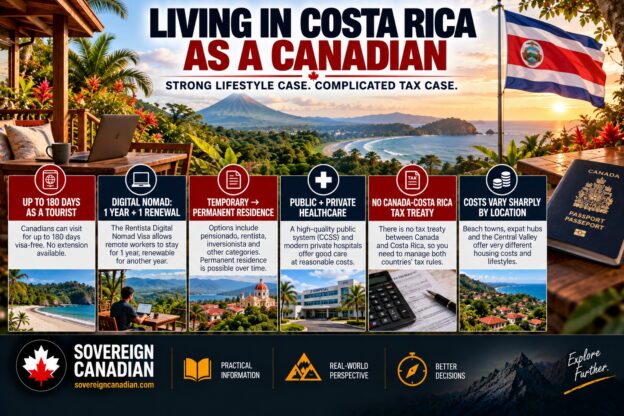
Costa Rica has been sold to Canadians for a generation as a four-part package: tropical weather, cheap living, easy residency and a tax system that supposedly ignores foreign income. In 2026 each of those four parts needs a footnote, and the footnotes are not the same size. The weather is what it always was. The residency routes exist and are easier to understand than most. The “cheap” part now depends on where you live and what you buy. The tax part is the one that breaks down once you read it from a Canadian rather than an American or European point of view.
The reason is structural. Canada and Costa Rica have no income-tax treaty, no social-security agreement and no treaty rule for deciding which country gets to call you a resident. Costa Rica’s territorial tax system is real, but a Canadian who moves there is not entering a tax-free zone. They are entering a gap between two systems that were never negotiated against each other. CPP, OAS and RRIF payments default to a 25% Canadian withholding rate. Leaving Canada triggers its own tax event. The widely repeated claim that a remote worker can sit in Escazú, bill Canadian clients and owe nothing locally is, at best, unresolved. Costa Rica went to the trouble of writing a special exemption for digital nomads, which is a good clue that ordinary residents may not enjoy the same treatment.
None of that makes Costa Rica a bad country to live in. It makes it a different proposition from the one on the brochure. Our reading of the evidence is that Costa Rica works better as a lifestyle jurisdiction than as a tax jurisdiction for Canadians. It offers a tropical climate close to home, an established foreign-resident ecosystem, residence routes that lead to permanent status, ordinary titled-property ownership outside the special coastal regime, substantial private healthcare and a long record of institutional continuity. Those are real reasons to live there. They are not the same as reasons to expect a lower tax bill, and a Canadian who confuses the two can make an expensive mistake.
There is a second thread running through this article. Costa Rica at 35, 55, 65 and 75 are four different propositions. The legal routes, the health system, the insurance market and the physical environment all interact with age in ways that the usual “retire to paradise” writing skips. A Canadian who establishes themselves at 60 is likely to have a very different experience at 75 from one who arrives for the first time at 75.
This is a research-based assessment, not a sales page, and it says “we don’t know” where the evidence does. Currency conversions use the Bank of Canada’s USD/CAD rate of 1.4246 on October 2, 2026. If you are building a wider picture of life abroad, our Expat Living hub collects the other country guides.
What Costa Rica actually offers a Canadian
Costa Rica is not a bargain-basement play, and it is not a European-style welfare state. It sits in an unusual middle position. A Canadian can get a flight home in a few hours, live in a country with a long democratic tradition, buy ordinary titled property, join a public health system as a qualifying resident, supplement it with private hospitals, and follow a written statutory path from temporary to permanent residence. Few tropical countries offer that combination.
The case rests on the package, not on any one element, and each element needs testing. The climate is not seriously in dispute. Proximity is geography. The legal residence routes are in the immigration statute. Property ownership works for ordinary titled land and becomes much more complicated in the coastal strip. Healthcare is two systems with very different waiting characteristics. The institutional record is real, but crime has changed. And “cheap” has stopped being a national statement and become a local one.
What follows tests those claims one at a time, starting with the first thing a Canadian actually encounters: the border.
How long can a Canadian actually stay?
The common claim is that Canadians get six months. The more precise version is that Canadians can be authorized to stay up to 180 days as tourists, with no visa required. The Embassy of Costa Rica in Canada describes it as up to 180 calendar days, not extendable. To enter, a Canadian needs a passport valid for at least one day on arrival, proof of funds of at least US$100 for each month or part-month of legal stay, a ticket home or onward, and no entry bar such as a recent conviction for an intentional offence that is a crime in both countries.
The 180 days is a maximum rather than a guarantee of admission for that full period. When fewer than 90 days are granted, Article 90 of the immigration law provides a mechanism for a tourist granted under 90 days to request an extension, subject to the statutory requirements.
Tourist status is also narrower than it sounds. The embassy defines tourism as leisure, business or professional travel that is not paid or lucrative inside Costa Rica. Article 92 of the immigration law generally bars non-residents from working except for specified categories. Whether quietly working remotely for a foreign employer falls within that prohibition is not something we could settle from the text. That ambiguity is part of why the country created a separate remote-work category, discussed below.
What about staying beyond 180 days by leaving and returning? We did not verify any formal minimum time outside the country, and entry is assessed again each time. We would not build a life around repeated tourist entries as a substitute for legal residence.
For Canadians who want to test the country before committing, tourist status is a perfectly good tool. It is not a legal residence strategy. Our snowbird versus full relocation guide covers the Canadian tax side of living abroad part-time. It matters here, because a long tourist stay does not by itself end Canadian residency.
Tourist, resident or digital nomad?
Costa Rica’s immigration law divides foreigners into residents and non-residents. Tourists are non-residents. So, importantly, are digital nomads. Article 87 of Law 8764 lists non-resident subcategories, including turismo and estancia. The digital-nomad regime sits in the second.
The official name matters. Law 10008, passed in 2021, creates the category Trabajador o Prestador Remoto de Servicios, a stay (estancia) within the non-resident category. It is not temporary residency (residencia temporal). “Digital nomad visa” is a fair shorthand as long as the legal classification stays in view, because the classification drives almost every consequence below.
The statute defines a qualifying person as a foreigner who provides paid services remotely, as an employee or independently, for a person or company outside Costa Rica and is paid from abroad. The applicant must show stable income averaging at least US$3,000 a month over the previous year, about CAD 4,274. For a family application, the combined income, which may include a spouse’s, must reach US$4,000 a month, about CAD 5,698. The applicant also needs medical insurance for the full stay. The implementing regulation requires qualifying medical coverage. Some secondary summaries differ on details, so applicants should check the current DGME requirements when applying.
The stay lasts one year and can be extended once for another year. To qualify for the extension, the holder must have spent at least 180 days in Costa Rica during the first year. Before expiry, the holder may ask to change category if the requirements for the new category are met. The law also gives holders limited practical tools: they may open savings accounts at national banks under anti-money-laundering rules, their foreign driver’s licence is recognized during the authorized stay, and they can import specified basic computer and telecom equipment free of import taxes.
The tax provision is the heart of it. Article 16 gives holders a total exemption from the income tax and states that they are not to be considered habitual residents for tax purposes, nor is the income they receive from abroad to be considered Costa Rican-source. Importantly, the tax benefit is not extended automatically to family members. A family member who wants the benefit has to qualify for it.
What the law does not do is equally important. It does not call the status residency. Permanent residence under Article 78 requires three consecutive years of residencia temporal, and non-resident stays under Article 87 are, by definition, not residence. Nomad time is not temporary-residence time. Costa Rica lets you live there as a digital nomad without that time building the ladder to permanent residence. The law is also silent on whether holders must join the public health system, so we cannot say that they are or are not exempt.
For a 25-year-old on CAD 90,000, the regime fits. For a 35-year-old consultant, it is the statutory path built specifically for the work they actually do. But it is a two-year product. After month 24 the person needs a different status, and the usual routes carry income or capital tests that a younger remote worker may not meet.
Pensionado, Rentista and Investor
The three classic residence routes are all residencia temporal, a status under Article 79 that lasts for more than 90 days and up to two years and is renewable. They carry a condition that surprises people: renewal generally requires proof of enrolment in the Costa Rican social insurance system, the Caja, from the date residence was granted and continuously thereafter. We return to that below.
Pensionado. Article 81 requires a monthly, permanent and stable pension from abroad of at least US$1,000, about CAD 1,425. What qualifies is the practical question. A government or employer pension fits the wording most naturally. Whether a particular combination of CPP, OAS, employer pension and RRIF withdrawals counts is something we did not verify from official guidance, and a discretionary RRIF withdrawal is not obviously “permanent and stable.” That is our reading, not a ruling. Anyone planning on this route should get written confirmation of how their income will be assessed.
Rentista. Article 82 requires monthly, permanent and stable income of at least US$2,500, about CAD 3,560, from abroad or from the national banking system. That amount can cover a spouse and children under 25, or older children with a disability. The “from the national banking system” wording is the basis for the commonly described deposit mechanism, in which a lump sum placed in a Costa Rican bank is paid out over the required period. That mechanism is widely reported, but we did not confirm its current administrative details from primary guidance, so confirm them with the directorate.
Investor. This is where the law is genuinely unsettled, and the unsettled state is itself informative.
The immigration regulation originally set the investor threshold at US$200,000. In 2021, Law 9996 reduced it to US$150,000 in Article 8, “for the term established by this law.” The law also gave investors, rentistas and pensionados a package of incentives, including duty-free import benefits and other tax concessions. Article 12 limited the Article 5 benefits to people who opted in within five years of the law taking effect and provided a ten-year benefit period for those who qualified during the window. The five-year window ended in July 2026.
The trouble is the drafting. Article 12 expressly limits the benefits in Article 5. It does not expressly say that Article 8’s lower investment amount expires at the same time. That creates two plausible readings: the lower US$150,000 figure expired with the temporary programme, allowing the previous US$200,000 threshold to re-emerge, or US$150,000 remains because the sunset provision did not actually terminate Article 8.
We found no post-expiry official clarification that resolves that conflict. The two figures are about CAD 214,000 and CAD 285,000. We would not treat either as definitive in October 2026. Anyone planning an investment-based application should get a current written answer from the immigration directorate before committing capital. This is useful evidence about the quality of the bureaucracy, not something to smooth over. It also affects only the investor route. The pensionado and rentista amounts sit in the immigration statute itself and were not created by the same temporary incentive provision.
One more point of caution on work. Temporary residence does not automatically mean unrestricted permission to work. Article 80 says temporary residents may carry out only the remunerated or lucrative activities, whether self-employed or employed, that the immigration directorate authorizes. Owning an investment or qualifying financially for residence is therefore not the same thing as having unrestricted permission to work in Costa Rica.
From temporary to permanent to citizen
The immigration ladder for Canadians is written down and comparatively straightforward: temporary residence can lead to permanent residence, and long-term official residence can eventually support naturalization.
Under Article 78, a foreigner, spouse and qualifying first-degree relatives who have held temporary residence for three consecutive years may apply for permanent residence. Article 79 lists investors, rentistas and pensionados among the temporary-residence categories. Their time therefore fits the statutory route. Digital-nomad time does not, because it is a non-resident stay rather than temporary residence.
Permanent residents also generally have to prove continuous Caja enrolment when renewing their residence document.
Citizenship is a separate step. The Costa Rican Constitution gives a five-year official-residence threshold to qualifying Central Americans, Spaniards and Ibero-Americans by birth. For other foreigners, including Canadians, Article 14 sets a minimum of seven years of official residence, along with the additional requirements imposed by law.
That makes seven years a threshold, not an automatic passport. The naturalization process has substantive requirements beyond simply running down a clock, and applicants should confirm the current procedural, language, examination and documentation rules with the Tribunal Supremo de Elecciones before planning around citizenship.
The contrast with the nomad route is the point. Someone on a nomad stay for two years has two years of lifestyle and no temporary-residence time toward the three-year permanent-residence threshold. Someone on a rentista or pensionado residence for the same two years has accumulated two years of the required temporary residence. A nomad can pursue a change of category before the authorized stay expires, but must independently qualify for the new category.
The tax story is where Costa Rica gets complicated
The standard pitch runs like this. Costa Rica taxes only Costa Rican-source income. Your income is Canadian. Therefore you can move there and pay no tax on it.
Each step in that argument has a hole. The first step is broadly right: Costa Rica’s system is territorial. The second step ignores where your income is sourced, which can depend on what you do and where you perform it, not merely who pays you. The third step ignores Canada entirely. Canada taxes its residents on worldwide income, and a Costa Rican residence card does not make you a non-resident of Canada. Even when you do become a Canadian non-resident, Canada retains taxing rights over specified Canadian-source income.
So the useful questions are not simply “does Costa Rica tax foreign income?” They are: Are you still a Canadian tax resident? If you leave, what does Canada charge on the way out and on what you collect afterward? And is your income actually foreign-source under Costa Rican law? The next sections take those questions in order.
There is no Canada–Costa Rica income-tax treaty
The Department of Finance’s treaty page shows no income-tax treaty in force with Costa Rica. The two countries do have a tax-information-exchange agreement, which entered into force on August 14, 2012. That facilitates the exchange of tax information. It does not allocate taxing rights or give residents the reduced withholding rates of an income-tax treaty.
Nor does Canada have a social-security agreement with Costa Rica. Costa Rica is absent from the CRA’s current list of countries with international social-security agreements.
The practical consequences are specific. There is no treaty tie-breaker to allocate tax residence if both countries claim you under domestic law. There are no treaty-negotiated withholding rates on Canadian pensions and similar payments, so Canada’s domestic rules apply. And there is no bilateral social-security coordination.
It would be wrong to conclude from this that Canadians in Costa Rica are automatically taxed twice. That claim, repeated widely, is too blunt. What the missing treaty really costs is predictability, rate relief and coordination. The sections ahead show where that matters.
Leaving Canada is its own tax event
Canada does not stop treating you as a resident because you have moved. It asks whether you have severed your residential ties. The CRA’s guidance on factual residents says you remain a factual resident if you keep significant residential ties while living abroad. The CRA’s folio on residence identifies a dwelling place, spouse or common-law partner and dependants as the major ties, with secondary ties weighed as part of the overall facts.
A Costa Rican residence card does not itself end Canadian tax residence. The CRA does recognize a “deemed non-resident” status where someone remains a factual Canadian resident but a tax treaty assigns them to the other country. With no Canada–Costa Rica income-tax treaty, that tie-breaker route is unavailable. A Canadian seeking non-resident status therefore needs the factual pattern of a genuine departure rather than relying on a treaty to resolve competing residence claims.
On timing, the CRA’s emigrant guidance says that when you leave Canada to settle in another country, you usually become a non-resident on the latest of three dates: the day you leave Canada, the day your spouse or common-law partner and dependants leave, and the day you become resident in the country where you settle. If you leave Canada while keeping residential ties here, the CRA says you are usually still a factual resident rather than an emigrant.
When you do become a non-resident, Canada can apply a deemed disposition, commonly called departure tax. You are treated as having disposed of many assets at fair market value on departure, potentially realizing gains without actually selling them. The exact property caught and excluded matters enormously, particularly for investment portfolios, private-company shares and foreign property. Registered plans and certain Canadian property have separate treatment.
This is one of the areas where general summaries are dangerous. Anyone with a meaningful portfolio, corporation or foreign real estate should model the departure before establishing the departure date. The Residency Flag goes deeper into the Canadian side of that decision.
Canadian real estate also does not simply disappear from the Canadian tax system after departure. A non-resident receiving Canadian residential rental income is generally subject to Part XIII withholding, and a later sale has separate non-resident procedures. Leaving Canada is therefore not a single tax event with a single bill. It changes which Canadian rules apply.
What happens to CPP, OAS, RRSPs and RRIFs
For a retiree, this is where the missing treaty becomes most visible. The CRA’s current NR4 guide says non-residents generally pay 25% Part XIII tax on taxable amounts, with treaty reductions available where applicable. It expressly says the 25% rate applies to taxable amounts paid to people in non-treaty countries.
Service Canada gives the same starting point for CPP and OAS: 25% non-resident tax unless reduced or exempted by a tax treaty. Costa Rica has no such treaty.
But 25% withholding is not necessarily the final tax result. A non-resident can elect under section 217 of the Income Tax Act to file a Canadian return covering certain Canadian income and potentially recover part of the withholding. The CRA’s section 217 guidance includes OAS, CPP, most pension and superannuation benefits, and most RRSP and RRIF income among the eligible categories.
If the section 217 calculation is beneficial, the CRA refunds tax withheld above the amount actually owing. A person expecting to make the election can also submit Form NR5 to request reduced withholding in advance. The CRA says an approved NR5 can cover five tax years, but the taxpayer must file a section 217 return for each covered year.
Whether the election produces a large refund, a small refund or none depends on the person’s income and circumstances, including world income used in the section 217 calculations. We would not give a generic retiree number. The important distinction is that 25% is the default withholding rate, not automatically the ultimate effective tax rate.
OAS has an extra layer. The CRA’s OASRI guidance says a non-resident receiving OAS generally must file an Old Age Security Return of Income and can face the recovery tax where net world income exceeds the threshold, unless a tax treaty limits or eliminates it. CRA publishes a list of countries whose residents qualify for an OASRI filing exception. Costa Rica is not on that list.
For 2025, the published threshold is CAD 93,454 and the recovery rate is 15% of income above the threshold, subject to the rule that the combined non-resident tax and recovery tax cannot exceed the OAS received. Future thresholds are indexed.
The TFSA and foreign tax credits
The TFSA can remain in place after departure, but under the CRA’s rules, contributions made while you are a non-resident are taxed at 1% per month for as long as the non-resident contribution remains in the account, until the full amount is withdrawn or Canadian residency resumes.
The account’s tax-free status is a Canadian rule. Costa Rica’s treatment of income inside a TFSA was not part of our research. Calling the TFSA “tax-free” without saying where would therefore overstate it.
Foreign tax credits are where the “no treaty means double taxation” claim breaks down. The CRA’s foreign-tax-credit folio confirms that section 126 of the Income Tax Act makes a foreign tax credit available to a taxpayer who is resident in Canada at any time in the year, subject to the detailed rules. A treaty is not a prerequisite for Canada’s domestic credit.
The CRA’s personal foreign-tax-credit guidance says that, in most cases, the federal credit for each foreign country is limited to the lesser of the eligible foreign income tax paid and the Canadian tax otherwise payable on the relevant net income from that country.
Costa Rica is a different story. The professional tax guidance we found says Costa Rica gives individuals no general foreign-tax-relief mechanism. We did not independently confirm that proposition from the Costa Rican statute, so it should not carry more weight than the source allows.
Where could real overlap occur? A Canadian tax resident earning Costa Rican-source income is one example: Canada can tax worldwide income while Costa Rica taxes its domestic-source income, with Canada’s foreign-tax-credit rules potentially providing relief. A genuine Canadian non-resident living in Costa Rica and receiving Canadian pension income presents a different pattern: Canada withholds on the Canadian-source payment, while Costa Rica’s territorial system may leave genuinely foreign-source passive income outside its ordinary income-tax base.
The missing treaty still matters. It removes reduced withholding rates, a residence tie-breaker and negotiated certainty. But that is not the same thing as saying every Canadian in Costa Rica is taxed twice.
Is foreign income really tax-free in Costa Rica?
Costa Rica’s tax law defines Costa Rican-source income around income generated in national territory, including income from services rendered there, property situated there and capital invested or used there.
Passive foreign income is often outside the ordinary territorial net, although Costa Rica’s treatment of foreign passive income has evolved and can become more complicated where income is connected with Costa Rican economic activity.
Services are the more difficult issue. A Costa Rican tax lawyer writing in El Financiero argued that the source rule looks to where the service is physically or materially performed. A lawyer writing in a Costa Rican business newspaper in 2023reached a similar conclusion for people providing services from Costa Rica.
If that reading is right, a consultant who physically does the work in Escazú can be earning Costa Rican-source income even when the client is in Toronto.
Expat websites frequently say the opposite, treating the client’s location as determinative. We did not find an authoritative tax ruling directly resolving the ordinary foreign-client consultant scenario.
That is where Law 10008 becomes useful evidence. Costa Rica specifically legislated that qualifying remote workers are not considered habitual tax residents during the authorized period and that their foreign remuneration is not considered Costa Rican-source. That special rule would be much less important if ordinary law already produced exactly the same result.
That does not prove how the tax authority would decide every ordinary consultant case. It is a reason not to tell Canadians that foreign-client remote work is automatically untaxed. The correct conclusion is narrower: the digital-nomad exemption is clear; the ordinary-resident treatment of foreign-client services physically performed in Costa Rica is not clear enough for us to promise a zero-tax result.
VAT is a separate question with its own sourcing rules. A service can have one treatment for income tax and another for VAT.
Four ways a Canadian remote worker can get this wrong
The right answer depends on who you are and how you work. In none of these cases should immigration permission, tax residence and income sourcing be treated as the same question.
| Situation | Immigration | Costa Rican income tax | Confidence |
|---|---|---|---|
| Canadian employee of a Canadian employer, living in Costa Rica | Tourist status does not provide a clean long-term work solution. The nomad stay is the category specifically created for foreign remote work. | The ordinary source rule creates a real question where employment services are physically performed in Costa Rica. | Tax: strong concern. Status outside the nomad regime: fact-specific. |
| Canadian consultant working from Costa Rica for Canadian clients | Same status problem. | Statutory wording and practitioner commentary point toward Costa Rican source; contrary expat guidance exists. No directly controlling ruling was found. | Contested |
| Owner of a Canadian corporation managing it from Costa Rica | Immigration is only one issue; corporate residence and management become separate questions. | Costa Rican source rules and Canadian corporate-residence rules both need professional analysis. Canadian dividends to a Costa Rican resident generally lack treaty-rate relief. | Unresolved |
| Digital nomad | A non-resident stay of one year, renewable once. | Foreign remuneration receives the statutory exemption and source treatment. | Confirmed for the tax exemption; Caja treatment remains unclear. |
Immigration status and tax residence are separate. Law 10008 expressly prevents the authorized nomad from being treated as a habitual resident for Costa Rican income-tax purposes during the authorization. That does nothing by itself to the Canadian side, where the question remains whether the person has severed their Canadian residential ties.
The Caja question deserves its own warning. Costa Rican law generally requires temporary residents to establish the social-insurance coverage required for renewal. The nomad statute is silent on Caja participation. Some websites describe nomads as exempt, but we did not find that exemption in the statute itself.
Healthcare: the reputation is partly deserved
Costa Rica’s public system, the Caja, is one of the reasons the country appeals to older foreigners. The immigration law makes proof of CCSS coverage a renewal requirement for temporary residents under Article 80 and contains a similar requirement for permanent residents.
What a resident pays is not a simple universal percentage. The migrant-insurance rules link contributions to income and migration category, and published estimates vary substantially. We could not verify a single current contribution table that would support giving every pensionado or rentista a percentage or monthly amount. The honest answer is that the cost depends on category, income and the Caja’s assessment.
The system’s weakness is time. According to CCSS figures reported by La Nación, the surgical waiting list stood at 204,622 cases in March 2026, with an average wait of 441 days. The Defensoría de los Habitantes reported that average outpatient consultation waits had risen from 470 to 573 days during 2025, while surgical waits were averaging roughly 424 to 439 days.
Those are scheduled-care waiting lists, not a claim that emergencies wait hundreds of days. They do mean that a resident relying entirely on the public system can face very long waits for specialist and elective care.
That is why many financially comfortable foreign residents combine Caja coverage with private care. The public system provides the resident’s institutional healthcare base; private hospitals and insurance can provide faster access where the person can afford and obtain it.
Private healthcare changes the picture
Costa Rica has substantial private hospitals. Clínica Bíblica in San José identifies itself as accredited by Joint Commission International and offers a broad range of emergency, surgical, diagnostic and specialist services. CIMA in Escazú is another major private hospital used by foreign residents.
JCI accreditation is a useful indicator of institutional processes and safety standards. It is not proof of comparative clinical outcomes. We did not find hospital-level outcomes data that would let a Canadian meaningfully compare Costa Rican and Canadian hospitals procedure by procedure, and we did not find sufficiently consistent published prices to build a reliable treatment-cost table.
The evidence therefore supports a restrained conclusion: Costa Rica has sophisticated private hospital capacity, particularly in the Central Valley. It does not support calling the entire private system “world class” based solely on accreditation.
Our Medical Tourism hub covers the wider question of using foreign care. For residents, the practical point is access. Private care can materially change the experience of Costa Rica’s public waiting lists. Whether that option remains available on attractive terms later in life depends heavily on insurance.
Costa Rica at 65 is different from Costa Rica at 75
Private insurance is where the age thread becomes concrete. The INS policy documents we retrieved were more specific than many expat summaries.
For the INS Medical Regional policy version reviewed, the stated entry range for an insured person and spouse was 18 to 70, while the coverage age itself was listed without an upper limit. That suggests a material distinction between entering the policy and remaining on it. Benefits and premiums can also change with age, and different INS plans have different limits.
Pre-existing conditions create another layer. The policy material we reviewed included waiting periods for specified conditions and, in some products, special treatment for declared pre-existing conditions. The exact terms vary by product and policy version.
Put those pieces together and the three cases differ sharply. A person who buys appropriate coverage earlier and continues renewing is in a stronger position than someone trying to enter the private-insurance market for the first time late in life. A first-time buyer around 70 is at or near the entry limit in the INS documents we reviewed. For a first-time arrival at 75, we did not find an INS route under those documents.
We did not comprehensively research every international insurer or private prepaid medical plan available in Costa Rica. So the evidence for meaningful comprehensive private coverage for a 75-year-old newcomer with chronic conditions is weak, not necessarily nonexistent.
For that person, Caja access becomes much more important, with the waiting-list consequences described above. The practical conclusion is that timing matters. Moving earlier, establishing residence, arranging Caja participation and buying private insurance while eligible can put someone in a materially different position at 75 from someone who arrives for the first time at that age.
Can you actually age there?
Elder care is where the marketing runs furthest ahead of the evidence. Costa Rica has a private care sector, concentrated particularly in the Central Valley. Indications from secondary research put assisted-living and higher-care costs broadly in the low thousands of US dollars per month, with more intensive or memory care costing more.
We did not obtain enough provider-direct fee schedules to treat those numbers as a market survey. Nor did we find evidence of a sufficiently documented national elder-care system for foreign retirees that would justify treating Costa Rica as an elder-care destination.
Home help is another model. Domestic and personal-care labour can cost materially less than in Canada, but inexpensive help is not the same thing as a regulated continuum of elder care with medical oversight and predictable transitions between independent living, assisted living and nursing care.
Accessibility is a further constraint. Costa Rica has disability-access legislation, but government and civil-society work has continued to identify accessibility gaps. We did not find good enough town-level evidence to rank Escazú, Santa Ana, Atenas, Tamarindo and Nosara for an older person with reduced mobility.
The evidence supports a general concern rather than a town ranking. Pavements, hills, buses, building access and distance to medical services all matter. For a Canadian who loved the country at 62, the question at 82 may be less about the beach than whether their particular neighbourhood still works for them physically.
Costa Rica is neither an elder-care paradise nor a disaster. The evidence is materially thinner than the country’s retirement marketing would suggest. Our Elder Care hub covers the wider planning questions.
Is Costa Rica still cheap?
Not as a national statement. Costa Rica’s cost depends on where you live and what lifestyle you want, and the old line that it is simply inexpensive has stopped being useful without those qualifiers.
Housing dominates the comparison. Statistics Canada’s figures for the second quarter of 2026 put the average asking rent for a two-bedroom apartment at CAD 3,030 in Vancouver, CAD 2,650 in Toronto and CAD 1,890 in Calgary.
Costa Rican rental data is not of that quality. It comes largely from brokers, listings and media rather than a comparable national statistical series, so the ranges should be treated as indicative. The research we reviewed put a two-bedroom in Atenas at roughly CAD 1,070 to CAD 1,710, Escazú around CAD 1,425 to CAD 2,850, and Tamarindo around CAD 1,425 to CAD 3,560.
Read together, inland Central Valley towns can be materially cheaper than Toronto or Vancouver and somewhat below Calgary. Escazú spans a wide range. Tamarindo and other premium beach communities can reach Canadian big-city rents.
A June 2026 Tico Times review estimated that a careful single expat living inland could spend around US$1,600 to US$2,200 a month, with substantially higher budgets for couples choosing cars, private insurance and premium coastal locations. These are lifestyle estimates, not official household-expenditure statistics.
“Costa Rica is cheap” now needs a location and a lifestyle attached to it to mean anything. The country can still be good value inland, and it can be expensive on the coast. It is not the automatic cheap-retirement arbitrage its reputation was built on.
Families can discover the expensive Costa Rica quickly
International schooling is where the housing advantage can disappear. Country Day School publishes tuition of US$20,352 for Grades 1 to 5 and US$21,723 for Grades 6 to 8, about CAD 28,994 and CAD 30,947 at the exchange rate used in this article. New students also face additional fees.
For two children in Grades 3 and 6, the listed tuition alone totals US$42,075, roughly CAD 60,000.
Not every family has to pay that. Other international and private schools can cost materially less, but comparable current fee schedules are not always public and our evidence for several alternatives came from secondary sources. We also did not research public-school eligibility, Spanish-medium private schools or special-needs support deeply enough to compare them.
The honest summary for a Canadian professional family is therefore not “school costs CAD 60,000.” It is that premium international schooling for two children can approach CAD 60,000 a year before additional fees, while less expensive alternatives exist. School choice can erase much of the housing advantage, particularly for a family living in Escazú.
Buying property is easy until the beach starts
Costa Rica allows foreigners to own ordinary titled property, and much of the country works that way. The complication is the coast.
Under the Maritime Zone Law, Law 6043, the maritime zone generally extends 200 metres from the ordinary high-tide line. The first 50 metres form the public zone. The remaining 150 metres form the restricted zone.
The restricted zone is governed by a concession system rather than ordinary private freehold ownership. Article 47 says concessions cannot be granted to foreigners who have not resided in Costa Rica for at least five years, to foreign-domiciled entities, or to entities whose capital is more than 50% foreign-owned. Article 48 sets concession terms at no less than five and no more than twenty years, with the possibility of renewal under the statute.
Not every coastal parcel falls into the same legal position. The law contains exceptions, including legitimately registered private property, and historical titles and local coastal boundaries can make the analysis complicated.
The accurate warning is therefore simple. “Foreigners can own property in Costa Rica” is true. “A Canadian can buy any beachfront home the way they would buy an Ontario freehold” is not. Anyone buying near the shoreline needs a Costa Rican lawyer to confirm title, maritime-zone status, concession rights and zoning before money changes hands. Our Foreign Real Estate hub covers the Canadian side of buying abroad.
Costa Rica is stable. That does not mean crime is low.
Costa Rica’s reputation rests partly on long democratic continuity, political stability and the absence of a standing army. Those are different questions from personal security.
On homicide, the recent trend is clear. Costa Rica recorded roughly 907 homicides in 2023, after averaging materially fewer in the preceding years. There were 876 in 2024 and 873 in 2025, leaving the recent national homicide rate around 16 to 17 per 100,000 depending on the population estimate used.
For comparison, Statistics Canada reported 788 homicides and a national rate of 1.91 per 100,000 in 2024. Costa Rica’s recent national rate is therefore roughly eight times Canada’s.
That comparison needs context. A large share of Costa Rican homicides is linked to organized crime and score-settling, and the violence is geographically and demographically concentrated. A national homicide rate eight times Canada’s does not mean an ordinary Canadian resident is eight times as likely to be murdered. It does mean that the country is materially more violent than its older “exceptionally safe” reputation suggests.
For most residents and visitors, the more immediate concerns are theft, robbery, break-ins and other property crime. The Government of Canada’s current travel advice tells Canadians to exercise a high degree of caution because of crime. As of the publication check, the advisory had been updated in August 2026.
We would not call Costa Rica unsafe as a blanket statement, and we would not call it uniformly safe either. Security is a real consideration, risk varies materially by location, and housing choices can include security costs that do not appear in simple cost-of-living comparisons.
Banking is not offshore secrecy
Costa Rica is not a secrecy jurisdiction, and it would be a mistake to treat it as one.
Costa Rica participates in the OECD Common Reporting Standard framework, and the CRA’s list of participating jurisdictions specifically lists Costa Rica with a 2017 implementation date.
More importantly, the CRA defines a “participating jurisdiction” for these purposes as one that has implemented the CRS and with which an agreement is in place to exchange CRS information with Canada. That resolves the uncertainty in the earlier research: Canada does treat Costa Rica as a CRS exchange partner.
A Canadian tax resident with financial accounts in Costa Rica should therefore assume the normal Canadian foreign-asset and reporting rules apply where relevant, rather than treating a Costa Rican account as invisible.
The detailed mechanics of opening accounts, deposit protection and transfer limits were not part of this research. One point is clear from the digital-nomad legislation: qualifying nomads are permitted to open savings accounts in the national banking system, subject to anti-money-laundering requirements.
Where would a Canadian actually live?
We do not have neighbourhood-level statistics good enough to turn this into a ranking, so the useful guidance is structural.
Escazú and Santa Ana are where affluent professionals and families tend to cluster. They offer the deepest concentration of international schools, major private healthcare, shopping and services, with relatively easy access to the main airport. Rents are higher than elsewhere in the Central Valley, traffic is a feature of life, and schooling can dominate a family budget.
Atenas and Grecia offer a quieter Central Valley life, a more modest cost structure and established foreign communities. They can suit retirees and remote workers who do not need the capital’s services daily, but proximity to major hospitals and international schools is weaker than in the western San José suburbs.
Tamarindo and the Guanacaste coast offer the beach lifestyle and a mature foreign-resident and tourism ecosystem, along with higher prices, seasonality and more exposure to the property questions that come with coastal land. Healthcare and schooling choices are thinner than in the Central Valley.
Nosara has a distinctive foreign community and premium lifestyle market. Coastal title and concession questions deserve particularly careful due diligence.
Jacó and the Central Pacific trade some resort character for easier access to San José.
Uvita and the Southern Pacific offer a more remote lifestyle, with the infrastructure and services trade-offs that implies.
We did not research internet reliability, water supply, road conditions or climate risk by town deeply enough to rank locations on those factors. A Canadian choosing a base should visit in more than one season and test the things that matter to their actual life: work connectivity, road access, healthcare, groceries and how dependent they would be on a car.
Who Costa Rica works for
The country is not the same proposition at every stage of life.
A 25-year-old remote worker earning CAD 90,000 fits the digital-nomad regime on income, and its tax exemption is one of the clearest parts of the law. But it is a two-year stay that does not build temporary-residence time toward permanent status.
A 35-year-old consultant finds the lifestyle attractive but the status and tax questions much more complicated than the “territorial tax” slogan suggests. The nomad regime is the category specifically built for foreign remote work, while ordinary residence does not produce an equally clear tax answer for services performed from Costa Rica.
A family can discover that private schools destroy much of the cheap-living thesis. The Central Valley generally offers the deepest school and healthcare infrastructure, and school choice may matter more to the budget than rent.
An entrepreneur should separate where they live from where the business sits. Costa Rica may work as a place to live while owning a business elsewhere. Whether it is a good place to domicile or manage that business is a separate question. That is the territory of our Flag Theory framework, including the Business Base and Residency Flag discussions.
A 55-year-old semi-retiree is potentially one of the strongest fits. There is time to establish residence, enter the Caja, arrange private insurance while eligibility is easier and build local systems before health becomes the main constraint.
A retired couple at 65 can find the pensionado route compelling, but Canadian withholding on CPP, OAS and RRIF income and the section 217 election matter to the net result.
An established resident at 75 has a materially stronger proposition if residence, Caja participation, private coverage and community were established earlier.
A first-time arrival at 75 faces a harder case. Evidence for new private-insurance coverage weakens, public waiting lists matter more, and accessibility and care planning move to the front.
An 85-year-old with reduced mobility may find that location matters far more than the beach. The evidence on accessibility and elder care points toward proximity to serious healthcare and a neighbourhood that functions with reduced mobility.
Costa Rica versus the alternatives
This is not a ranking, only a short account of structural differences.
Mexico has both an income-tax treaty and a social-security agreement with Canada, which Costa Rica lacks. It also offers more geographic variety and extensive air connections to Canada, with a different security and institutional profile. See our guide to living in Mexico as a Canadian.
Portugal also has an income-tax treaty and social-security coordination with Canada and offers European Union rights, a different healthcare and citizenship framework, and a much longer trip home. See living in Portugal as a Canadian.
Georgia is a very different proposition: cheaper for the right person, much farther from Canada, and with its own institutional, tax and healthcare questions. See living in Georgia as a Canadian.
Panama is the obvious regional comparator, with a territorial tax system and retiree-oriented residence options. We did not research it deeply enough in this piece to turn that comparison into a verdict.
What Costa Rica offers is a particular combination: tropical climate, relatively short flight times, long democratic continuity, established residence routes, a large foreign community and both public and private healthcare infrastructure. Where treaty countries such as Mexico and Portugal have a structural advantage is in the tax and social-security architecture connecting them to Canada.
So, should a Canadian actually move to Costa Rica?
Costa Rica should not win this question because it is the cheapest, the most tax-efficient, the safest, the easiest or the best for healthcare. The evidence supports none of those claims as blanket statements.
Costs depend on where you live. The tax case is weaker than the slogans suggest. Homicide has risen materially. Residence is comparatively understandable but comes with immigration, Caja and renewal conditions. Healthcare is effectively a public-private combination for many financially comfortable residents: one side can involve very long waits, while the other depends on the ability to pay or obtain suitable insurance.
The stronger case is the package. A financially comfortable Canadian can get a tropical climate, a relatively short trip home, an established foreign-resident community, substantial private healthcare, ordinary titled-property ownership outside the special coastal regime, formal residence routes, a written path from temporary to permanent residence and a country with a long democratic record.
That package has value, and for many people it is a good reason to move. But Canadians increasingly pay for it in housing, schools, healthcare, taxes and sometimes security.
The best reason to move to Costa Rica in 2026 is that you want to live in Costa Rica.
The weakest is that you think you have found a Canadian tax escape.
The research does not support that, and several of the questions that matter most to an ordinary remote worker or business owner still do not have an authoritative answer strong enough for us to pretend otherwise. Do the move on the basis of the life you want, plan it around the age you will be rather than only the age you are, get written confirmation where the law or administration is unclear, and get Canadian and Costa Rican tax advice before you sell major assets or restructure your financial life.