
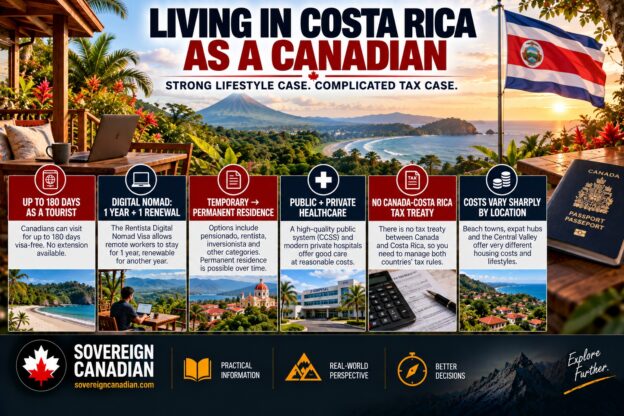
Costa Rica has been sold to Canadians for a generation as a four-part package: tropical weather, cheap living, easy residency and a tax system that supposedly ignores foreign income. In 2026 each of those four parts needs a footnote, and the footnotes are not the same size. The weather is what it always was. The residency routes exist and are easier to understand than most. The “cheap” part now depends on where you live and what you buy. The tax part is the one that breaks down once you read it from a Canadian rather than an American or European point of view.
The reason is structural. Canada and Costa Rica have no income-tax treaty, no social-security agreement and no treaty rule for deciding which country gets to call you a resident. Costa Rica’s territorial tax system is real, but a Canadian who moves there is not entering a tax-free zone. They are entering a gap between two systems that were never negotiated against each other. CPP, OAS and RRIF payments default to a 25% Canadian withholding rate. Leaving Canada triggers its own tax event. The widely repeated claim that a remote worker can sit in Escazú, bill Canadian clients and owe nothing locally is, at best, unresolved. Costa Rica went to the trouble of writing a special exemption for digital nomads, which is a good clue that ordinary residents may not enjoy the same treatment.
Continue reading