
Tag Archives: Family

Living in Bali as a Canadian with signs for Canggu, Sanur, Ubud, Denpasar and Uluwatu highlighting schools, healthcare and airport access

Living in Bali as a Canadian: Where on the Island Should You Actually Build Your Life?

Bali is not physically large. On a normal map, Canggu, Sanur, Ubud, Jimbaran and Denpasar look almost absurdly close together, a cluster of names you could imagine strolling between over a long weekend. Read the map that way and choosing a base becomes a lifestyle question: do I want the surf-and-café scene, the rice terraces, the calm beachfront, the cliffs?

That map is misleading. Twenty kilometres in Bali does not mean twenty minutes. A house that appears perfectly placed can put you on the wrong side of the island’s road network from the school, hospital or airport your life actually depends on. And the failure is rarely a steady, predictable slowness. It is variance: the same trip that takes a comfortable half hour on a good afternoon becomes an hour and a half on a bad one, and you find out on the day it matters.

So I want to start from a different question. Not “Where in Bali would I most like to live?” but “Which journey in my life cannot afford to fail?” The answer changes with your age, your work, whether you have children, and how your health is holding up. It determines which parts of Bali are options for you and which are traps that look like options.

Continue reading →

Home-buying process in Canada showing deposit, mortgage approval, lawyer trust account, title insurance, closing funds and registration

The Home-Buying Process in Canada: Title Insurance, Legal Steps, CMHC Mortgage Insurance, and What Actually Happens Before You Get the Keys

You have an accepted offer. You already sent a deposit to somebody. Your bank told you the mortgage is approved. Then your lawyer calls and asks you to send tens of thousands of dollars into something called a trust account, a few days before closing, for reasons nobody explained clearly. Somewhere in the background, your bank is preparing to send hundreds of thousands of dollars to a place you will never see. The seller still has their own mortgage registered against the house. And then, on closing day, the lawyer calls again and says the house has closed, and you can pick up the keys.

What actually happened in between?

Where did the deposit go. Why was pre-approval not the same thing as approval. Who paid off the seller’s bank, and how did your lawyer know that would actually happen. When did the house legally become yours. Why did you pay for title insurance on top of a lawyer who already searched the title. And if you put down less than 20 percent, why did you pay thousands of dollars for an insurance policy that mostly protects your bank and not you.

Continue reading →
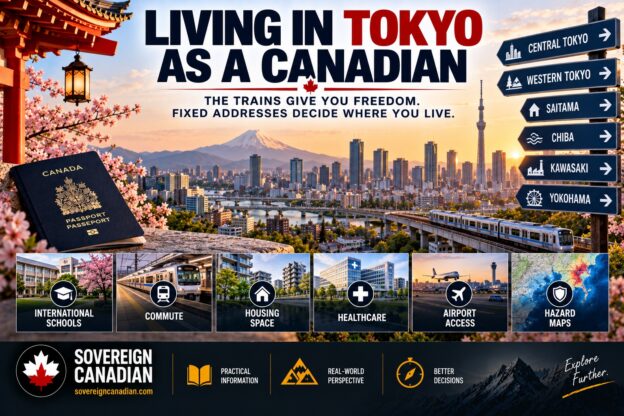
Living in Tokyo as a Canadian with Greater Tokyo trains, housing, schools and signs for Tokyo, Yokohama, Kawasaki, Saitama and Chiba

Living in Tokyo as a Canadian: Where in Greater Tokyo Should You Actually Build Your Life?

Tokyo has, by most honest measures, the most extraordinary urban railway system on earth. Someone living in a different prefecture, an hour’s drive from the Imperial Palace on a map, can step onto a platform and be standing in Marunouchi before a typical Torontonian has cleared the Don Valley Parkway. A Canadian moving to Greater Tokyo could, in principle, live in Kanagawa, Saitama or Chiba and still reach central Tokyo faster than they reached their own downtown back home.

That fact creates a seductive impression. If the trains are that good, does it even matter where you actually live?

Continue reading →
Living in Osaka as a Canadian with Osaka Castle and signs for Osaka, Kobe, Kyoto and Nara

Living in Osaka as a Canadian: Is Kansai a Better Place to Live Than Tokyo?

A Canadian decides Japan works. I have already made that case at length in Living in Japan as a Canadian, so I am not reopening it here. The visas, the tax residency ladder, the schooling trade-offs, the safety and the hazards all still apply exactly as I described them there. Nothing about choosing Osaka instead of Tokyo changes a single national rule.

But once Japan clears that first test, a second question arrives fast: Tokyo or Osaka. I went into this research expecting to answer that question. I came out of it thinking the question itself is slightly wrong.

Here is why. Someone can live in Kobe and be standing on the platform at Osaka Station about twenty minutes later. Someone can live in Nara and reach Namba in well under forty. Kyoto and Osaka are connected by a train fast enough that a Canadian used to commuting across the Greater Toronto Area would barely register the distance as remarkable. Osaka, Kobe, Kyoto and Nara are not four cities that happen to be near each other. They function, for a lot of daily life, as one interconnected region with several downtowns.

Continue reading →
Living in South Korea as a Canadian with Seoul skyline, traditional Korean architecture and a Canadian passport

Living in South Korea as a Canadian: Is It Actually a Good Expat Destination?

South Korea is one of the most technologically advanced, safest, most convenient, and clinically capable countries a Canadian could reasonably consider living in. Its trains run on time to the minute. Its broadband is faster than almost anything in North America. Its hospitals are excellent. Its cities feel orderly, humane, and extraordinarily easy to move through. And Canadians can walk into the country for up to six months without a visa at all.

That last part sounds almost absurdly easy. It is easy. But the question this article actually asks is a different one: does a country being exceptionally good at running itself mean it is exceptionally good at absorbing you into it? Those are not the same question, and the gap between them is where most expat regret lives.

Continue reading →
HOOPP pension deep dive showing defined benefit income, early retirement, bridge benefits, CPP, OAS and retirement investments

HOOPP Pension Deep Dive: What Is It Actually Worth, and How Should It Change Your Financial Plan?

Picture two households, both 55, both about to retire.

Household one has $1 million sitting in RRSPs and non-registered accounts. No pension. They look at their net worth statement and feel good about it. A million dollars is a million dollars.

Household two has $600,000 in investments and a HOOPP pension that will pay roughly $45,000 a year for the rest of their life, starting now. Their net worth statement, the conventional kind, says they have $600,000. Six hundred thousand dollars looks a lot smaller than a million.

So which household is actually in the stronger position?

Continue reading →
TOSI and income splitting in Canada showing family tax planning strategies for business owners, couples and retirees

TOSI and Income Splitting: The Family Tax-Splitting Toolkit

Ask any Canadian business owner what happened to income splitting and you will get the same answer: TOSI killed it. Before 2018, a private corporation could pay dividends to a spouse who did nothing, to adult children away at school, to whoever in the family sat in the lowest tax bracket that year. Then the rules changed, and the general understanding is that this entire category of planning simply stopped working.

That understanding is half right, which is the most dangerous kind of half right. What actually happened is narrower and more interesting than “income splitting is dead.” The Tax on Split Income did shut down one specific manoeuvre: paying private-company income to family members whose only qualification was being related to the person who owned the business. That manoeuvre is genuinely closed. But it was never the whole of income splitting, and treating it as though it were has left a lot of Canadian households ignoring a real, current, and in some cases newly attractive set of tools, while continuing to half-remember advice that stopped being true eight years ago.

Continue reading →
Multi-generational wealth in Canada showing capital and opportunity being passed from one generation to the next

Multi-Generational Wealth in Canada: How Do You Actually Build Wealth That Survives Generations?

CIBC has cited estimates that roughly a trillion CAD will change hands between Canadian generations from 2024 through 2026, the largest transfer of its kind in the country’s history. Statistics Canada reports that the average size of a monetary gift to first-time home buyers rose 73% to $115,000 between 2019 and 2024. Nearly a third of first-time home buyers are now getting help from family to close the deal, up from a fifth in 2019. Whatever else is true about the Canadian economy right now, this is happening, and it is happening at a scale that will shape who owns what in this country for the next generation. It is worth noting, for reasons that will become clear a few sections from now, that some of CIBC’s own wealth commentary on this transfer repeats the claim that seventy percent of family wealth disappears by the second generation. It is a small, useful demonstration of how far that number has travelled, and how little scrutiny it has received along the way.

Continue reading →
Mortgage prepayment versus RESP in Canada comparing debt reduction with education savings and CESG grants

Mortgage Prepayment vs RESP: Should You Pay Down the Mortgage or Save for Your Kids?

The previous articles in this series compared mortgage prepayment with investing inside a TFSA, an RRSP, and a non-registered investment account. The RESP creates a different decision because there are really two RESP comparisons hiding inside the same account.

The first is whether I should contribute enough to receive the available Canada Education Savings Grant or put that money against the mortgage instead. The second is what I should do after I have already captured the grant. Should another dollar go into the RESP without receiving any additional CESG, into my TFSA if I still have room, or against the mortgage?

Continue reading →
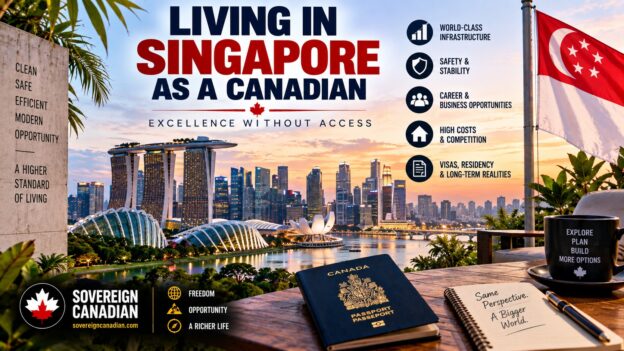
Living in Singapore as a Canadian with Marina Bay skyline, Singapore flag and Canadian passport

Living in Singapore as a Canadian: Excellence Without Access

Every country in this series so far has sold some version of the same trade. You get access, and you give up certainty. Thailand lets you stay for years on a chain of visas that never quite becomes permanence. Vietnam gives you presence without the paperwork to make it stick. Malaysia formalizes the temporariness so cleanly that it becomes its own kind of stability. The Philippines hands out durable permission but keeps dependability conditional. Indonesia is the purest version of the trade: extraordinary attachment to a place, with almost no institutional tenure underneath it.

Singapore does something none of the other five do. It does not ask you to trade certainty for access. It gives you the certainty, in full, and then makes access the scarce resource instead.

Continue reading →