
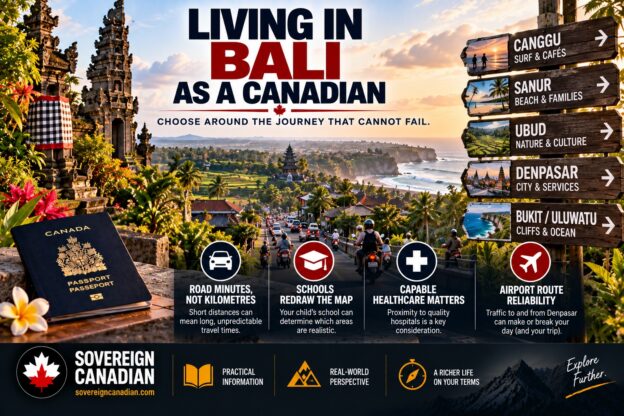
Bali is not physically large. On a normal map, Canggu, Sanur, Ubud, Jimbaran and Denpasar look almost absurdly close together, a cluster of names you could imagine strolling between over a long weekend. Read the map that way and choosing a base becomes a lifestyle question: do I want the surf-and-café scene, the rice terraces, the calm beachfront, the cliffs?
That map is misleading. Twenty kilometres in Bali does not mean twenty minutes. A house that appears perfectly placed can put you on the wrong side of the island’s road network from the school, hospital or airport your life actually depends on. And the failure is rarely a steady, predictable slowness. It is variance: the same trip that takes a comfortable half hour on a good afternoon becomes an hour and a half on a bad one, and you find out on the day it matters.
So I want to start from a different question. Not “Where in Bali would I most like to live?” but “Which journey in my life cannot afford to fail?” The answer changes with your age, your work, whether you have children, and how your health is holding up. It determines which parts of Bali are options for you and which are traps that look like options.
That is the argument of this article. Bali is geographically small but functionally fragmented. Your address matters less for its reputation than for which fixed point you cannot afford to put on the wrong side of a bottleneck. A school with buses can, in a sense, be moved on paper. A capable hospital and a dependable airport route cannot. And the fixed point that binds shifts as you move through life stages. Bali’s real map is measured in road minutes, not kilometres, and the useful exercise is to redraw it around the things you can’t move.
I’m not going to crown a best neighbourhood, because the evidence doesn’t support one. What it supports is a way of choosing. I have written elsewhere on this site about the broader Indonesian picture in Living in Indonesia as a Canadian, including visas, tax residency, property and the question of long-term permanence. This piece deliberately stays closer to geography, because once you have decided that Indonesia is legally and financially workable, the harder question is which Bali works for the life you are actually trying to live.
The usual Bali map is the wrong map
Most English-language coverage of Bali runs on a familiar shorthand. Canggu is where remote workers and the international crowd gather, with the cafés, coworking spaces and beach clubs that go with them. Ubud is culture, wellness and greenery. Sanur is the quieter, older, family-and-retiree coast. Seminyak is the established restaurant-and-boutique zone. The Bukit and Uluwatu mean cliffs, surf and villas. Nusa Dua is resorts. Denpasar and Renon are the working Indonesian city, mostly ignored by foreign writers because it doesn’t photograph well.
There is some truth in every one of these labels, and none of them tells you whether a location will work for a resident. They describe the amenity layer, the things that make a place pleasant on an ordinary Tuesday. They say nothing about the things that determine whether your household functions when something goes wrong or when the calendar demands a fixed commitment.
Those are different questions. Where is the work, and can you reach it? Where is the school, and how does a child get there? Which hospital would you actually want to be taken to if something serious happened, and how reliably can you reach it? How dependable is the route to the airport, given that every trip home to Canada involves at least one connection? And what happens when traffic, heavy rain or an infrastructure failure removes the easy route?
The brand of a neighbourhood answers none of these. The road network does, along with a handful of institutions that sit where they sit and are not going to move.
Bali’s real map is a road-minute map
Start with the roads, because everything else is filtered through them.
What the numbers say
Officials describe the corridor between the airport and Canggu as carrying up to roughly 150,000 people and 80,000 vehicles a day. That is the corridor the government is now planning a battery-powered tram for. I’ll come back to that, because it is a good example of how easy it is to mistake a plan for infrastructure.
More useful than that headline number are the engineering studies of specific road segments, most of them from local universities. They are small studies, and they don’t always agree, but taken together they are unusually consistent about one thing: the roads that matter are at or beyond their design capacity at peak.
Jalan Raya Canggu, the spine of the Canggu strip, was assessed at level of service E in a 2025 Universitas Hindu Indonesia study, which found peak volumes of about 2,236 passenger-car units an hour against a capacity of about 2,453, meaning traffic close to the limit. An earlier 2022 study of side friction on the same road, from Universitas Pendidikan Nasional, found level of service F at every peak and light-vehicle speeds of roughly 13 to 14 kilometres an hour. Notice that the two studies disagree sharply on speed. The newer one reports an average around 41 km/h. They measured different conditions and should not be treated as a single definitive speed estimate. What both indicate is a road operating under serious capacity pressure.
Further south, an analysis of a segment of road in Uluwatu found volume-to-capacity ratios of about 1.14 in the morning, 1.49 at midday and 1.71 in the afternoon. Anything above 1.0 means demand exceeds what the road can carry. On the Ngurah Rai Bypass at Sanur Beach, a study in an academic conference series found a saturation degree of 1.21, with actual travel speeds around 38 km/h against a free-flow speed near 62. A study of Jalan Teuku Umar Barat in central Denpasar found it slightly over capacity too.
Officials are saying similar things in plainer language. Badung’s transport chief has said that on the Pecatu corridor, travel times can reach three hours or more under severe congestion. He has also said that Canggu’s roads are nearly all the same width and heavily trafficked, which is exactly why one-way schemes and diversions are so hard: there is no big road to divert onto. Airport access is serious enough that Indonesia’s land transport authorities warned publicly in late 2025 about severe congestion on the approaches over the Christmas–New Year period, and the airport reworked parts of its access-road traffic flow in 2026.
One number should be handled with care because it is dramatic. On 29 December 2023, the stretch from the Tugu Ngurah Rai underpass to the airport gate reportedly took about an hour and a half, against roughly ten minutes normally, and some travellers abandoned their vehicles and walked. That was an extreme holiday-peak day, not a normal commute. I cite it because it shows the shape of the risk: a short approach that can fail almost completely on the wrong day.
I am deliberately not going to give you a table of commute times between Bali’s areas. No authoritative door-to-door dataset exists that I could find, and the estimates that circulate come mostly from transfer operators and property sites. Where I use minutes, treat them as rough estimates. The point of this section is not that every trip is terrible. Most of the time, at most hours, many of these journeys are fine. The point is variance and unreliability, and the fact that the pain is concentrated in a few predictable places.
Six places that explain most of the trouble
You do not need a road atlas. A small number of bottlenecks explain most of what makes movement in south Bali hard, and once you know them the map begins to make sense.
The first is the exit from Canggu. The road web inside Canggu, through Batu Bolong, Berawa and Pererenan, is uniformly narrow, and most routes toward the south eventually funnel through Kerobokan and toward the Sunset Road and Simpang Siur system, where traffic from Kuta, Seminyak and Denpasar meets. If you live in Canggu, the question is never just how far the airport is. It is how much of that funnel you are going to be in, and when.
The second is the airport approach itself: the Ngurah Rai Bypass, the roads around Tuban and the Tugu Ngurah Rai area. The Bali Mandara toll road offers relief for some routes, but the last stretch to the terminals is where a bad day can get worse.
The third is the entrance to the Bukit. Traffic bound for Jimbaran, Ungasan, Pecatu and Uluwatu converges on a relatively constrained road system before continuing south. Badung authorities trialled traffic-engineering changes on the Uluwatu approaches in 2026, which tells you that the problem was serious enough to intervene. Whether those changes are enough is a different matter.
The fourth is Tohpati, the interchange east of Denpasar where traffic from Sanur, Denpasar, Gianyar and the eastern highway converges with the Bypass.
The fifth is the run from Denpasar toward Ubud. Traffic funnels through the Batubulan–Celuk–Sukawati corridor before it reaches Ubud, where the centre itself, around the Palace, Jalan Hanoman and the Monkey Forest, can be congested through the middle of the day.
The sixth is not a junction but a category: flood-sensitive road points. The Simpang Dewa Ruci underpass was badly affected during the September 2025 floods, and flooding has also disrupted the South Kuta stretch of the Bypass. A route that works perfectly well for most of the year can fail during a serious rain event, and it tends to fail exactly when everybody else is trying to find another route.
The tram is an agreement, not a railway
It is worth pausing on the airport–Canggu tram, because the temptation to treat announced infrastructure as existing infrastructure is strong, and it distorts location decisions. On 1 September 2026, the provincial government, Badung Regency and state railway operator KAI signed a cooperation agreement for a battery-powered tram between the airport and Canggu. The announced timetable targets groundbreaking in 2027 and operations beginning later in the decade.
That is a serious step. It is also an agreement and a target, not a railway carrying passengers today. If your plan for a Canggu house depends on the tram fixing your commute, you are betting on infrastructure that does not yet exist.
A practical test
The most useful advice in this section is also the simplest. Before you sign a lease, travel the routes you will actually depend on. Do the school run around 07:30 on a weekday. Do the airport run around 17:00 on a weekday. Do the route to the hospital you would want in a serious emergency at least once, at a busy time. This will tell you more than any distance in kilometres, and more than this article can.
Ask a driver or a neighbour which day of the week is worst. If you would not want to make the trip regularly, do not choose a house that requires it.
The three fixed points
This is the centre of the argument. In choosing a base, three things can matter enormously: the school, the hospital and the airport. Not all of them are equally fixed, and the differences are more interesting than the similarities.
Schools: fixed, except when they aren’t
If you are moving with children, and especially if you are committed to a particular curriculum, the map of Bali’s international schools effectively redraws the island. This is the same reason schooling can completely change the answer to an expat year with kids: the destination may be flexible, but eventually the child has to be somewhere at 8:00 on Monday morning.
The serious schools cluster in a few places. Canggu Community School sits in Tibubeneng, on the Canggu side, and runs from early years through to the IB Diploma, alongside the IGCSE route. Bali Island School, in Sanur, runs the full IB continuum, Primary Years through Middle Years to the Diploma. Gandhi Memorial Intercontinental School, known as GMIS, is in Renon in Denpasar and offers IB programmes together with Cambridge IGCSE. The Australian Independent School, AIS Bali, is in Denpasar Barat and follows an Australian curriculum with senior pathways including the IB Diploma. Dyatmika, in East Denpasar, combines Cambridge and Indonesian curriculum elements rather than operating as an IB school.
Two more deserve careful description. ACS Bali, inside the Kura Kura Bali development between Sanur and Denpasar, opened in 2025 and is adding grades as it grows. It is not currently an IB Diploma school. Its curriculum material says it intends to seek IB authorisation, with a first Diploma cohort planned for August 2027. That is a plan, and authorisation should not be treated as guaranteed.
Green School is a different animal altogether. It follows its own educational model, famous for its bamboo campus, rather than being a conventional IB school in the way several of the others are. Its address, incidentally, is Sibang Kaja in Abiansemal, Badung Regency, not Ubud itself. That detail turns out to matter.
The Bukit deserves a specific comment, because it is sometimes described as having no serious international secondary schooling. That is not quite right. Asian Intercultural School Bali in Jimbaran offers a Cambridge pathway through IGCSE and AS and A Levels. Uluwatu School, in Pecatu, serves younger grades. What I could not verify on the Bukit is an IB Diploma school.
So the distinction is between families who are content with Cambridge, who may have a local Bukit route, and families committed to the IB Diploma, who face a different map: Canggu, Sanur, Renon or Denpasar, or Green School’s catchment.
Tuition, for the schools that publish it, runs well into the hundreds of millions of rupiah a year. Green School’s published 2025–26 schedule — not a 2026–27 schedule — ranged from roughly 178 million rupiah for the youngest children to about 319 million for the final two years, before some additional charges. Bali Island School’s official 2026–27 fee schedule puts upper-secondary tuition at roughly 285 to 335 million rupiah. Fees change every year and several schools do not publish current schedules openly, so check the school directly rather than relying on an old article.
Now the part that sharpens the whole thesis. You might assume a school is the most immovable of the three fixed points: it sits where it sits, and you live near it or you commute. Green School shows that is not always true. Its Bio Bus publishes pickup points serving Ubud and the Canggu–Pererenan–Munggu side of the island.
That means Green School has effectively stretched its catchment across two very different living environments. A family can put the child on a bus rather than having a parent personally cross the island twice a day. A school with a bus network can partially decouple home from school.
That is a genuinely different kind of fixed point from a hospital.
I would not overgeneralise. Not every school runs buses of comparable reach, and I could not verify comparable services for several of the others. But the principle stands: a fixed point that can come toward you, even partially, is less fixed than one that cannot.
That leaves the two that really cannot.
Healthcare: the nearest hospital is not necessarily the hospital that matters
The natural way to think about healthcare when choosing a home is proximity: how close is the nearest hospital? I think that is the wrong metric.
The better one is what I’d call capability-adjusted proximity: how close is a hospital that can deal with the problem you might actually have?
A twenty-minute drive to a clinic that stabilizes you and sends you elsewhere is not the same as twenty minutes to a hospital that can treat you.
Bali’s hospitals fall into rough tiers. Prof. Dr. I.G.N.G. Ngoerah Hospital, still known to many by its former name, Sanglah, in Denpasar, is a major public referral hospital. You will see it described online as Bali’s only “Level 1 trauma centre.” I could not verify that terminology from an authoritative Indonesian health source, so I would not build a decision around it.
Siloam Hospitals Bali, on Jalan Sunset Road in the Kuta–Kerobokan corridor, has stronger evidence as an established private tertiary hospital. BIMC, with hospitals in Kuta and Nusa Dua, is important for international-facing routine and emergency care, with English-language access and long experience with foreign patients. But a hospital that can handle routine emergencies and stabilize serious patients is not necessarily the same thing as the deepest tertiary referral centre. That distinction is the one that matters here.
Then there is Bali International Hospital, in the Sanur Health and Wellness Special Economic Zone, which is the most interesting and hardest to assess. It is one reason Sanur is increasingly discussed as a health-oriented base, and it may prove transformative. What can be said confidently is narrower.
It is worth separating three things: what the hospital was designed to be, what it advertises, and what can be shown in official operating data.
BIH advertises a 255-bed design, five centres of excellence, 38 intensive-care rooms, eight operating rooms and four catheterization labs. But the Indonesian Ministry of Health’s national hospital registry currently displays a much smaller registered bed footprint. Its listed categories include 38 VIP beds, six VVIP beds, four ventilated adult ICU beds, one non-ventilated adult ICU bed, four HCU beds and smaller paediatric, neonatal and isolation categories, while its ICCU/ICVCU categories display zero.
The registry does not establish that those numbers equal the hospital’s total real-world operating capacity today, and its update information is not sufficiently clear to use it that way. I am therefore not claiming BIH has only the beds shown in that registry. I am equally not assuming that every element of the 255-bed design is operational.
That distinction matters.
If you are considering Sanur largely because of BIH, the question is not whether there is an impressive new hospital nearby. The question is whether the specific capability you might need is operating when you need it.
BIH also advertises international insurance and direct-billing relationships. But a logo on a hospital website is not confirmation that your particular policy is in-network. Anyone relying on a particular hospital should ask their insurer, in writing, whether it is a direct-billing facility for their specific policy.
That leaves medical evacuation. For the most complex cases, Singapore repeatedly appears as the major regional referral destination because of its proximity and specialist depth. There is no useful single evacuation price: aircraft, medical crew, urgency, destination and the patient’s condition can change the cost dramatically. The practical conclusion is simpler. If serious medical risk is part of your planning, carry international health insurance that explicitly includes medical evacuation and understand the terms before you need it.
Emergency response is a further uncertainty. I found no sufficiently robust independent dataset on Bali ambulance response times to turn it into a neighbourhood comparison. And that points back to the theme of this article: in an emergency, the road network becomes part of the healthcare system.
Home visits are a partial answer for less serious problems. Doctors on call, home nursing and physiotherapy are available through providers in the major expat areas, including BIMC’s home-care services. This makes routine care easier wherever you live.
It does not bring a cath lab to your door.
The airport: the fixed point everybody eventually uses
There is no nonstop flight between Canada and Bali as of this writing. Every trip home involves at least one connection. In practice the hinges include Singapore, Dubai and major North Asian hubs depending on where in Canada you are starting and which airline you use.
The structural point is that living in Bali as a Canadian means the airport is not an occasional inconvenience. It is the umbilical cord. Two or three long trips a year, perhaps for family, health, tax or business reasons, all begin with the road to Ngurah Rai, and the connection at the far end will not wait if that road has a bad day.
That is why the reliability of the airport route matters more than it seems when you are choosing a house.
The airport is also subject to disruptions that have nothing to do with roads. Nyepi, the Balinese day of silence, closes the airport for roughly a day each year. Volcanic ash can periodically disrupt flights even when Bali’s own volcanoes are not the source.
In early September 2026, for example, activity at Anak Krakatau disrupted Bali flights even though Ngurah Rai itself continued operating. By the afternoon of September 6, airport management had recorded 42 flights affected by cancellations or schedule adjustments. Earlier eruptions of Mount Lewotobi on Flores also caused Bali flight disruption.
None of this is a reason to avoid Bali. It is a reason not to build an international itinerary around an unnecessarily tight connection.
And I want to be careful not to overstate airport geography. Airport access is not a reason nobody should live in Canggu, Ubud or on the Bukit. It is a cost those locations impose differently, and it should be conscious rather than accidental.
Putting it together
If you overlay these three fixed points on the areas people talk about, you get something like the following. It is not a ranking, and it does not tell you where to live. It shows what each area asks of you.
| Area | Strongest use case | Main fixed point nearby | Main geographic friction | School situation | Healthcare geography | Airport friction |
|---|---|---|---|---|---|---|
| Canggu / Berawa / Pererenan | Work, social life, network | Canggu Community School | Narrow roads; funnel toward Kerobokan and the south | CCS locally; Green School buses serve the wider area | Major hospitals farther south, close on a map but variable in time | Substantial, variable |
| Umalas / Kerobokan / Seminyak | Established services, central position | Siloam / Kuta healthcare corridor | Congested central-south road system | Options toward Canggu and Denpasar | Better access to Siloam and BIMC Kuta | Moderate to substantial |
| Sanur | Quiet coastal life, families, health-priority households | BIH, Bali Island School; Renon schools nearby | Ngurah Rai Bypass and Tohpati | Strong school cluster in Sanur/Renon/Denpasar | BIH nearby but operating depth still developing; major Denpasar hospitals accessible | Relatively favourable |
| Denpasar / Renon | Functional city life, services | Ngoerah; GMIS, AIS, Dyatmika | Urban congestion; flood-sensitive locations | Several international schools | Strongest overall hospital geography | Moderate |
| Ubud / Gianyar | Focused work, culture, quieter life | Green School catchment | Batubulan–Sukawati corridor; central Ubud congestion | Green School; younger-grade alternatives | Local hospitals and clinics; deeper care in Denpasar | Substantial |
| Jimbaran / Bukit | Coastal lifestyle, surf, villas | AISB (Cambridge) | Constrained south-Bali road corridors | Cambridge locally; no IB Diploma school verified | Clinics and some hospital care locally; deeper tertiary care farther away | Highly location-dependent |
| Nusa Dua | Resort-style setting | BIMC Nusa Dua | Bypass/toll-road dependence | More limited locally | BIMC locally | Relatively favourable |
The infrastructure layer nobody puts in the villa photos
Roads and institutions are only part of it. There is another layer that decides whether a house is comfortable and whether it is safe, and it almost never appears in a listing.
Waste
Bali’s waste system came under acute stress in 2026, and the story is more complicated than “the landfill closed.”
From 1 April 2026, Indonesia’s Environment Ministry restricted Suwung so that it was supposed to stop accepting organic waste and receive residual waste instead. The transition immediately exposed how dependent the existing system remained on the landfill. Waste accumulated at processing facilities and haulers pushed back.
By mid-April, the Environment Minister temporarily allowed separated organic waste into Suwung twice a week while processing infrastructure caught up. Then in June, the ministry clarified the larger objective: Suwung itself was not simply being closed; open dumping was to end, with waste increasingly sorted and processed before residual material reached the landfill.
That distinction matters because both simplified versions are wrong. Suwung did not disappear on April 1, and Bali did not seamlessly replace it with a mature decentralized waste system either.
A waste-to-energy project is intended to add future capacity, but future capacity is not present capacity.
One caution against lazy writing: Suwung is in South Denpasar on the Benoa Bay side. It would be wrong to turn that into the claim that Sanur residents simply live beside an active open dump. The useful point is broader. Waste management is part of the infrastructure due diligence of living in Bali, and 2026 demonstrated that the system is still in transition.
Water and sewage
Here the honest answer is that the evidence is incomplete.
Municipal piped water is only part of the supply picture. Many households and villas rely to varying degrees on wells, boreholes, storage tanks and tanker deliveries. Saltwater intrusion into coastal groundwater has been documented in southern Bali. And Bali’s centralized sewer infrastructure covers only part of the developed south, while septic systems remain normal in many areas.
I cannot give you a reliable island-wide infrastructure map from current public data. What I can give you is a set of questions to ask the landlord before you sign.
Does the water come from the municipal supply, a well or a tanker? What happens in the dry season? Is there a storage tank? Does the pump have backup power? Is the property connected to a sewer or a septic system, and when was the septic tank last serviced? Who collects the rubbish? Did the street flood during the major 2025 rains? Which internet connection is actually installed, and can you see a speed test?
And is the property itself legal for the use being advertised?
These are less glamorous questions than whether the pool faces the sunset. They are much closer to the questions that determine whether you enjoy living there.
Flooding, tsunami and earthquakes
The September 2025 floods were a major disaster across Bali, with Denpasar particularly badly affected and flooding also hitting tourism-heavy areas. Roads, homes and businesses were inundated, and the event was a reminder that drainage and river proximity matter at the level of the individual address, not merely the neighbourhood name.
Bali also sits in an active tectonic region. Researchers have produced tsunami hazard modelling for southern Bali, and Sanur has formal tsunami evacuation planning. Studies of Kuta and Tanjung Benoa illustrate why the south coast cannot be treated as one uniform risk zone: inundation depth, arrival time, road access and evacuation options can change substantially over short distances.
I am not going to rank areas by safety, because the evidence does not support that level of simplification.
Whether you are exposed depends on your address: elevation, distance from the shore, distance from a river or drain, local flood history, access to raised ground, evacuation routes and whether the road you would use in an emergency is itself vulnerable.
Ubud and Gianyar have a different version of the problem in slopes, ravines and landslide exposure.
Ask about flood history. Look at the drainage. Know the evacuation route. Understand the building you are renting.
I also would not rely on an article like this for the current alert status of Mount Agung, Mount Batur or any other volcano. If current volcanic activity matters to a decision, check Indonesia’s official monitoring information at the time.
What does it actually cost to live there?
I am not going to publish a rent table by area, because the available data do not support one.
What exists is agent asking prices, scattered live listings and “from” prices that mix furnished and unfurnished, monthly and yearly. A table full of ranges would look authoritative while quietly comparing different products.
What I can offer is orders of magnitude from the market observed during this research. A furnished two-bedroom pool villa on a yearly lease in the popular coastal markets commonly lists in the hundreds of millions of rupiah per year.
In Sanur, yearly two-bedroom villa asking prices I found began in roughly the mid-hundreds of millions of rupiah. In Balangan and the wider Bukit, two-bedroom yearly listings stretched across a similarly wide band depending heavily on location and quality. In Canggu and Berawa, monthly two-bedroom asking prices frequently reached into the tens of millions of rupiah per month, with annual leases generally priced differently from simply multiplying a monthly rate by twelve.
Several things complicate the numbers.
Monthly and yearly listings are not directly comparable, because flexibility costs money. Annual rent is often paid substantially or entirely upfront, which changes your cash flow. Deposits vary by owner. Pools, ocean views, construction quality and exact location move the price enormously. Utilities, air conditioning, pool maintenance, internet, water, staff and local fees all sit outside the headline rent.
I would also resist the temptation to say Sanur is simply cheaper than Canggu, or the reverse. I could not build a sufficiently clean like-for-like comparison to support it.
And Denpasar is a different product. Its housing stock contains far more local houses, apartments and rooms rather than the tourism-oriented pool villas that dominate English-language listings in Canggu or Uluwatu. Comparing them as though they were one market is misleading.
This is another reason the broader Expat Living roadmap starts with renting and testing a place before treating it as a permanent answer.
The life-stage map
If the central claim is that the binding fixed point shifts through life, then the useful thing to do is walk through the stages and ask what actually binds at each one.
This is not a ranking of places. It is a description of what each stage asks of you.
In your twenties and thirties, as a remote professional or entrepreneur, the binding constraint is usually the network. Social density, coworking, restaurants and a community of people doing something similar matter a great deal, and the airport and hospital are tolerable occasional frictions because you are generally healthy and mobile. This is the profile that made Canggu famous, and for the right person it makes sense, alongside Pererenan, Seminyak and, for people who want something different, parts of Ubud.
Sort out immigration status before anything else. Anyone intending to work or run a business needs a status that permits the activity and should not assume tourist entry authorizes work. The visa mechanics belong in the broader Indonesia guide rather than here.
When children arrive, in your thirties and forties, the school starts to redraw the map. If the kids are young and you are flexible about educational system, the map remains relatively broad. Green School’s bus network is particularly interesting because it stretches the school’s practical catchment across both the Ubud and Canggu sides.
If you need international secondary education, the school becomes much more fixed. The IB geography matters. Bukit families who want Cambridge have a local option; those committed to the IB Diploma face a different map. ACS Bali may change the picture if it ultimately receives the authorization it is seeking, but that is a future possibility rather than a present fact.
In your forties and fifties, as an established professional or business owner, several fixed points can matter at once: the business, airport, children’s schools and healthcare. This is where the cost of putting two of them on opposite sides of the island becomes most obvious, because you are living between them every day.
A house that suits the school run and airport run may not suit the office. It is worth deciding which journeys you are willing to cross a bottleneck for and which you are not.
From your fifties to sixty-five, as you approach retirement or become financially independent, the map can expand again. Work and school stop pinning you down, and lifestyle can matter more. But healthcare and airport access begin to carry more weight, and this is the point at which it makes sense to choose with a longer horizon than the next lease.
Between about sixty-five and seventy-five, for a healthy retiree, Bali can work well. Sanur, Denpasar and Renon deserve serious attention because of their concentration of hospitals and functional urban infrastructure, and the flat Sanur beachfront is easier to navigate than many parts of Bali. I would not call any of them a universal winner.
Other areas can work perfectly well for a healthy person with good insurance and reliable transportation. Ubud, for example, may suit someone who values the setting and is prepared to hire a driver for the trips that matter.
Between seventy-five and eighty-five, the map begins to shrink. Scooters become a worse answer, uneven pavements become more consequential, and distance to a capable hospital starts to carry real weight. Home care, accessible buildings, transportation and the journey back to Canada if it becomes necessary all move to the front.
The evidence supports saying that Bali becomes progressively more complicated as medical and mobility needs increase.
At eighty-five and beyond, I am not going to recommend an area, because the evidence is too thin to justify one. Advanced age, dementia, frailty or high medical needs fundamentally change the decision.
Bali has home nursing and doctor visits, and a small assisted-living presence, but the care ecosystem is not documented well enough to make confident claims. At that stage the relevant fixed points may become care services, hospital capability, evacuation arrangements, family — and potentially Canada itself.
| Stage | What tends to bind | Areas that deserve serious consideration | What you accept |
|---|---|---|---|
| 20s–30s, remote worker or entrepreneur | Network and work | Canggu, Pererenan, Seminyak, parts of Ubud | Traffic; distance from deeper healthcare |
| 30s–40s, young children | School, flexibility | Sanur, Renon/Denpasar, Umalas/Canggu, Ubud with Green School transport | Route planning; school-driven geography |
| Family needing international secondary | The exact school | Canggu; Sanur/Renon/Denpasar; Green School catchment; Bukit for Cambridge | A fixed school geography |
| 40s–50s, established professional | Several fixed points at once | Depends on which two or three matter most | The cost of crossing bottlenecks |
| 50s–65, approaching retirement | Lifestyle, with rising weight of health and airport | Sanur, Ubud, Umalas, Nusa Dua and others depending priorities | More healthcare planning |
| 65–75, healthy | Hospital access, mobility, insurance | Sanur, Renon/Denpasar, potentially Ubud with a driver | Less dependence on scooters; insurance cost |
| 75–85 | Mobility, care, hospital capability | Denpasar–Sanur corridor deserves closer examination | A shrinking set of practical options |
| 85+ | Care and medical access | No general recommendation | Very thin evidence; Canada may re-enter the decision |
Retirement and ageing deserve their own discussion
I want to spend longer on this than the table allows, because the retirement story about Bali is told so glowingly and the reality is more conditional.
The case for a healthy retiree is real. The climate is warm, services are plentiful, private healthcare is accessible, household help is comparatively affordable, daily life can cost less than in major Canadian cities, and there is a large international community. For someone in their late sixties with good health and insurance, Bali can be a very workable place.
But cheap household labour is not the same as clinical care, and retirement writing often blurs the two.
A housekeeper, companion, personal caregiver, nurse, doctor, physiotherapist and dementia specialist are different things.
It may be relatively easy to hire someone to cook, clean and keep an eye on an older person. It is a different exercise to find, verify and coordinate clinically trained care.
What does exist is worth naming. Doctors on call, home nursing, wound care and physiotherapy are offered across the main areas, including through established hospital groups. Hovi Assisted in Saba is one of the few purpose-built residential elder-care operations I found, offering assisted living, dementia and respite services, while Hovi also operates day-care services in Denpasar.
That is evidence that the category exists. It is not evidence that Bali has a deep Canadian-style long-term-care ecosystem.
Dedicated memory-care options appear limited, and ordinary international health insurance generally focuses on medical treatment rather than years of custodial long-term care.
Mobility matters as much as medicine. Sanur’s long, relatively flat beachfront path can work well for people with reduced mobility, and resort-oriented parts of Nusa Dua can also be easier to navigate than many traditional Bali streets. But I would be careful about generalizing from a promenade or resort complex to an entire district.
Away from those pockets, kerbs, drainage channels, broken or missing sidewalks, stairs and traffic can make a short distance surprisingly difficult. Central Ubud adds hills and uneven surfaces. Canggu’s narrow road environment creates its own challenges.
So the honest statement is this:
Bali can work well for a healthy sixty-five-year-old but becomes progressively more complicated as mobility and medical needs increase.
Above all, ageing in Bali should not be romanticized because domestic help is affordable.
The question is what you would do if you needed a hospital, a nurse or a wheelchair — and where those things are relative to your bed.
For the broader Canadian side of that decision, I maintain a separate Elder Care roadmap, because the financial and care questions eventually become much larger than the destination itself.
The Canadian layer
A few Canadian specifics matter enough to include, kept short because the broader tax and residency questions belong to the wider material on this site.
Flights
There is no nonstop Canada–Bali service. Plan on at least one connection, generally through an Asian or Middle Eastern hub, and take the reliability of the airport route seriously.
CPP and OAS
This is where a careless article can mislead you.
The Canada–Indonesia tax treaty caps Canadian source tax at 15% on certain periodic pension payments, but Article 18 expressly excludes payments under social-security legislation from that ceiling.
CPP and OAS are Canadian social-security benefits.
Service Canada’s current non-resident pension guidance says the standard withholding rate on CPP and OAS is 25% unless a treaty reduces or exempts it. Its country table does not give Indonesia a reduced CPP/OAS rate. The practical result is that a Canadian non-resident living in Indonesia should generally expect the 25% Canadian non-resident withholding rate on CPP and OAS rather than assuming the treaty’s 15% pension ceiling applies.
That is withholding, not necessarily the end of every Canadian tax-planning question. Non-residents receiving Canadian pension income may in some circumstances use mechanisms such as a section 217 election or an approved NR5 application to alter the ultimate tax result. Employer pensions, RRSP withdrawals and RRIF payments also have their own rules.
The larger point is simple: do not model retirement in Indonesia by applying a blanket 15% treaty rate to every Canadian pension.
This is also where Canadian tax residency matters. Spending substantial time abroad does not by itself determine that you have ceased Canadian tax residence, and actually becoming non-resident can create its own consequences. I cover that separately in Canadian Tax Residency: The Flag That Sets the Bill and the site’s departure-tax material.
OAS has another rule worth knowing. Service Canada confirms that if you live outside Canada, you generally need at least 20 years of Canadian residence after age 18 to continue receiving OAS abroad. Social-security agreements can sometimes help Canadians meet that requirement, but Indonesia does not provide the kind of Canada–Indonesia social-security totalization agreement that would solve that gap.
For someone who spent most of adult life in Canada before retiring to Bali, that may be irrelevant. For someone who left Canada young, it can matter enormously.
Provincial health coverage
Take Ontario as the example.
OHIP normally requires Ontario to remain your primary residence and requires physical presence in Ontario for at least 153 days in any twelve-month period, subject to specific extended-absence exceptions.
A temporary year abroad and permanent relocation are therefore different situations.
Do not generalize Ontario’s rules to every province. Check the provincial plan that actually covers you.
Driving and scooters
The Government of Canada’s International Driving Permit guidance is clear on one point Canadians sometimes miss: an IDP only authorizes the same vehicle classes covered by your Canadian licence.
If your Canadian licence covers automobiles but not motorcycles, obtaining an IDP does not suddenly license you to ride a motorcycle abroad. The federal travel guidance also warns that travel insurance may not cover an accident if you were operating a vehicle without the proper licence.
I have not verified every Indonesian licensing rule for every residence-permit category and would not substitute a general article for that advice.
Road risk itself is easier to document. Indonesian National Police reported 8,256 traffic accidents and 622 deaths in Bali in 2024, including 21 foreign-national deaths. Police subsequently reported that the overall accident count declined by about 4% in 2025.
Foreigners are a minority of the toll, not the majority. But the numbers are enough to make one point clearly: whether your household intends to depend on scooters is not a minor lifestyle detail, particularly with children or as you age.
What I’d actually do
If I were choosing a Bali base, I would begin by ignoring the neighbourhood’s reputation and writing down the two or three fixed points that matter most for the next three to five years.
Then I would arrange the search around them.
If international education mattered, I would choose the school before the house.
I would decide which hospital I would actually want to be taken to for a serious problem, not which clinic is nearest, and I would ask my insurer about it in writing.
I would test the airport route.
I would travel the school and airport routes at genuine weekday peak times before committing to anything.
I would rent before buying, or before signing anything unusually long, because the first year of living somewhere teaches you what no research does. That is especially important in Indonesia, where the property and tenure system for foreigners is fundamentally different from Canada; the broader Living in Indonesia as a Canadian guide deals with that distinction in detail.
I would ask neighbours, not just the agent, about flooding, water, septic systems and rubbish.
I would carry international health insurance with explicit evacuation cover.
And I would expect to re-evaluate when my life stage changed.
That last point is the one I think matters most, and it is where this connects to what this site cares about.
Geographic optionality is not simply having more places you could live. It is keeping the ability to change your setup when the binding constraint changes.
The person who chose Canggu at thirty-two for the network may be wise to move at forty-five for the school, and again at sixty-seven for the hospital.
The house that was perfect for one chapter can become the trap in the next.
That is also the useful part of Flag Theory for Canadians. The objective is not to collect jurisdictions for their own sake. It is to build enough optionality that you can change the geography when the life changes.
The sovereign move is not finding the permanent answer.
It is holding your choices loosely enough to revisit them.
Bali is small on the map. Your life there is not.
Bali’s geographic scale creates an illusion of interchangeability. The island is small enough that everything looks nearby, and so the neighbourhood names float free of the geography, as though you could pick whichever felt best and reach the rest easily.
But road capacity, schools, hospital capability, airport access, floods and infrastructure combine to create functional islands inside the island, separated by bottlenecks that do not appear on the map.
The best place to live in Bali is not determined by which neighbourhood has the best reputation.
It is determined by which fixed points matter in this chapter of your life, and which bottlenecks you are willing to cross to reach them.
A school bus can redraw the map.
A capable hospital cannot.
The airport cannot.
And as your life changes, the fixed point that matters most changes with it.
Choose the fixed points first.
This article is for general information and does not constitute legal, tax, immigration, medical, insurance or financial advice. Immigration rules, tax treatment, insurance networks, hospital capabilities, school authorisations and fees, infrastructure projects and travel conditions change, sometimes quickly, and your situation is your own. Tax outcomes in particular depend on individual circumstances, including residency status and the type of income involved. Verify any material decision with the relevant authorities, such as the Canada Revenue Agency, Service Canada, your provincial health plan, Indonesian immigration and your insurer, and with qualified professionals, before acting.