
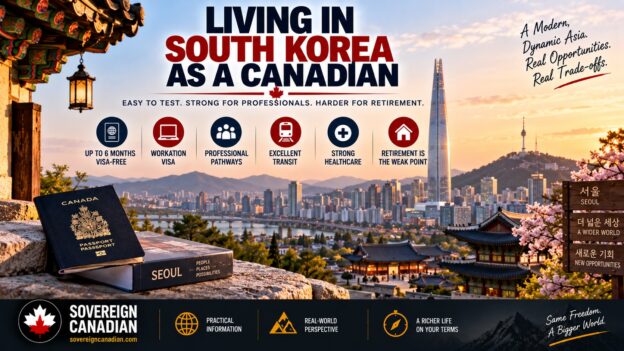
South Korea is one of the most technologically advanced, safest, most convenient, and clinically capable countries a Canadian could reasonably consider living in. Its trains run on time to the minute. Its broadband is faster than almost anything in North America. Its hospitals are excellent. Its cities feel orderly, humane, and extraordinarily easy to move through. And Canadians can walk into the country for up to six months without a visa at all.
That last part sounds almost absurdly easy. It is easy. But the question this article actually asks is a different one: does a country being exceptionally good at running itself mean it is exceptionally good at absorbing you into it? Those are not the same question, and the gap between them is where most expat regret lives.
I want to test a specific, falsifiable thesis rather than a slogan, because the slogans I tried out while researching this piece did not survive contact with the evidence. Korea is not simply “a great short chapter and a terrible long one.” It is not simply “easy to try, expensive to keep.” What actually held up, once I pushed on immigration law, tax treaties, healthcare data, schooling rules, and housing mechanics rather than vibes, is more specific and more useful: South Korea is unusually easy for a Canadian to test, increasingly attractive for high-income temporary residents, professionals, and entrepreneurs, and surprisingly credible as a permanent-residence destination through the right visa track. Its real structural weakness is narrower and sharper than “hard to integrate.” It is conventional retirement. Korea offers no straightforward retirement visa, deliberately made passive investment immigration dramatically more expensive in 2023, treats Canadian CPP and OAS less favourably at the source than several other treaty destinations, Portugal among them, and becomes a genuinely harder place to navigate once healthcare needs shift from excellent clinical medicine toward language-intensive long-term and dementia care.
That progression, by life stage rather than by simple duration, turns out to be the more revealing way to read this country. Korea at 35 as a remote professional looks very different from Korea at 45 with children, which looks different again from Korea at 65 as a healthy semi-retiree, which looks different again from Korea at 85 needing residential care. The rest of this article walks that progression honestly, stage by stage, with the actual visa codes, tax treaty articles, and Ministry of Justice policy history behind each conclusion rather than a tourism-brochure version of any of it.
The Early Bottom Line
These are qualitative working conclusions, not a numerical score. Your own fit will shift with income, age, Korean-language ability, and whether you are moving alone, as a couple, or with children.
| Canadian use case | Likely fit |
|---|---|
| 2 to 8 week reconnaissance trip | Excellent |
| 2 to 3 month extended stay | Excellent |
| 3 to 6 month seasonal stay | Very good |
| 6 to 12 month remote-work experiment | Very good, if you clear the income bar |
| One school year with young children | Good to very good, schooling-dependent |
| 1 to 5 year professional chapter | Good |
| Entrepreneur or business owner | Good |
| Permanent residence | Good, through the right visa track |
| Conventional retirement | Weak |
| Citizenship strategy | Mixed, renunciation is the default |
| Tax-driven relocation | Mixed |
| Lifestyle-driven relocation | Good to very good |
Notice the shape. Korea scores strongly across almost the entire range, right up to permanent residence for the right professional or investor profile. Then it falls off sharply and specifically at retirement. That is not the pattern most casual “is Korea a good place to retire” content prepares you for, and it is the pattern the rest of this article explains. This piece sits alongside the rest of Sovereign Canadian’s Expat Living series, and if you have not yet read the introduction to that series, it lays out the general framework this article applies specifically to Korea.
Canadians Get an Unusually Long Test Drive
Start with the part that is genuinely, unambiguously good news. Canadian passport holders can enter South Korea visa-free for up to six months, not the 90 days most nationalities get. That figure is confirmed by the Government of Canada’s current travel guidance for South Korea.
On top of that generous baseline, Canada is one of the countries currently exempt from South Korea’s K-ETA (Korea Electronic Travel Authorization) pre-screening system. That exemption has been extended repeatedly since 2023 and currently runs through December 31, 2026. Absent another extension, Canadians would again become subject to the K-ETA requirement from January 1, 2027, a minor bit of friction rather than a real visa requirement, but worth watching if your planning horizon crosses that date.
None of this creates residence rights. Visa-free entry is exactly what it says: entry for tourism, family visits, and permitted short-term business activity, not employment, and not a workaround for immigration status through repeated entries or “visa runs.” Korean immigration authorities take that distinction seriously, and I would not build a Korea strategy around cycling in and out on tourist status the way some long-term expats in other countries do.
What this six-month window actually buys you is something more valuable than most Expat Living destinations offer: enough time to discover whether Korea genuinely works for you before you commit to a visa category, a lease, a school, or any capital at all. A two-week trip tells you almost nothing. A properly used six months, spanning at least two seasons, in both Seoul and a second city, tells you a great deal. Use it that way before you use it any other way.
The F-1-D Workation Visa: The Biggest Current-News Story in This Article
If there is one development that should change how a Canadian thinks about testing Korea, it is this one, and it is very recent.
Korea’s Ministry of Justice piloted a Digital Nomad, or “Workation,” visa (F-1-D) from January 1, 2024. On June 30, 2026, that pilot became a permanent visa category, and the terms improved meaningfully at the same time.
The applicant must have worked in the same industry for at least one year and currently be employed by, or own, a business based outside Korea. You cannot work for a Korean employer or take on Korean clients on this status; the entire point is that your income originates abroad. The maximum stay is now three years, up from two under the pilot. The standard income threshold is twice Korea’s per-capita Gross National Income for the prior year, which sits around KRW 105 million as of 2026 figures. A meaningfully lower threshold, one times GNI, applies to qualifying younger applicants living outside the Seoul metropolitan region or in designated population-declining areas, a genuine incentive to consider a life outside Seoul specifically. Medical-insurance requirements also apply, and dependent family members can accompany a qualifying applicant.
One procedural point deserves caution. Canada’s current travel guidance states that Canadians generally cannot change visa status once they are in South Korea as tourists. Korea substantially revised F-1-D in 2026, and visa-specific procedures can differ from the general rule, but I would confirm the current application and status-change procedure directly with Korea Immigration Service before assuming that a visa-free Canadian can enter as a tourist and convert to F-1-D without leaving the country.
Even with that caveat, this is a genuinely strong package, and it makes Korea’s version of the workation visa substantially more useful for a real multi-year remote-work chapter than Japan’s six-month digital-nomad status.
Here is the distinction that matters most, and the one a lot of casual coverage misses entirely: F-1-D is an excellent lifestyle and testing visa, and a dead end for immigration. Time spent on F-1-D does not count toward the five-year residence requirement for permanent residence, and it does not lead toward naturalization. If you spend two or three years on a workation visa and decide Korea is genuinely home, you cannot simply keep renewing the same status indefinitely. You need to exit that track and move onto a qualifying professional, business, or investment status, with the residence requirements of that new route applying from there. Plan for that in advance. Do not discover it after you have built a life around F-1-D.
Professional and Permanent Residence: The Ladder Actually Works
Set aside the workation visa and Korea offers a real, working path from professional employment to permanent residence, and the general timeline compares favourably with a lot of what people assume about Asian immigration systems.
The standard route runs through Korea’s E-series employment visas, professional occupations, specialized skills, and so on, or the F-2 long-term resident status, into F-5 permanent residence. The general route requires sustained residence on qualifying status plus income and integration requirements. Korea’s immigration system makes Korean-language and social-integration capability a meaningful part of that process, particularly through the Korea Immigration and Integration Program, or KIIP.
A separate points-based route, F-2-7, lets certain skilled professionals qualify based on factors including age, education, income, and Korean-language ability. Korea has also introduced newer programs aimed specifically at retaining highly skilled foreign graduates and technical talent. I would treat the detailed scoring mechanics and program-specific eligibility rules as items to verify directly with Korean immigration authorities or a specialist at application time rather than settled facts to build a multi-year plan around from an article. These programs are recent enough, and immigration rules move often enough, that false precision is worse than acknowledging that the details need to be checked when you actually apply.
The larger point is the one worth taking away: Korea is not merely a country for temporary expats. A professional who deliberately enters the correct immigration track can build toward permanent residence. Eligibility is not automatic simply because enough calendar years have passed; income, integration, visa category, and other requirements still have to be satisfied. But the ladder itself is real.
Entrepreneurs and D-8: Korea Wants Builders More Than It Wants Retirees
This is one of the more useful contrasts in the whole article, because it sets up the retirement section that follows.
Korea’s D-8 Corporate Investor visa is a standard route for a foreign entrepreneur who wants to establish and actually operate a business in Korea. A foreigner bringing at least KRW 100 million into Korea to establish and operate a qualifying foreign-invested corporation can potentially apply for D-8 status, subject to the corporate structure and immigration requirements.
That is a materially different proposition from passive investment. D-8 is built around an operating company and an active role, not simply transferring money into Korea and calling yourself an investor.
D-8 can form part of a longer-term route toward permanent status, but it is not an automatic five-year countdown to F-5. Whether a D-8 holder ultimately qualifies depends on the permanent-residence category they use and the income, business-performance, integration, and other conditions applying at that time. Treat D-8 as a credible route to build toward permanence rather than a guaranteed one.
For a Sovereign Canadian reader who owns or is considering acquiring a business, particularly in advanced manufacturing, industrial automation, maritime and shipbuilding, batteries, robotics, or technology-adjacent services, Korea deserves to be treated as an actual business jurisdiction rather than a lifestyle backdrop. This is a real, developed, technically sophisticated economy that is materially more open to a foreigner who intends to build and operate something than to one who simply wants to arrive with capital and not work. That is not incidental. It is a policy choice, and it explains the next section.
Retirement: The Structural Weakness
This is the section where the evidence points hardest in one direction, and it deserves to be stated plainly rather than softened.
South Korea does not have a conventional retirement visa. There is no Ministry of Justice visa category built around demonstrating passive pension or investment income and simply being retired. That alone would put Korea in the same category as many developed countries, including Japan, which also has no dedicated retirement visa.
What makes Korea’s position more interesting is what happened to its investment-immigration program. Korea previously offered a substantially cheaper retiree-oriented investment threshold. In 2023, that preferential retiree route was removed and the general public-interest investment threshold was increased sharply.
Today, Korea’s Ministry of Justice lists the general Public Interest Investment Immigration threshold at KRW 1.5 billion, with investment maintained for at least five years providing a route from F-2 residence to F-5 permanent residence. A KRW 3 billion high-value route can provide F-5 status immediately, subject to maintaining the investment for the required five-year period.
The Ministry of Justice also describes two structures. One is a principal-protected, zero-interest public fund administered through Korea Development Bank. The other involves qualifying development projects where investment gains or losses can occur.
Those are genuinely large sums, and the comparison with D-8 is revealing. Korea will consider an active entrepreneur entering with a qualifying operating investment at a fraction of the capital demanded from a passive investor trying to secure residence primarily through money.
That does not mean Korea is hostile to wealthy retirees. It means its immigration architecture is much better designed for workers, skilled professionals, entrepreneurs, and very high-net-worth investors than for an ordinary Canadian couple whose qualification is simply that they have accumulated enough retirement savings to support themselves.
That distinction is the structural weakness.
Taxes: Neither a Haven Nor a Trap
Korean tax residency generally turns on residence, domicile, and the familiar 183-day threshold. Korean residents can become liable on worldwide income, with progressive national income-tax rates supplemented by local income tax.
The meaningful relief valve for a newly arrived foreign resident is Korea’s special treatment of certain foreign-source income. A foreign national who has been resident in Korea for five years or less during the preceding ten-year period is generally taxed on foreign-source income only to the extent that it is paid in Korea or remitted into Korea. Once the five-out-of-ten-year window is exceeded, the treatment changes.
There are also special tax rules available to qualifying foreign employees, including a flat-rate regime in circumstances prescribed by Korean tax law.
None of this makes Korea a tax haven. It is not. But it is not a uniformly tax-hostile jurisdiction either, particularly for someone in their first several years.
None of this is settled purely by what Korea does. Moving to Korea does not, by itself, make you a non-resident of Canada for tax purposes; the CRA looks at your residential ties, principally a home, spouse, and dependants left behind, and a Canadian who keeps significant ties can remain a Canadian tax resident throughout a Korea posting regardless of what Korea’s own rules say.
Someone who genuinely severs Canadian residency, by contrast, needs to account for Canada’s own departure tax, including the deemed disposition rules that can apply to certain property on departure. Which side of that line you land on is a Canadian-law question, separate from Korea’s own residence rules, and worth resolving with a cross-border accountant before, not after, the move.
Canadian Pensions: Where This Gets Genuinely Important
This is the section worth reading slowly if retirement is any part of your interest in Korea, because it is one of the most specific and consequential findings in this entire article.
Canada and Korea are governed by the Canada-Korea Income Tax Convention, signed in 2006 and replacing the previous treaty. Article 18, covering pensions and annuities, has a structure worth understanding precisely rather than approximately.
CPP and OAS. Article 18(4)(b) says benefits arising under the social-security legislation of one country and paid to a resident of the other are taxable only in the country in which they arise. For a Canadian benefit paid to a resident of Korea, Canada retains the taxing right.
The important catch is that Article 18’s ordinary periodic-pension ceiling expressly excludes payments under social-security legislation. In other words, the treaty’s ordinary ceiling of the lesser of 15 percent of the gross periodic pension or the Canadian-resident-equivalent rate does not automatically apply to CPP and OAS.
That distinction matters because Canadian non-resident taxation can therefore be materially less favourable for a Korea-resident recipient of CPP and OAS than for a Canadian retiree living in certain other treaty countries that receive specific relief.
Employer pensions and RRIFs. Employer pension income is different. Qualifying periodic pension payments can fall under Article 18(2), which limits Canadian tax to the lesser of 15 percent of the gross payment or the Canadian-resident-equivalent rate.
RRIF treatment requires another layer of care. Canada’s own Income Tax Conventions Interpretation Act determines whether a payment qualifies as a “periodic pension payment.” That means not every withdrawal from a RRIF automatically receives the treaty ceiling merely because the account itself is a RRIF. Large or non-periodic withdrawals can produce a different result.
I could not locate a Korea-specific CRA technical interpretation resolving every RRIF scenario. The general statutory mechanism is sufficiently clear to explain, but a Canadian planning actual RRIF withdrawals while resident in Korea should model the withdrawal schedule with a cross-border tax professional rather than extrapolate from a general article.
RRSP lump sums. The same principle makes large lump-sum RRSP withdrawals particularly important to review before becoming non-resident. A lump sum is not automatically treated as a qualifying periodic pension payment merely because the money came from a registered retirement account.
The OAS recovery tax. This is separate again.
A non-resident OAS recipient can be subject to the Old Age Security recovery tax where their net world income exceeds the applicable threshold and the treaty with their country of residence does not eliminate that exposure. For the 2026 income year, the minimum recovery threshold is CAD $95,323.
Korea is also absent from the CRA’s current list of countries whose qualifying residents are exempt from filing the Old Age Security Return of Income. Portugal, Mexico, the United States, and a number of other countries are on that exemption list; Korea is not.
The recovery tax is calculated separately from ordinary non-resident withholding, although the combined non-resident tax and OAS recovery tax cannot exceed the OAS benefits received.
Put together, this is a coherent retirement-planning issue, but it rests on several distinct Canadian mechanisms rather than one rule. The Canada-Korea treaty governs taxing rights and treaty limits. Canadian domestic law governs non-resident withholding. The OAS recovery-tax system adds a separate income-tested mechanism. Korea’s treatment is materially less favourable than that of several other countries Canadians commonly consider for retirement, but the exact result depends on the type of pension and the retiree’s income.
That is precisely why the pension issue should be modelled before a retirement move rather than discovered afterward.
The Social Security Agreement: A Different Thing Entirely
Do not confuse the tax treaty above with Canada’s separate Social Security Agreement with Korea.
That agreement came into force in 1999 and coordinates the two countries’ pension systems. If someone does not independently have enough Canadian or Korean coverage to qualify for certain benefits, periods under the other country’s system can in some circumstances help establish eligibility. The amount ultimately paid by each country, however, is based on the periods creditable under that country’s own pension system.
The agreement can also prevent some temporarily posted workers from being forced to contribute to both countries’ social-security systems for the same employment.
It does not determine the income-tax treatment discussed in the previous section. Pension eligibility, contribution coordination, and taxation are separate questions.
Cost of Living: Real Ranges, Not a Single Number
Skip the single “X percent cheaper than Toronto” headline. Cost-of-living indexes for Korea disagree with each other depending on methodology, and a single blended number hides more than it reveals.
Rent is the biggest variable, and Seoul and Busan diverge meaningfully. In Seoul, a one-bedroom apartment commonly runs KRW 900,000 to 1.8 million a month, depending heavily on district, with Gangnam and other premium neighbourhoods at the top of that range and outer districts well below it. Busan can be materially cheaper, particularly on housing, while everyday expenses such as food and consumer goods narrow the difference.
The following are planning ranges to orient your own thinking, not official statistical estimates, and they will move with district, lifestyle, and the exchange rate on any given day. A professional or remote-working couple in a comfortable one-bedroom in a mid-tier Seoul neighbourhood, cooking often and using public transit, might plan for the rough equivalent of CAD 3,500 to 5,000 a month all-in. A family of four in a two-bedroom Seoul apartment, without international school, sits meaningfully higher on housing but broadly similar on everyday costs, perhaps CAD 5,500 to 7,500 a month before schooling. Add international school for two children and the same family’s budget can rise by tens of thousands of Canadian dollars per year.
A couple choosing Busan instead of Seoul can reduce the housing portion of that budget materially without giving up much in the way of food quality, healthcare access, or general convenience. A healthy semi-retired couple that has already solved the immigration question could live comfortably in Busan or a secondary city on a budget below what the equivalent urban lifestyle costs in much of Canada.
The more useful question than any of these numbers, though, is this: what does money actually solve in Korea, and what does it not?
Money buys better housing, an international-school seat, professional immigration and tax help, and a smoother relocation generally. Money does not buy Korean fluency, genuine social integration, a retirement visa that does not exist, a friendlier time zone, physical proximity to Canadian family, or effortless English-language elder care.
That distinction, more than any single cost-of-living figure, is the one worth carrying into every other section of this article.
Jeonse and Wolse: Korea’s Housing System Is Genuinely Alien to a Canadian
This deserves real explanation, because nothing in Canadian renting prepares you for it, and getting it wrong can be expensive.
Korean residential leases traditionally come in two structures. Wolse is the familiar one: a smaller deposit plus ordinary monthly rent, functionally similar to a Canadian lease.
Jeonse is not familiar at all: the tenant hands the landlord a large lump-sum deposit, often equivalent to a significant fraction of the property’s value, and pays little or no monthly rent for the lease term, with the deposit expected to be returned at the end. Economically, it resembles an interest-free loan from the tenant to the landlord in exchange for occupancy.
That system creates a risk Canadian renters are not accustomed to carrying: the possibility that the landlord’s debt, falling property value, or insolvency leaves the tenant unable to recover the entire deposit.
Deposit-protection mechanisms exist, including Korea’s jeonse guarantee system, and procedural protections such as properly registering residence and securing the appropriate lease date matter enormously. But the existence of protection does not turn a six-figure deposit into the equivalent of a Canadian last-month’s-rent payment.
So, directly: would I advise a newly arrived Canadian to place the equivalent of CAD 100,000 to 300,000 into a jeonse deposit? Not in the first year.
Wolse dramatically reduces the specific large-deposit exposure that makes jeonse alien to a Canadian, even though it obviously does not eliminate ordinary rental risks. For a first year, the boring answer is the correct one: rent conventionally, learn the system, and keep your capital liquid.
If jeonse becomes attractive later, use Korean-fluent professional help, inspect the property’s title and existing secured debt, complete the required residence and lease-registration procedures immediately, and verify that deposit-return guarantee coverage is actually available for your specific lease before committing the money.
Jeonse is not inherently a scam. It is a normal Korean institution carrying risks and procedures that a newcomer should understand before treating it casually.
Where Would a Canadian Actually Live?
“Korea” is not one place, and Seoul is not Korea.
Within Seoul, neighbourhood choice matters enormously. Gangnam offers newer buildings, strong transit, and a concentration of business and finance, at the top of the city’s price range. Yongsan and Itaewon carry Seoul’s most established international community and strong day-to-day English accessibility, useful for a first year specifically. Mapo and Seongdong offer a younger, more local feel. Songpa can work well for families depending on school choice.
None of this needs to be a permanent choice. A newcomer is better served by learning the city before optimizing a long-term lease.
Busan deserves to be taken seriously rather than treated as an afterthought, particularly for a financially independent Canadian who does not need Seoul’s job market specifically. It is a genuine coastal metropolis with beaches, a somewhat milder climate, lower housing costs, international schools, solid healthcare, its own airport, and a smaller but real international community.
For a remote worker, an entrepreneur whose business does not require a Seoul physical presence, or a semi-retired couple that has solved the immigration question, Busan is a legitimate alternative rather than a consolation prize.
Jeju is best treated as a lifestyle location rather than an immigration strategy. It offers a genuinely different pace, natural beauty, and a notable cluster of international schools. Whether it works as a long-term base depends heavily on whether you need deep specialist healthcare, a large employment market, or frequent travel off the island.
Secondary cities such as Incheon and Songdo, Daejeon, and Daegu can make sense for specific profiles: airport proximity and newer housing around Incheon and Songdo, and lower costs for someone who does not need Seoul’s density or Busan’s coastline.
If I were testing Korea for a specific profile, I would send a remote worker or entrepreneur to Seoul or Busan depending on whether their work needs a Seoul-based network; a family to the area around its chosen school rather than choosing the neighbourhood first; and a semi-retired couple to Busan precisely because the cost and pace advantages matter more once the pressure of building a career is gone.
Healthcare: The 60, 75, 85 Test
Apply the test at three different ages, because the answer changes sharply across them.
At 60, Korea looks genuinely excellent. Foreign residents can enter Korea’s National Health Insurance system under the applicable residence and enrollment rules, giving access to an extensive hospital and specialist network. Korea’s major teaching hospitals are particularly strong in diagnostics, cancer treatment, cardiac medicine, and orthopaedics.
English-language service is concentrated most heavily in major Seoul hospitals and becomes less dependable as you move away from large international centres. Many affluent residents supplement the national system with private insurance or simply pay directly for services that are not fully covered.
At 75, the picture moves from episodic medicine to ongoing care. Chronic-disease management and rehabilitation remain within a highly capable medical system, while Korea’s separate Long-Term Care Insurance framework becomes increasingly relevant for people assessed as needing ongoing assistance. Korea has also been expanding home and community-based care, including through its Integrated Community Care framework.
At 85, the picture changes again, and this is where the evidence needs the most careful framing. Korean reporting in 2026, citing the country’s Health Insurance Research Institute, found that foreigners represented only a tiny fraction of Long-Term Care Insurance beneficiaries, with ethnic-Korean visa holders making up the overwhelming majority of that already-small foreign group.
What that shows clearly is that Korea has substantial long-term-care infrastructure but relatively little demonstrated use of it by non-ethnic-Korean foreigners.
What it does not establish is why.
The foreign population is disproportionately working-age. Some long-term foreign residents may leave Korea before reaching advanced age. Family structure and expectations around elder care vary. Language and system-navigation barriers are plausible contributors. The data does not let us isolate the cause.
So can Korea’s excellent clinical system carry a non-Korean-speaking Canadian from 60 through 85?
At 60, the evidence points strongly toward yes.
By 85, once care becomes social, residential, and language-intensive rather than primarily clinical, the proposition becomes much less certain. Korea’s hospitals can be excellent without automatically making Korea an equally easy place for an English-speaking foreigner to experience dementia care, residential long-term care, or the final decade of life.
That distinction matters enormously for a retirement decision.
Families and the One-Year Experiment
This may be one of Korea’s strongest genuine use cases for a Canadian family, though the evidence supports a conditional yes rather than a simple one.
Korean public schools operate overwhelmingly in Korean. For a young child, immersion can work remarkably well. For an older child arriving with no Korean, dropping directly into an all-Korean academic environment is a much more difficult proposition.
That is consistent with the broader issue explored in The Expat Year with Kids: the question is not merely whether a foreign country has good schools. It is whether the particular child can successfully enter that school system for the amount of time the family actually plans to stay.
International schools are therefore the realistic route for many Canadian families, and they are expensive. Tuition can easily run into tens of thousands of Canadian dollars per child per year at established institutions, before transportation, meals, activities, capital fees, and other charges.
Set schooling aside and ordinary childhood in Korea has real strengths: low crime, excellent public transit, dense neighbourhood amenities, parks and public spaces, and a level of independent mobility for children that can feel unusual to Canadian parents.
The friction runs the other way into academic intensity. Korea’s hagwon, or after-school academy, culture is genuinely demanding, and even families who opt out will notice its influence on the broader educational environment.
So, explicitly: could South Korea be an unusually good place to give Canadian children one formative year abroad, even if you would not raise them there permanently?
For a younger child with an intentionally chosen schooling plan, yes.
For an older child with no Korean and no international-school budget, the answer becomes considerably more mixed.
That is a more useful question than asking whether Korea is simply “good for families.”
Language: Functioning Is Not Belonging
This distinction matters enormously in Korea because the gap between the two can be wide.
In Seoul, a foreigner can handle a remarkable amount of ordinary life without speaking Korean. Transit is highly navigable. Translation technology is excellent. Restaurants, retail, airports, and major tourist-facing services are manageable.
Then you hit the systems that matter more.
Healthcare outside major international hospitals. Banking. Government offices. Housing contracts. School administration. Business negotiations. Workplace relationships. Long-term care.
The English safety net thins quickly.
Structured integration measures reinforce the point. Korea’s KIIP program is not merely a language course; it is part of the country’s formal immigration and social-integration architecture. Korean ability also matters across other immigration pathways and, much more importantly, in ordinary life.
The honest synthesis is that Korea can be extraordinarily easy to navigate without Korean while remaining genuinely difficult to fully participate in without it.
Living comfortably, functioning independently, building friendships, integrating professionally, and genuinely belonging are five different thresholds. Korea clears the first two far more easily than the last three.
That is not a claim that Korean society is closed or that foreigners are permanently excluded. Plenty of long-term foreign residents build rich, connected lives here. It is simply a distinction worth understanding before Seoul’s extraordinary convenience convinces you that integration will be equally automatic.
Daily Life After the Honeymoon
What still impresses after six months tends to be the infrastructure: excellent transit, delivery and convenience-store culture, broadband and mobile connectivity that make remote work painless, restaurants at every price point, and a level of everyday personal safety that changes how it feels to exist in public.
What starts to grate tends to be the friction around systems built primarily for Koreans: identity verification, banking, government interfaces, workplace and social conventions tied to age and status, dense apartment living, humid summers, cold winters, and periodic fine-dust and air-quality problems.
Some of this is solvable inconvenience. Korean ability, good translation tools, local friends, and time smooth out a great deal.
Some of it is simply the trade-off you are choosing.
That distinction becomes more important, not less, the longer you stay.
Safety, Air Quality, and North Korea
Ordinary daily safety in South Korea is genuinely strong. Canada’s current travel advice remains at its baseline level: take normal security precautions.
That does not mean geopolitical risk is imaginary. Canada’s guidance also explicitly warns that tensions on the Korean Peninsula can escalate with little notice and that the security situation can deteriorate suddenly.
Those two facts are not contradictory.
A Canadian living in Seoul can experience extremely low ordinary personal-security risk while simultaneously living within range of a low-probability, extremely high-consequence geopolitical conflict.
Korea’s civil-defence infrastructure and drills reflect that reality. Residents largely treat the North Korea question as part of the background architecture of life rather than a reason to spend every day afraid.
For most expats, the more frequent quality-of-life issue is environmental rather than military. Fine dust and seasonal air pollution are real and should be treated as an actual lifestyle cost rather than a minor footnote.
The useful distinction is therefore between daily risk and tail risk. Korea performs extremely well on the first. The second exists and cannot honestly be reduced to zero.
Property: Rent First, and Understand Why
Foreigners can own property in Korea, but the regulatory environment has tightened meaningfully.
In August 2025, Korea’s Ministry of Land, Infrastructure and Transport designated all of Seoul, seven districts of Incheon, and 23 cities and counties in Gyeonggi Province as foreign land-transaction permit areas for residential purchases. In August 2026, the ministry extended that designation for another year rather than allowing it to expire.
Foreign buyers in the affected areas face approval and real-residence requirements. Korea has also strengthened disclosure rules around foreign purchases, including residence status and overseas funding.
A September 2026 update extended and expanded certain grace arrangements for owner-occupancy where an existing tenancy prevents immediate move-in, while preserving the underlying owner-occupancy requirement.
The direction of policy is therefore clear even if individual procedural rules continue to evolve: Korea is scrutinizing foreign residential property purchases more closely, not less.
Owning Korean property does not, by itself, create ordinary immigration status.
Given all of that, the default practical conclusion remains simple: rent before buying.
Rent long enough to understand the neighbourhood, the housing system, your immigration status, and your own tolerance for Korean daily life before treating Korean residential property as anything other than a personal-use decision.
Banking and Capital
Korean banking for a new arrival can involve a temporary circularity: residence documentation, a Korean phone number, identity verification, and banking access often interact in ways that make the first few weeks more frustrating than the system’s eventual convenience would suggest.
Major Korean banks have services aimed at foreign customers, and once properly established, daily banking is fast, digital, and highly capable.
It is worth separating three questions.
As a daily banking jurisdiction, Korea is strong once the initial setup friction is cleared.
As a business banking jurisdiction, it is a sophisticated developed-market system capable of supporting foreign-invested companies and ordinary commercial operations.
As a capital-storage jurisdiction for the bulk of an affluent Canadian’s investment portfolio, banking sophistication does not by itself create a reason to relocate large amounts of long-term capital into Korea. Nothing about living there requires abandoning geographic diversification.
Use Korean banking because you live or operate a business in Korea, not because excellent mobile banking suddenly makes geographic concentration a financial strategy.
Korea Versus Japan: Not a Winner, a Fit
Sovereign Canadian has already covered living in Japan as a Canadian in detail, and that country’s central tension — extraordinarily functional daily life paired with a more difficult path to deep integration — has obvious parallels with Korea.
But the two countries diverge in ways that matter.
For Canadians simply testing the country, Korea offers the longer runway: up to six months visa-free rather than Japan’s ordinary 90-day visitor stay.
For remote workers, Korea’s newly permanent F-1-D can support a substantially longer remote-work chapter than Japan’s six-month digital-nomad status. That makes Korea particularly interesting for someone who wants more than a sabbatical but is not yet ready to immigrate permanently.
For permanent residence, both countries have real pathways, but they are highly dependent on the applicant’s visa category, professional profile, income, and integration. Japan’s ordinary permanent-residence route is generally longer, while its Highly Skilled Professional system can accelerate the timeline dramatically for qualifying applicants. Korea has its own professional, points-based, and talent-retention routes.
For entrepreneurs, Korea’s D-8 structure provides a credible route for someone actually establishing and operating a Korean company. Japan also has a Business Manager route, but its requirements have tightened substantially.
For a wealthy non-working retiree, neither country provides the clean, passive-income retirement visa that exists in a number of other Asian or European destinations. Korea’s public-interest investment program can create residence or permanent residence, but at very high capital thresholds.
On citizenship, both countries require serious scrutiny before being treated as second-passport strategies because retention of Canadian citizenship cannot simply be assumed for an ordinary naturalization applicant. Anyone treating nationality as one of their flags should start with the broader Sovereign Canadian guide to second citizenship and then verify the current nationality law of the country involved.
One dimension does not distinguish Korea and Japan at all: geography. Seoul and Tokyo share UTC+9. Both remain a long flight and a difficult working-time-zone relationship away from Canada.
The useful question is therefore not which country is “better.”
It is which country fits which Canadian, at which life stage, for which purpose.
Flag Theory: Korea by Category
Applying Sovereign Canadian’s own Flag Theory framework makes Korea easier to understand because the country is not uniformly attractive or unattractive. Its value depends heavily on which flag you are trying to plant.
As a lifestyle flag, Korea is strong for the right person and the right time horizon. Infrastructure, personal safety, transit, healthcare, food, connectivity, and convenience are genuine strengths, and the six-month visa-free window lets a Canadian test those strengths before making a serious commitment.
As a residence flag for a professional or entrepreneur, Korea is more credible than many outsiders assume. The important distinction is between visas designed merely to let you stay and statuses that can actually form part of a permanent-residence strategy. Anyone who thinks Korea might become home should make that distinction at the beginning, not three years into the wrong visa.
As a retirement-residence flag, Korea is much weaker. There is no ordinary retirement visa, and passive investment immigration requires very substantial capital. That weakness becomes more important precisely when employment-based immigration stops being relevant.
As a tax-residence flag, Korea is mixed. The foreign-source-income rules applying to newer foreign residents can be useful. But Korea is not a classic low-tax jurisdiction, and Canadian retirees face specific Canadian pension and OAS issues that can make Korea materially less attractive than several alternative retirement destinations.
As a business flag, Korea is strong and arguably underused by Canadians relative to the sophistication of its economy. Advanced manufacturing, shipbuilding, batteries, robotics, industrial technology, electronics, logistics, and adjacent services create real reasons for the right Canadian operator to be there beyond lifestyle.
As a banking flag, Korea is strong for daily life and operating businesses, but that does not automatically make it the best place to store the majority of a globally diversified investment portfolio.
As a property flag, Korea is less compelling. Foreign ownership is possible, but recent policy has added restrictions and disclosure requirements in important residential markets, while ownership itself provides no general immigration advantage. Property is therefore something I would consider after deciding to live in Korea, not a reason to decide to live there.
As a family-year flag, Korea is unusually interesting. Safety, transit, cultural exposure, and the possibility of international schooling can create an exceptional year abroad for the right child. But schooling has to be deliberately solved before the move.
As a permanent-residence flag, Korea is genuinely credible for the right professional, entrepreneur, investor, or other qualifying applicant. It should not be dismissed as a place where foreigners can only ever remain temporary.
As a citizenship flag, it is considerably less attractive for a Canadian who wants to accumulate nationalities without surrendering the one they already have. This is an area where nationality law, not lifestyle preference, ultimately decides the strategy.
And as a healthcare flag, Korea may be strongest earlier in retirement than later in it. The clinical system is highly capable. The unanswered question is how easily a non-Korean-speaking foreigner can transition from excellent medicine into language-intensive residential and long-term care decades later.
That asymmetry is what makes Korea interesting from a Flag Theory perspective. You do not need every flag in the same country. Korea may be an exceptional place for one or two of them without being the jurisdiction where you should plant all of them.
What I’d Actually Do
Given everything above, I would start by exploiting Korea’s most unusual advantage for Canadians: the ability to test it properly before committing.
I would use the six-month visa-free window for a real experiment, ideally spanning more than one season and divided between Seoul and Busan rather than spent entirely in the capital. I would not buy property during that period. I would not commit a six-figure sum to jeonse. I would use an ordinary rental arrangement, learn the systems, and keep my capital liquid.
If I were working remotely and qualified for F-1-D, I would consider it for a genuine multi-year experiment rather than trying to manufacture permanent residence out of repeated tourist stays. But I would go into F-1-D understanding that a good lifestyle visa and a good immigration visa are not the same thing. If Korea began to feel permanent, I would deliberately investigate the professional, business, or investment status that could support that goal rather than waiting until the workation period was nearly over.
For a family, I would solve schooling before choosing the apartment. A younger child spending a year in a carefully chosen school is a very different proposition from an older child arriving without Korean and without an international-school budget. If the family expected to stay beyond a year, Korean-language learning would start immediately for adults and children rather than waiting until Seoul’s English accessibility stopped being enough.
For a Canadian entrepreneur, I would take Korea much more seriously than the usual expat literature does. The country makes more sense to me as a place to operate an industrial, technical, or technology-adjacent business than as a place to passively retire. That is a meaningful distinction for the Sovereign Canadian audience.
For retirement, I would reverse the order most people use. I would not fall in love with the lifestyle and then ask how to make the numbers and immigration work. I would first solve the immigration status, then model the Canadian pension and OAS treatment, then investigate what healthcare and elder care actually look like for a non-Korean-speaking couple at 75 and 85. Only after those questions worked would I treat Korea as a genuine retirement candidate.
And throughout all of this, I would keep the bulk of investment capital internationally diversified rather than concentrating it in Korea simply because Korea happened to be where I was living.
Return, finally, to the question this article opened with: whether a country that is exceptionally good at running itself is also exceptionally good at absorbing you into it.
The answer depends less on the number of years than on which years of your life you are talking about.
At 35, on the right remote-work or professional status, Korea can be an extraordinary chapter, and Canadians have the rare advantage of being able to test it for months before making a serious commitment.
At 45, with children, it can be a safe, highly functional, genuinely formative year, provided schooling is solved deliberately rather than assumed.
At 55, running a business, Korea becomes a serious and underused jurisdiction for the right Canadian operator. The country has much more to offer an entrepreneur who fits its economy than the generic expat conversation suggests.
At 65, as a conventional retiree, the picture changes. The immigration door narrows, passive investment becomes expensive, and Canadian pension taxation matters more precisely when employment-based routes matter less.
And at 85, Korea’s superb hospitals stop being the whole answer. The important questions become linguistic, residential, social, and deeply personal: who helps you navigate dementia care, who advocates for you when you cannot easily advocate for yourself, and whether the long-term-care system that works extremely well for Koreans works equally naturally for you.
That is the asymmetry at the heart of Korea.
It is not simply a great country for short stays and a bad country for long ones. It is not simply easy to enter and hard to belong.
It is a country whose strengths line up remarkably well with certain stages of a Canadian life — and considerably less well with others.
The useful question is therefore not whether South Korea is a good expat destination.
It is which version of a Korean life you are actually planning for.
This article is general information for Canadians researching life in South Korea and is not legal, immigration, tax, or financial advice. Visa rules, tax treatment, investment thresholds, and benefit programs change, so verify current requirements with the relevant Canadian and Korean authorities and obtain professional advice where appropriate.