Tag Archives: Retirement

Living in Italy as a Canadian: Families, Retirement, Sabbaticals and the Reality Behind the Dream

Italy is the easiest country in this series to want and one of the harder ones to think clearly about. Two weeks of trains, piazzas, markets and long lunches can leave a Canadian half-convinced they should sell the house and move, and the brochure version of that decision is everywhere: cheap stone cottages, la dolce vita, a slower and richer life. I am not immune to it. I find the Italian case genuinely compelling, which is exactly why I want to be careful with it. The useful question for this series is not whether Italy is wonderful, because it plainly can be. The question is whether the Italy you fall for on holiday survives an ordinary Tuesday: the bureaucracy, the taxes, the slower institutions, the language, the regional inequality, and the gap between visiting a place and being administered by it.

The short version, which the rest of this piece will earn, is that Italy rewards one kind of Canadian and quietly punishes another, and the dividing line is almost entirely about where your money comes from and how much of Italian life you are actually willing to join. Bring your income with you, choose one region with real intent, treat Italian as non-optional, and Italy offers one of the deepest lifestyle returns in Europe. Arrive needing to earn locally, expecting effortless paperwork, planning to live in English, or hoping for a simple tax return, and it becomes one of the weaker choices in Western Europe. Italy is unusually good at being lived in slowly. It is unusually bad at being treated as a frictionless international product.

Continue reading

Living in Mexico as a Canadian: Snowbirds, Families, Sabbaticals and Retirement

Most articles about Mexico answer a question almost nobody serious is actually asking. They tell you whether Mexico is a nice place to visit. Of course it is. The harder and more useful question is whether a Canadian could build part of a life here, and the honest answer is that it depends entirely on which life you mean.

Mexico is one of the very few countries where a financially comfortable Canadian can plausibly imagine several completely different arrangements. Three winter months in Puerto Vallarta. A family year in Merida. Two years working remotely from Playa del Carmen. Raising children in Mexico City. Retiring near Lake Chapala. Keeping a house in Ontario while establishing a second base south of the border. Each of those is a different decision with different math, different risks, and a different verdict.

Continue reading

Expat Living for Canadians: Why Live Abroad, and Should You?

Canada is a good country. That is worth stating plainly before anything else, because most writing about living abroad starts from the opposite premise, that the place you are leaving has somehow failed you. Millions of people spend years and fortunes trying to move here. Anyone fortunate enough to already hold a Canadian passport should begin any conversation about leaving from a position of gratitude rather than grievance.

So this is not an argument that you should go. It is an argument that you might have more choices than you have been treating as available.

The interesting question is not whether Canada is a good country. It obviously is. The more interesting question is whether one country has to supply every chapter of a life. The default Canadian script runs in a straight line: grow up, build a career, buy a house, raise children, retire, and perhaps escape the worst of a few winters somewhere warm near the end. That script is not wrong. It has just quietly been treated as the only one.

Continue reading
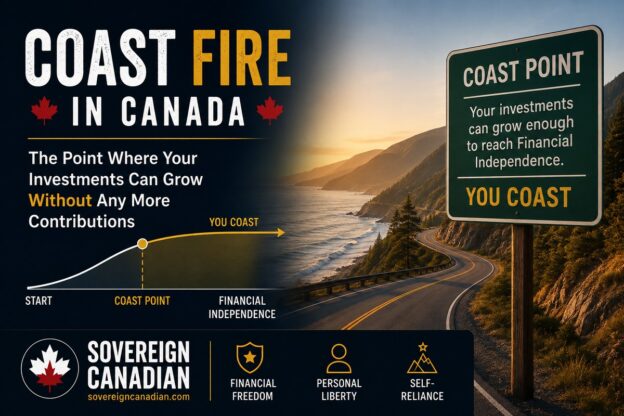
Coast FIRE for Canadians showing retirement savings growing toward financial independence without further contributions

Coast FIRE for Canadians: The Math, the Myths, and Whether It Holds Up Here

I want to start with a confession, because it frames everything that follows. The first time I ran my own Coast FIRE number, I felt something close to relief. A single formula told me I could stop saving aggressively, keep a job I mildly enjoyed, and still retire on schedule. Then I changed one input, the assumed rate of return, from 7 percent to 5 percent, and the number I needed nearly doubled. That is the whole story of Coast FIRE in one sentence: a real, useful idea sitting on top of assumptions most people never stress test.

This is not a piece designed to sell you on Coast FIRE. It is designed to help you understand exactly what it is, where the math is solid, where it quietly cheats, and whether it survives contact with Canadian taxes, Canadian accounts, and a Canadian cost of living. If you finish this and decide Coast FIRE is not for you, I will consider that a good outcome. Clarity is the product here, not enthusiasm.

Continue reading
Reverse mortgages in Canada: costs, compounding debt, estate impact, and alternatives like a HELOC, downsizing, or selling the home

Reverse Mortgages in Canada: The Honest Case Against (and the Narrow Case For)

I’ll tell you where I stand before we start, because you’d figure it out by paragraph three anyway: I think a reverse mortgage in Canada is the wrong product for almost everyone who reads this site, and a genuinely useful one for a small handful of people I can describe precisely.

That’s not the same as saying it’s a scam. It isn’t. It’s a regulated loan from a federally regulated bank, with real consumer protections built in. But it’s an expensive loan wearing the costume of a retirement solution, sold with soft-focus advertising and a celebrity spokesperson, to people who are frightened of running out of money and reassured to hear they can “unlock” their home without selling it.

So let’s do what the brochure won’t. Let’s put the actual mechanics, the actual 2026 rates, and the actual compounding math in daylight, and then figure out the small number of situations where I’d tell a friend to seriously consider one. Educated criticism, not reflexive dismissal.

Continue reading
Canada Pension Plan: What Every Canadian Needs to Know — Sovereign Canadian featured graphic with CPP wooden blocks, Canadian flag, and a $100 bill.

Canada Pension Plan: The 2026 Owner’s Manual

Most Canadians treat the Canada Pension Plan the way they treat the furnace in the basement — they assume it works, they resent the bill, and they never once read the manual. That’s a mistake. The CPP is one of the few pieces of your retirement that is inflation-indexed for life, backed by an $800-billion sovereign fund, actuarially certified to last three-quarters of a century, and — crucially for anyone thinking about how their assets survive contact with creditors, divorce, or a move abroad — structured very differently from the retirement accounts you actually own.

I want to walk through the whole thing the way I’d want it walked through for me: how the money goes in, where it sits, whether it’s actually solvent (spoiler: it’s in far better shape than the American equivalent), what it pays out, when you should turn it on, and what happens to it when you die or when a creditor comes knocking. I’ll default to Ontario for the tax examples, and I’ll flag the figures worth double-checking against the official rate card at publish time, because these numbers move every January.

Let’s read the manual.

Continue reading
Greece real estate investing for Canadians guide - book, investor checklist, and Peloponnese coastal property on a desk

Greece Real Estate Investing for Canadians

Portugal sells you a legal system you already recognize. Greece sells you something else entirely: the lowest entry price left in Western Europe, a government that’s actively courting your capital, and a market that’s still catching up to where Spain and Portugal already are. That’s the trade. You give up some of the polish and predictability, and in exchange you get in earlier, cheaper, and with fewer people ahead of you in line.

If you’ve read the foreign real estate investing pillar post or the Portugal introduction post, you know the drill by now. This is the primer for the Greek arm of the series — the 30,000-foot view before we go deep on Athens, Crete, and the islands in later posts. It won’t make you an expert on Halkidiki versus the Peloponnese. It will get you to the point where you know whether Greece deserves a spot on your shortlist at all, and what you’d need to figure out next if it does.

Continue reading

RRSP Withdrawal Tax Canada: The Golden Handcuffs of Retirement

The Retirement Trap Nobody Warns You About

You were smart. You maxed your RRSP and kept your taxes down. But RRSP withdrawal tax in Canada doesn’t care how disciplined you were on the way in. You can arrive at retirement with a six or seven-figure balance and a tax bill that, in the wrong circumstances, looks worse than the one you were dodging while you worked.

The RRSP itself is not the trap. For most Canadians it is one of the best deals the tax system offers. The trap is building a very large RRSP without ever modelling the other end of the transaction. You optimize the front end, the deduction, and never run the numbers on the back end, where RRIF minimums, CPP, OAS and everything else collide.

I’m in this boat right now. Here’s what I’m seeing.

Continue reading