
Tag Archives: RRSP

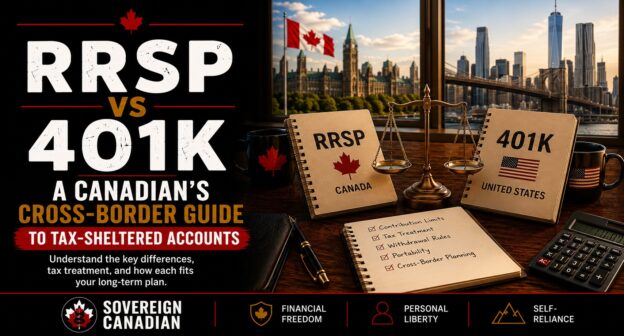
RRSP vs 401k: A Canadian’s Cross-Border Guide to Tax-Sheltered Accounts

You consume a lot of American financial content. So do I. The podcasts, the YouTube channels, the Reddit threads — most of it is US-centric. And most Canadians absorb it without ever asking: does this actually apply to me?

It often doesn’t.

The tax-sheltered account structures in Canada and the US rhyme. But they don’t match. The rules differ. The limits differ. The tax treatment at the border differs. If you’re optimizing your financial life based on American advice without running it through a Canadian filter, you’re leaving money on the table — or worse, making avoidable mistakes.

Here’s the full cross-border breakdown. No fluff.


RRSP vs 401(k): The Retirement Heavyweights

These are the flagship accounts. Both defer tax on contributions. Both grow tax-sheltered. Both get taxed on withdrawal. The architecture is similar. The details are not.

The RRSP (Registered Retirement Savings Plan)

The RRSP is yours. Individual. Not tied to your employer. You open it, you fund it, you control it.

Contributions reduce your taxable income in the year you contribute. Growth inside the account is tax-sheltered. Withdrawals are taxed as income — at whatever rate applies in that year. Contribution room is 18% of your prior year’s earned income, up to a federal annual maximum indexed to inflation. Unused room carries forward indefinitely — this is powerful and underused. The deadline to contribute and deduct is 60 days after year-end. You must convert to a RRIF by December 31 of the year you turn 71.

The RRSP’s superpower is timing. You contribute in high-income years to reduce a high marginal tax rate. You withdraw in lower-income retirement years when your rate is lower. The spread between those two rates is your actual gain. Work that spread intentionally.

Two features Americans don’t have in their 401(k):

The Home Buyers’ Plan (HBP): First-time buyers can withdraw up to $35,000 tax-free from an RRSP to purchase a qualifying home. Must be repaid over 15 years.

The Lifelong Learning Plan (LLP): Withdraw up to $10,000 per year (max $20,000 total) to fund full-time education for yourself or your spouse. Repayment required over time.

The 401(k)

The 401(k) is employer-linked. You access it through your workplace. When you leave, you roll it.

The Traditional 401(k) works on pre-tax contributions, tax-deferred growth, and taxed withdrawals — same basic structure as an RRSP. There’s also a Roth 401(k) option with after-tax contributions and tax-free withdrawals. Contribution limits are significantly higher than the RRSP — the combined employee/employer limit exceeds $60,000 USD annually. Many employers match contributions. Required Minimum Distributions kick in at age 73. Early withdrawal carries a 10% penalty before age 59½.

The employer match is a 401(k) structural advantage Canadians largely don’t have. If an American employer matches 4% of salary and the employee doesn’t contribute enough to capture it, that’s pure negligence. Canadian employers sometimes offer group RRSPs with matching, but it’s less universal and less codified.

FeatureRRSP401(k)
Individual or employerIndividualEmployer-linked
Tax on contributionDeductiblePre-tax (Traditional)
Tax on growthDeferredDeferred
Tax on withdrawalTaxed as incomeTaxed as income
Contribution limit (2024)18% of income, max ~$31,560 CAD$23,000 USD employee; ~$69,000 USD total
Unused room carryforwardYes, indefinitelyNo
Early withdrawal penaltyWithholding tax (no penalty per se)10% before age 59½
Employer matchNot standardCommon
Special provisionsHBP, LLPHardship withdrawals, loans

TFSA vs Roth IRA: Tax-Free Growth, Different Rules

Both accounts let your money grow tax-free. Both allow tax-free withdrawals. They look like twins. They’re not.

The TFSA (Tax-Free Savings Account)

The TFSA launched in 2009. It is one of the best financial tools in Canada and most people use it wrong — as a savings account for a vacation fund rather than as a tax-free investment account holding growth assets.

Contributions are made with after-tax dollars. Growth is completely tax-free. Withdrawals are completely tax-free — and the withdrawn amount is added back to your contribution room the following calendar year. Room accumulates every year you are 18+ and a Canadian resident. Lifetime cumulative room for someone eligible since 2009 is over $95,000. No income requirement — you can contribute even with zero earned income. No conversion deadline. Over-contributions trigger a 1% per month penalty tax — track your room.

The TFSA’s structural edge: room comes back. Withdraw $50,000 this year, you get $50,000 in new room next January 1. The Roth IRA doesn’t work that way.

One trap: the IRS does not recognize the TFSA as a tax-free account. If you’re a US person living in Canada, gains inside your TFSA are fully taxable to the IRS. Painful surprise for dual citizens.

The Roth IRA

After-tax contributions, tax-free growth, tax-free qualified withdrawals. Annual contribution limit is $7,000 USD in 2024 ($8,000 if 50+). Income limits apply — single filers above ~$161,000 USD start to phase out; above ~$240,000 you can’t contribute directly (workaround: the “backdoor Roth”). Contributions (not earnings) can be withdrawn anytime without penalty. No Required Minimum Distributions during the owner’s lifetime.

The Roth’s structural limitation vs the TFSA: the limit is low, the income restriction is real, and the room doesn’t regenerate on withdrawal.

FeatureTFSARoth IRA
Tax on contributionAfter-taxAfter-tax
Tax on growthTax-freeTax-free
Tax on withdrawalTax-freeTax-free (qualified)
Contribution limit (2024)~$7,000 CAD/year$7,000 USD/year
Lifetime room$95,000+ CAD (since 2009)Annual limits stack, no lifetime cap
Income limitNonePhases out at higher incomes
Withdrawal room regenerationYes — next calendar yearNo
RMDsNoneNone (owner’s lifetime)

RESP vs 529: Education Savings

This is where Canada genuinely wins. It’s not close.

The RESP (Registered Education Savings Plan)

Contributions are not tax-deductible. Growth is tax-sheltered. Withdrawals for qualifying education expenses are taxed in the student’s hands — typically near zero given low student income.

The Canada Education Savings Grant (CESG): The federal government contributes 20% on the first $2,500 contributed per year, per beneficiary — a free $500/year, up to a lifetime max of $7,200 per child. Lower-income families qualify for enhanced grants.

The Canada Learning Bond (CLB): Additional federal money for lower-income families — up to $2,000 per child with no contribution required from the family.

Lifetime contribution limit is $50,000 per beneficiary. Plans can stay open for 35 years. If the child doesn’t pursue post-secondary, options include transferring to a sibling, rolling up to $50,000 into your RRSP, or closing the plan with a 20% penalty on growth.

The CESG alone makes the RESP a no-brainer. A guaranteed 20% return on your first $2,500 contributed each year beats almost any investment return you’ll find elsewhere. If you have children and you’re not maxing the CESG annually, you are declining free government money.

The 529 Plan

Contributions are not federally deductible (some states offer state-level deductions). Growth is tax-free federally. Withdrawals are tax-free for qualified education expenses — which now include K-12 tuition, apprenticeship programs, and some student loan repayment. Contribution limits are high — often $300,000–$550,000+ per beneficiary depending on the state. No government matching grant. A recent rule change allows up to $35,000 in unused 529 funds to roll into a Roth IRA for the beneficiary, reducing the sting of over-saving.

FeatureRESP529
Tax deduction on contributionNoNo (federal); some states yes
Tax-free growthYesYes
Tax on withdrawal (education)Taxed in student’s hands (low)Tax-free
Government grantYes — 20% CESG on first $2,500/yrNo
Max government grant$7,200 lifetime per childN/A
Lifetime contribution limit$50,000 per beneficiary$300,000–$550,000+
Flexibility if no post-secondaryTransfer, RRSP rollover, or penaltyRoth rollover or change beneficiary

What Is an IRA?

You hear “IRA” constantly in American financial media. Canadians nod along. Here’s what it actually is.

IRA stands for Individual Retirement Account. It’s the individual, non-employer-linked retirement savings vehicle in the US — the rough Canadian equivalent of the RRSP.

Traditional IRA: Contributions may be tax-deductible depending on income and whether you have a workplace plan. Growth is tax-deferred. Withdrawals taxed as income. Contribution limit is $7,000 USD in 2024 ($8,000 if 50+). RMDs required at age 73. 10% early withdrawal penalty before age 59½.

Roth IRA: After-tax contributions, tax-free growth, tax-free qualified withdrawals. Same contribution limits. Income limits apply. No RMDs during the owner’s lifetime. (Covered in detail above.)

SEP-IRA: For self-employed individuals and small businesses. Contributions up to 25% of compensation or ~$69,000 USD — whichever is less. For self-employed Americans, this is a major tool. The Canadian equivalent would be maximizing RRSP room or, for incorporated business owners, an Individual Pension Plan (IPP).

The RRSP contribution room (18% of earned income, up to ~$31,560 CAD) is more generous for middle-to-high Canadian earners than the flat $7,000 USD IRA limit for Americans without a 401(k). Americans with a workplace 401(k) often run parallel accounts. Canadians typically consolidate in the RRSP unless they have a group plan or pension at work.


The Cross-Border Tax Reality

The Canada-US Tax Treaty matters — and most Canadian financial content ignores it.

RRSP and RRIF balances are recognized by the IRS as tax-deferred for US persons living in Canada, if you file the right elections. The TFSA and RESP are not recognized by the IRS — gains inside these accounts are fully taxable to US persons. 401(k) and IRA balances held by Canadians can often be left in the US or rolled over, but the CRA has specific rules. Withholding tax on cross-border withdrawals applies — typically 15–25% depending on account type and treaty provisions.

If you have cross-border exposure — even just dual citizenship — get a cross-border tax specialist involved. This is not the area to DIY.


The Bottom Line

Canada has strong tax-sheltered infrastructure. The RESP with the CESG beats the 529. The TFSA room regeneration beats the Roth on flexibility. The RRSP carryforward room gives strategic control the 401(k) doesn’t.

What the US has: higher 401(k) limits, employer matching as a cultural norm, and a broader IRA ecosystem with the Roth baked in at the individual level.

The mistake is consuming American financial content as if it’s universally applicable. The architecture rhymes. The details — limits, tax treatment, government grants, cross-border implications — diverge in ways that matter.

Know the system you’re actually operating in. Then use it fully.

That’s sovereignty.


This article is for educational purposes only and does not constitute financial or tax advice. Cross-border situations require advice from a qualified professional.

Advanced RRSP Strategy in Canada,

RRSP Expanded: The Advanced Playbook

If you’re looking for an advanced RRSP strategy in Canada, you’ve probably already figured out the basics aren’t enough…

My last post on RRSPs got some traction — and some pushback.

Good.

That means people are actually thinking about this instead of blindly maxing their contributions every February and waiting for the magic to happen.

I called RRSPs the golden handcuffs of Canadian retirement. I stand by that — for people who never plan beyond the contribution receipt. But here’s the thing: I’ve evolved my thinking. Because the numbers I’ve run on my own situation have shown me something I wasn’t fully accounting for.

A well-managed RRSP — paired with the right strategy — is actually a powerful weapon.

The key word is managed.

And for Canadians executing an advanced RRSP strategy, managed means planned withdrawals, coordinated income, and knowing your exit before you’re forced into one

Let’s get into the advanced playbook.


The Meltdown Strategy: Don’t Wait for the CRA to Force Your Hand

The biggest mistake high-income Canadians make with their RRSP is the same mistake they make with everything else: they procrastinate on the decision until someone else makes it for them.

At 71, the CRA makes it for you. Your RRSP converts to a RRIF. Minimum withdrawals kick in. And if you’ve been a diligent saver your whole career, those forced withdrawals pile on top of CPP, OAS, maybe rental income, maybe business income — and suddenly you’re in a 48% bracket again. Exactly where you were during your working years. Except now you’ve lost the deduction.

The RRSP meltdown strategy flips this. You start drawing down your RRSP intentionally, in years when your income is low, before you’re forced to.

The sweet spot is your 50s and early 60s — especially if you’ve engineered a period of lower personal income.

Here’s where it gets interesting for business owners.


HoldCo + RRSP Meltdown: The Power Combination

If you run a corporation and have retained earnings parked in a HoldCo, you have something most Canadians don’t: control over your personal income in any given year.

The play looks like this.

Your HoldCo is accumulating after-tax business profits. You’re not taking a big salary. Your personal income is low — maybe intentionally so. You’re living off HoldCo distributions structured efficiently, or you’ve simply reduced lifestyle spending for a period.

In those lower-income years? You pull from the RRSP.

You target a specific bracket. Maybe you’re filling up the 26% federal bracket. Maybe you go a bit higher if the math works. You’re paying tax — but at a far lower rate than you would have if you’d waited until your RRIF minimums forced the issue on top of everything else.

Meanwhile, the HoldCo keeps compounding. Cash builds. You’re not touching it. You’ll use it later for other purposes.

The RRSP comes down deliberately. The HoldCo goes up deliberately. You control the tax rate you pay for the rest of your life.

This is what actual financial sovereignty looks like. It’s also the core of any advanced RRSP strategy in Canada that actually holds up under scrutiny.


The Sabbatical and Mini-Retirement Play

Here’s an angle most people never think about.

Your RRSP isn’t just a retirement account. It’s an income bridge.

If you’ve built a meaningful RRSP balance and your HoldCo or investments can sustain operations without your active involvement for a period — you have the option to engineer a year or two of low personal income and pull from the RRSP at low rates while you take that trip, write that book, spend time with your kids while they’re still young, or just decompress.

This isn’t a fantasy. It’s arithmetic.

Say you’ve got $1M–$1.5M in your RRSP at 48. You take a one-year break from active income. Your basic personal amount and lower-bracket space means you could pull $90,000–$110,000 from your RRSP at an effective tax rate well below what you’d pay if you kept that money in until 71 when your income stack is much higher. That withdrawal barely moves the needle on a balance that size — but it funds an entire year of your life.

You funded a year of freedom. And you reduced your future RRIF tax liability at the same time.

This only works if you plan for it. The people who can pull this off are the ones who kept their RRSP and/or HoldCo fat, kept their personal spending under control, and built the optionality years in advance.

Optionality is the whole game.


Spousal RRSP: Income Splitting for People Who Actually Think Ahead

The attribution rules scare most advisors away from properly explaining spousal RRSPs. Let me be direct.

If your spouse earns significantly less than you — or will be in a much lower bracket in retirement — the spousal RRSP is one of the cleanest income-splitting tools available in Canada.

Here’s how it works: you make the contribution (you get the deduction), but the account belongs to your spouse. When they withdraw in retirement, the income is taxed in their hands — at their lower rate.

Two people drawing $60,000 each in retirement pay far less total tax than one person drawing $120,000. Full stop. Canada’s progressive tax system means every dollar you can shift to a lower-income spouse is a dollar taxed at a cheaper rate.

The three-year attribution rule is the thing people stumble on. If your spouse withdraws within three calendar years of your last contribution, CRA attributes that income back to you. Plan around it. Stop contributing to the spousal RRSP at least three years before you expect withdrawals to start.

For the meltdown strategy specifically, this is powerful. If you’re planning to draw down aggressively in your 50s, structure contributions to the spousal account earlier in the decade so the attribution window is clear by the time the tap opens.

What happens at death? The spousal RRSP rollover on death is clean — the account transfers to the surviving spouse tax-free. It only becomes taxable when the second spouse draws it down. For estate planning purposes, a spousal RRSP used deliberately as part of a meltdown strategy means you’re systematically reducing what’s left to be taxed on the final return.

That’s the play: spend it on your terms, at low rates, on your timeline. Don’t leave the CRA a 48% inheritance.


Creditor Protection: The Angle Nobody Talks About

Most conversations about RRSPs focus entirely on taxes. Understandably. But there’s another dimension that matters a great deal if you’re a business owner, self-employed, or in any profession with liability exposure.

After one year of holding, RRSP assets are generally protected from creditors in bankruptcy under the Bankruptcy and Insolvency Act. The one-year rule exists to prevent people from stuffing money in right before a creditor claim. But contributions made in the normal course — years before any financial trouble — are protected.

This is a meaningful consideration.

If you run a business, carry personal guarantees, operate in a litigious industry, or simply understand that life is unpredictable — your RRSP is a protected silo. A creditor cannot reach it. The CRA can (they’re always different), but a business creditor going after your personal assets cannot touch a properly structured RRSP that’s been held for the qualifying period.

Contrast this with a non-registered investment account. That’s fully exposed.

Your RRSP, sitting quietly, growing tax-deferred, and shielded from most creditor claims after year one — that’s not a liability account. That’s a vault.

Practical implication: If you’re in a high-liability profession and you’ve been deprioritizing RRSP contributions in favor of a non-registered account — you may be leaving protection on the table. Run the math. The creditor-protection angle might change the calculus.

Provincial variation matters here. Bankruptcy and Insolvency Act protection is federal, but court judgments outside of bankruptcy can have different rules depending on your province. Ontario, BC, and Alberta have some of the strongest protections. Get specific advice for your province if this is a serious consideration for you.


What the Advanced RRSP Playbook Actually Looks Like

Pull together an advanced RRSP strategy in Canada and here’s what you’re actually building:

Your RRSP is not a passive account you contribute to and forget. It’s one instrument in a coordinated strategy.

You build the HoldCo to retain active cash profits and give you personal income control. You use that control to engineer low-income years. In those years, you execute the RRSP meltdown — withdrawing at low marginal rates, deliberately, on your schedule. You use a spousal RRSP if the income-splitting math makes sense for your household. And through all of this, your RRSP assets sit protected from creditors in a way your non-registered accounts never will be.

The end state: you’ve extracted the RRSP at below-average tax rates, reduced your RRIF exposure at 71, income-split with your spouse, maintained creditor protection throughout, and possibly funded a mini-retirement or sabbatical along the way.

That’s not the golden handcuffs. That’s using the tool correctly.


The Shift in My Thinking

I was genuinely bearish on large RRSPs in my last post. I’ve adjusted.

The problem was never the RRSP itself. The problem is Canadians who treat it as a savings account and never model the exit. When I ran my own numbers — with a proper meltdown timeline, spousal contributions already in place, and HoldCo income management — the picture changed significantly.

A large RRSP, extracted at low rates over 10–15 years, on your timeline, beats waiting for mandatory RRIF minimums to stack on top of everything else.

The math is in your favor if you’re willing to do the planning.

Most people aren’t. Which is either an opportunity for you, or a warning.


Are you building toward controlled withdrawals — or just hoping the tax gods are kind at 71?

The sovereign move is to stop hoping and start modeling.

Let’s hit those RRSP maximums!

RRSP Withdrawal Tax Canada: The Golden Handcuffs of Retirement

The Retirement Trap Nobody Warns You About

You were smart. You maxed your RRSP and kept your taxes down. But RRSP withdrawal tax in Canada doesn’t care how disciplined you were on the way in. Now you’re staring down retirement with a six or seven-figure balance — and a tax bill that might be worse than when you were working.

This is the trap a lot of upper-middle-class Canadians walked into. They optimized for the front end — the deduction — and never ran the numbers on the back end. RRSPs work fine for the average earner. For someone who actually built wealth? They’re a ticking tax clock.

I’m in this boat right now. Here’s what I’m seeing.


The Setup: Why RRSPs Seem So Smart

  • You contribute pre-tax, lowering your income today
  • Investments grow tax-deferred
  • Many employers match contributions — free money
  • You pay tax on withdrawal “in retirement,” when your income should be lower

That logic holds — if your retirement income drops off a cliff. But what if it doesn’t? What if your lifestyle stays high, CPP and OAS add to your income, and your withdrawals push you right back into a top bracket?

What if you end up paying more tax in retirement than you ever saved while working?


The RRSP Withdrawal Tax Canada Doesn’t Advertise: Paying 48% on Money You Saved at 30%

Here’s the gut punch. Say you contributed $20,000 a year during your prime earning years and saved 30% in tax. That’s a $6,000 refund every year — felt good at the time.

Fast forward 25 years. Your RRSP has ballooned to $800,000 or more.

At 71, you’re forced to convert it to a RRIF and start pulling money whether you need it or not. The minimum withdrawal starts at 5.28% at age 71 and climbs every year after that. Those forced withdrawals can push you into the 43%–48% marginal bracket — especially if your spouse has passed and income splitting is off the table.

Then there’s the OAS clawback. In 2025, it kicks in at $90,997 of individual net income. Every dollar above that claws back 15 cents of your Old Age Security. At $148,065, it’s gone entirely. For most high earners, OAS is either gutted or irrelevant.

So you saved $6,000 a year for two decades — and now you’re handing back more than half of every dollar you pull out.

You didn’t beat the system. You deferred the damage.


What’s the Alternative?

If you’re paying attention — and not just nodding along to whoever sits across from you at the bank — you have options. None of these are one-size-fits-all, but all of them put you back in control.

Here’s what I’m running through right now:

TFSA Same market growth. Zero tax on withdrawals. No mandatory minimums. Ideal for dividend income, U.S. growth stocks, or bitcoin ETFs. Completely invisible to OAS and GIS clawback calculations.

Cash Investment Accounts You pay tax on capital gains and dividends — but you control when. Capital gains are taxed at 50% of your marginal rate, and you choose when to trigger them. Canadian dividend income comes with a tax credit that makes it highly efficient in lower brackets. You can also tax-loss harvest when the market hands you an opportunity.

Holding Companies and CCPC Structures If you own a business — even part-time — you can retain earnings inside a Canadian-controlled private corporation. Most provinces tax the first $500,000 of active business income at 11%–12.5%, well below personal rates. Those retained earnings can be deployed into passive income-producing assets. Pay yourself dividends in low-income years and keep your personal tax bill tight.

Smith Maneuver Convert your non-deductible mortgage interest into deductible investment debt while building a personal portfolio. Your home becomes a productive asset — without selling or moving.

RRSP Meltdown Strategy Don’t wait until 71. Intentionally pull RRSP funds in your 50s or early 60s while your income is lower. Pair withdrawals with TFSA top-ups, part-time income years, or periods with heavy deductions. The goal: drain the account gradually at low rates before mandatory RRIF withdrawals force your hand.

Spousal RRSPs When one spouse earns significantly more, the higher earner contributes — but the lower-income spouse withdraws in retirement. Spreads income across two people. Reduces total household tax.

Attribution rule to know: If the lower-income spouse withdraws within three calendar years of a contribution, the income is attributed back to the contributor. Plan contributions at least three years ahead of expected withdrawals.

Hard Assets and Strategic Leverage Own real estate. Hold bitcoin. Build a cash stock portfolio. Then — instead of selling and triggering tax — borrow against those assets.

Borrowed money isn’t taxable income. You keep the upside, maintain your portfolio, and access liquidity when you need it. Real estate and blue-chip equities can be collateralized through margin loans or secured lines of credit. Even bitcoin — though volatility means sizing matters.

This is how serious wealth stays intact: own appreciating assets, use leverage to spend without selling.

You can’t do any of that with an RRSP.


What Happens When You Die?

If you die with a large RRSP and no surviving spouse, the entire balance is treated as income in your final tax year. That can mean 48%+ goes straight to the CRA.

A spouse designated as beneficiary can receive the account tax-free — but when the second spouse passes, the same rule applies. Full income inclusion. Large tax bill for the estate.

Spousal RRSPs don’t solve this — they only delay it. The answer is keeping RRSP balances modest and planning your drawdown well before the government forces it.


Living Abroad with a RRIF

Moving abroad doesn’t make your RRIF disappear — it just creates new complexity.

Canada applies a 25% withholding tax on RRIF withdrawals for non-residents. Tax treaties can reduce that, often to 15%.

Favorable jurisdictions:

  • Portugal – Often no local tax; 15% Canadian withholding under treaty
  • Mexico – 15% withholding; moderate local inclusion rules
  • Thailand – Often no local tax if offshore income is delayed 1+ year
  • Panama – No local tax on foreign-source income

Less favorable:

  • France – High double taxation risk; no special treaty provisions
  • Germany – May require full income inclusion and reporting
  • Japan – Strict global income rules

Before you relocate, get a cross-border tax advisor to map exactly how your RRIF will be treated.


Don’t Just Contribute — Calculate

Employer match your RRSP? Take the free money. Full stop. Beyond that, start modeling.

  • What bracket will you be in when you withdraw?
  • What happens if you retire early — or move abroad?
  • What does the tax bill look like if you die with a large balance?

Want to run the numbers? Start here: 🔗 Wealthsimple RRSP vs. TFSA Calculator

The sovereign move isn’t to panic. It’s to plan. Run the numbers. Own the outcome.

See more Advanced RRSP Strategy in Canada.


Are you optimizing your future — or just delaying the damage? Drop your scenario in the comments. I’ll share my own modeling in a follow-up post.