Tag Archives: Government

The Canada Medical Expense Tax Credit – How to claim

The CRA Is Letting You Leave Money on the Table — Here’s How to Stop It with the Canada Medical Expense Tax Credit.

Most Canadians file their taxes, take the standard deductions they know about, and move on. They assume if it mattered, their accountant would have caught it. They’re wrong — and the Canada Medical Expense Tax Credit is one of the most consistently overlooked credits in the entire Income Tax Act.

This isn’t a loophole. It’s not complicated. The CRA publishes the rules in plain language. But because it requires a bit of organization and strategic thinking, most people either skip it or massively underuse it. That’s money you’ve already spent — sitting unclaimed.

Here’s how to get it back.


What the Medical Expense Tax Credit Actually Is

The Canada Medical Expense Tax Credit (METC) is a non-refundable federal tax credit on lines 33099 and 33199 of your return. It reduces the federal income tax you owe at a flat 15% rate. Most provinces stack their own parallel credit on top of it.

Non-refundable means it reduces your tax payable — it won’t generate a refund beyond what you’ve already paid. But if you have any tax liability at all, this credit directly reduces it dollar for dollar.


The Threshold — And Why the Claimant Matters

You don’t get to claim every dollar of medical expenses. The CRA applies a threshold — the lesser of:

  • 3% of the claimant’s net income (line 23600), or
  • $2,759 (the 2024 fixed ceiling, indexed annually)

Only expenses above that threshold qualify. The credit is then calculated at 15% on the excess.

Here’s the math: if your threshold is $1,500 and you have $4,000 in eligible expenses, you’re claiming $2,500 — generating a $375 federal credit. That’s before provincial. Not life-changing on its own, but stacked over multiple years with a family’s worth of expenses? That’s real money.

Now here’s the part most people miss: the 3% is based on the claimant’s net income — not household income. Which means who claims these expenses matters enormously.

If your household income is $280,000 combined, you don’t split the expenses. You run the calculation on each spouse individually and put the claim on the lower-income partner’s return. Their 3% threshold is smaller. More of your total family expenses clear the floor.

A household with one spouse at $230,000 and one at $50,000: the higher earner hits the $2,759 fixed cap. The lower earner’s threshold is just $1,500. Same pool of expenses — but claimed under the lower earner, you get $1,259 more into the claimable column. That’s a difference of roughly $190 in federal credit on that spread alone, every single year.


Who Can You Claim For

You can pool eligible medical expenses paid on behalf of:

  • Yourself
  • Your spouse or common-law partner
  • Your dependent children born in 2006 or later

All of the above go on Line 33099 of your return.

For other dependants — parents, grandparents, adult children, siblings — those are claimed separately on Line 33199, with the threshold recalculated against their individual net income. If an elderly parent has low income, the threshold against their expenses can be very small, making almost the entire expense pool claimable.

See: Lines 33099 and 33199 — CRA filing instructions


What Counts as an Eligible Medical Expense

The list is longer than you think. Here’s what qualifies for the Canada Medical Expense Tax Credit:

Medical and hospital: prescription drugs and medications, physician and specialist fees, hospital care (including private room premiums), surgery, anaesthesia, diagnostic tests like MRIs and bloodwork, medical devices including CPAP machines and insulin pumps, hearing aids and batteries, eyeglasses and contact lenses, laser eye surgery, fertility treatments including IVF, ambulance fees, and attendant care for disability support.

Dental: fillings, crowns, extractions, orthodontics including braces, periodontal treatment, dentures and implants, root canals, and oral surgery. Routine teeth whitening and purely cosmetic procedures don’t qualify.

Paramedical practitioners: chiropractors, physiotherapists, psychologists and psychotherapists, occupational therapists, speech-language pathologists, naturopaths, acupuncturists, registered massage therapists, and dietitians — but only if they are licensed or regulated under provincial law. This is a hard requirement. An RMT in Ontario is regulated and eligible. An unlicensed practitioner in a province without regulatory oversight is not. Know the rules in your province.

What doesn’t count: gym memberships, cosmetic procedures, over-the-counter vitamins, teeth whitening, and private health insurance premiums paid personally.

See: CRA Guide RC4065 — Medical Expenses


Your Benefits Plan Doesn’t Disqualify the Rest

If your employer’s group benefits covered part of a procedure, you don’t lose the credit entirely. You claim the out-of-pocket portion only — the amount you personally paid after reimbursement.

A $500 dental procedure where your benefits paid $350 means you’re claiming $150. Simple. Keep your Explanation of Benefits statements from your insurer alongside your receipts. If the CRA reviews your claim, they’ll want both.

What you cannot do is claim any portion that was or will be reimbursed — even if the reimbursement lands in a different tax year.


The 12-Month Window Most Canadians Don’t Use

This is where it gets interesting. The CRA does not require you to claim medical expenses on a strict January–December calendar year basis. You may claim any consecutive 12-month period that ends in the tax year you’re filing.

When filing your 2024 return, your claim window could be:

  • February 1, 2023 – January 31, 2024
  • July 1, 2023 – June 30, 2024
  • November 1, 2023 – October 31, 2024

Or any other 12-month stretch that ends in 2024.

Why does this matter? Timing. Medical expenses aren’t evenly distributed. A major surgery in November 2023 with significant follow-up costs running into early 2024 — claimed on a strict calendar year basis — could end up split across two returns, with neither year clearing the threshold on its own. Shift the window to pull them together and you potentially convert two non-qualifying years into one substantial claim.

The constraint: each receipt can only appear in one claim period. You can’t double-count.


You Can Go Back 10 Years

If you’ve been leaving this credit unclaimed — or claimed it poorly — you’re not out of luck. The CRA allows adjustments to prior returns via a T1 Adjustment (Form T1-ADJ) going back 10 years. In 2025, that means as far back as 2015.

The fastest route is through My Account on the CRA website using the “Change my return” function. Online adjustments typically process in a few weeks. Paper takes longer.

You’ll need your receipts and EOB statements. Organize them first — trying to claim without documentation is a waste of everyone’s time.

If you’re a high-income earner with a family and haven’t been claiming this systematically, a few hours with an accountant working through the last three to five years could generate a meaningful recovery. The fee pays for itself quickly.

See: CRA — how to change a prior year return


The Move

Stop treating your tax return as a form to fill out and start treating it as a financial optimization exercise. The METC isn’t exotic — it’s built into the system, published by the CRA, and available to anyone who takes thirty minutes to organize their receipts and run the numbers.

Identify the lower-income spouse. Collect all receipts and EOBs. Map out your expenses over time and find the optimal 12-month windows. Then file — or refile.

The government isn’t going to remind you. That’s your job. Use the Canada Medical Expense Tax Credit!

Liberals Spring Economic Update 2026

The Carney government tabled its 2026 spring economic update today. The headlines are friendly. The math is messier. Here’s what’s in it — and what a sovereign Canadian should actually do about it.

BY SOVEREIGN CANADIAN·APRIL 28, 2026·10 MIN READ

The Short Version

The Liberals walked into the House of Commons today carrying what they called “good news.” Finance Minister François-Philippe Champagne tabled the Spring Economic Update 2026 — Carney’s first since flipping the budget calendar and moving the main budget to fall. The backdrop is chaotic: a U.S.-Israel war on Iran has choked off the Strait of Hormuz, oil prices are surging, the trade war with the United States is still grinding, and Carney now has a majority government after sweeping three April byelections. He’s not asking permission anymore.

The headline: the deficit is coming in lower than projected. The fine print: it’s still a deficit. And they’re already planning to spend the savings before you can blink.

KEY MEASURES AT A GLANCE

  • Deficit for 2025-26 projected to come in well below the $78.3B forecast
  • Canada Strong Fund — a new $25B sovereign wealth fund for “nation-building”
  • Federal fuel excise tax paused until Labour Day (saving ~10¢/litre on gas, 4¢/litre on diesel) at a cost of $2.4B
  • GST benefit boost for lower-income households, landing in June
  • One-time grocery benefit arriving in July
  • Foreign direct investment outpacing all other G7 economies (per Carney)
  • Non-U.S. exports up significantly, with trade diversification accelerating
  • Bank of Canada rate decision due tomorrow (currently 2.25%)

The Fiscal Picture: Better Than Projected, Worse Than You Think

Let’s start with the number everyone’s watching. Carney’s November budget projected a deficit of $78.3 billion for the fiscal year that just ended March 31. The fiscal monitor through February showed the deficit sitting at $25.5 billion over the first eleven months — well below the trajectory. March typically blows up the number, but even accounting for that, most analysts expect the final figure to land materially lower than the $78.3B projection.

Carney called this proof that his team are “good fiscal managers.” The opposition called it a lucky break from surging oil revenues tied to the Iran conflict. Both things can be true.

ORIGINAL DEFICIT PROJECTION (2025-26)

$78.3B

Carney’s Nov. 2025 budget forecast

DEFICIT THROUGH FEB 2026

$25.5B

11 months of 12 — well ahead of pace

PROJECTED ANNUAL DEFICIT (5-YR AVG)

$64B

Declining from 2025 budget horizon

CANADA STRONG FUND

$25B

Initial federal contribution — new sovereign wealth fund

What didn’t happen: any credible path to a balanced budget. Poilievre demanded Carney cap the 2026-27 deficit at $31 billion and present a balanced budget timeline. He didn’t get it. The Conservatives are screaming “credit card budgeting.” The Liberals are calling it nation-building. You’re paying interest on all of it either way.

“We were determined to get spending down with a lot of very difficult decisions. You can’t do everything at the same time.”— PM MARK CARNEY, APRIL 27, 2026


The Canada Strong Fund: Sovereign Wealth or Political Slush Fund?

The marquee announcement dropped yesterday, one day before the update: Canada now has its first sovereign wealth fund. The Canada Strong Fund launches with a $25 billion federal endowment. It will invest alongside the private sector in nation-building projects — ports, mines, LNG, critical minerals, trade corridors, energy infrastructure. There’s also a retail investment product planned so everyday Canadians can buy in directly.

Sounds compelling. But there are legitimate questions here that don’t have answers yet.

Norway’s Government Pension Fund — the model everyone cites — is funded by oil surpluses, not borrowed money. The Liberals are launching this fund while running a nine-figure deficit. One economist from the MEI put it bluntly: a sovereign wealth fund should be funded by budgetary surplus, not debt. When the fund makes returns, great. When it doesn’t, Canadian taxpayers absorb it.

The governance structure is also still being designed. “Further details to follow in the coming months” is not a business plan. Fifteen major projects have been referred to the Major Projects Office since September 2025, representing over $126 billion in investments. LNG, nuclear, nickel, graphite, tungsten, transportation infrastructure — these are real assets with real potential. But government-directed capital allocation has a long history of political interference crowding out better private decisions.

Watch this closely. The concept is sound. The execution will determine whether this is Norway’s oil fund or Ontario’s Hydro One. History is not kind to the latter.


Affordability Measures: Relief You’ll Feel, Costs You Won’t See

The Liberals came with a bag of immediate relief items. The federal excise tax on gas and diesel is paused until Labour Day. That’s roughly 10 cents a litre on gasoline saved at the pump. At $2.4 billion in foregone revenue, it’s real money — and it’s the right move given that oil market chaos from the Iran war is squeezing Canadians at the pump.

Also announced: a GST benefit boost for lower-income households landing in June, and a one-time grocery benefit arriving in July. These are targeted at the bottom of the income distribution, which is where the pain is most acute.

Here’s the tension. Every dollar of relief announced is a dollar added back to the deficit — or subtracted from the “better than expected” fiscal position Carney is touting. Champagne acknowledged that “volatility is omnipresent.” He’s not wrong. But you can’t cut the deficit and spend the savings simultaneously. The Liberals are trying to do both, and the update essentially confirms it.


The Macro Backdrop: War, Tariffs, and Trade Rewiring

Context matters. The global economy is in the middle of a significant shock. The U.S.-Israel military action against Iran has effectively choked oil exports through the Strait of Hormuz. Canada is a net energy exporter — that means higher oil prices are a revenue windfall for Alberta and the federal government, even as they punish consumers at the pump. Crude near $100/barrel is the kind of fiscal tailwind that makes deficit numbers look better than the underlying spending discipline would justify.

On the trade front, the U.S. tariff war has accelerated Canada’s export diversification. Non-U.S. exports rose 11.2% in 2025. Canada’s merchandise exports to countries outside the U.S. were 10.9% higher in the second half of 2025 compared to the first. Energy exports to countries other than the U.S. rose 22.3% to $28.8 billion. That is real structural progress, though it started from a high base of U.S. dependence and has a long way to go.

Foreign direct investment into Canada is reportedly outpacing all other major economies — Carney’s framing. The Desjardins take is more measured: Canada remains one of the “cleanest fiscal dirty shirts” among advanced economies, which is a diplomatic way of saying we’re less bad, not actually good. There’s no credit downgrade imminent, but the fiscal trajectory isn’t something to celebrate.

GDP growth was 1.7% for 2025. The slowest since COVID. The Bank of Canada is holding at 2.25%. Business confidence is low. Private sector employment is declining in early 2026. These are not the numbers of a booming economy. They’re the numbers of an economy holding on while the world rearranges itself around it.


What This Means If You’re Building Sovereign Wealth

THE REAL TAKEAWAY

Forget the political theatre. Here’s what this update actually tells you about the environment you’re operating in.

The fuel tax cut is real money in your pocket — but temporary. If you drive for business, own vehicles, manage logistics, or run any operation with fuel costs, Labour Day is your deadline. Plan around it. Use the savings now; don’t build your financial model around them persisting.

Oil is the new X factor. If you hold Canadian energy stocks, REITs with Alberta exposure, or commodities — the Strait of Hormuz situation is your most important variable right now, not the federal budget. The fiscal tailwind for Ottawa comes directly from your fuel bills. This is wealth transfer in real time.

The Canada Strong Fund is worth watching as an investor. If a retail product launches that lets individual Canadians co-invest in LNG terminals, transmission corridors, and critical mineral projects — that is a genuinely interesting asset class. It’s not a registered account trick. It could be real infrastructure exposure at scale. Wait for the design details before getting excited. But don’t dismiss it because Liberals announced it.

Deficits at this scale are inflationary pressure, slowly. Inflation is currently within target (1-3%) — Carney is right about that. But structural deficits averaging $64 billion annually are a long-term currency debasement story. If you’re holding large amounts in Canadian dollars, or long-duration Canadian fixed income, understand what you own. Hard assetsincome-producing real estate, and globally diversified equity are your hedge.

The trade diversification is actually the most important story. Nobody in the media is leading with this, but Canada rewiring its export relationships — less U.S., more Europe, Asia, and emerging markets — is the single biggest structural shift happening in the Canadian economy right now. For business owners, this is a decade-long tailwind if you position into it. For investors, watch the sectors benefiting: LNG, potash, uranium, gold, aluminum.

A majority government changes the legislative risk environment. Carney doesn’t need anyone’s permission anymore. Capital gains inclusion rates, housing policy, investment rules, resource regulations — all of it can move faster. Stay close to what’s coming in the Fall 2026 budget. That’s when the real policy agenda arrives.

SOVEREIGN CANADIAN TAKE

The Liberals walked in today with a smaller deficit and a bag of relief measures. The media will call it a good day for Carney. Maybe it is.

But here’s what doesn’t change: the government spent $25 billion on a wealth fund it doesn’t technically have. It borrowed to cut your gas tax. It projected $64 billion deficits for the next five years. It handed out GST cheques and grocery benefits funded by oil revenues that could evaporate the moment the Strait of Hormuz reopens.

This is not a government that trusts you to manage your own money better than they can. Every benefit, every fund, every cheque is a dependency mechanism. The sovereign move is to note where they’re spending, get out of the way of the opportunity it creates, and build financial structures that don’t require Ottawa’s permission to sustain your family.

The fund you actually control is more powerful than anything Champagne tabled today.


The question isn’t whether the Liberals had a good fiscal day. The question is: what are you doing with the information? The macro environment is clear. The policy direction is known. What’s your move?


Canada Strong Fund: An Introduction

The Canada Strong Fund is Canada’s first sovereign wealth fund — and it just launched. What It Is, What Gets Built, and How You Invest

Carney made the Canada Strong Fund announcement on April 27, 2026, the day before his government’s Spring Economic Update. The fund is designed to give all Canadians a direct stake in the Build Canada agenda, with a mandate to achieve commercial returns and build the wealth of Canada.

Big words. Let’s cut through them.


What the Canada Strong Fund Actually Is

The government seeds the fund with $25 billion over 3 years on a cash basis. That’s the starting capital. The fund grows through investment returns and asset recycling — gains get reinvested rather than spent, and additional government assets can flow in over time. Canada Strong Fund — Official Government Backgrounder

It operates at arm’s length as a new Crown corporation, guided by a CEO and a qualified independent board of directors. Think CPPIB, not a ministerial slush fund. That’s the stated model. Whether it holds to that standard is what you watch for.

The mandate is straightforward: invest in strategic Canadian projects and companies alongside private investors, focused primarily on equity, with a goal of delivering market-rate returns.


What Gets Built: The Canada Strong Fund Project Pipeline

This is where it gets interesting for anyone who actually cares about Canada’s economic backbone.

Since September 2025, 15 projects have been referred and six transformative strategies are in development by the Major Projects Office. The sectors: nuclear, LNG, critical minerals — nickel, graphite, and tungsten — and transportation infrastructure.

The Canada Strong Fund targets major Canadian industrial projects across energy, infrastructure, mining, agriculture, and technology.

Read that list again. Nuclear. LNG. Critical minerals. Transportation. These are the hard assets that create durable national wealth. Not apps. Not subsidies. Real stuff in the ground and in the grid.

Carney’s framing is historically accurate — transformative projects like the CPR, the oil sands, and the Trans-Canada built generational wealth. The question is whether this fund replicates that discipline or becomes a vehicle for politically convenient pet projects.

The Major Projects Office is the gatekeeper. They’re processing the pipeline of candidates, and the government is assessing projects for potential designation under the Building Canada Act, which fast-tracks regulatory approvals. That matters — regulatory gridlock has killed more Canadian resource projects than any shortage of capital ever has.


The Canada Dividend: The Part Nobody’s Talking About Enough

Here’s where it gets philosophically interesting.

Norway’s Government Pension Fund — the gold standard globally — distributes wealth back to citizens over time. Alaska does it annually through the Permanent Fund Dividend. Every Alaskan gets a cheque from oil revenues. Every year. Full stop.

Canada is gesturing in that direction. The government will launch a retail investment product, giving Canadians a direct stake in the nation’s long-term prosperity and a share in the returns.

The key phrase: share in the returns. That’s the Canada Dividend concept, even if they’re not calling it that yet.

The details are still being designed through consultation over the coming months, with additional specifics expected in the Spring Economic Update 2026. What we know conceptually is promising: as the Canada Strong Fund succeeds, investors share in the upside while their initial invested capital is protected.

Principal protection plus upside participation. If that holds, it’s a genuinely interesting instrument.


How Individual Canadians Can Invest in the Canada Strong Fund

This is the part that should matter most to readers of this site. And I’m watching this closely to see if it is a good addition to my RRSP and other investing.

The government will offer Canadians the opportunity to participate directly through a new retail investment product — broadly accessible coast to coast, easy and simple to purchase, hold, and transact.

Carney compared it to a government bond where the initial investment is protected. Think: government-backed capital protection plus direct exposure to the upside of major Canadian industrial projects.

Here’s how to think about it as a sovereign-minded individual investor:

What’s potentially good: Direct exposure to the asset class that has historically built real wealth in this country — energy, infrastructure, critical minerals. Not through some mutual fund with a 2.5% MER skimming your returns. Direct participation. And if principal protection is real, your downside is bounded.

What you need to watch: Design details haven’t been released. “Principal protected” can mean a lot of things. Is it inflation-adjusted? What’s the lock-up period? What fees are buried in the structure? How do you exit? A bond-like structure that protects nominal dollars but erodes purchasing power in a 3% inflation environment isn’t actually protecting you.

The deeper question: Is this RRSP/TFSA eligible? If yes, this becomes a genuinely interesting domestic asset class for investors who want to stop exporting capital to US equities. If no, the tax drag changes the calculus considerably.

None of that is answered yet. The Transition Office will consult on these specifics over the coming months.


The Honest Skepticism

Poilievre’s critique isn’t wrong on its face. Canada is running a projected $78-billion deficit — countries need wealth to have a wealth fund, and this is effectively sovereign debt being recycled into equity investments.

That’s a real tension. Norway built its fund from oil surplus revenues. Canada is building this from borrowed money. The math only works if investments generate returns above the cost of that debt. The C.D. Howe Institute made exactly that point — the fund needs to outperform its financing costs just to break even.

That’s not impossible. But it’s a tighter rope than the announcement language suggests. You need the fund generating 7–9% real returns while financing debt at 4–5% and clearing fees and operational overhead. That requires a genuinely skilled investment team executing equity deals in complex infrastructure. The CPPIB does it. Not every Crown corporation does.


What This Means for the Sovereign-Minded Canadian

The Canada Strong Fund is the most interesting structural development in Canadian finance in a generation. The concept is right — pool national capital, deploy it into hard assets, and create a mechanism for ordinary Canadians to participate in their country’s resource and infrastructure wealth.

The execution will determine everything.

Watch the Spring Economic Update for structural detail. Watch the Transition Office consultation — that’s where the retail product gets designed. And watch which specific projects get funded in the first wave. That tells you whether this is a genuine commercial vehicle or a political instrument wearing a financial suit.

Canada has been exporting its resource wealth for a century. The question was always whether we’d build institutions to capture a bigger share of that value domestically. This is an attempt to answer that question.

Whether it succeeds depends on whether the arm’s-length structure holds under political pressure, whether the investment team is genuinely world-class, and whether the retail product is designed for Canadian savers — not Canadian optics.

Stay tuned. More detail will follow.

Are you considering putting money into the Canada Strong Fund when the retail product launches? Drop it in the comments.

Sources & Further Reading

  1. Canada Strong Fund — Official Government Backgrounder
  2. PM Carney’s Announcement — Prime Minister of Canada
  3. CBC News — Carney announces Canada’s first sovereign wealth fund
  4. BNN Bloomberg — Canada Strong Fund analysis

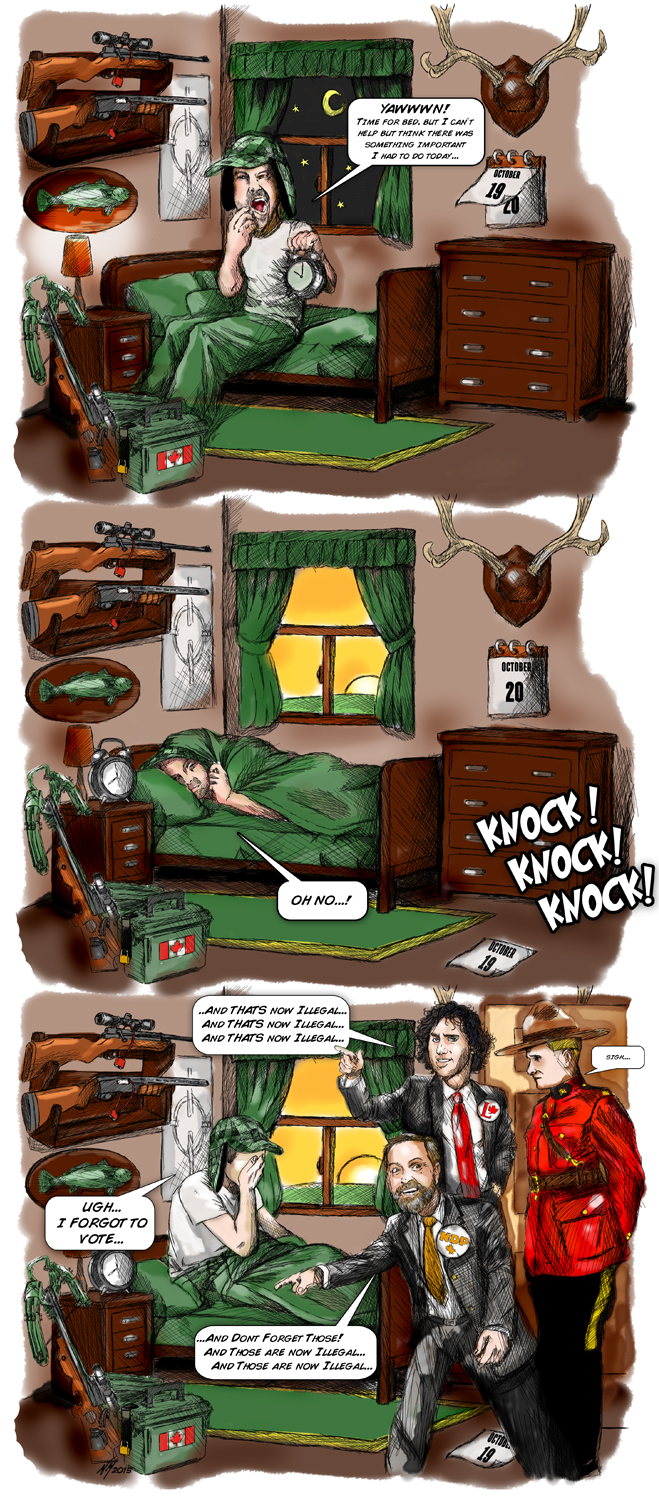
Do the Liberals and NDP want to Steal our Guns?

I am was actively trying to stay out of the federal election political shit storm.

But then I see the Facebook posts about what Mulcair and Trudeau have to say about firearms.
Some of it is true and some of it is shock-media fear mongering.
There is, however, some definite truth to the hype of them bringing back the gun registry.
Though it may be old, I was forwarded this article in the National Post about Mulcair’s plans: NDP government would create new and improved gun registry

Sure it’s an election cycle and all of these ineffective talking heads have to have talking points and promises to lie about.
But nothing scares me more than allowing any more room for commies, socialists, pinkos, regressive ‘progressives’, antis of any sort, and Turdeau’s Libertarded army.

Below is a great cartoon I found on Right Wing Nation, but I think it originated from the NFA (a cluster fpuck of an organization and has circle jerked itself into ineffectiveness right before one of the most important elections in Canada regarding firearms rights).

Enjoy.  Be on the look out for the Beardo and the Kid.

You could wake up with the NDP and/or Liberals wanting to steal your guns

You could wake up with the NDP and/or Liberals wanting to steal your guns

Worst thing to happen to Ontario since forever

Ontario Provincial Election

Some thoughts on the upcoming Ontario Provincial Election

Well first, being a current BC resident I want to say “I don’t care”. But that would be a mistake for so many reasons.  First, I grew up in rural Ontario and have many friends and family there.  They have suffered enough and don’t deserver to have any more of this Liberaltatorship. Life is much too short to waste it following provincial politics – but you would have to be living under a rock to not hear how badly things have been going in Ontario. It seems that every week in Ontario there is a new scandal, fiasco, or  generally inept handling of what should be a routine task. Some of the topics of interest:

Continue reading

High River, the “Abolished” Long Gun Registry & the CFP

So, what are we Canadians supposed to think?  What are we to make of the recent developments regarding the so-called “abolished” Long Gun Registry, the smashing of personal liberty in High River, AB and the Canadian Firearms Program (CFP which is administered by the RCMP) nearly criminalizing thousands of legitimate gun owners with the stroke of a pen?

In my humble opinion, something smells bad…really bad.  Not so unusual though, it is emanating from Ottawa, the headquarters of Canadian bureaucracy.  Consider this term “Bureaucratic Dictatorship”…look it up and tell me you don’t see the makings of a disaster.

Continue reading

Federal Government Bans Incandescent Bulbs

The Canadian Federal Government Bans Incandescent Bulbs

Starting 01 January 2014, there is a ban on standard incandescent light bulbs with an output of 75W and 100W.  I had totally forgotten about this, since the discussions were seven years ago.  But now I see that this is still set to take effect in the new year.  40W and 60W are set to be off the shelves by the end of 2014.

The goal is to displace the use of incandescent bulbs with the more expensive compact fluorescent CFL bulbs.  This is still the direction that they are going, even though there is still much controversy on their efficiency claims, bulb life expectancy, and disposal concerns (these bulbs contain Mercury).

Personally, I feel there is a place in the house for both CFL bulbs and traditional incandescent.  I’m not an opponent of energy efficiency or protecting the environment.  But sometimes we are blind by trying to optimize for only one variable.

My go-to source for information on this has been a recent Globe & Mail Article:  Federal Incandescent Light Bulb Ban Set to Start in New Year

Continue reading

Ron Paul Videos

Collection of Ron Paul Videos

As Canadians, we don’t usually look to the USA for political or economic advise – especially these days with the turmoil going on there.  But there is an Exception: Dr. Ron Paul.

Dr. Paul is a Republican, but not a big government Republican like the rest of them.  He is an opponent of big gov, fascism,  corporatism, income tax, and foreign military intervention.  In this way, we are on the same page regarding politics: Less is More.

Hear is a collection of my favourite Ron Paul Videos:

Continue reading

Consumer Nutrition Responsibility

I recently answered some questions on a survey for the Canadian Government about Consumer Nutrition, Food Labelling, and what they can do to help.

The survey was poorly laid out for most consumers to actually answer; Questions were unclear and the survey was too long.  It likely cost us a lot of money to put on though, no doubt.

I thought I would share some of my answers which reflect my opinions on consumer nutrition responsibility and food labelling requirements.

Continue reading

In the News: US Government Shutdown

Today we are all reading about the US government shutdown.

Should we in Canada care?  Does it affect us?

Well yes and no.  It doesn’t really affect you (unless you’re travelling to a national park) – but it is good to pay a bit of attention to it.

But in reality it is interesting to see how this is playing out, the causes, and the effects.  It is really coming off as a bit of a child’s game.

Continue reading