
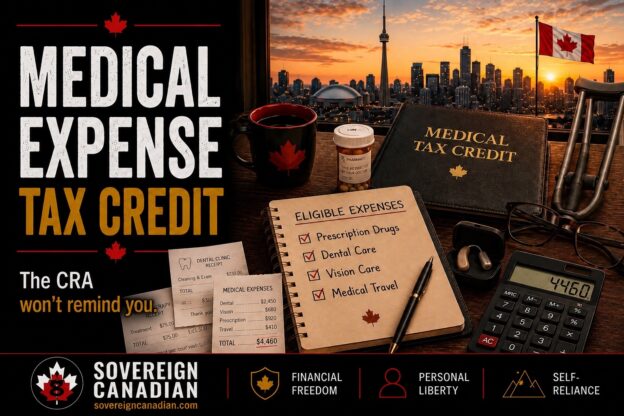
The CRA Is Letting You Leave Money on the Table — Here’s How to Stop It with the Canada Medical Expense Tax Credit.
Most Canadians file their taxes, take the standard deductions they know about, and move on. They assume if it mattered, their accountant would have caught it. They’re wrong — and the Canada Medical Expense Tax Credit is one of the most consistently overlooked credits in the entire Income Tax Act.
This isn’t a loophole. It’s not complicated. The CRA publishes the rules in plain language. But because it requires a bit of organization and strategic thinking, most people either skip it or massively underuse it. That’s money you’ve already spent — sitting unclaimed.
Here’s how to get it back.
What the Medical Expense Tax Credit Actually Is
The Canada Medical Expense Tax Credit (METC) is a non-refundable federal tax credit on lines 33099 and 33199 of your return. It reduces the federal income tax you owe at a flat 15% rate. Most provinces stack their own parallel credit on top of it.
Non-refundable means it reduces your tax payable — it won’t generate a refund beyond what you’ve already paid. But if you have any tax liability at all, this credit directly reduces it dollar for dollar.
The Threshold — And Why the Claimant Matters
You don’t get to claim every dollar of medical expenses. The CRA applies a threshold — the lesser of:
- 3% of the claimant’s net income (line 23600), or
- $2,759 (the 2024 fixed ceiling, indexed annually)
Only expenses above that threshold qualify. The credit is then calculated at 15% on the excess.
Here’s the math: if your threshold is $1,500 and you have $4,000 in eligible expenses, you’re claiming $2,500 — generating a $375 federal credit. That’s before provincial. Not life-changing on its own, but stacked over multiple years with a family’s worth of expenses? That’s real money.
Now here’s the part most people miss: the 3% is based on the claimant’s net income — not household income. Which means who claims these expenses matters enormously.
If your household income is $280,000 combined, you don’t split the expenses. You run the calculation on each spouse individually and put the claim on the lower-income partner’s return. Their 3% threshold is smaller. More of your total family expenses clear the floor.
A household with one spouse at $230,000 and one at $50,000: the higher earner hits the $2,759 fixed cap. The lower earner’s threshold is just $1,500. Same pool of expenses — but claimed under the lower earner, you get $1,259 more into the claimable column. That’s a difference of roughly $190 in federal credit on that spread alone, every single year.
Who Can You Claim For
You can pool eligible medical expenses paid on behalf of:
- Yourself
- Your spouse or common-law partner
- Your dependent children born in 2006 or later
All of the above go on Line 33099 of your return.
For other dependants — parents, grandparents, adult children, siblings — those are claimed separately on Line 33199, with the threshold recalculated against their individual net income. If an elderly parent has low income, the threshold against their expenses can be very small, making almost the entire expense pool claimable.
See: Lines 33099 and 33199 — CRA filing instructions
What Counts as an Eligible Medical Expense
The list is longer than you think. Here’s what qualifies for the Canada Medical Expense Tax Credit:
Medical and hospital: prescription drugs and medications, physician and specialist fees, hospital care (including private room premiums), surgery, anaesthesia, diagnostic tests like MRIs and bloodwork, medical devices including CPAP machines and insulin pumps, hearing aids and batteries, eyeglasses and contact lenses, laser eye surgery, fertility treatments including IVF, ambulance fees, and attendant care for disability support.
Dental: fillings, crowns, extractions, orthodontics including braces, periodontal treatment, dentures and implants, root canals, and oral surgery. Routine teeth whitening and purely cosmetic procedures don’t qualify.
Paramedical practitioners: chiropractors, physiotherapists, psychologists and psychotherapists, occupational therapists, speech-language pathologists, naturopaths, acupuncturists, registered massage therapists, and dietitians — but only if they are licensed or regulated under provincial law. This is a hard requirement. An RMT in Ontario is regulated and eligible. An unlicensed practitioner in a province without regulatory oversight is not. Know the rules in your province.
What doesn’t count: gym memberships, cosmetic procedures, over-the-counter vitamins, teeth whitening, and private health insurance premiums paid personally.
See: CRA Guide RC4065 — Medical Expenses
Your Benefits Plan Doesn’t Disqualify the Rest
If your employer’s group benefits covered part of a procedure, you don’t lose the credit entirely. You claim the out-of-pocket portion only — the amount you personally paid after reimbursement.
A $500 dental procedure where your benefits paid $350 means you’re claiming $150. Simple. Keep your Explanation of Benefits statements from your insurer alongside your receipts. If the CRA reviews your claim, they’ll want both.
What you cannot do is claim any portion that was or will be reimbursed — even if the reimbursement lands in a different tax year.
The 12-Month Window Most Canadians Don’t Use
This is where it gets interesting. The CRA does not require you to claim medical expenses on a strict January–December calendar year basis. You may claim any consecutive 12-month period that ends in the tax year you’re filing.
When filing your 2024 return, your claim window could be:
- February 1, 2023 – January 31, 2024
- July 1, 2023 – June 30, 2024
- November 1, 2023 – October 31, 2024
Or any other 12-month stretch that ends in 2024.
Why does this matter? Timing. Medical expenses aren’t evenly distributed. A major surgery in November 2023 with significant follow-up costs running into early 2024 — claimed on a strict calendar year basis — could end up split across two returns, with neither year clearing the threshold on its own. Shift the window to pull them together and you potentially convert two non-qualifying years into one substantial claim.
The constraint: each receipt can only appear in one claim period. You can’t double-count.
You Can Go Back 10 Years
If you’ve been leaving this credit unclaimed — or claimed it poorly — you’re not out of luck. The CRA allows adjustments to prior returns via a T1 Adjustment (Form T1-ADJ) going back 10 years. In 2025, that means as far back as 2015.
The fastest route is through My Account on the CRA website using the “Change my return” function. Online adjustments typically process in a few weeks. Paper takes longer.
You’ll need your receipts and EOB statements. Organize them first — trying to claim without documentation is a waste of everyone’s time.
If you’re a high-income earner with a family and haven’t been claiming this systematically, a few hours with an accountant working through the last three to five years could generate a meaningful recovery. The fee pays for itself quickly.
See: CRA — how to change a prior year return
The Move
Stop treating your tax return as a form to fill out and start treating it as a financial optimization exercise. The METC isn’t exotic — it’s built into the system, published by the CRA, and available to anyone who takes thirty minutes to organize their receipts and run the numbers.
Identify the lower-income spouse. Collect all receipts and EOBs. Map out your expenses over time and find the optimal 12-month windows. Then file — or refile.
The government isn’t going to remind you. That’s your job. Use the Canada Medical Expense Tax Credit!