
Tag Archives: Taxes

Capital gains tax in Canada 2026 — Canadian flag, house, calculator, and a tax planning checklist

Capital Gains Taxes in Canada

Most of what you’ve read about capital gains taxes in Canada over the last two years is now wrong. Not slightly out of date — actually wrong, because the rules people were bracing for never came into force.

So let’s reset. This is a plain-language, resident-and-non-resident walkthrough of how capital gains are actually taxed in Canada as of 2026: stocks, real estate, the exemptions that matter, and the traps that catch people who move money — or themselves — across borders. I’ll flag the numbers you should confirm before you rely on them, because indexed thresholds drift and I’d rather you check than trust a blog post with your tax bill.

If you’ve already read my Lifetime Capital Gains Exemption deep-dive, a lot of this will connect back to it. If you haven’t, this is the wider map that the LCGE sits inside.

Continue reading


Lifetime capital gains exemption in Canada — business owners shaking hands over a share purchase agreement outside a fabrication shop

Lifetime Capital Gains Exemption

The $1.275M Question Most Canadians Never Get to Ask

There is exactly one place in the Canadian tax system where the government hands you a seven-figure gain and takes nothing.

Not defers. Not reduces. Takes nothing.

It isn’t your RRSP — that’s a deferral with a bill attached at the end. It isn’t your TFSA — the ceiling is too low to matter at this scale. It isn’t even your principal residence exemption, which is generous but pays out in a form most people immediately reinvest in a more expensive version of the same asset.

It’s the Lifetime Capital Gains Exemption. For 2026, it shelters up to $1,275,000 of capital gains on qualifying property, per person, once in a lifetime. At a 50% inclusion rate and Ontario’s top combined marginal rate of 53.53% — an effective 26.77% on a capital gain — that’s roughly $341,000 of tax that simply never happens.

Continue reading
Departure tax Canada explained: deemed disposition on leaving Canada

Departure Tax Canada

What Leaving Actually Costs (And What It Doesn’t)

Every time I mention leaving Canada in a conversation, someone says the words “departure tax” in the tone you’d use for a diagnosis.

It’s become the boogeyman of Canadian expat planning. A vague, enormous, unavoidable levy the government slaps on you at the border for the crime of moving somewhere warmer. I’ve read forum threads where people talk themselves out of a decade-long plan because of a number they never actually calculated.

So let’s calculate it.

Continue reading
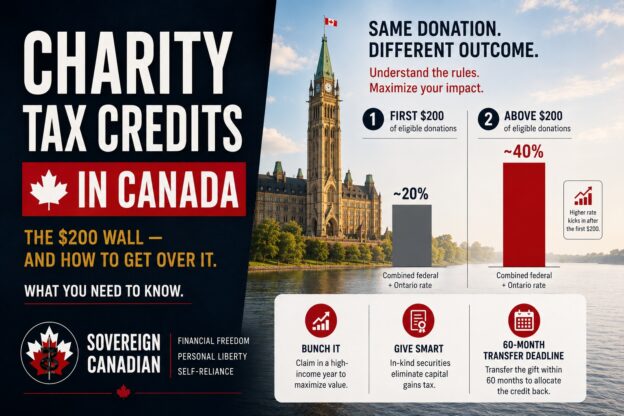
Charity tax credits Canada: chart comparing the ~20% combined federal and Ontario credit rate on the first $200 of donations to the ~40% rate above $200.

Charity Tax Credits in Canada

How to Turn Giving Into a Deliberate Tax Strategy

Charitable giving is one of the very few places where Canadian tax policy and your personal values actually point in the same direction. The government wants you to fund the causes it doesn’t want to fund directly, so it hands you a credit for doing it. That’s the deal. And yet most Canadians either leave real money on the table — by giving cash when they should be giving stock, or by scattering small donations across years that never clear the threshold where the credit gets good — or they overcomplicate it chasing schemes that get their receipts denied.

So let’s do what we always do here: strip out the feel-good marketing, look at the actual mechanics, and figure out how a Canadian with real assets — a decent income, a brokerage account with some winners in it, maybe a business, maybe an estate to plan — should think about charity tax credits.

Continue reading
Dividend tax treatment in Canada: tax integration chain from corporate profits through gross-up to the dividend tax credit

Dividend Tax Treatment in Canada:

What You Actually Keep From Every Kind of Dividend

Dividends are the one form of investment income where the government has quietly built you a tax break — and where most Canadians never bother to find out how big it is, where it applies, and where it silently disappears. So you get people paying full freight on US dividends they should have sheltered, holding American stocks in the exact wrong account, and treating the T5 that lands in their inbox as a mystery number they just plug into the software and hope for the best.

Continue reading

The Canada Medical Expense Tax Credit – How to claim

The CRA Is Letting You Leave Money on the Table — Here’s How to Stop It with the Canada Medical Expense Tax Credit.

Most Canadians file their taxes, take the standard deductions they know about, and move on. They assume if it mattered, their accountant would have caught it. They’re wrong — and the Canada Medical Expense Tax Credit is one of the most consistently overlooked credits in the entire Income Tax Act.

This isn’t a loophole. It’s not complicated. The CRA publishes the rules in plain language. But because it requires a bit of organization and strategic thinking, most people either skip it or massively underuse it. That’s money you’ve already spent — sitting unclaimed.

Here’s how to get it back.


What the Medical Expense Tax Credit Actually Is

The Canada Medical Expense Tax Credit (METC) is a non-refundable federal tax credit on lines 33099 and 33199 of your return. It reduces the federal income tax you owe at a flat 15% rate. Most provinces stack their own parallel credit on top of it.

Non-refundable means it reduces your tax payable — it won’t generate a refund beyond what you’ve already paid. But if you have any tax liability at all, this credit directly reduces it dollar for dollar.


The Threshold — And Why the Claimant Matters

You don’t get to claim every dollar of medical expenses. The CRA applies a threshold — the lesser of:

  • 3% of the claimant’s net income (line 23600), or
  • $2,759 (the 2024 fixed ceiling, indexed annually)

Only expenses above that threshold qualify. The credit is then calculated at 15% on the excess.

Here’s the math: if your threshold is $1,500 and you have $4,000 in eligible expenses, you’re claiming $2,500 — generating a $375 federal credit. That’s before provincial. Not life-changing on its own, but stacked over multiple years with a family’s worth of expenses? That’s real money.

Now here’s the part most people miss: the 3% is based on the claimant’s net income — not household income. Which means who claims these expenses matters enormously.

If your household income is $280,000 combined, you don’t split the expenses. You run the calculation on each spouse individually and put the claim on the lower-income partner’s return. Their 3% threshold is smaller. More of your total family expenses clear the floor.

A household with one spouse at $230,000 and one at $50,000: the higher earner hits the $2,759 fixed cap. The lower earner’s threshold is just $1,500. Same pool of expenses — but claimed under the lower earner, you get $1,259 more into the claimable column. That’s a difference of roughly $190 in federal credit on that spread alone, every single year.


Who Can You Claim For

You can pool eligible medical expenses paid on behalf of:

  • Yourself
  • Your spouse or common-law partner
  • Your dependent children born in 2006 or later

All of the above go on Line 33099 of your return.

For other dependants — parents, grandparents, adult children, siblings — those are claimed separately on Line 33199, with the threshold recalculated against their individual net income. If an elderly parent has low income, the threshold against their expenses can be very small, making almost the entire expense pool claimable.

See: Lines 33099 and 33199 — CRA filing instructions


What Counts as an Eligible Medical Expense

The list is longer than you think. Here’s what qualifies for the Canada Medical Expense Tax Credit:

Medical and hospital: prescription drugs and medications, physician and specialist fees, hospital care (including private room premiums), surgery, anaesthesia, diagnostic tests like MRIs and bloodwork, medical devices including CPAP machines and insulin pumps, hearing aids and batteries, eyeglasses and contact lenses, laser eye surgery, fertility treatments including IVF, ambulance fees, and attendant care for disability support.

Dental: fillings, crowns, extractions, orthodontics including braces, periodontal treatment, dentures and implants, root canals, and oral surgery. Routine teeth whitening and purely cosmetic procedures don’t qualify.

Paramedical practitioners: chiropractors, physiotherapists, psychologists and psychotherapists, occupational therapists, speech-language pathologists, naturopaths, acupuncturists, registered massage therapists, and dietitians — but only if they are licensed or regulated under provincial law. This is a hard requirement. An RMT in Ontario is regulated and eligible. An unlicensed practitioner in a province without regulatory oversight is not. Know the rules in your province.

What doesn’t count: gym memberships, cosmetic procedures, over-the-counter vitamins, teeth whitening, and private health insurance premiums paid personally.

See: CRA Guide RC4065 — Medical Expenses


Your Benefits Plan Doesn’t Disqualify the Rest

If your employer’s group benefits covered part of a procedure, you don’t lose the credit entirely. You claim the out-of-pocket portion only — the amount you personally paid after reimbursement.

A $500 dental procedure where your benefits paid $350 means you’re claiming $150. Simple. Keep your Explanation of Benefits statements from your insurer alongside your receipts. If the CRA reviews your claim, they’ll want both.

What you cannot do is claim any portion that was or will be reimbursed — even if the reimbursement lands in a different tax year.


The 12-Month Window Most Canadians Don’t Use

This is where it gets interesting. The CRA does not require you to claim medical expenses on a strict January–December calendar year basis. You may claim any consecutive 12-month period that ends in the tax year you’re filing.

When filing your 2024 return, your claim window could be:

  • February 1, 2023 – January 31, 2024
  • July 1, 2023 – June 30, 2024
  • November 1, 2023 – October 31, 2024

Or any other 12-month stretch that ends in 2024.

Why does this matter? Timing. Medical expenses aren’t evenly distributed. A major surgery in November 2023 with significant follow-up costs running into early 2024 — claimed on a strict calendar year basis — could end up split across two returns, with neither year clearing the threshold on its own. Shift the window to pull them together and you potentially convert two non-qualifying years into one substantial claim.

The constraint: each receipt can only appear in one claim period. You can’t double-count.


You Can Go Back 10 Years

If you’ve been leaving this credit unclaimed — or claimed it poorly — you’re not out of luck. The CRA allows adjustments to prior returns via a T1 Adjustment (Form T1-ADJ) going back 10 years. In 2025, that means as far back as 2015.

The fastest route is through My Account on the CRA website using the “Change my return” function. Online adjustments typically process in a few weeks. Paper takes longer.

You’ll need your receipts and EOB statements. Organize them first — trying to claim without documentation is a waste of everyone’s time.

If you’re a high-income earner with a family and haven’t been claiming this systematically, a few hours with an accountant working through the last three to five years could generate a meaningful recovery. The fee pays for itself quickly.

See: CRA — how to change a prior year return


The Move

Stop treating your tax return as a form to fill out and start treating it as a financial optimization exercise. The METC isn’t exotic — it’s built into the system, published by the CRA, and available to anyone who takes thirty minutes to organize their receipts and run the numbers.

Identify the lower-income spouse. Collect all receipts and EOBs. Map out your expenses over time and find the optimal 12-month windows. Then file — or refile.

The government isn’t going to remind you. That’s your job. Use the Canada Medical Expense Tax Credit!

Rental Property Taxes in Canada

Rental Property Taxes in Canada: What High Earners Need to Know

You’re paying 50 cents of every rental dollar to CRA. Maybe more. And most Canadian landlords don’t even realize it — because they never bothered to understand how rental property taxes in Canada actually work at a high income. That’s not a tax problem. That’s an ignorance problem. Fix it here.

Along with RRSPs, proper understanding and deployment of a tax strategy here can really make a difference.

STR vs LTR: How Rental Income Hits Your Personal Return

Short-term rental. Long-term rental. Doesn’t matter which one you run — both land on Form T776 and flow straight onto your T1 personal return. At a 46 to 53 percent marginal rate, every dollar of net rental income is expensive. You need to know this going in, not at tax time.

Here’s the distinction CRA actually cares about. LTR is almost always rental income — clean, simple, predictable. STR flips into business income the moment you start offering hotel-like services. Daily cleaning. Meals. Concierge. Cross that line and you’re suddenly owing CPP on top of income tax. Stick to basic amenities and it stays rental. Know where the line is.

When your expenses beat your income:

This is where high earners stop leaving money on the table. If your allowable expenses exceed your rental income — excluding CCA — you have a net rental loss. That loss hits Line 12600 and reduces your total personal income directly. A $10,000 rental loss at a 50 percent marginal rate is $5,000 back in your pocket. Real money. Legitimate. Not a grey area.

One rule you cannot bend: CCA cannot create or increase a rental loss. Depreciation reduces rental income to zero and stops there. You cannot use it to manufacture a loss. Don’t try.

CRA Watch — STR Compliance: Since 2024, CRA and several provinces will deny all expense deductions on STRs that violate local municipal licensing rules. No license where one is required means no deductions. Full stop. Compliance isn’t a suggestion anymore.

Partial Year Use: Mixing Personal and Rental

You use the cottage in July and August. You rent it the rest of the year. CRA is fine with that — but they want a clean proration. Every shared expense gets split based on the portion of the year the property was genuinely available for rental use.

Eight rental months out of twelve means you claim 8/12 of shared costs. Insurance, property tax, mortgage interest — all prorated. Purely rental expenses like advertising and management fees can be 100 percent deductible. The personal portion? Gone. Non-negotiable.

One trap that catches people off guard. Converting your principal residence to a partial rental can trigger a deemed disposition at fair market value. That means a capital gains bill you never saw coming. Get the Section 45 election right — Form T2091 — before you make that move. Not after.

Co-Ownership With a Lower-Income Spouse

Here’s a lever most high-income Canadians never pull correctly — or pull without understanding the risk.

Rental income splits according to ownership interest. Fifty-fifty on title means fifty-fifty on the T776. In theory. In practice, CRA’s attribution rules under ITA Section 74.1 exist specifically to stop you from doing this casually. If you funded the purchase, paid the mortgage, and ran all the money through your accounts — CRA will attribute that income straight back to you. The split disappears. You’ve accomplished nothing except a more complicated tax return.

The fix is a prescribed-rate spousal loan. Your spouse borrows their proportionate share from you at CRA’s prescribed rate. They pay you that interest every year — actually pay it, documented, within 30 days of year end. From that point forward, their share of rental income is legitimately theirs, taxed at their lower rate. On $30,000 of net rental income, the difference between a 50 percent and 20 percent bracket is $9,000 a year. Every year. Compounding.

But run this calculation first. If the property is currently at a net loss, you want 100 percent of that loss on your return — not your spouse’s. A loss is worth more at a higher marginal rate. The right structure depends on whether this property makes or loses money — and which direction it’s heading.

CCA: Should You Claim It?

Capital Cost Allowance is depreciation on the building. Not the land — just the building. You can claim it every year. You never have to. That optionality is the entire game.

The building typically sits in Class 1 at 4 percent declining balance. Half-year rule applies in year one. On a $400,000 building value, you’re looking at roughly $8,000 maximum in year one.

Here’s what the brochure doesn’t tell you. Every dollar of CCA you claim shrinks your adjusted cost base. When you sell, CRA recaptures every single dollar — taxed as ordinary income at your full marginal rate. Not capital gains rates. Your full rate. You’re not saving tax. You’re deferring it, and potentially deferring it onto a bigger future income if you’re still climbing.

CCA makes sense when you’re at peak income now and expect to sell in a meaningfully lower-income year. Retirement. A slow year. A planned wind-down. The math only works if the deferral value exceeds the future recapture when properly discounted.

Skip it if you’re holding long-term, if your income trajectory is up, or if you want a clean ACB at disposition.

In a co-ownership structure, each spouse files their own T776 and makes their own CCA election independently. What’s right for you may be wrong for your spouse. Run the numbers individually. Don’t make a household decision on what is fundamentally an individual tax calculation.

Expenses You Can Claim

CRA allows deductions for expenses that are reasonable, actually incurred, and spent for the purpose of earning rental income. That last part matters. Personal expenses with a rental label on them don’t survive scrutiny.

Here’s what legitimately belongs on your T776:

Mortgage interest — not principal, just interest
Property taxes
Property and liability insurance
Utilities you pay as landlord
Repairs and maintenance
Advertising and platform fees
Property management fees
Accounting and legal fees tied to the rental
Travel to inspect or manage the property
Landscaping, snow removal, cleaning
Condominium fees
CCA on the building (Class 1) and furnishings (Class 8)

Know the line between a repair and a capital improvement. Fixing a broken furnace is a repair — deduct it now. Installing a new high-efficiency system that adds value to the property is a capital improvement — it goes onto the ACB and depreciates through CCA. CRA looks at this closely. Document the condition before and after. When it’s borderline, capitalize it and sleep better.

“Available for Rent” vs. “Actually Rented”

This distinction is worth real money and most landlords get it wrong. This distinction can make a real difference with your rental property taxes in Canada.

CRA allows you to claim expenses during any period your property was genuinely available for rent — even if nobody rented it. Vacant doesn’t mean disqualified. Actively listed, marketed, with a paper trail showing you were trying to rent it? You’re covered.

What kills your deduction: personal use periods, time spent off-market, renovations that benefit you personally. Those windows are dead to you from a deduction standpoint.

Listed and rented — tenant in place: claim it Listed, marketed, sitting vacant: claim it Off market for personal use: nothing STR — dates blocked for yourself: nothing STR — open on platform, no bookings: claim it

Your documentation is your defence. For STR, export your availability calendar. Screenshot your listing. For LTR, keep the MLS listing, tenant correspondence, and showing records. CRA auditors don’t accept your word. They accept your paper trail.

One more thing STR owners miss. Your blocked personal-use dates on Airbnb aren’t just scheduling decisions — they’re your personal-use ratio, locked into the platform’s own records. That data exists whether you acknowledge it or not. Keep those dates clean and separated from day one.

The Bottom Line on Rental Property Tax in Canada

The tax code is not your enemy. Ignorance of it is.

Rental real estate gives a high-income Canadian access to legitimate, powerful tools — net loss offsets, prorated expenses, income splitting done properly, and discretionary CCA. None of them require creativity. All of them require competence.

The landlords who get reassessed aren’t the aggressive ones. They’re the sloppy ones. The ones who split income without substance. The ones who claimed personal expenses as rental expenses. The ones who never separated their personal-use days from their rental days because it was inconvenient.

You don’t have that excuse anymore.

Get a T776-literate accountant. Build the structure that matches your filing position. Document everything like CRA is watching — because eventually, they might be.

Are you a landlord? Have an STR? How are you handling your rental property taxes in Canada?

Here is a a good reference: CRA Guide to Rental Income (T4036)

This post is for informational purposes only and does not constitute tax or legal advice. Consult a qualified Canadian tax accountant for guidance specific to your situation.