
What You Actually Keep From Every Kind of Dividend
Dividends are the one form of investment income where the government has quietly built you a tax break — and where most Canadians never bother to find out how big it is, where it applies, and where it silently disappears. So you get people paying full freight on US dividends they should have sheltered, holding American stocks in the exact wrong account, and treating the T5 that lands in their inbox as a mystery number they just plug into the software and hope for the best.
Let’s do what we always do here: strip out the noise, get the mechanics right, and figure out how a Canadian with real assets — a non-registered account with some winners in it, a maxed RRSP, a TFSA, maybe a corporation — should actually think about dividend taxation.
Here’s my position up front. Canadian eligible dividends are one of the most efficient forms of income a Canadian can earn, sometimes taxed at a negative rate at low income. US dividends are fine, but only if you put them in the right account — and the “right account” is not the one most people assume. And if you own a corporation, the dividend-versus-salary question is a genuine decision with no universal answer, not a hack. The whole game is knowing which dividend you’re holding and which account it’s sitting in. Get those two things right and the tax mostly takes care of itself.
How Canadian dividends actually get taxed: the gross-up and the credit
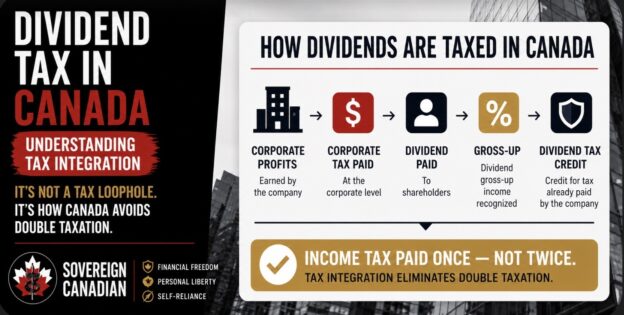
Start with the thing that confuses everyone: the gross-up. When you receive a Canadian dividend, you don’t just report the cash you got. You report a larger, inflated number, and then you get a credit to bring the tax back down. It feels like a shell game. It isn’t — it’s Canada trying to solve a real problem called double taxation.
Here’s the logic. A Canadian corporation already paid corporate tax on its profit before it sent you a dividend. If Canada then taxed that same money again in your hands at your full rate, the income would be taxed twice. So the system “grosses up” the dividend to approximate the pre-tax corporate profit, taxes that bigger number at your marginal rate, and then hands you a dividend tax credit (DTC) meant to represent the corporate tax already paid. The name for this whole balancing act is integration — the theory that income earned through a corporation and then paid out to you should end up taxed at roughly the same total rate as if you’d earned it directly.
There are two flavours of Canadian dividend, and the difference matters:
Eligible dividends — these come from public corporations and from the general-rate income of larger private companies. They get the better treatment: a 38% gross-up and a 15.0198% federal dividend tax credit on the grossed-up amount.
Non-eligible dividends (the CRA calls them “other than eligible”) — these come out of income that was taxed at the low small-business rate, typically from a small CCPC. Because less corporate tax was paid, you get a smaller offset: a 15% gross-up and a 9.0301% federal dividend tax credit.
The payer decides which is which — it’s designated on your T5 slip, and you don’t get to choose. Eligible dividends are the good stuff. Non-eligible dividends carry a heavier combined tax load because the corporation underneath them paid less tax to begin with.
Then the provinces stack their own dividend tax credit on top, and the rates vary a lot. In Ontario, for example, the provincial DTC runs roughly 10% of the grossed-up amount for eligible dividends and around 3% for non-eligible. (Provincial DTC rates change — verify your province at publish.) This is why the effective tax rate on an eligible dividend for a mid-bracket Ontario investor lands in the mid-20s percent — meaningfully below what you’d pay on the same dollar of interest or salary.
The quirk almost nobody tells you about: the negative tax rate
At low income levels, the dividend tax credit can be worth more than the tax on the grossed-up dividend. The credit exceeds the tax, and the effective rate on that dividend income goes negative. That’s not a loophole — it’s the integration math working as designed for someone in a low bracket. It’s the entire reason a retiree living mostly on eligible Canadian dividends, or an owner-manager with room in a low-income year, can pull a surprising amount of dividend income with almost no tax. Worth knowing if you ever have a low-income year to work with.
The gross-up trap: it inflates your income even though you never got the cash
Here’s the flip side, and it bites people who don’t see it coming. The grossed-up number — the inflated one — is what flows into your net income for the purpose of income-tested benefits and credits. So even though the DTC fixes your tax, the gross-up can quietly:
- Push you over the OAS clawback threshold (around $90,997 for 2025 — verify at publish), triggering the recovery tax.
- Reduce the Canada Child Benefit if you’ve got kids at home.
- Chip at other income-tested credits.
If you’re a retiree leaning on dividends, or a family optimizing CCB, this is the sharp edge of dividend income. A dollar of eligible dividend can inflate your reported income by 38 cents for benefit-clawback purposes, even though you never saw that 38 cents. Something to model before you lean hard on a dividend-heavy portfolio in retirement.
“Qualified dividend” — the American word that trips up Canadians
Let me clear this one up directly, because it’s the source of a lot of confusion — and it’s usually the first thing that goes sideways when a Canadian reads US financial media or watches an American YouTube finance channel.
“Qualified dividend” is a US tax term. It has no place on your Canadian tax return. In the US system, a dividend that meets certain holding-period and source rules is “qualified,” which means the American taxpayer gets to tax it at the lower long-term capital gains rates instead of ordinary income rates. It’s their version of a break on dividends.
Canada does not use that word or that mechanism. Our equivalent distinction is eligible versus non-eligible dividends, and instead of a preferential rate table we use the gross-up-and-credit system I walked through above. So if you’re a Canadian resident and someone asks whether your dividend is “qualified,” the honest answer is: wrong country’s vocabulary. What you actually want to know is whether it’s eligible or non-eligible, and whether it’s Canadian or foreign — because those are the labels that change your Canadian tax bill.
And here’s the part that stings: US dividends — qualified or not, in American eyes — get no Canadian dividend tax credit at all. From Canada’s point of view they’re just foreign income, taxed at your full marginal rate with no gross-up and no DTC. The favourable Canadian treatment is reserved for Canadian dividends. Which is the perfect segue into what actually happens to your US stocks.
US stocks and the 15% withholding tax
When a US company pays a dividend to a Canadian, the US takes its cut before the money ever reaches your account. This is withholding tax at source, and it happens automatically — no form to file in the moment, no line item you have to action.
The default US rate on dividends paid to a foreign investor is 30%. But under the Canada-US tax treaty, that drops to 15% for Canadian residents — as long as your brokerage has a valid W-8BEN on file for you. Every major Canadian broker (Wealthsimple, Questrade, RBC Direct, TD Direct, and the rest) submits this form for you automatically when you open the account, and it’s good for three years before it needs renewing. So 15% is the rate you’ll see by default. If you ever notice 30% coming off, your W-8BEN has lapsed — go fix it.
So a $1,000 US dividend shows up as $850 in your account, with $150 gone before you see it. The critical question — the one that determines whether that $150 is lost or recoverable — is which account is holding the stock.
In a non-registered (taxable) account, that 15% is recoverable. Because you are paying Canadian tax on that US dividend (remember: full marginal rate, no DTC), Canada lets you claim a foreign tax credit to avoid being taxed twice on the same income. You claim it on your T1 (Form T2209, flowing to the federal foreign tax credit line — verify current line numbers at publish), and it offsets your Canadian tax dollar-for-dollar, up to the 15% treaty amount. If the treaty rate withheld matches, you typically recover essentially all of it. The withholding stings in the moment but washes out at tax time.
That recovery mechanism is the whole reason the account matters so much. Take the stock out of a taxable account, and the story changes completely.
The RRSP exemption — and exactly where it stops working
This is the single most underused tax advantage in Canadian investing, and most people who don’t know about it are quietly bleeding 15% of every US dividend they collect.
Under the Canada-US tax treaty, US dividends paid into an RRSP, RRIF, LIRA, or LIF are exempt from US withholding entirely — 0%. The treaty recognizes these as retirement accounts, so the US doesn’t withhold on the dividends they receive. Hold a US-listed stock or a US-listed ETF directly inside your RRSP, and the full pre-tax dividend lands in the account. No 15% haircut, and nothing to recover because nothing was taken. This is why the standard Canadian advice is: US dividend-paying equities belong in the RRSP.
Now the three places it stops working, because this is where people get burned:
The TFSA trap. Despite the name, the TFSA does not shield you from US withholding. The treaty exemption covers RRSPs and RRIFs — it does not extend to the TFSA, FHSA, RESP, or RDSP. So US dividends in your TFSA lose 15%, and here’s the kicker: because TFSA income isn’t taxable in Canada, there’s no Canadian tax to credit against, so you can’t recover it either. The money is simply gone, permanently. Holding US dividend stocks in a TFSA is the worst of both worlds — you eat the withholding and you get no recovery. If you’re going to hold US dividend payers somewhere, the TFSA is the account to avoid for that job. (Growth and Canadian holdings in the TFSA? Perfectly fine. It’s specifically US dividends that leak.)
The Canadian-listed ETF wrapper problem. This one is sneaky. A lot of Canadians get their US exposure through a Canadian-listed ETF that holds US stocks (think a TSX-listed S&P 500 wrapper). When you do that, the US withholds 15% at the fund level — before the cash ever reaches the Canadian fund — and that layer cannot be recovered even inside your RRSP. The treaty benefit applies to you, the investor; but the fund is technically the one receiving the dividend, so the exemption doesn’t reach through the wrapper. Same underlying index, meaningfully different tax outcome. If you’re holding US equities in an RRSP and the amount is large enough to matter, the US-listed version (bought with US dollars in the account) is the tax-efficient choice. For a small position, the convenience of the Canadian wrapper can be worth the drag — just know you’re paying for it.
REITs, ADRs, and non-US foreign dividends. The RRSP exemption is narrower than people assume. US REITdistributions are treated differently under the treaty and can still get hit with 15% even inside an RRSP. ADRs (foreign companies trading on US exchanges) can be subject to withholding in an RRSP too. And the exemption is US-only — dividends from UK, German, Japanese, or other foreign stocks still face their treaty withholding (usually 15%) even in your RRSP, with no recovery. For non-US foreign dividends, a non-registered account (where you can at least claim the foreign tax credit) is often the more efficient home than a registered one. The clean rule to remember: the 0% RRSP exemption is for direct US-listed holdings, full stop.
One more housekeeping note if your US holdings get large: foreign property with a total cost over CAD $100,000 triggers T1135 foreign income verification reporting. That’s a reporting form, not a tax — but the penalties for skipping it are ugly, so it’s worth flagging. (Verify threshold and form at publish.)
Small business dividends: minority owner vs. full owner
Dividends from a private corporation are a different animal, and your situation depends entirely on whether you controlthe company or just hold a slice of it.
If you’re a minority owner
If you own a minority stake in a private corporation — a stake in a family business, a professional partnership structured through a corporation, a friend’s company you put money into — you’re mostly a passenger on the tax side. The corporation decides when it pays dividends and whether they’re designated eligible or non-eligible, and you receive a T5 reporting your share. You report it like any other Canadian dividend, get the appropriate gross-up and DTC, and that’s largely the end of it. You don’t control the designation, the timing, or the mix. Your job is to know whether what you’re receiving is eligible or non-eligible (it changes your effective rate) and to keep an eye on whether those grossed-up amounts are quietly affecting your income-tested benefits.
If you’re the full owner (or owner-manager)
This is where it gets interesting, and where real planning lives. If you run your own CCPC (Canadian-controlled private corporation), you’re choosing how to pay yourself, and dividends are one of the levers. A few things you need to have straight:
Salary vs. dividends is a genuine trade-off, not a hack. Salary is deductible to the corporation, creates RRSP contribution room, and requires you to pay into CPP (a cost, but also a future benefit). Dividends are not deductible to the corporation, create no RRSP room, and involve no CPP. Under perfect integration the two routes land in a similar place on total tax — so the decision usually turns on the secondary effects: whether you want RRSP room, whether you want to pay into CPP, your cash-flow needs, and your province’s specific rates. Anyone selling you “always pay dividends” or “always pay salary” as a universal answer is selling you something. Run your own numbers each year.
Which dividend can your corporation even pay? A CCPC can only pay eligible dividends to the extent it has a balance in its GRIP (General Rate Income Pool) — essentially income that was taxed at the higher general corporate rate. Income taxed at the low small-business rate comes back out as non-eligible dividends. You can choose what to pay out, but you can’t relabel small-business-rate income as eligible just because eligible is taxed more favourably in your hands.
Two more pools worth knowing by name: If your corporation earns investment income, some of the tax it pays is refundable through the RDTOH (refundable dividend tax on hand) mechanism when it pays dividends — the system’s way of discouraging you from using a corporation purely to defer tax on passive investments. And the capital dividend account (CDA) lets a corporation pay out the tax-free half of its realized capital gains as a tax-free dividend to you. That last one is genuinely valuable and routinely underused — if your corporation has realized capital gains, the CDA is money you may be able to take out completely tax-free. Talk to your accountant about your CDA balance; it’s the closest thing to a free lunch in this whole area.
The honest summary for owner-managers: the dividend-vs-salary optimization is real but modest under integration, while the CDA and the timing of dividends across high- and low-income years are where the meaningful wins usually are.
If you leave: how all of this changes when you’re a non-resident
Everything above assumes you’re a tax resident of Canada. The moment you sever residency and retire offshore — Portugal, Panama, Dubai, wherever — the entire machine I’ve just described gets swapped out for a different one. This is worth understanding before you go, because it’s simultaneously one of the structural advantages of being Canadian and one of the easiest places to make a six-figure mistake.
Start with the big-picture reframe. The gross-up, the dividend tax credit, the eligible-versus-non-eligible distinction, integration — all of it is a resident’s apparatus. It exists because residents file a T1 on worldwide income and the system needs a way to avoid double-taxing corporate profit. A non-resident doesn’t file that return. So the entire DTC apparatus simply stops applying to you. In its place is something much blunter: flat withholding at source.
Here’s the sovereign angle, and it’s real. Canada taxes on residency, not citizenship. Unlike an American — who drags the IRS around the planet by passport for life — a Canadian can genuinely step out of the Canadian tax net by becoming a non-resident. That’s the whole thesis behind residency-based tax planning. But Canada doesn’t let you leave for free. There’s a toll booth on the way out.
The departure tax (deemed disposition). When you emigrate, Canada treats you as having sold most of your capital property at fair market value the moment you leave, and taxes the accrued gains. Becoming non-resident triggers a deemed realization of most capital property. Your non-registered stock portfolio is squarely caught — all those unrealized gains you’ve been deferring get crystallized on the way out. What’s exempt from the deemed disposition: RRSPs, RRIFs, TFSAs, RESPs, and FHSAs, plus directly held Canadian real estate and Canadian business property. You can elect to post security and defer the actual payment rather than writing the cheque on departure.
Canadian dividends as a non-resident. Once you’re gone, dividends from your Canadian stocks are hit with Part XIII withholding tax: a 25% default rate, which a tax treaty between Canada and your new country can reduce. Most treaties bring that down to 15% for individuals. Critically, this withheld amount is a final tax — the non-resident generally doesn’t file a Canadian return for it. To get the treaty rate instead of the full 25%, your broker needs treaty-eligibility paperwork on file (Form NR301 for individuals). Notice what’s gone: there’s no gross-up, no DTC, no eligible/non-eligible sorting. A flat 15% (or 25%) comes off the top and that’s the end of your Canadian obligation. For a high-income person this can actually be lower than the resident rate; for a modest retiree it can be higher than what integration would have given them. It cuts both ways.
Your registered accounts don’t vanish, but the rules shift. Your RRSP/RRIF and TFSA aren’t deemed-disposed on departure — you keep them. But: withdrawals by a non-resident face 25% Part XIII withholding, reduced by treaty, and most treaties cut periodic RRIF payments to 15% — often well below the top resident rate, which is why when you draw down relative to when you leave is a genuine planning lever. The TFSA is the trap here: you can keep it, but you can’t contribute while non-resident without a 1% monthly penalty tax — and, more importantly, your new country may not recognize the TFSA (or even the RRSP) as tax-sheltered at all, and could tax the income inside it under its own rules. “Tax-free” is a Canadian promise; it doesn’t automatically travel.
US dividends get complicated fast. This is the part people miss. The 15% US rate and the 0% RRSP exemption you enjoyed came from the Canada-US treaty, which applied to you because you were a Canadian resident. Leave Canada, and that treaty is no longer yours to claim. Your US-dividend withholding now depends on whether your new country has a treaty with the United States — and the RRSP’s US-dividend exemption in a post-emigration world is genuinely murky and structure-dependent. This is not a place to guess. If you hold meaningful US equity and you’re leaving, get a cross-border specialist to map it before you move, not after.
The new country is the whole game. Where you land determines whether leaving was brilliant or expensive:
- A zero-tax jurisdiction (e.g., the UAE): no capital gains tax there means there are no foreign tax credits to offset the Canadian departure tax — it becomes the final, permanent cost on your historical wealth. Great for future income, but the exit toll is unavoidable.
- A treaty country (much of Europe, plenty of Latin America): you get the reduced withholding on Canadian dividends, but treaty tie-breaker rules decide your residency, and being deemed resident there triggers the departure tax just as a physical move would. The new country will also tax you on its own terms, sometimes crediting the Canadian withholding, sometimes not.
- A non-treaty country: you eat the full 25% Canadian withholding on Canadian dividends with no treaty relief, and possibly no credit on the other side. The worst of both.
The honest bottom line for the retire-offshore crowd: departure changes the form of Canadian tax, not always the factof it. You trade the gross-up/DTC system for flat withholding, you pay a one-time exit toll on your unrealized gains, and you inherit a brand-new tax system in your destination that may or may not play nicely with your Canadian accounts. Done with a cross-border accountant and a year of runway, it can be a genuinely powerful move. Done casually — sell nothing, tell no one, assume the TFSA is still magic — it’s how people hand the CRA and a foreign tax authority a bill they never saw coming.
What I’d actually do
Strip all of it down and here’s the playbook I actually run in my head:
- Canadian eligible dividends are the most efficient equity income a Canadian can earn — and they’re most efficient in a non-registered account, where the dividend tax credit actually gets used. Don’t waste eligible-dividend efficiency by burying those stocks in a TFSA where the credit does nothing for you.
- US dividend-paying stocks and US-listed ETFs go in the RRSP, held directly, US-listed, ideally bought with US dollars in the account. That’s the one spot where the withholding genuinely hits 0%.
- Never park US dividend payers in the TFSA. You eat 15% and can’t get it back. Put growth-oriented and Canadian holdings in the TFSA instead.
- In a non-registered account, US dividends are fine — you’ll see 15% withheld, but you recover it with the foreign tax credit. Just make sure your W-8BEN is current so it’s 15% and not 30%.
- Watch the gross-up, not just the tax. If you’re near an OAS clawback line or optimizing CCB, model the inflated income before you lean on dividends.
- If you own a CCPC, treat salary-vs-dividend as an annual calculation, mind your GRIP for eligible designations, and ask your accountant about your CDA balance — that’s where the quiet, real money usually is.
- If you’re planning to retire offshore, remember the whole DTC system is a resident’s tool — you’ll trade it for flat withholding, pay a departure-tax toll on your unrealized gains, and inherit your new country’s rules. Model the exit tax and get a cross-border accountant before you go, not after.
Know which dividend you’re holding, and know which account it’s in — and know whether you’re still a resident at all. That’s 90% of getting this right.
This is personal documentation of how I think about dividend taxation as a Canadian investor — not tax advice. Everything here defaults to a Canadian resident; the non-resident section is a high-level map, not a route — cross-border tax is genuinely specialist territory and the mistakes are expensive. Dividend rules, credit rates, treaty provisions, departure-tax mechanics, and benefit thresholds change, and they interact with your specific province, income, account structure, and destination country in ways a blog post can’t capture. Confirm the current figures and talk to a CPA — a cross-border specialist if you’re leaving — before you make placement, compensation, or emigration decisions off any of this.
Further Reading:
Line 40500 – Federal foreign tax credit – Canada.ca
TaxTips.ca – Dividend Tax Credit for Eligible Dividends
T1135 Foreign Income Verification Statement – Canada.ca
Leaving Canada (emigrants) – Canada.ca