This is one in an occasional series where I document my own version of the sovereign life — the small, mostly-free, mostly-unglamorous decisions that add up to a life you actually chose instead of one that happened to you. A week of family camping in Algonquin is one of them. None of this is advice. It’s just what the bush does to my head, and what it does for my kids.
Let me be honest about the part nobody prints on the brochure: a week of family camping in Algonquin is not a holiday. It’s a logistics project.
You plan every meal before you leave the driveway. You pack for four kinds of weather because you’ll get all four. You haul your own water, hang your food from a tree (well a cooler in the car for me) so the bears leave it alone, and when the plan falls apart at 4 p.m. in the rain, there’s no takeout, no front desk, and no signal to Google your way out of it. It is, measured honestly, more work than staying home.
It’s also the clearest my head gets all year. Those two facts are not a coincidence. They’re the whole point.
The logistics are the vacation
At home, my attention is sliced into a hundred pieces before I’ve finished my coffee. Work, messages, the news, the thing I was supposed to remember, the tab I left open. None of it is urgent and all of it is loud.
In Algonquin, the list of things that matter shrinks to about six: is everyone warm, is everyone fed, is the water filtered, is the fire going, is it going to rain, and where did the four-year-old put his other shoe. That’s it. That’s the entire operating system for a week.
And here’s the strange part — that’s restful. Not because it’s easy. Because it’s finite. You can actually finish the list. You plan the meals, you pack the bins, you set up the tent, and then you’re done, and the reward for being done is a lake and nothing to do beside it. I spend fifty weeks a year with a to-do list that regenerates faster than I can clear it. Two weeks a year, I get one I can actually beat. That turns out to be worth more than a resort.
The meal planning alone does something to you. When you have to write down every single thing your family will eat for seven days — and then carry it — you stop buying on autopilot. You notice how little you actually need. You come home and the pantry looks absurd. That noticing doesn’t stay at the campsite. It’s the same muscle that tells you which subscriptions to cancel and which “opportunities” are just noise wearing a suit.
The days come back down to the right size
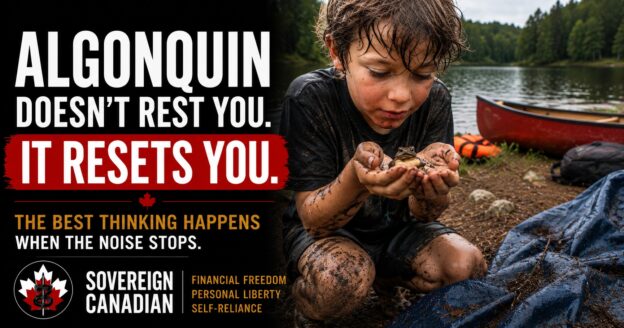
By the second evening, my kids had a system I didn’t teach them and couldn’t have. They’d disappear to the forest and come back with toads — cupped in two hands, breathing between the fingers, presented to me like a quarterly report. Third night it was a bucket full. A toad in the hands of a seven-year-old is a genuinely good use of a Tuesday. Nobody’s optimizing anything. Nobody’s bored in the bad way — they’re bored in the good way, the way that turns into a fort, or a dam, or a two-hour investigation of a single log.
That was most days, honestly. Toads, then acorns — pockets full of acorns, for reasons known only to them. A whole morning spent spotting mushrooms we were very much not going to eat. Long stretches of a stick dragged through the dirt, which is apparently a complete and satisfying activity if you’re five. No screen, no schedule, no adult standing by with a better idea. Just the slow, self-directed work of a bored kid, which is the most productive kind of bored there is.
I’ve come to think boredom is one of the last free inputs we don’t let our kids have anymore. At home it gets filled the instant it appears — school, soccer, swimming, more soccer, a screen, a play date, helping with chores. But boredom isn’t an absence to be fixed. It’s raw material. It’s the empty room the imagination needs before it will build anything in it. Hand a kid a device the moment they’re bored and you’ve bought their quiet by spending the exact thing that would have made them interesting to themselves. The bush doesn’t offer the trade. There’s nothing to fill the gap with, so they fill it themselves — and what they come up with beats anything the screen was going to hand them.
It works on adults too, if you let it. The Italians have a phrase for the state I keep chasing and rarely reach: il dolce far niente — the sweetness of doing nothing. Not the scroll-until-numb kind of nothing, which leaves you emptier than you started. The chosen kind: a hammock, a lake, an afternoon with no next thing in it and no guilt about the gap. We’ve been trained to read that as laziness, because it doesn’t produce anything you can hold up and show someone. But the doing-nothing is precisely what makes room for the thinking that comes later — and it’s the same permission I’m trying to hand the kids when I refuse to rescue them from an idle hour. A stick in the dirt for them, a hammock for me. Same medicine.
See: Boredom fuels creativity, and a low-risk feature of healthy development, not a bug.
I mostly watched from a hammock. I’d love to tell you I read something constructive. I napped. Afternoon, in the trees, with a book open on my chest that I never got past page four of — the best sleep of the year happens outdoors, in the middle of the day, with kids yelling about frogs forty feet away. You cannot schedule that nap. You can only build the conditions for it and let it find you.
We hiked. Not epic distances — the good news about Algonquin is that you don’t have to earn the views with suffering. The Highway 60 corridor has a stack of short interpretive trails that a family with small legs can actually finish, and a couple of climbs that pay out a ridge-top view for maybe ninety minutes of effort. The kids complain for the first ten minutes of every hike and then forget they were ever unhappy the moment the trail does anything interesting. That’s a lesson I keep having to relearn about most hard things.
None of this shows up on a net-worth statement. That’s fine. Not every return is denominated in dollars — I’ve written before about how the garden pays you in things you can’t buy, and this is the same ledger. Food you grew, sleep you earned, a kid who now knows how to hold a toad without squeezing it. You can’t outsource any of it and you can’t fake it.
No signal, no work — and the thinking that finally shows up
Here’s the section I actually sat down to write.
There is no cell service through most of Algonquin’s interior, and it’s spotty at best along the corridor. For the first day, that’s a low-grade panic. By the third day, it’s the best thing about the trip. My phone became a camera and a flashlight — which is roughly what it should have been all along.
And in the space where the noise used to be, the real thinking showed up. Not the reactive kind — the strategic kind. The stuff I’m always going to sit down and think about and never do, because sitting down to think about your life is somehow the one task that never makes it onto the calendar.
Somewhere around the fourth morning, gathering water at the lake’s edge before anyone else was up, I found myself actually working through the next moves. Should I take the new role or build the thing on the side instead? Is the rental doing what I want it to do, or am I just used to it? What’s the honest next step on the business — and what’s the version of “side hustle” that’s really just a hobby I’m charging myself for? These are the questions I claim to care most about and reliably avoid, because at home there’s always something louder.
I’ve come to think this is the most underrated financial move available to a busy person: leave. Not to escape the questions — to finally have room for them. Your best thinking about your next job, your next investment, your next business, your next real side hustle almost never happens while you’re trying to force it at a desk. It happens when your hands are busy with firewood and your brain finally has nothing else to hold. The desk is where you execute the decision. The lake is where you actually make it.
I didn’t come home with a spreadsheet. I came home with two or three decisions that had been rattling around, unresolved, for the better part of a year — resolved. That’s the return on a week with no signal. If you want to pressure-test where those decisions actually lead, that’s what a scenario planner is for once you’re back at the desk. But the deciding happens first, and it happens somewhere quiet.
What the kids are actually banking
I’m not romantic about roughing it. But I’ve noticed my kids come home from a week in the bush different, and it’s not the fresh air.
It’s competence. They learn that dry firewood is a real constraint and not a suggestion. That you wear the layers before you’re cold. That the tarp goes up before the rain, not during it. That if you leave food out, something takes it, and that’s on you. There’s no adult smoothing every edge, because the edges are the curriculum. A kid who has planned, packed, carried, and cleaned up after a meal has quietly learned something the tablet was never going to teach.
That’s the same self-reliance thread that runs under everything I write about — the idea that a life you can run yourself is worth more than a life you have to keep paying other people to run for you. Camping is just the toddler version of that thesis. It happens to be cheap-ish, and it happens to involve toads.
The unromantic practical bit
Because this is still the internet and someone will want to actually do it, the logistics — kept short:
Book early, or don’t bother. Algonquin is one of the busiest parks in the province, and the good sites are gone within minutes of the window opening. Ontario Parks lets you reserve five months ahead, at 7 a.m. ET on the day the window opens — so you’re booking February 1 for a July 1 arrival. Have your site picked, backups ready, and your login working before 7 a.m. This is not the morning to be resetting a password.
Car camping vs. the interior. With young kids, start with the developed campgrounds along the Highway 60 corridor— roughly 56 km with eight car-accessible campgrounds, fourteen interpretive trails, and a genuinely excellent Visitor Centre. You drive to your site, you bring what you want, and there are showers at several of the main campgrounds. The vast interior — thousands of lakes across some 7,600 square kilometres — is paddle-in or hike-in only, and it’s magnificent, but it’s a graduation, not a first day.
When to go. July and August are warmest and most crowded. May and June are gorgeous and buggy — black flies and mosquitoes are not a rumour. If you can swing it, September is the sweet spot: warm days, cool nights, thinning crowds, fewer bugs, and the first of the colour coming in.
Bears are a food-storage problem, not a horror movie. Follow the storage rules without exception and you’ll almost certainly never have an issue. Sloppiness is the only real risk.
Assume no signal. Tell someone your plan and your out-date before you lose service. Then enjoy losing it.
What it actually cost, and what it actually paid
The trip cost a tank or two of gas, a week of site fees, and the groceries we would have eaten anyway. (well a lot more chips). Call it a rounding error against a real vacation.
Against that: the best sleep of the year, kids who learned that boredom is raw material, and a head clear enough to finally make three decisions I’d been dodging since the winter. I’ve never once come home from Algonquin rested, exactly. I come home reset — which is the more useful of the two.
Somewhere on the drive out, the seven-year-old asked if we could bring the toads home. We could not. But the version of him that knows how to find them, hold them gently, and let them go — that one’s coming with us. That’s the return. You can’t buy it, you can’t hurry it, and you can only get it by doing the unreasonable thing and going into the woods with your family for a week with no plan except to be there.
File this one away for February 1. Set the alarm for 6:55.