
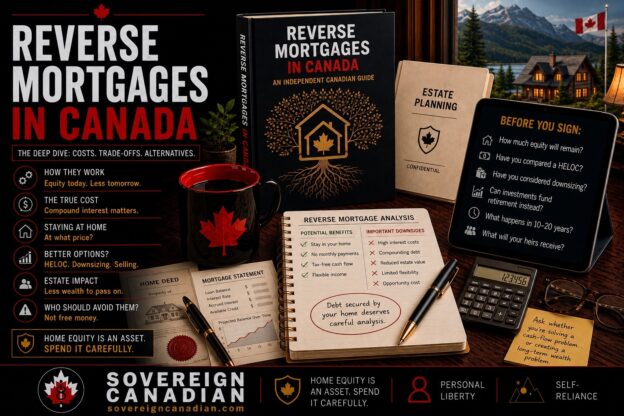
I’ll tell you where I stand before we start, because you’d figure it out by paragraph three anyway: I think a reverse mortgage in Canada is the wrong product for almost everyone who reads this site, and a genuinely useful one for a small handful of people I can describe precisely.
That’s not the same as saying it’s a scam. It isn’t. It’s a regulated loan from a federally regulated bank, with real consumer protections built in. But it’s an expensive loan wearing the costume of a retirement solution, sold with soft-focus advertising and a celebrity spokesperson, to people who are frightened of running out of money and reassured to hear they can “unlock” their home without selling it.
So let’s do what the brochure won’t. Let’s put the actual mechanics, the actual 2026 rates, and the actual compounding math in daylight, and then figure out the small number of situations where I’d tell a friend to seriously consider one. Educated criticism, not reflexive dismissal.
What a reverse mortgage in Canada actually is
A reverse mortgage lets a Canadian homeowner aged 55 or older borrow against their home equity and make no monthly payments. Instead of you paying the bank down every month, the interest gets added to the balance, and the balance grows. You keep the title. You keep living there. The loan comes due only when the last borrower on title sells, permanently moves out, or dies.
That’s the whole pitch, and it’s genuinely different from a normal loan in three ways that matter:
You don’t have to qualify on income. A conventional mortgage or a HELOC makes you prove you can service the debt. A reverse mortgage doesn’t — it’s underwritten against the house and your age, not your paystub. Hold that thought, because it’s the single most important feature and the source of the only good reasons to use one.
You don’t make payments. Ever, unless you choose to. The interest compounds instead. This is sold as the benefit. It’s actually the whole problem, and we’ll spend real time on it below.
There’s a no-negative-equity guarantee. With the mainstream products, if you meet your obligations — property taxes paid, insurance in force, home kept in reasonable repair — you’ll never owe more than the fair market value of the home when it’s sold, even if the loan balance has ballooned past what the house is worth. Your estate isn’t on the hook for the shortfall. That guarantee is real and it’s worth something. It’s also priced into the rate you pay.
The money you receive is tax-free, because it’s borrowed money, not income. That’s not a special reverse-mortgage perk — every loan works that way — but it does have a genuine planning consequence I’ll come back to.
The two banks, and what they charge in 2026
For practical purposes there are two reverse mortgage lenders in Canada: HomeEquity Bank, which runs the CHIP Reverse Mortgage and has been the incumbent since the 1980s, and Equitable Bank, which entered the market in 2018. A couple of smaller players (Home Trust, Bloom) exist around the edges, but CHIP and Equitable are the market. CHIP alone reports over 40,000 customers and roughly $9 billion in loans outstanding.
Here’s where rates sit as I write this, in mid-2026:
| Lender / product | Headline 5-yr fixed | Max loan-to-value | Min age |
|---|---|---|---|
| CHIP (HomeEquity Bank) | ~6.4% (special), ~6.6% standard | up to 55% | 55 |
| Equitable Flex | ~6.5% | up to 55% | 55 |
| Equitable Flex Lite | ~6.4% (lump sum only) | up to 40% | 55 |
| Equitable Flex PLUS | higher | higher % | 70 |
A few things to register from that table. Most products cap you at 55% of your home’s value, but in practice most borrowers qualify for far less — the older you are, the higher the percentage, and a 55-year-old is looking at something closer to 15–25%. You typically need a home worth at least $250,000. And on top of the rate you’ll pay a setup fee (roughly $995), an appraisal (up to ~$500), and mandatory independent legal advice (~$550) — that last one is a consumer protection, not a cash grab, and I’m glad it’s required.
Now put that ~6.4% next to the rest of the 2026 borrowing landscape. The Bank of Canada has held its overnight rate at 2.25% since October 2025, which puts prime at 4.45%. The best conventional five-year fixed mortgage is around 4%. A HELOC runs roughly prime plus a half, call it 5%. So a reverse mortgage costs you something like 1.5 to 2.5 percentage points more than the alternatives — and unlike those alternatives, you’re not paying it down, so that premium compounds on itself year after year.
That premium isn’t the bank being greedy, exactly. Reverse mortgage lenders wait years or decades to get repaid, they carry that no-negative-equity guarantee, and they don’t have access to the cheap funding a big bank uses for regular mortgages. The premium is real risk being priced. But it’s your equity paying for it.
The math nobody prints on the brochure
This is the section that matters. Everything else is detail.
Take a homeowner who draws $250,000 at a 6.4% fixed rate. Reverse mortgages compound semi-annually, so the effective annual rate is about 6.5%. No payments are made. Here’s what the balance owed becomes:
| Year | Balance owed | Multiple of what you borrowed |
|---|---|---|
| 5 | $342,560 | 1.4× |
| 10 | $469,390 | 1.9× |
| 15 | $643,178 | 2.6× |
| 20 | $881,308 | 3.5× |
| 25 | $1,207,605 | 4.8× |
Borrow a quarter-million at 55, live to 80, and you owe roughly $1.2 million. That’s not a trick rate or a worst case — that’s 6.4%, roughly today’s best reverse mortgage rate, doing exactly what compound interest does when nobody’s paying it down.
“But the house appreciates too,” says the salesperson, and that’s true. So let’s give the house every benefit of the doubt. Say it’s worth $700,000 at the outset — so drawing $250k leaves you $450,000 of equity — and say it appreciates a healthy 3% every single year. Here’s your remaining equity:
| Year | Home value (3%/yr) | Loan balance | Equity left |
|---|---|---|---|
| 0 | $700,000 | $250,000 | $450,000 |
| 5 | $811,492 | $342,560 | $468,932 |
| 10 | $940,741 | $469,390 | $471,351 |
| 15 | $1,090,577 | $643,178 | $447,400 |
| 20 | $1,264,278 | $881,308 | $382,969 |
| 25 | $1,465,645 | $1,207,605 | $258,040 |
Look at what happens. Even with the home compounding at 3% a year — a good outcome — your equity peaks around year 10 and then goes backwards. By year 25 you’ve got $258,000 of equity left out of a $1.47 million house. The loan is growing at 6.5% and the house is growing at 3%, and that 3.5-point gap is the sound of your equity being eaten.
And that’s the nominal picture, which flatters it. Adjust for even 2% inflation and your $450,000 of starting equity is worth $258,000 in today’s dollars by year 20 and about $157,000 by year 25. In real terms, the equity roughly halves over 25 years — despite the home appreciating the whole time.
Here’s the contrast that makes the cost concrete. Suppose instead of a reverse mortgage you had a HELOC on that same $250,000 at 5% and simply serviced the interest — about $12,375 a year out of pocket. Over 20 years you’d pay roughly $247,500 in interest, and you’d still owe exactly $250,000, because you never touched the principal. The reverse mortgage owes $881,000 on that same draw over the same period. The difference — over $630,000 — is the price of not writing a monthly cheque.
That’s the trade, stated honestly: a reverse mortgage converts “I don’t want to make payments” into a six-figure claim on your estate. Sometimes that trade is worth making. Usually it isn’t.
Why you’re probably the wrong customer
The archetypal reverse mortgage borrower is house-rich and cash-poor: a retiree whose entire net worth is the paid-off house, who has little in registered or non-registered savings, who can’t income-qualify for a HELOC, and who would rather borrow against the walls than sell and move.
If you read this site, that’s usually not you. You’ve likely got a TFSA you’ve maxed for years, RRSP or RRIF assets, maybe a non-registered portfolio, possibly a corporation with retained earnings, possibly real estate outside Canada. You have liquidity and options. And for someone with liquidity and options, the reverse mortgage is almost always the most expensive door in the building.
Walk the alternatives, because this is the real comparison:
- A HELOC costs 1.5–2.5 points less and preserves your principal if you service it. The catch is you have to income-qualify to set one up — so you set it up before you retire and kill your T4 income, not after. Establish the line while a bank still likes your paystub, then it’s there for life.
- Drawing your own portfolio costs you nothing but opportunity cost, and if you’re sequencing withdrawals well (TFSA and non-registered first, RRIF melted down strategically) it’s almost always cheaper than borrowing at 6.5%. I’ve written about the RRSP meltdown mechanics in the ⚠️ [RRSP meltdown deep-dive] and the drawdown-order logic in the ⚠️ [TFSA guide].
- Downsizing frees the most capital of all and stops the equity erosion cold. It’s emotionally the hardest and financially the cleanest.
The reverse mortgage only wins when all of those doors are closed. Which brings us to the interesting part — because for a specific kind of person, some of those doors genuinely are.
The narrow band where it actually makes sense
I promised educated criticism, not a hatchet job. Here are the situations where I’d tell someone I respect to look hard at a reverse mortgage in Canada rather than dismiss it.
1. You’re wealthy on paper but can’t income-qualify for cheaper credit
This is the strongest case, and it’s more common among incorporated readers than you’d think. Say you’ve spent years minimizing personal income — paying yourself in dividends, retaining earnings in the corp, keeping your T1 lean for all the right tax reasons. Now you’re 68, the house is paid off, you’ve got a seven-figure portfolio, and you want a chunk of liquidity without triggering a taxable disposition or disrupting a portfolio that’s compounding nicely. You go to the bank for a HELOC and discover that on paper, with your lean reported income, you don’t qualify.
The reverse mortgage doesn’t care about your income. That’s its one genuine superpower. If you’re asset-rich, income-lean-by-design, and you didn’t set up a HELOC back when you still had T4 income, the reverse mortgage may be the only no-qualification tap on your own equity. The right move is usually to have avoided the situation — set up the HELOC years earlier — but if that ship has sailed, this is the lifeboat.
2. Bridging to a deferred CPP and OAS at 70
Deferring CPP to age 70 boosts it by 42%, and deferring OAS boosts it by 36% — both guaranteed, both indexed to inflation, both paid for life. That’s one of the best “annuities” available to a Canadian, and it’s underused because bridging the gap from 65 to 70 requires spending down other assets first.
For someone determined to defer but reluctant to draw down a portfolio in a down market, a modest reverse mortgage draw to bridge those five years can pencil out — you’re trading 6.5% debt for a permanently enhanced, inflation-protected, longevity-hedging income stream. I’d still usually rather bridge with the portfolio or a HELOC. But if those aren’t available, this is a defensible use, not a foolish one.
3. You’re planning to die with zero, and heirs aren’t the point
Every equity-erosion table I showed you above assumes you care about the number at the bottom — what’s left for the estate. The entire case against reverse mortgages is, fundamentally, “it shrinks the inheritance.”
If leaving the house to heirs simply isn’t your goal — no kids, or grown kids you’ve already looked after, or a genuine “die with zero” philosophy — then that objection evaporates. A paid-off house you’re living in is a large, illiquid, non-income-producing asset. If the plan is to consume it rather than bequeath it, a reverse mortgage is one efficient way to turn those dead walls into spending money while you’re alive to enjoy it. That fits the freedom-of-time thesis better than dying as the richest person in the graveyard.
4. Avoiding a forced sale at the wrong time
Housing markets have bad years. If a health event or a cash crunch would otherwise force you to sell the home into a soft market, a reverse mortgage can be the bridge that lets you not sell at the bottom — the housing equivalent of not liquidating your portfolio in a crash. Niche, but real, and occasionally the difference between a good outcome and a panicked one.
The tax nuances — handled honestly
Two tax angles get oversold, so let me give you the sober version.
The OAS clawback angle. Because the proceeds are tax-free and never touch line 23600 of your return, drawing from a reverse mortgage doesn’t add to the net income that triggers the OAS recovery tax. In 2026 the clawback starts around $95,000 of net income and takes 15 cents of OAS per dollar above it, with OAS fully gone near $155,000. So in theory, drawing tax-free reverse-mortgage cash instead of a taxable RRIF withdrawal keeps you under the threshold and preserves your OAS. In practice? You’re paying 6.5% compounding interest to protect a maximum OAS benefit of about $8,900 a year. Unless the amounts are small and the timing tight, that’s a bad trade — you’d usually do better drawing your TFSA, which is equally invisible to the clawback and costs you nothing. I cover the full clawback mechanics and the cleaner ways around it in the ⚠️ [OAS and federal benefits guide].
The interest-deductibility angle. You’ll occasionally hear that reverse mortgage interest is deductible if you use the money to invest — the same use-of-funds logic behind the Smith Manoeuvre (⚠️ [Smith Manoeuvre / HELOC post]). Be very careful here. The interest-deductibility test does turn on what you did with the borrowed money, and in principle borrowing to earn investment income can qualify. But reverse mortgage interest is capitalized — you’re not paying it — and the treatment of deducting interest that’s compounding rather than being paid is murky enough that I wouldn’t build a plan on it without a tax professional signing off in writing. And even if it works, clearing a 6.5% compounding hurdle with investments is a high bar. File this under “theoretically interesting, practically aggressive,” not “free lunch.”
The marketing tricks to see through
A few lines you’ll hear, and what they’re doing:
“You keep ownership of your home!” True, and irrelevant to the actual question. You keep title, but the bank registers a growing claim against it. Owning a house with a lien that compounds at 6.5% is not the same as owning a house.
“The money is tax-free!” True of every loan on earth. Your credit card advance is also tax-free. This tells you nothing about whether it’s cheap.
“You’ll never owe more than your home is worth!” The no-negative-equity guarantee is genuine and good. But it’s a floor against catastrophe, not evidence of a good deal — and you’re paying for it in the rate. It protects your estate from a shortfall; it does nothing to protect the equity that’s being consumed on the way there.
The celebrity spokesperson. HomeEquity has leaned on famous, reassuring faces for years. That’s a tell about who the product is sold to — people who respond to comfort and trust rather than to a spreadsheet. You’re a spreadsheet person. Act like one.
What I’d Actually Do
If I were 60-something, house-rich, and eyeing my home equity, here’s my actual decision order:
First, I’d set up a HELOC while I still had the income to qualify — ideally years before I need it and before I wind down T4 income. A cheap, flexible line I never have to use beats an expensive loan I can’t undo. If you’re reading this at 50, this is the single most useful sentence on the page: get the line of credit approved now.
Second, I’d run my own drawdown properly — TFSA and non-registered first, RRIF meltdown timed against my bracket and the OAS threshold — before borrowing against the house at all. Cheaper, more flexible, and it doesn’t compound against my estate.
Third, I’d seriously weigh downsizing. It’s the emotionally hard option and the financially clean one, and “I don’t want to move” is a real cost worth naming honestly rather than papering over with a 6.5% loan.
And then, only if I were income-lean-by-design and couldn’t qualify for a HELOC, or genuinely committed to spending the house down rather than leaving it, or bridging to a deferred pension with no better bridge available — only then would I take a reverse mortgage, borrow the smallest amount that solved the problem, and go in with the compounding table above taped to my monitor so I never mistook “no payments” for “no cost.”
That’s the honest verdict. Not a scam. Not a solution. A narrow, expensive tool for a narrow set of problems — most of which a little foresight would have prevented you from ever having.
This post is personal documentation of how I think about a financial product, written for readers who like to reason from first principles. It is not financial, tax, legal, or mortgage advice, and I am not a licensed advisor, planner, or mortgage broker. Rates, thresholds, and product terms change constantly and were current as of writing; verify everything against the lenders and against CRA before acting. Reverse mortgages are significant, long-term financial commitments — get independent legal and financial advice specific to your situation before signing anything.