
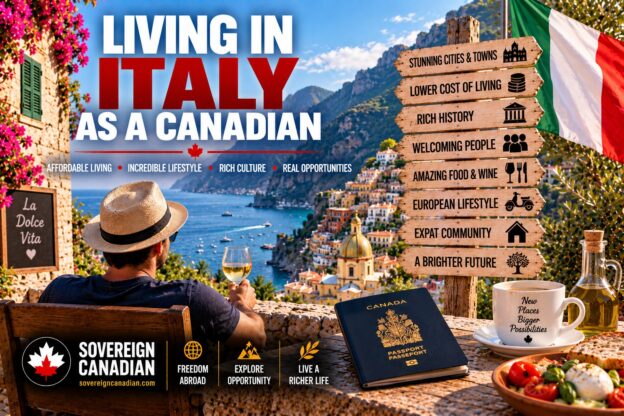
Italy is the easiest country in this series to want and one of the harder ones to think clearly about. Two weeks of trains, piazzas, markets and long lunches can leave a Canadian half-convinced they should sell the house and move, and the brochure version of that decision is everywhere: cheap stone cottages, la dolce vita, a slower and richer life. I am not immune to it. I find the Italian case genuinely compelling, which is exactly why I want to be careful with it. The useful question for this series is not whether Italy is wonderful, because it plainly can be. The question is whether the Italy you fall for on holiday survives an ordinary Tuesday: the bureaucracy, the taxes, the slower institutions, the language, the regional inequality, and the gap between visiting a place and being administered by it.
The short version, which the rest of this piece will earn, is that Italy rewards one kind of Canadian and quietly punishes another, and the dividing line is almost entirely about where your money comes from and how much of Italian life you are actually willing to join. Bring your income with you, choose one region with real intent, treat Italian as non-optional, and Italy offers one of the deepest lifestyle returns in Europe. Arrive needing to earn locally, expecting effortless paperwork, planning to live in English, or hoping for a simple tax return, and it becomes one of the weaker choices in Western Europe. Italy is unusually good at being lived in slowly. It is unusually bad at being treated as a frictionless international product.
Italy’s central trade: the best-run Italy and the cheapest Italy are not the same place
This is the idea I want you holding through everything below, because almost every specific decision routes back to it. Italy’s strongest institutions – its best hospitals and medical specialists, its real employment markets, its fast trains, its international schools, its most reliable public administration – cluster disproportionately in the north and centre. That is also the expensive Italy, and the Italy where you pay ordinary Italian tax. The lower-cost Italy, the southern and small-town Italy that can deliver astonishing lifestyle per dollar and that hands foreign retirees a remarkable tax break, generally comes with thinner services, weaker labour markets, longer distances to a major hospital or a useful airport, and a harder set of trade-offs as you age.
That is the fork. The Italy people picture on vacation – Tuscany, the lakes, Milan, Rome, Florence, Bologna – is not the Italy that subsidizes your relocation. The tax incentive and the dream point in opposite directions, and no amount of enthusiasm collapses them into the same place.
I want to be precise that this is not “north good, south bad.” Palermo and Lecce and Ostuni are not lesser places, and plenty of Canadians will be happier there than in grey, expensive Milan. It is a genuine sovereignty trade with real weight on both sides: institutional depth and connectivity on one side, cost and a particular quality of daily life on the other. The mistake is not choosing the south. The mistake is letting a tax rate choose your town for you, discovering the trade only after you have signed a lease, and pretending the two Italys are interchangeable because they share a flag and a cuisine.
Bottom line: how Italy scores for different Canadians
Grades reflect how well Italy fits each use, not how much I like the country. Several of these are strong. A couple are genuinely weak, and I would rather say so.
| Canadian use case | Grade | One-line reason |
|---|---|---|
| 2 to 8 week reconnaissance | A | Nothing stops you, and this is exactly how you should test the idea |
| 2 to 3 month seasonal stay | A- | Fits inside Schengen limits; best in spring and autumn, not deep winter |
| Traditional 5-month snowbird | D | The 90-in-180 wall, now automatically enforced, rules this out on tourist status |
| 6 to 12 month sabbatical | B+ | Excellent for the right family, but needs a visa and a plan |
| One school year with young kids | A- | Real language and cultural capital; much easier to manage with younger children than teenagers |
| 1 to 5 year family move | B | Wonderful life, real friction, and international school wrecks the budget |
| Remote worker | B | The visa works if you are “highly qualified”; tax residence after 183 days is the catch |
| Entrepreneur or local earner | C- | A country to consume from, not earn from; heavy contributions and paperwork |
| Semi-retiree, seasonal repeat | A- | Possibly Italy’s best-kept Canadian use, done in the shoulder seasons |
| Full retiree, ordinary tax, north or centre | B+ | Pay for the place you want; cheap public healthcare, deep daily life |
| 7%-regime retiree, south | B | Powerful on paper; Canadian withholding erodes it; weigh aging in the south |
| Permanent relocation | B- | It works, but you are trading Canadian dependencies for Italian ones |
| EU-citizenship seeker | B | Ten-year clock, B1 Italian, now level with Portugal |
| Purely tax-motivated move | C | The wrong reason for most; the number that fits you is rarely the advertised one |
Visitor rules, and why Italy is not a snowbird country
Canadians travel to Italy visa-free as tourists, but the Schengen limit is the hard constraint everything else bends around: 90 days inside any rolling 180-day window, counted across the whole Schengen area, not Italy alone. That is not five months, and it is not “90 days per country.” As of April 2026 it is also no longer loosely policed. The EU’s Entry/Exit System (EES) went fully live across Schengen on 10 April 2026, replacing passport stamps with a biometric record of every entry and exit. The old grey-zone trick of relying on a border guard forgetting to stamp is finished; the clock is now machine-tracked.
ETIAS, the pre-travel authorization Canadians will eventually need, is still not in force. The European Union currently says it is scheduled to begin operating in the last quarter of 2026, but no exact launch date has been announced and travellers do not need to do anything yet. When it arrives it will cost EUR 20 and generally remain valid for three years or until the associated passport expires. It is a travel authorization, not a visa, and it does not change the underlying 90-days-in-180 Schengen limit. For now, the 90/180 wall is the thing that matters.
One small bureaucratic note that trips people up: if you enter Italy overland or by air from another Schengen country rather than directly, you are technically required to file a declaration of presence (dichiarazione di presenza) within eight days. It is minor, but it is the first hint of a theme – Italy has a form for things you did not know needed a form.
The practical conclusion is that Italy, like Portugal, is simply not a natural home for the classic Canadian snowbird who wants November to April somewhere warm. You cannot legally do five straight months on tourist status. What you can do is far more interesting, and I will come back to it: shoulder-season Italy, which happens to be when the country is at its best anyway.
Residence routes a Canadian would actually use
There are many Italian visas. Three matter for this reader, and none of them is “buy a house and get residence.” Italy has never offered residence for buying property, and it does not now. Say that twice, because a great deal of online writing implies otherwise.
The Elective Residence Visa (ERV) is the retiree and financially-independent route, and it is the one most Sovereign Canadian readers will look at first. It is for people who will live in Italy on passive income and not work. Using the Italian Consulate General in Toronto as the source of record, the economic threshold is set at three times the annual amount in “Table A” of the Interior Ministry’s 1 March 2000 directive, which the consulate states as approximately EUR 32,000 per applicant (roughly CAD 48,000). Crucially, that figure is described as a minimum starting value assessed at the consulate’s discretion, not a guarantee, and the income must come from pensions, annuities, securities, real estate, or stable business holdings. The Toronto consulate is explicit that income from employment or self-employment cannot be counted, and that the money must be available independently of any day-to-day work. That prohibition is the whole character of this visa: it is designed for people supporting themselves independently rather than continuing an active working life. A Canadian intending to keep working remotely should be looking at the Digital Nomad / Remote Worker route instead. You also need accommodation (a purchase or a lease of at least a year) and private health insurance with at least EUR 30,000 of coverage. After arrival you convert the visa to a residence permit (permesso di soggiorno) within eight working days, renew it annually, and can reach EU long-term residence at five years and citizenship eligibility at ten.
The Digital Nomad and Remote Worker Visa, live since a February 2024 decree, is the route for someone bringing foreign work income. The income bar is modest by immigration-program standards: the Toronto consulate requires annual lawful income of at least three times Italy’s minimum income level for exemption from medical and public-assistance cost sharing. At the current EUR 8,500 base used by Italian consular guidance, that implies roughly EUR 25,500 a year, though I would verify the threshold at the time of application rather than build a plan around a fixed euro figure. The real filter is not the money; it is the “highly qualified” test. Applicants need at least six months of experience in the remote-work or digital-nomad field and must separately demonstrate a qualifying education or professional background – generally through a recognized degree or, in specified cases, several years of equivalent professional experience – while performing the work remotely for a foreign employer or non-Italian clients. Add health insurance, accommodation, a clean record, and a roughly EUR 116 fee. The part the marketing skips: a long-term move can make you an Italian tax resident on worldwide income under Italy’s residence, domicile and physical-presence tests, which is a different and larger conversation than the visa itself.
The Investor Visa, Italy’s version of a golden visa, deserves only a mention here. It grants residence for one of four commitments: EUR 250,000 in an innovative startup, EUR 500,000 in an Italian company, EUR 1 million in a philanthropic donation, or EUR 2 million in Italian government bonds. It carries no minimum-stay requirement and, notably, no real-estate route. Its thresholds held steady into 2026 while Portugal stripped property out of its own programme and Greece raised its bar, which is why Italy’s version drew less political fire. For most readers it is capital-inefficient relative to simply qualifying for the ERV, and I would not lead with it.
The paperwork spine: what residence actually feels like
Before the tax section, a reality check, because the residence routes above are the easy part. Living in Italy legally means assembling a set of interlocking documents, each of which gates the others. You need a codice fiscale (tax code) for almost everything. You register with your comune to establish residenza. You deal with the Questura for the permesso. You will want SPID, the national digital identity, to touch most online public services, and getting SPID as a foreigner is its own small quest. You open a bank account, arrange utilities, sign a registered rental contract, and register with the health system separately.
None of this is impossible, and Italians navigate it every day. But it is slow, it is local, and it does not run on your schedule. Appointments are booked weeks out, offices close at lunch and on Sundays and for festivals and for strikes, the same rule is administered differently in two neighbouring towns, and the answer you get depends partly on who is behind the desk. This is the friction the vacation never shows you, and it is worth budgeting real patience and, for many people, a professional (a commercialista, sometimes an immigration lawyer) to manage it. Money genuinely helps here. It does not make the system fast, but it lets you pay someone to stand in the queue.
Taxes: the part that decides more than people expect
Start with the default, because most of what you read about Italian tax breaks describes exceptions to it. If you are an Italian tax resident – broadly, if for most of the tax year you are physically present in Italy or meet Italy’s residence or domicile tests – Italy taxes your worldwide income. Those concepts are broader than simply counting 183 overnight stays, so anyone maintaining substantial ties in both Canada and Italy should model residency under both domestic law and the Canada-Italy treaty rather than relying on a day count alone. National income tax (IRPEF) for 2026 runs at three brackets: 23 percent up to EUR 28,000, 33 percent from EUR 28,000 to 50,000 (the middle band was cut from 35 percent by the December 2025 budget), and 43 percent above EUR 50,000. On top sit a regional surtax of roughly 1.23 to 3.33 percent and a municipal surtax up to about 0.9 percent, so the real top marginal rate lands somewhere around 45 to 48 percent depending on your comune. Investment income – most dividends, interest, and capital gains – is taxed outside that schedule at a flat 26 percent (12.5 percent on white-list government bonds).
Two wealth-style taxes matter to Canadians because they hit foreign assets. IVIE applies to foreign real estate at a standard 1.06 percent, and IVAFE generally applies to foreign financial assets at 0.2 percent. Higher IVAFE rates apply to financial products held in specified low-tax jurisdictions, which Canada is not, so the ordinary rate is the relevant one for most Canadian holdings. Italian residents also file the Quadro RW to report foreign holdings, a real compliance burden with real penalties for getting it wrong. Hold that thought, because two special regimes switch much of this off.
On Canadian registered accounts, set expectations low. Italy does not recognize the TFSA’s tax-free character; to Italy it is simply an account, and its income is taxable and reportable under ordinary residence. RRSPs and RRIFs are treated as pensions, with the cross-border withholding described below. This is one of those places where a structure that is elegant in Canada becomes ordinary or worse once you cross the border.
The Canada-Italy treaty, and why “7 percent” is not your all-in rate
The treaty allocates who taxes what, and for a retiree the pension articles are the whole game. Canadian periodic pensions, including CPP, fall under Article 18(2): Canada may tax them, but the first roughly CAD 12,000 of periodic pension (other than Old Age Security and war-veteran pensions) is exempt, and the excess is capped at 15 percent Canadian withholding. Old Age Security is treated separately under Article 18(3): Canada retains the right to tax it as a source-state social security benefit, at up to 25 percent, though you can file a Canadian return as if resident to bring that down. RRSP lump-sum withdrawals face 25 percent Canadian withholding; periodic RRIF payments generally 15 percent under the treaty. War-veteran pensions are exempt.
The reason this matters is that Canada keeps taxing your Canadian retirement income at source regardless of where you live. An Italian tax regime does not switch that off. So when you read that Italy offers retirees a 7 percent rate, understand what it is and is not: it is the Italian tax on your foreign income, not the total of what Canada and Italy together will take.
The 7 percent southern pension regime, honestly
This is the headline, and it is real. Under Article 24-ter of the Italian tax code, a foreign pensioner who moves tax residence to an eligible municipality can elect a flat 7 percent substitute tax on all foreign-source income – not just the pension, but foreign dividends, interest, rental income and capital gains too – for ten years. It also waives IVIE, IVAFE and the Quadro RW reporting. To qualify you must receive a foreign pension (Canadian CPP, OAS, a RRIF or an employer pension all plausibly count, though Italy assesses pension status under its own law), you must not have been an Italian tax resident in the prior five years, and you must move to a qualifying comune.
“Qualifying” is where the geographic fork bites. Eligible municipalities are those under 30,000 residents – a ceiling raised from 20,000 by Law 34/2026, effective 7 April 2026 – in eight southern regions (Sicily, Sardinia, Calabria, Campania, Basilicata, Molise, Puglia and Abruzzo), plus designated central earthquake zones. None of the famous northern or Tuscan destinations qualifies. The 2026 expansion did pull in more liveable mid-sized towns, which I will name later, but the front door is the same: south, small, and not the postcard.
Now the Canadian catch, which is the most useful thing in this article and which I have not seen stated plainly elsewhere. The 7 percent is a substitute tax, and the ordinary foreign-tax-credit mechanism generally does not operate in the same way for income brought inside the Article 24-ter election. Income excluded from the regime can instead fall back into ordinary Italian taxation, where foreign-tax-credit relief may be available, which creates a potentially useful planning lever for Canadians with income from several countries. Because Canada independently withholds on your OAS (up to 25 percent) and periodic pensions (15 percent above the CAD 12,000 floor), that Canadian tax is not automatically neutralized by the Italian regime. Your all-in cross-border tax burden on Canadian retirement income therefore should not be assumed to be 7 percent, and depending on the mix of income it can be materially higher. I am deliberately not going to compute an effective rate, because the honest answer is that this requires professional cross-border modelling against the treaty and Agenzia delle Entrate guidance (Circular 21/E of 2020 and later rulings). Anyone who quotes you a clean “7 percent” for a Canadian retiree is skipping the part where Canada already took its cut.
One more caution to carry, not to obsess over: the income-tax code rewrite scheduled for 1 January 2027 appears, on a literal reading, to carry forward the old 20,000 population ceiling rather than the new 30,000. It is widely read as a drafting slip rather than a deliberate reversal, but it is unsettled, so eligibility for any specific mid-sized town should be verified close to the time rather than assumed.
The wealthy new-resident regime, briefly
For completeness and then to set aside: Italy also offers a lump-sum regime for high-net-worth new residents under Article 24-bis. From 1 January 2026 it costs EUR 300,000 a year (up from EUR 200,000) as a flat substitute tax on all foreign income of any size, plus EUR 50,000 per included family member, for up to fifteen years, available to those non-resident for nine of the prior ten years. It only makes arithmetic sense above roughly EUR 700,000 of annual foreign income. If that is you, you have your own advisors. For the ordinary upper-middle-class Canadian this regime is a curiosity, not a plan, and I mention it mainly so you can recognize it and move on. There is also an inbound-worker (impatriate) regime giving about a 50 percent exemption on Italian-source employment income, but it only helps someone actually earning in Italy, which is not this reader.
Leaving Canada is a separate decision from entering Italy
A point Canadians routinely get wrong: obtaining an Italian visa does not make you a non-resident of Canada. Canadian tax residency turns on residential ties – home, spouse, dependants, and the web of secondary connections – not on your immigration status abroad. You can hold an Italian permesso and still be a Canadian tax resident, or sever Canadian residency and still owe Italy. These are two separate determinations, and you want them deliberately aligned rather than accidentally contradictory.
If you do become a non-resident, Canada applies departure tax: a deemed disposition of most property at emigration, triggering capital gains as if you had sold. Important exceptions include Canadian real property, RRSPs and RRIFs, TFSAs, and registered pensions, which are not deemed disposed. Your principal residence has its own rules and elections. Extended residence abroad can eventually cost you provincial health coverage, but each province applies its own physical-presence and temporary-absence rules; Canadian tax non-residence does not, by itself, determine the exact date your provincial coverage ends. And the federal retirement pieces each behave differently abroad: CPP is payable anywhere for life; OAS continues indefinitely only if you had 20 years of Canadian residence after age 18, and otherwise stops about six months after you leave; the Guaranteed Income Supplement is not payable to non-residents beyond roughly six months. I have written about the mechanics of all of this at length elsewhere, and it deserves its own modelling before you cross any line. [INTERNAL LINK: Canadian Tax Residency] [INTERNAL LINK: Departure Tax Canada]
The seasonal case, which may be Italy’s best Canadian use
Here is the insight I would press hardest. For a lot of Canadians, the smartest way to have Italy is not to move there at all, and not to snowbird there in winter, but to live there in the shoulder seasons while staying firmly Canadian.
The reasoning is partly climate and partly law. Italy in spring and autumn is close to its best – warm without the punishing July and August heat, alive without the peak-summer tourist crush – and those are precisely the months a snowbird abandons for winter sun. And staying under the 90-in-180 Schengen limit keeps you out of Italian tax residence and out of the permesso and comune machinery. Staying within a short-term Schengen pattern will often fit comfortably inside a Canadian province’s temporary-absence rules too, assuming you otherwise remain eligible, and travel insurance can fill the medical gap – but check your own province rather than treating Schengen compliance as proof of continued health coverage. You remain a two-country person rather than an emigrant.
The Schengen math needs respect, not fear. You get 90 days in any rolling 180. That can support meaningful spring and autumn stays in the same year, but the dates have to be planned against the rolling window; a long spring stay does not simply reset because you spend the summer back in Canada. Think shorter spring and autumn blocks rather than two automatic three-month stays. Done well, this pattern delivers a very large share of the lifestyle upside with almost none of the bureaucratic or tax cost. If reversibility and optionality are what you value, and for many Sovereign Canadian readers they are, this is arguably the single strongest configuration in the whole article.
The family case and the arithmetic that kills it
For families the Italian daily-life offer is strong and the schooling decision is where the money goes to die, exactly as in Portugal and Mexico. Take them in order.
Legally resident foreign children are entitled to attend Italian state schools, effectively free, and for younger children this is not a consolation prize – it is arguably the best version of the whole plan. Immersion works fastest when kids are small, and a year or two inside an Italian school buys real language and cultural capital while classmates and neighbourhood life do the integration that no tutor can. Italian schooling is academically traditional and the school day and calendar differ from Canada’s, but for a formative stretch, particularly before the high-school years harden, the public system is a genuine asset rather than a compromise. The nuance is age: the younger the child, the more the state-school route shines, and the less disruptive the eventual return to Canadian school.
Then there is international school, and the numbers are sobering. Real 2025-26 fee schedules put upper-secondary and IB-year tuition in Milan, Rome and Florence in roughly the EUR 18,000 to 28,000 range per child (about CAD 27,000 to 42,000), before registration, facilities and lunch fees. Do the two-child arithmetic and you are at EUR 36,000 to well over EUR 50,000 a year in tuition alone. Whatever cost-of-living arbitrage drew you to Italy evaporates at the school gate. The honest guidance is the same as it was for Portugal: if your children must be in international school for years, Italy is not cheaper than a good Canadian private school, and you should choose it for the life, not the savings. The exception that works beautifully is the single formative year for younger kids in a bilingual or public setting, which is a different and much better proposition.
What childhood actually looks like
Strip away the tuition and the friction and there is something real underneath the romance, but it is worth being specific about where it exists. In a walkable Italian city or a proper town, children genuinely have more of the old autonomy: they move through public space, they are welcome in restaurants and piazzas rather than tolerated, multigenerational life is normal, football is a birthright, and the default evening is people and streets rather than screens and cul-de-sacs. Public transit and compact geography let older kids get themselves places, which is quietly one of the biggest differences from suburban Canada.
But the “European childhood” is a function of place, not passport. It lives in the historic centres and the mid-sized towns with real street life. It thins out in car-dependent sprawl at the edge of cities, and in isolated villages where the young have largely left and the school bus is the whole social world. If this is what you are chasing, choose accordingly, and do not assume a cheap house in a beautiful but emptying hill town delivers it. It may deliver the opposite.
Healthcare: one national system, many local realities
Italy’s Servizio Sanitario Nazionale is a genuine strength and a genuine argument for the country, and the price for a resident is remarkably low. Employees are enrolled automatically and free. Non-working residents such as ERV retirees enrol voluntarily, on an income-based contribution introduced by the 2024 budget: 7.5 percent of income up to about EUR 20,658 and 4 percent above that up to about EUR 51,646, with a floor of EUR 2,000 a year (about CAD 3,000). Realistically that is roughly EUR 2,000 to 2,800 a year for the same access a citizen gets – GP, specialists, hospital, subsidized prescriptions. The contribution covers the enrolled person and any fiscally dependent family members, but a spouse or other adult with their own income who is not a dependent pays a separate contribution, so a two-pension couple should budget for two. Either way it is inexpensive for what it buys, and the exact treatment is worth confirming with the specific local health authority. ERV applicants still need private insurance at the visa stage and can switch to voluntary SSN enrolment once resident.
The catch is not price; it is that “Italian healthcare” is really twenty regional systems of uneven depth. The north (Lombardy, Emilia-Romagna, Veneto) runs some of Europe’s best hospitals; parts of the south have longer waits, thinner specialist coverage, and older facilities. This is not a slur, it is a documented structural feature: southern Italians themselves travel north for major treatment in large numbers, and the state runs an inter-regional compensation system precisely because of it. For a healthy person the difference is manageable and private clinics fill gaps cheaply by Canadian standards. For a retiree thinking honestly about the years when chronic illness, reduced mobility and long-term care arrive, the region you choose is not a detail. A cheap southern town that is charming at 65 can be a problem at 82 if the nearest capable hospital is two hours away. Compared with Canada, routine and emergency care is easy to access and far less expensive out of pocket; the trade is that you are choosing into a specific regional system, not a uniform national one. [INTERNAL LINK: Medical Tourism for Canadians]
Cost of living, in real budgets
“Italy is cheaper than Canada” is true and useless. What is cheaper depends entirely on the life you build. Illustrative monthly budgets, in EUR with rough CAD at 1.50, and deliberately not padded:
A reconnaissance couple renting a furnished one-bed in a mid-tier city and eating out often might run EUR 3,000 to 4,000 (CAD 4,500 to 6,000) all in, before flights. A family of four using public or bilingual school in a city like Bologna or Turin lands around EUR 4,000 to 6,000 (CAD 6,000 to 9,000), housing-dependent. The same family using international school adds EUR 3,000 to 5,000 a month in tuition alone and jumps past EUR 8,000 (CAD 12,000-plus). A remote-working couple in Turin or a secondary city can live well on EUR 3,500 to 5,000. A retired couple in a secondary city on ordinary tax, EUR 3,000 to 4,500. A 7%-regime couple in a southern town, materially less on housing and daily costs, though with the tax caveats above and the healthcare-distance trade baked in.
What is genuinely cheaper than Canada: groceries and superb produce, restaurants, wine, domestic help, public transit, private healthcare, and housing outside the superstar markets. What surprises Canadians by being expensive: electricity and gas, fuel, cars and highway tolls, premium housing in central Milan, Rome and Florence, international school, home renovation, and professional and bureaucratic fees. Poorly insulated older homes plus high energy prices make winter heating a real line item people forget when they scout in May.
Housing, and the cheap-house myth
On rents, the spread is the story. A one-bed in Milan runs roughly EUR 1,100 to 1,400 citywide and EUR 1,400 to 1,800-plus in central or well-connected areas, the highest in Italy; Rome sits perhaps ten to thirty percent lower; Florence is pricey and tourism-squeezed; Turin and Bologna offer better value among northern cities, though Bologna’s student and tourist demand keeps its centre tight; and the south runs 30 to 50 percent below the north. Against local wages this is brutal – a central Milan one-bed can eat most of an average Italian net salary – which is a preview of the work section.
The famous one-euro houses deserve exactly one paragraph, this one. They are real and almost entirely irrelevant to this decision. They exist in shrinking, remote towns, require binding renovation commitments and large real spending, and sit precisely where employment, transport, services and specialist healthcare are weakest. The general rule is that cheap Italian property is cheap for structural reasons – depopulation, distance from airports and hospitals, weak local economies – not because a bargain is hiding in plain sight. Treat cheap as a signal to investigate, never as opportunity by definition. If your interest is the investment case rather than where to live, that is a separate analysis. [INTERNAL LINK: Italy Real Estate Investing for Canadians]
Where a Canadian should actually look
Italy cannot be evaluated as one country, so here is a working map rather than twenty travel guides. Rents are illustrative one-bed monthly asking prices; premium central areas run well above.
| Place | Illustrative 1-bed rent | Healthcare depth | Canada link | 7% eligible | Best-fit Canadian |
|---|---|---|---|---|---|
| Milan | EUR 1,100-1,800 | Strong | Nonstop from YYZ/YUL | No | Remote worker, professional chapter, international schools |
| Turin | Below Milan | Strong | Via Milan | No | Value northern city, Alps, immersion, families |
| Bologna / Emilia-Romagna | Below Milan, tight centre | Among Italy’s best | Bologna hub, 1-stop | No | Dark-horse family choice |
| Florence / Tuscany | ~10-20% below Milan | Good | Pisa/Bologna nearby | No | The dream, at full price and full crowds |
| Rome | EUR 900-1,700 | Mixed, big-city strain | Nonstop from YYZ/YUL | No | Big-city life, if you accept the bureaucracy |
| Verona / lakes / Veneto | Lake premium | Good | Verona/Venice + Milan | No | Scenery and access, second-home feel |
| Abruzzo / Marche | Low | Adequate, thinner specialists | Rome reachable; Pescara | Abruzzo: many towns; Marche: designated earthquake towns | Value plus mountains and coast, near Rome |
| Puglia | 30-50% below north | Adequate, specialist gaps | Bari/Brindisi | Yes (many towns) | Lifestyle plus 7%, if you accept summer heat |
| Sicily | Lowest, high value | Weakest tier on average | Catania/Palermo; new Montreal-Catania | Yes (many towns) | Culture and value and 7%, biggest infrastructure trade |
| Sardinia | Island premium in season | Adequate, island logistics | Cagliari/Olbia, seasonal | Yes (many towns) | Beauty and 7%, with island isolation |
North versus south, as a real trade
The paradox is worth naming because it is the whole decision in miniature: the Italy with the strongest economy, the best hospitals, the fastest trains and the most reliable administration is the expensive north and centre, taxed normally; the Italy offering the lowest costs and the 7 percent incentive is the south, where public services and specialist care are thinner and the labour market is weaker. Neither is better in the abstract. A remote-working family that values connectivity and schools will be happier in Bologna or Turin and should pay for it. A self-funded retiree who wants warmth, beauty, a slower rhythm and a lower bill, and who is clear-eyed about healthcare distance and airports, may find the south not just acceptable but wonderful. The error is importing a northern set of expectations into a southern town because a tax rate pointed you there.
Daily life after month three
Once the honeymoon ends, two lists coexist. The friction is real: the codice fiscale and comune and Questura runs, SPID, bank onboarding, utilities, registered leases, health registration, converting a licence and dealing with car ownership, appointments booked far out, offices shut at lunch and for strikes and festivals, cash still expected in places, and customer service that does not share the North American definition of the term. Trains are excellent between major cities and patchier in the deep south, and strikes are a periodic fact of life.
And yet the other list is why people stay. The passeggiata and the evening street life. Markets with produce that embarrasses a Canadian supermarket. Coffee culture as a daily ritual rather than a to-go transaction. Neighbourhoods where you are known. Public space that is beautiful and used. A weekend that can mean mountains, coast, or a two-thousand-year-old city on a cheap train. The genuine question is whether the second list outweighs the first for you specifically, and the answer is not universal. For people who find the friction merely annoying rather than crazy-making, and who put a high value on beauty and public life, Italy pays out for decades. For people who need systems to be fast and legible, it grinds.
Language: Italy is not Portugal here
Do not plan around English. Italy has plenty of tourist and professional English in Milan and in international workplaces and among the young in big cities, but it thins fast in secondary cities, small towns and the south, and it is scarce in exactly the places you most need it – government offices, the doctor, the landlord, the contractor, the school. There is a real ladder here: you can survive as a tourist in English, but functioning as a resident, and certainly integrating and belonging, requires Italian. A satisfying multi-year life without the language is close to impossible outside a small expat bubble, and the bubble is not what most people came for. Treat Italian as a core project from day one, not a someday intention. It is also the gate on the long game: naturalization requires B1 Italian, so if EU citizenship is any part of your plan, the language is not optional at any point.
Work and business: consume from, do not earn from
Italy is one of Europe’s clearest examples of a country far more attractive to spend money in than to make it in. Local wages are low relative to housing, youth and regional unemployment are stubborn, and the rent-to-income math in the productive northern cities is punishing for anyone on a local salary. Employer social contributions are heavy, self-employment through a partita IVA carries significant contribution and compliance load, and business formation and administration are slow. There are real clusters – Milan for finance and design, Turin and the northern belt for industry and tech, Emilia-Romagna for manufacturing and food – but a Canadian trying to enter the local labour market is taking a pay cut into a hard system.
The corollary is the good news, and it is the spine of this whole article: the same country is a superb place to spend foreign income. Bring Canadian or global earnings, and Italy’s costs, beauty and daily life work strongly in your favour. Separate where you earn from where you live and Italy shifts from a weak bet to a strong one. [INTERNAL LINK: Flag Theory for Canadians]
Safety
Italy is a safe country by any reasonable measure, and neither the crime-free fantasy nor the Mafia caricature is accurate. Violent crime is low by North American standards. The everyday issue is property crime and pickpocketing in tourist-dense areas of the big cities – Rome, Milan, Naples train stations and transit – which is an annoyance to manage, not a danger. Organized crime is a real feature of certain southern areas but overwhelmingly does not touch the daily life of a foreign resident. Women’s and children’s safety is generally strong, street life is busy and social rather than menacing, and the main practical risk for many newcomers is Italian roads, where driving is more assertive than Canadians expect. Choose neighbourhoods with the usual care and Italy is not a place you need to worry about.
Climate and environmental risk: scout the bad season
Italy’s climate is not one climate, and the pleasant version you meet in May hides the parts that matter. The north has cold, grey, damp winters and the Po Valley carries some of Europe’s worst air pollution. Summers across the centre and south now bring extreme heat, drought and water stress, plus wildfire risk, and poorly insulated housing makes both heat and winter cold more punishing than the raw temperatures suggest. Real seismic risk runs through central and southern Italy, which is not incidental to this article – the earthquake-zone municipalities are part of the tax-regime map. Flooding hits Emilia-Romagna and the northern rivers periodically, Venice has its own well-known water problems, and volcanic risk is a genuine if localized factor around Naples and eastern Sicily. None of this argues against Italy. It argues for visiting your target place in its worst season, not its best, before you commit – August in Puglia and January in the Po Valley tell you more than a perfect week in spring.
Getting home: connectivity to Canada
Italy is farther than Mexico but well connected. Toronto and Montreal both have nonstop service to Rome and Milan on Air Canada, ITA Airways and Air Transat, at roughly eight and a half to nine hours, with a six-hour time difference. For 2026 the southern picture improved specifically: Air Canada added Montreal to Catania in Sicily and Montreal to Naples, which meaningfully helps the southern-Italy retirement case that historically meant a connection through Rome or a European hub. Fares vary; treat any number as illustrative and cheaper in the shoulder seasons. The practical verdict is that Italy is close enough to run a real two-country life – a family emergency or a business trip is a long day, not an odyssey – but the six-hour gap and the distance are real, and they weigh on the “move permanently and age here” version more than on the seasonal one.
Full retirement: three models, compared honestly
Rebuilt from scratch, the Italian retirement decision resolves into three distinct models, and they suit different Canadians.
Model A, the lifestyle retirement. Northern or central Italy – Tuscany, Emilia-Romagna, a northern city or town – at ordinary Italian tax, with the best healthcare and infrastructure and the places you actually dreamed about. You pay full freight, but you pay for exactly what you want, and the cheap public healthcare and deep daily life carry a lot of the value. This is the right answer for most affluent retirees who came for the Italy in their heads.
Model B, the 7 percent retirement. An eligible southern or small town, lower housing and living costs, and the special tax regime – powerful on paper, and genuinely attractive if the town is a good one. But you must consciously price in the Canadian-withholding erosion of the headline rate, the thinner specialist healthcare and airport access, the slower administration, and above all the aging question: is this town credible at 82, not just delightful at 65. For the right person in the right town it is a real and rare opportunity. For the wrong person it is a tax rate that chose a life.
Model C, seasonal semi-retirement. Stay principally Canadian, rent in Italy for shoulder-season stretches inside the Schengen limit, generally remain within your province’s temporary-absence rules if otherwise eligible, preserve optionality, and never take on Italian residence at all. This is the lowest-commitment, most reversible model, and for a large share of Sovereign Canadian readers it quietly beats both of the others.
Which wins depends on you, but the ranking I would default to is: test with Model C, and only graduate to A or B once Italy has earned it.
The one-year family sabbatical: where I would actually put them
For the right family, Italy is close to ideal for exactly one school year, and the visa, the school and the region matter more than the postcard. Route it through the appropriate long-stay visa, keep Canadian tax residency and provincial health where possible for a single year, choose the school before the house, and start Italian immediately.
And do not default to Rome or Florence. If a Canadian family asked me where to put children for one formative year, my answer is Bologna. It is a real working city rather than a tourist set, among the best in Italy for healthcare, walkable and green, a rail hub that turns weekends into the whole country, and it has genuine bilingual and international options (the International School of Bologna runs the IB from age three to eighteen, with an Italian-curriculum bridge for families who want it). “Big enough to matter, small enough to manage” is the phrase locals use, and it is the right brief for a family year. For deeper immersion and better value, Turin, less international by design, which is a feature when the goal is Italian. For the Tuscan feeling without Florence’s overtourism, Lucca. Parma, Modena and Verona round out the same short list. The common thread is a mid-sized northern or central city with schooling, healthcare, trains and walkability – not the places that photograph best. [INTERNAL LINK: The Expat Year With Kids]
Permanent relocation and the EU-citizenship option
If the goal is a permanent move and eventual EU citizenship, know the clock. Naturalization by residence takes ten years of continuous legal residence for a non-EU national, plus B1 Italian, financial self-sufficiency, a clean record and tax history. A 2025 referendum that would have cut it to five failed on turnout, so ten years stands. EU long-term residence is available at five years and confers most day-to-day rights short of a passport. Citizenship by descent, long Italy’s famous back door, was narrowed sharply in 2025. For many applicants born abroad with another nationality, eligibility now depends on much closer generational and substantive ties – for example, a parent or grandparent who held exclusively Italian citizenship, or in some cases a parent who lived in Italy for the required period before the child’s birth. For most Canadian-Italians with a distant Italian ancestor, it is no longer the easy route it once was and should not anchor a living decision.
The comparison with Portugal is now the interesting part. Portugal recently moved its naturalization clock from five years to ten for third-country nationals, erasing the edge it held over Italy, which has always been a ten-year country. For a Canadian prepared to play a decade-long EU-optionality game, Italy and Portugal are now level on the timeline, and the choice comes down to the life rather than the shortcut. The deeper sovereignty question is honest and uncomfortable: permanent relocation does not simply add Italy as an option. It swaps a set of Canadian dependencies – the CRA, provincial health, familiar institutions – for a set of Italian ones – the Agenzia delle Entrate, a regional health system, permesso renewals, and a slower bureaucracy. Make sure you are adding optionality, not just changing which country you depend on. [INTERNAL LINK: Citizenship Flag / Second Citizenship]
What money solves, and what it does not
Money solves a lot in Italy, more than in most places, because so much of the friction is convertible. It buys a good neighbourhood, private healthcare on top of the SSN, international school, air conditioning against the heat, a car and taxis instead of hauling groceries up hill-town stairs, and, above all, professionals – a commercialista, an immigration lawyer, a renovation manager, a language tutor – who absorb the bureaucracy on your behalf. Proximity to a major airport and a strong hospital is also, in effect, something you buy through where you choose to live.
What money cannot solve is the part people underestimate. It does not make the bureaucracy fast or the local administration competent. It does not give you the language or the belonging; those take years and humility, not euros. It does not deepen a thin regional health system or move a good hospital closer to a cheap town. It does not shrink the distance to family in Canada, cool an August heatwave, or stop an earthquake. And it cannot fix the underlying labour-market weakness if your plan quietly depends on earning locally. The things money solves are real and worth spending on. The things it does not solve are exactly the ones that decide whether a permanent move works.
What I’d Actually Do
If I were seriously testing Italy for myself, and I am closer to that than to detached observation, this is the order I would run it in.
- Name the actual objective first – one formative family year, a decade toward EU citizenship, a self-funded retirement, or simply shoulder-season living – because the objective, not the map, chooses everything downstream.
- Choose the region before the visa and long before any property. In Italy the region is the decision; the paperwork is downstream of it.
- Spend real time there in an ordinary season, not a holiday one. August in the south and January in the north tell the truth.
- Test a secondary city, not just Rome or Florence. Bologna, Turin, Verona, Lucca and the like are where the family and daily-life case is often strongest.
- Rent, and keep renting, until I have lived through the bureaucracy, a bad-weather season, and an ordinary Tuesday.
- If children are involved, choose the school before the house, and lean toward public or bilingual immersion for younger kids rather than budget-destroying international school.
- Learn Italian from day one, treating it as the gate on both daily life and any citizenship ambition.
- Model the tax before crossing into residence – with a cross-border professional, and specifically test whether the 7 percent regime survives contact with Canadian withholding for my income mix, or whether ordinary tax in a place I actually want is the better deal.
- Default to the seasonal model first. Keep Canada intact, stay under Schengen limits, and let Italy prove itself before I hand it anything.
- Buy, and only then commit residence, once Italy has earned the right to replace something Canadian – and let the life I want choose the town, never the tax rate.
The Italy-specific conclusion is the one I started with and now believe more firmly. Italy is unusually good at being lived in slowly by someone whose income arrives from somewhere else and who commits to one region and the language, and unusually bad at being treated as a frictionless international product. Resolve the geographic fork in that spirit: for most Canadians, choose the Italian life you actually want first and model the tax second, and do not let a 7 percent rate pick your town. But leave the door open, because a genuinely good southern town, chosen with clear eyes about healthcare and aging, can make that regime a real and rare exception rather than a trap. [INTERNAL LINK: Expat Living for Canadians] [INTERNAL LINK: Most Popular Expat Destinations for Canadians]
This article is general information for Canadians researching life in Italy, not legal, tax, immigration, or financial advice. Rules, thresholds and tax regimes described here are current as of 2026, are administered with real regional variation, and change; several figures carry verify-before-relying flags in the underlying research. Confirm your own situation with qualified Italian and Canadian cross-border professionals before making any decision.