
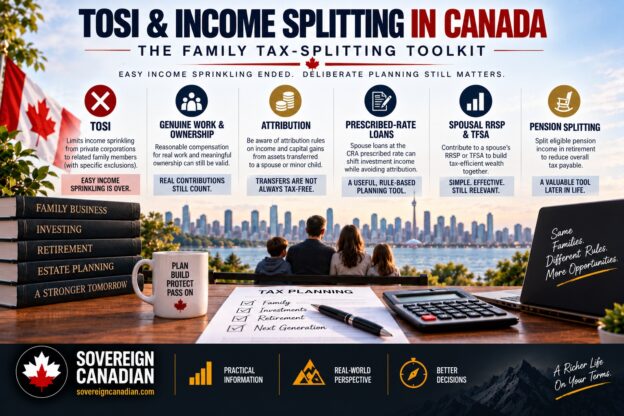
Ask any Canadian business owner what happened to income splitting and you will get the same answer: TOSI killed it. Before 2018, a private corporation could pay dividends to a spouse who did nothing, to adult children away at school, to whoever in the family sat in the lowest tax bracket that year. Then the rules changed, and the general understanding is that this entire category of planning simply stopped working.
That understanding is half right, which is the most dangerous kind of half right. What actually happened is narrower and more interesting than “income splitting is dead.” The Tax on Split Income did shut down one specific manoeuvre: paying private-company income to family members whose only qualification was being related to the person who owned the business. That manoeuvre is genuinely closed. But it was never the whole of income splitting, and treating it as though it were has left a lot of Canadian households ignoring a real, current, and in some cases newly attractive set of tools, while continuing to half-remember advice that stopped being true eight years ago.
Easy income sprinkling died, and deliberate structural planning became more important. Where the money sits, whose name is on the account, who genuinely works in the business, and when a retirement account gets tapped now matter more than what a corporation decides to pay out at year end. That shift is the subject of this piece.
TOSI and Attribution Are Not the Same Thing
Almost every piece of confused income-splitting advice traces back to conflating two rules that have nothing to do with each other.
TOSI, formally the tax on split income under section 120.4 of the Income Tax Act, is primarily about income connected to a related private business. It asks whether certain dividends, interest, capital gains and other amounts that flow to an individual from a related business fall within “split income” and, if so, whether one of the statutory exclusions applies. Where TOSI applies, the federal calculation effectively subjects that split income to the highest federal personal tax rate rather than allowing it to benefit from the recipient’s lower tax brackets. The basic personal amount and most other credits cannot be used to reduce the federal TOSI calculation; the disability, dividend and foreign tax credits receive specific treatment. This is not, strictly, a recharacterization of the income into something else. It is a special tax regime designed to stop private businesses from being used as income-sprinkling machines.
The CRA’s guidance on the split-income rules for adults is useful here because the exclusions matter just as much as the basic TOSI rule.
Attribution is a completely different animal, and it has existed in something like its current form since long before TOSI was a gleam in anyone’s eye at Finance Canada. It has nothing to do with whether someone owns a business. It asks whether property—an investment, a portfolio, cash that gets invested—was transferred or loaned between certain related people, most commonly spouses or minor children. If a spouse gives the other spouse a stock portfolio, the dividends and capital gains that portfolio produces generally keep belonging, for tax purposes, to the spouse who gave it away, regardless of whose name is on the brokerage statement. A gift to a minor child generally pulls interest and dividend income back to the parent, though capital gains are treated differently. There does not need to be a business anywhere in this story. A retiree with no corporation who gifts a rental property to a spouse can run into attribution just as a business owner can.
Because these are separate regimes, a given arrangement can have a TOSI problem, an attribution problem, both, or neither, and the fix for one does nothing for the other. A father who gives his adult daughter fifty thousand dollars to invest generally has no attribution problem under the ordinary family attribution rules merely because she is his adult child. But if that same daughter is also a minority shareholder in her father’s consulting firm and receives a dividend from it, TOSI is a live question, because TOSI cares about the private-business connection rather than whether a gift of investment property occurred. Meanwhile, a couple with no business whatsoever, where one spouse simply gives the other spouse an investment account, can have an attribution problem and no TOSI exposure at all.
Keep those two questions separate as you read the rest of this, because almost every strategy below is really an answer to only one of them.
The Working Couple
Take an Ontario couple with no corporation. Spouse A earns $250,000 a year in employment income. Spouse B earns $60,000. At Ontario’s 2026 combined federal and provincial rates, Spouse A’s marginal rate is far higher than Spouse B’s, whose next dollars of ordinary income sit around the 29.65 percent combined federal-Ontario rate. At still higher incomes, Ontario’s top combined ordinary-income rate reaches roughly 53.53 percent. That spread is the entire reason income splitting is worth thinking about for this household, and it is also exactly why the obvious move does not work.
Spouse A cannot simply have $50,000 of employment income redirected to Spouse B and expect it to be taxed as Spouse B’s income. Employment income belongs, for tax purposes, to whoever actually did the work that earned it. There is no mechanism, notional or otherwise, that lets a paycheque be assigned to someone else the way a dividend can sometimes be allocated among shareholders. Nor can Spouse A simply hand Spouse B an existing investment portfolio and walk away. If income-producing property moves from one spouse to another without structuring the transfer to fit an exception to the attribution rules, the resulting income and capital gains can be pulled straight back to Spouse A for tax purposes. Giving your spouse your portfolio does not give your spouse your tax bracket.
What this couple can actually do does not happen in an afternoon. It happens over years, through decisions about whose money funds what.
The simplest version requires no prescribed-rate loan, no special election, and no corporation. Spouse A pays a larger share of genuine household consumption expenses—groceries, utilities, insurance, children’s expenses and the other costs of running the household—out of Spouse A’s own after-tax income. Spouse B invests a correspondingly larger share of Spouse B’s own paycheque, directly, into an account in Spouse B’s own name. Nothing has been transferred from Spouse A into that investment account. Spouse B’s investments are funded by Spouse B’s own earned income, which was always Spouse B’s to begin with.
We found no CRA ruling addressing this exact household arrangement. The logic instead comes from the underlying attribution rules: if Spouse B invests Spouse B’s own earned income, there has been no transfer of that investment capital from Spouse A. Ten years of doing this consistently can produce a meaningfully sized portfolio taxed entirely in Spouse B’s hands, built from money that was never Spouse A’s to begin with.
The place this gets messy is commingling. If Spouse A’s paycheque and Spouse B’s paycheque land in the same joint account and the money that eventually gets invested in “Spouse B’s account” can no longer be traced cleanly to Spouse B’s own earnings, the arrangement starts to look more like an indirect transfer. The clean version requires Spouse B’s own income to flow clearly into Spouse B’s own investments, not through a shared pool funded heavily by Spouse A. Similar tracing questions can arise around mortgage principal on jointly owned property, jointly funded investment accounts and heavily commingled bank accounts. Separate labels on paper do not change where the money actually came from.
Registered accounts offer a second, cleaner lane. Spouse A can give Spouse B cash to put into Spouse B’s own TFSA, and CRA explicitly says the amount and the income earned on it will not be attributed back to Spouse A while using this TFSA contribution strategy. CRA specifically identifies giving money to a spouse or common-law partner to fund their TFSA as an available option.
There is an important technical wrinkle once money is withdrawn and then invested outside the TFSA: CRA has taken the position in technical interpretation that substituted-property attribution can become relevant again. The practical point is simpler than the tax terminology makes it sound: funding a spouse’s TFSA is expressly permitted, but do not assume the attribution exemption necessarily follows the money forever after it leaves the TFSA.
A spousal RRSP is the third lane, and it remains genuinely useful even though pension income splitting, covered later in this piece, reduced some of the need to perfectly equalize registered retirement balances. Spouse A contributes to a plan registered in Spouse B’s name, using Spouse A’s own contribution room, and gets the deduction at Spouse A’s higher marginal rate.
The catch is timing. If the contributing spouse made contributions to any of the spouse’s spousal RRSPs in the withdrawal year or either of the two preceding calendar years, some or all of a withdrawal can attribute back to the contributor. This is a calendar-year rule, which makes timing matter. A contribution in December 2024 can potentially be outside the attribution window for a withdrawal beginning in January 2027, assuming there are no later spousal contributions. Move that contribution just one month later to January 2025 and the clean withdrawal date potentially moves to January 2028. CRA explains the attribution period in its guidance on withdrawals from spousal or common-law partner RRSPs.
One practical exception is important: once the plan becomes a spousal RRIF, the attribution calculation applies to withdrawals above the RRIF minimum rather than the mandatory minimum itself. That makes the three-year window primarily a constraint on discretionary withdrawals above the minimum once the money is in a RRIF.
For a couple whose taxable, non-registered savings eventually grow large enough that lending, rather than gifting, starts to make sense, there is a fourth option, and it deserves its own section.
Prescribed-Rate Loans: The Strategy That Gets Interesting at Scale
A prescribed-rate loan is the place where the attribution rules provide a deliberate escape hatch, and it works like this. Spouse A lends money to Spouse B, in writing, at an interest rate no lower than the prescribed rate applicable when the loan is made. Spouse B invests the borrowed money. As long as the arrangement satisfies the statutory requirements and Spouse B actually pays Spouse A the required interest no later than 30 days after the end of each calendar year—January 30 in the usual case—the investment income can remain taxable to Spouse B rather than attributing back to Spouse A.
The rate is locked in when the loan is created. It does not rise later simply because the quarterly prescribed rate changes.
That rate has been unusually favourable lately. It was 4 percent through the first half of 2025, dropped to 3 percent effective July 1, 2025, and has stayed at 3 percent through every quarter of 2026. CRA has confirmed that the relevant rate remains 3 percent for the fourth quarter of 2026. CRA publishes the prescribed interest rates for each calendar quarter.
The mechanics matter more than the headline number, and this is where a lot of casual description of the strategy goes wrong. The loan does not sweep the entire investment return into the lower-income spouse’s bracket. Spouse B owes Spouse A real interest on the loan, at whatever rate was locked in, and Spouse A reports that interest as ordinary income, taxed at Spouse A’s own rate, same as any other interest income Spouse A receives. What effectively shifts to Spouse B’s lower bracket is the investment return remaining after the deductible interest expense. The wider the spread between investment income and the prescribed-rate interest cost, the larger the potential benefit.
Run the numbers on a $500,000 loan at the current 3 percent rate, from a spouse taxed at Ontario’s top combined rate of 53.53 percent to a spouse whose other income keeps them in the 29.65 percent bracket even after the additional investment income is added, treating the entire portfolio return as ordinary interest income to keep the comparison simple:
| 4% portfolio return | 6% portfolio return | 8% portfolio return | |
|---|---|---|---|
| Portfolio income | $20,000 | $30,000 | $40,000 |
| Interest owed to the lending spouse | $15,000 | $15,000 | $15,000 |
| Borrowing spouse’s net taxable investment income | $5,000 | $15,000 | $25,000 |
| Tax paid by borrowing spouse | $1,483 | $4,448 | $7,413 |
| Tax paid by lending spouse on the interest received | $8,030 | $8,030 | $8,030 |
| Total household tax | $9,513 | $12,478 | $15,443 |
| Tax if the lending spouse simply held the $500,000 directly | $10,706 | $16,059 | $21,412 |
| Annual household tax saved | $1,193 | $3,581 | $5,969 |
Notice what drives that last row. It is not the loan itself. It is the gap between the 3 percent the borrowing spouse pays the lender and however much taxable investment income the portfolio actually generates above that. A portfolio that barely clears the hurdle saves the household very little; at an 8 percent ordinary-income return, this simplified model produces nearly six thousand dollars a year of tax savings.
The economics change materially with the type of investment return. Capital gains already receive preferential treatment compared with ordinary interest income, so the baseline tax cost to the higher-income spouse is lower and the potential tax advantage from shifting the return is correspondingly smaller. Interest deductibility also depends on the borrowed money having the required income-earning purpose, so a strategy built entirely around assets expected only to appreciate in value deserves more care than this simplified interest-income example suggests.
None of this works if the paperwork is loose. The loan needs to be a real loan, documented properly, with the required interest actually paid by January 30, not merely accrued on a spreadsheet. Missing that deadline even once does not just cost the borrower the attribution exception for that particular year. The same indebtedness fails the exception in subsequent years as well.
Repaying a failed or higher-rate loan and establishing a genuinely new one may be possible, but it should not be treated as a casual rate-reset button. The repayment and replacement need to be real transactions and the specific facts matter. This is one of those strategies where a few hundred dollars of professional setup can be much cheaper than years of getting the tax treatment wrong.
Where TOSI Actually Bites: The Business Owner
Everything up to this point has involved no corporation at all. Once a family business enters the picture, TOSI becomes the dominant question, and this is where the “income splitting is dead” myth does the most damage, because it stops business owners from noticing which options genuinely survived and which did not.
This also fits into the broader corporate-structure questions in the Sovereign Canadian Business Ownership roadmap. A HoldCo, multiple corporations or a different share structure can solve legitimate ownership, capital-allocation and risk-separation problems, but adding another corporation does not by itself make TOSI disappear.
Consider a private Ontario corporation and six different ways it could get $60,000 to the owner’s spouse in a given year.
| Scenario | What happens under TOSI |
|---|---|
| $60,000 dividend, spouse does no work and holds no qualifying shares | Generally exposed to TOSI |
| $60,000 salary for genuine work at reasonable compensation | Salary itself is outside TOSI; ordinary employment and deductibility rules apply |
| $60,000 dividend, spouse genuinely meets the excluded-business test | Can be excluded from TOSI |
| $60,000 dividend, spouse met the excluded-business test in any five prior years | Can continue to qualify for the exclusion |
| $60,000 dividend, spouse owns shares that independently qualify as excluded shares | Can be excluded if all statutory conditions are met |
| $60,000 dividend, owner is 65 or older and the spouse can rely on the special spouse rule | Can potentially be excluded where the statutory conditions are satisfied |
Five of these six scenarios can potentially escape TOSI if the stated conditions are genuinely satisfied. The first generally cannot. For the others, the result turns on the underlying facts actually matching the exception being relied on. A simplified table is not a substitute for the statute.
The excluded-business rule provides one of the clearest paths. CRA generally considers an individual actively engaged in the business for a year if the individual works an average of at least 20 hours per week during the portion of the year that the business operates. An individual can also qualify based on meeting that test in any five prior taxation years; those years do not have to be consecutive.
The excluded-shares test is different. For an adult who has reached age 25, the individual must directly own shares representing at least 10 percent of both votes and value. The corporation cannot be a professional corporation for purposes of this TOSI rule, less than 90 percent of its business income can come from providing services, and its income cannot be derived directly or indirectly from another related business in respect of the individual, other than a business of the corporation itself.
That services condition quietly rules out many consulting firms, agencies and other predominantly service businesses. A product-oriented or capital-intensive company may have a real path to the excluded-shares exception where a pure consulting company does not.
Where neither of those clearer exceptions applies, the reasonable-return exception can still matter. Rather than turning on a single threshold, it considers the work the family member performed, property contributed to the business, risks assumed, amounts already paid and other relevant factors. CRA says it generally does not intend to substitute its judgment where taxpayers have made a genuine good-faith attempt to determine a reasonable amount using those criteria, but the taxpayer still needs to be able to support the analysis. Having contributed something to the business in a general sense does not make any dividend amount reasonable.
For many incorporated businesses, employing a spouse for real work at a defensible salary can therefore be structurally cleaner than trying to engineer a dividend around one of TOSI’s exceptions. Salary is not split income for TOSI purposes. Instead, the corporation has to satisfy the ordinary rules governing the deductibility and reasonableness of compensation.
That does not make salary automatically safe. The work needs to be real. The spouse should have actual duties, genuinely work the hours being claimed, and receive compensation that can be defended against what the business would reasonably pay for comparable work. Payroll needs to be run properly, with the required source deductions and reporting. A fabricated salary for invented work is not rescued merely because TOSI does not apply to salary.
Salary and dividends also differ in ways that have nothing to do with TOSI. Salary is generally deductible to the corporation, creates RRSP room for the recipient and normally involves CPP contributions. Dividends are paid from after-tax corporate income, do not create RRSP room and do not themselves generate CPP participation. None of that makes dividends wrong where a spouse legitimately qualifies for a TOSI exclusion. It means TOSI is only one piece of the compensation decision.
Adding a spouse as a shareholder, by itself, does not solve anything. Ownership alone answers none of the questions TOSI actually asks.
The Retirement Years Change Everything
Everything discussed so far requires the household to build something, over years, with genuine ownership and genuine documentation behind it. Retirement is different. Parliament built explicit income-splitting mechanisms directly into the retirement system.
The first is pension income splitting. Once a couple has eligible pension income, qualifying income can be allocated between spouses through an annual joint election on Form T1032. The transferring spouse can allocate up to 50 percent of eligible pension income to the receiving spouse, and the receiving spouse can participate regardless of their own age if the other conditions are satisfied. Qualifying registered pension plan income can be eligible regardless of the transferring spouse’s age, while RRIF and certain other retirement income generally become eligible once the spouse who actually receives that income is 65 or older.
Nothing actually moves between accounts. Each spouse still files an individual tax return; the election changes the amount of pension income reported by each for tax purposes. CRA’s pension-income-splitting guidance sets out the current eligibility and election mechanics.
The obvious benefit is bracket arbitrage, moving taxable income from a higher-income spouse to a lower-income spouse. The less obvious benefit involves income-tested programs, particularly the OAS recovery tax. For 2026 income, the minimum OAS recovery threshold is $95,323. Pension splitting can sometimes push the higher-income spouse back below that threshold without pushing the receiving spouse above it.
Take a couple where one spouse, 65 or older, has $90,000 of RRIF income, $15,000 of CPP, and roughly $8,700 of OAS, putting their income at approximately $113,700 before other adjustments. The other spouse has $8,000 of CPP, roughly $8,700 of OAS and $12,000 from a small non-registered investment account, putting them around $28,700.
If the higher-income spouse elects to allocate $45,000—half of the eligible RRIF income—to the lower-income spouse, the higher-income spouse falls to roughly $68,700 while the lower-income spouse rises to roughly $73,700. In this simplified illustration, both end up below the $95,323 OAS threshold. Compared with leaving the full RRIF withdrawal with the first spouse, that can eliminate roughly $2,757 of OAS recovery tax, before even considering the ordinary income-tax effect of shifting taxable pension income between brackets.
The receiving spouse may also become entitled to the pension income amount because the allocated pension income is treated as eligible pension income in their hands for that purpose. That makes pension splitting more than a simple comparison of two marginal tax rates.
CPP pension sharing is entirely different. It is not a tax-return election. It is an application to Service Canada that changes how the couple’s actual CPP retirement pensions are paid. The amount available for sharing depends on the couple’s CPP circumstances and the portion of their contributory periods during which they lived together. If both contributed, portions of both pensions may be shared; if only one contributed, part of that pension may be shared. The combined CPP retirement pension does not increase simply because the couple uses pension sharing.
CPP sharing and CRA pension-income splitting are therefore separate mechanisms, and a couple can potentially use both.
The spousal RRSP deserves a second look here because pension income splitting reduced some of the pressure to perfectly equalize RRSP balances between spouses without making spousal RRSPs obsolete. The age condition for splitting eligible RRIF income turns on the spouse who actually receives the income before the split, not on the spouse receiving the allocation, so a 67-year-old with eligible RRIF income can generally split up to half of it with a 60-year-old spouse.
But that 50 percent ceiling matters. A couple drawing registered savings before the account holder’s income becomes eligible for pension splitting gets nothing from the election in those earlier years, and severely uneven balances cannot necessarily be fully equalized through pension splitting alone. A spousal RRSP funded years earlier puts actual registered assets in the lower-income spouse’s hands rather than relying entirely on an annual tax election later.
Adult Children: Splitting Income or Giving Away Wealth?
This is where the loosest thinking in popular income-splitting advice tends to show up.
Once a child is an adult, the ordinary spousal-and-minor attribution framework generally does not attribute investment income or gains on an outright gift back to the parent merely because of the parent-child relationship. A parent who genuinely gives a 25-year-old $100,000 in cash can therefore put the capital—and the future investment income on it—in the child’s hands.
The mistake is treating that as a clever tax result. It is not. It is what happens when a parent genuinely gives away $100,000. The money used to be the parent’s; now it is the child’s. The child pays tax on what the child’s own money earns, the same as any other adult would.
That distinction becomes much more important when thinking about wealth across generations, which is why I treated early transfers separately in Multi-Generational Wealth in Canada: How Do You Actually Build Wealth That Survives Generations?. A tax-efficient transfer is not automatically a good wealth-transfer decision. Control, timing, the child’s circumstances and the parent’s own retirement security still matter.
Where a loan rather than an outright gift makes sense for an adult child, the reason often has more to do with retaining a legal claim to the principal than with the ordinary spousal/minor attribution rules. A documented loan can preserve an expectation of repayment, create a clearer paper trail and allow the parent to retain a degree of control that an outright gift permanently gives up.
There is, however, a broader anti-avoidance rule for certain low-interest or interest-free non-arm’s-length loans where one of the main reasons for the indebtedness is to reduce or avoid tax. That is another reason not to turn the adult-child point into the categorical claim that an interest-free family loan can never create an attribution issue. The cleaner statement is narrower: the ordinary attribution rules applying specifically to spouses and related minors do not simply extend to every adult child because of the family relationship.
Where TOSI can still reach an adult child is the same place it reaches other adult family members: a private-business connection. An adult child who holds shares in the family corporation or receives income connected to a related business can still face the TOSI rules. Becoming an adult does not make TOSI disappear.
What’s Actually Dead
A few specific things really did stop working, and old advice still describing them as live options is simply out of date.
Paying dividends to a spouse or adult child who does no work, contributes no meaningful capital, assumes no relevant risk and satisfies none of TOSI’s exclusions, purely because that person sits in a lower bracket, is no longer the straightforward strategy it once was. Routing the same private-business income through a discretionary family trust does not make TOSI disappear either. Simply issuing a spouse or adult child shares in the family corporation is not enough on its own; the actual TOSI exclusions still have to be satisfied.
And the federal Family Tax Cut, a temporary credit worth up to $2,000 that let an eligible higher-income parent with a child under 18 notionally transfer up to $50,000 of taxable income to a spouse for the calculation, existed for only the 2014 and 2015 tax years. It was eliminated beginning in 2016. If you find an article recommending it today, you have found an old article.
The Real Question Isn’t This Year’s Tax Bill
The tax return is where all of this eventually shows up, but it is the last step in the process, not the first. By the time a couple files a return claiming a pension split, or a business owner’s spouse reports a dividend that clears an excluded-shares test, or an adult child reports investment income on money a parent gave away years earlier, the decisions that actually mattered were made long before, often years before.
The more useful questions sit further back than the return itself. Whose earned income actually funded a given investment. Who genuinely works in the business, and for how long. Who put capital at real risk, and who simply holds a share certificate. Which spouse’s registered account received a contribution, and in which calendar year. When a retirement account will actually be tapped, and at what age. What happens to an arrangement if a marriage ends, a business is sold, or a family member’s circumstances change in ways nobody planned for.
None of that is answered by minimizing this year’s tax bill. It is answered by managing the household’s after-tax wealth over a lifetime, with enough attention paid to control, liquidity and flexibility that the structure still makes sense a decade from now, not just on the return sitting in front of you this April.
TOSI closed one narrow, specific door. Everything else in this piece is the door that stayed open, provided someone actually walks through it early enough for it to matter.
This is general information about Canadian tax rules current as of 2026, not personalized tax or legal advice. Ontario rates were used throughout for illustration; other provinces will produce different numbers from the same mechanics. Anyone applying these strategies to their own situation should work through the specifics with a qualified accountant or tax lawyer before acting.