
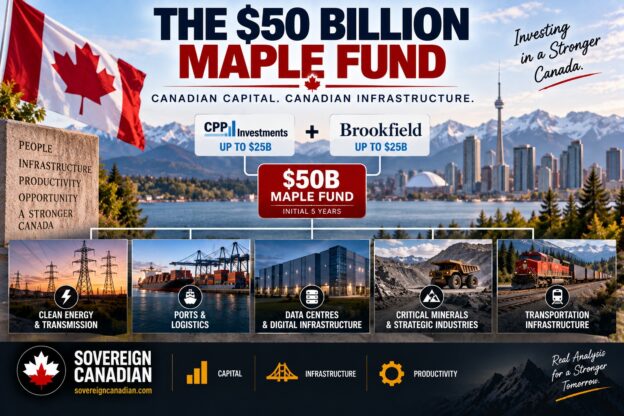
One of the announcements that caught my attention coming out of this week’s Canada Investment Summit was the creation of something called the Maple Fund.
The headline number is enormous: $50 billion.
CPP Investments and Brookfield Asset Management have created a new framework to pursue some of the largest infrastructure and strategic investments in Canada. Each organization could put as much as $25 billion into it over the next five years.
I covered the broader summit in Canada’s $1 Trillion Investment Boom: What the Investment Summit Actually Means for Canadians. The important distinction there was between capital being announced and capital actually being deployed.
The Maple Fund deserves the same treatment.
But I also think it raises a more interesting question for an individual investor.
If two of the most sophisticated pools of capital in Canada are preparing to invest tens of billions of dollars into Canadian infrastructure and strategic industries, is there any practical way for an ordinary Canadian to invest alongside them?
The answer is yes, sort of.
But it is not as simple as buying “the Maple Fund.”
What the Maple Fund Actually Is
First, the name is slightly misleading.
This is not a conventional investment fund that has raised $50 billion and is now sitting on that money waiting to invest it.
CPP Investments and Brookfield describe the Maple Fund as a joint cooperation framework through which they can generate and execute up to $50 billion of equity investments in large Canadian projects.
The basic structure is straightforward.
CPP Investments can provide up to $25 billion.
Brookfield can provide up to $25 billion.
Investments are expected to be structured 50/50 between them, initially over a five-year period.
And these are not small projects.
The partnership is specifically looking for opportunities requiring more than $5 billion of equity capital. Other investors can also be brought into individual transactions.
That puts the Maple Fund in a very different category from most infrastructure investing.
We are potentially talking about major energy systems, transportation infrastructure, digital infrastructure, industrial projects and other assets that require billions of dollars simply to get built.
There is another important qualification.
Neither CPP Investments nor Brookfield has blindly committed $25 billion to whatever comes along.
Each individual investment still has to be independently assessed and approved through each organization’s normal investment and governance processes. Both organizations are also free to pursue other investments independently.
So I would read the headline as:
Up to $50 billion of investment capacity has been created.
Not:
$50 billion has been invested.
That distinction matters.
You Already Have Some Exposure Through CPP
There is a slightly strange answer to the question of how Canadians can participate in the Maple Fund.
Millions of us already do.
CPP Investments manages the assets backing the Canada Pension Plan. At June 30, 2026, the CPP Fund had approximately $864 billion in assets.
If the Maple Fund makes successful investments, those returns ultimately become part of the much larger CPP investment portfolio.
That is useful, but it isn’t particularly actionable.
I can’t decide that I like the Maple Fund and contribute another $20,000 to CPP Investments.
The more interesting side of the partnership is Brookfield.
Because Brookfield is publicly traded.
Unfortunately, this is also where things get complicated.
Which Brookfield Are We Talking About?
Anyone who has looked at Brookfield before knows that buying “Brookfield” isn’t quite as simple as it sounds.
There is Brookfield Asset Management.
There is Brookfield Corporation.
There is Brookfield Infrastructure.
There is Brookfield Renewable.
And there are several other parts of the Brookfield ecosystem.
For the Maple Fund, I think the two most interesting securities to understand are Brookfield Asset Management (TSX/NYSE: BAM) and Brookfield Corporation (TSX/NYSE: BN).
They provide very different kinds of exposure.
BAM: Owning the Asset Manager
Brookfield Asset Management is the cleaner business to understand.
BAM is an asset-light alternative asset manager.
As of 2026, Brookfield reports more than US$1 trillion of assets under management and more than US$600 billion of fee-bearing capital.
The business manages money for pension funds, sovereign wealth funds, institutions, insurance companies and other investors. It earns fees for doing that and can also participate in investment performance through carried interest.
In simplified terms, BAM is in the business of managing other people’s capital.
That makes the Maple Fund interesting.
CPP Investments brings an enormous pool of long-duration capital. Brookfield brings capital too, but it also brings something else: its ability to originate, develop, operate and execute very large investments.
If the Maple Fund develops into a much larger Canadian investment platform, Brookfield’s role in that process could have economic value.
But there is an important limitation.
The Maple Fund announcement does not establish that $50 billion suddenly becomes $50 billion of new fee-bearing capital for BAM.
That would be a major leap.
The public announcement does not spell out conventional fund management fees or carried-interest arrangements between CPP Investments and Brookfield. It describes a 50/50 investment framework.
So I would not buy BAM on the theory that Brookfield has suddenly added another $50 billion to its conventional fee-paying private funds.
What I do find interesting is the larger pattern.
Brookfield has built an enormous business around putting institutional capital into infrastructure, energy, real estate, credit, private equity and other real assets.
The Maple Fund is another demonstration of the position Brookfield has created for itself.
When enormous pools of institutional capital need somewhere to go, Brookfield is increasingly one of the organizations capable of originating, structuring and operating investments large enough to absorb it.
That is a much broader investment thesis than the Maple Fund itself.
BN: Owning More of the Brookfield Machine
Brookfield Corporation is different.
BN owns operating businesses and investments across the Brookfield ecosystem, along with a very significant ownership interest in Brookfield Asset Management itself.
According to Brookfield Corporation’s current financial reporting, BN holds approximately 74% of BAM.
So buying BN gives an investor indirect exposure to BAM, but also to Brookfield’s broader collection of invested capital and operating businesses.
That changes the investment proposition.
With BAM, I am primarily interested in the economics of managing capital.
With BN, I am buying into a much broader capital-allocation machine.
If Brookfield itself ends up committing billions of dollars of capital alongside CPP Investments, that broader exposure becomes relevant.
It also means BN is not a pure Maple Fund investment either.
Far from it.
An investor buying BN is buying an enormous global organization with assets and businesses extending well beyond Canada and well beyond whatever eventually happens with the Maple Fund.
What About Brookfield Infrastructure or Brookfield Renewable?
The other tempting conclusion is that the Maple Fund is about infrastructure, therefore I should buy Brookfield Infrastructure Partners (BIP/BIPC).
Or that much of Canada’s investment push involves energy, therefore I should buy Brookfield Renewable (BEP/BEPC).
Maybe those businesses eventually participate in individual projects.
But I wouldn’t make that assumption today.
The Maple Fund announcement is between CPP Investments and Brookfield Asset Management. It does not say that projects will automatically be placed into BIP, BEP or any other publicly traded Brookfield vehicle.
Those companies should therefore be evaluated on their own merits.
They may eventually own assets that fit the same Canadian investment theme.
That isn’t the same thing as saying that buying BIP gives me a share of the Maple Fund.
It doesn’t.
The More Interesting Question: Where Does the $50 Billion Go?
This is where I think the story becomes much more interesting for a Sovereign Canadian.
Instead of asking:
How do I invest in the Maple Fund?
Ask:
If $50 billion actually gets invested, who gets paid?
Imagine that CPP Investments and Brookfield eventually approve a $7 billion infrastructure project.
The institutional investors provide the equity and ultimately expect to earn a return on that capital.
But before they earn that return, somebody has to actually build the thing.
Engineering firms get paid.
Construction companies get paid.
Electrical equipment manufacturers get paid.
Automation companies get paid.
Industrial contractors get paid.
Transportation and logistics businesses get paid.
Environmental consultants get paid.
Software companies get paid.
Equipment suppliers get paid.
And once the asset exists, somebody has to operate, inspect, repair and maintain it for the next several decades.
That is exactly why I don’t think the most interesting way to position for Canada’s proposed investment boom is necessarily to buy a basket of infrastructure assets.
In the broader Investment Summit analysis, I came to a similar conclusion.
Follow the spending, not just the capital.
The $50 Billion Could Become Much More Than $50 Billion of Economic Activity
There is another subtle point in the announcement.
The $50 billion number refers to potential equity investment.
The projects themselves can have additional financing and can bring in additional investors.
That means the total value of the infrastructure and businesses ultimately associated with Maple Fund investments could be larger than the amount contributed by CPP Investments and Brookfield themselves.
We don’t yet know whether that will happen.
We don’t even know which projects will qualify.
But it illustrates why the second-order effects may eventually matter more to individual investors than trying to find a direct Maple Fund proxy.
If enormous projects actually move from announcement to construction, billions of dollars start flowing through an ecosystem of suppliers.
And some of those suppliers are much smaller businesses.
The Private Business Angle May Be Even More Interesting
This is where the Maple Fund intersects with another recurring theme on Sovereign Canadian: business ownership.
Imagine two investments.
One is a tiny indirect ownership interest in a $10 billion infrastructure asset.
The other is ownership of a $5 million industrial service business that maintains equipment used across several infrastructure projects.
Those are obviously completely different investments.
The infrastructure asset may have extraordinary durability and relatively predictable long-term cash flows.
The small business has customer concentration risk, operating risk, employee risk and considerably more work attached to it.
But it can also have something the infrastructure asset doesn’t:
a much smaller denominator.
A modest Canadian company does not need to capture billions of dollars of infrastructure spending to materially increase its revenue.
A specialized electrical contractor, industrial automation company, equipment distributor, filtration company, machine shop or maintenance provider might only need another $1 million or $2 million of recurring annual business for the effect on the owner to be enormous.
That is one reason I’m increasingly interested in the operating layer underneath Canada’s investment plans.
I don’t need to own the railway.
Owning a profitable business that the railway pays every month can also be a very good place to sit.
This Is Also Different From the Canada Strong Fund
There is another new Canadian investment initiative that could easily be confused with the Maple Fund.
Earlier this year I wrote an introduction to the Canada Strong Fund.
The two should not be conflated.
The Canada Strong Fund is a separate government-backed Canadian investment initiative.
The Maple Fund is different. It is a cooperation framework between CPP Investments and Brookfield Asset Management for very large institutional investments.
There is currently no Maple Fund ETF, mutual fund or retail share class that I can buy.
For individual investors, participation therefore has to be indirect.
So How Could a Canadian Actually Position Around the Maple Fund?
I see several distinct layers, and they shouldn’t be confused with one another.
The first is CPP. Most working Canadians already have indirect exposure, but we can’t meaningfully increase it at will.
The second is BAM. That provides exposure to Brookfield’s asset-management business. If the Maple Fund strengthens Brookfield’s ability to deploy institutional capital and creates incremental management or performance economics, BAM could participate. But the announcement itself doesn’t tell us how much.
The third is BN. That gives broader exposure to Brookfield, including its large ownership stake in BAM and its own invested capital. It is a much wider investment than the Maple Fund.
The fourth is Brookfield’s listed infrastructure and renewable vehicles. They could potentially participate in the same themes, but I have seen nothing establishing that they will automatically receive Maple Fund assets.
The fifth is the public companies that actually supply Canadian infrastructure development.
And the sixth is the private-business layer: contractors, service businesses, equipment distributors, industrial maintenance companies and other firms that earn revenue from the assets being built.
Those are six quite different bets.
The right question isn’t simply which ticker has “Brookfield” in its name.
It is which part of the economic chain I actually want to own.
What I Am Watching Next
The announcement itself isn’t enough to make the Maple Fund an investment thesis.
The next announcements will be much more useful.
I want to see the first actual transaction.
What sector is it in?
How much equity is required?
How is it financed?
Which Brookfield entity actually provides the capital?
Does BAM earn management fees or other economics from the arrangement?
Do BIP, BEP or other Brookfield vehicles participate?
Who receives the major construction and equipment contracts?
And perhaps most importantly, does the first transaction demonstrate that these enormous Canadian projects can actually get through financing, permitting and development and into construction?
Those answers will tell us much more than the $50 billion headline does.
The Sovereign Canadian Take
I don’t think the Maple Fund is a reason, by itself, to run out and buy Brookfield stock.
The announcement is too early and the economics are too undefined for that.
But I do think it reinforces something more important.
Canada appears to be trying to create the institutional architecture required to finance projects on a scale that has been difficult to achieve here for a long time.
The Canada Investment Summit brought together the capital.
The Maple Fund creates one mechanism for deploying some of it.
Now the projects have to get built.
If they do, there will be several places along that chain where value accumulates.
Brookfield may earn money managing and deploying capital.
Brookfield Corporation may earn returns on capital it invests.
Infrastructure owners may earn returns for decades.
Public suppliers may sell billions of dollars of equipment and services.
And smaller Canadian businesses may quietly make very good money building, maintaining and servicing everything underneath it.
That last layer is easy to overlook because it doesn’t generate a $50 billion press release.
For an individual Canadian trying to build wealth, however, it may ultimately be the most interesting part of the story.
I don’t necessarily need to invest in the Maple Fund.
I want to understand where the Maple Fund’s money eventually goes.