
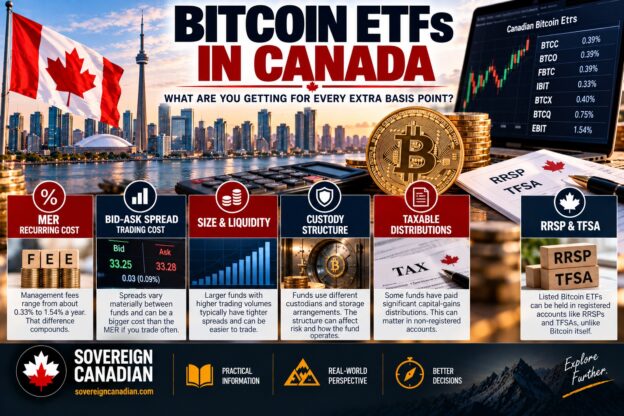
A Canadian can buy a Bitcoin ETF that costs about 0.33% a year, or one that costs more than 1.5%. Either way, the investor ends up with exposure to the same Bitcoin. On CAD 100,000, that is roughly CAD 330 a year versus CAD 1,540 a year, before any compounding.
So what is the more expensive fund doing for the extra money?
The answer is more nuanced than “buy the cheapest one.” The annual fee recurs, but bid-ask spreads are paid when you trade. Custody structures differ. In a taxable account, some of these funds have paid out large capital-gains distributions. And Canadians are not limited to Canadian-listed funds, even inside an RRSP or TFSA.
This article assumes you have already decided you want Bitcoin through an ETF. It does not argue for or against owning Bitcoin. Figures are dated throughout because they come from different measurement periods and are not simultaneous quotes.
The Seven Funds at a Glance
Seven Canadian-listed funds currently hold Bitcoin directly or through a Bitcoin trust. The table is listed by issuer, not ranked by quality. Assets are as of October 1 or 2, 2026. MERs are the latest full-year figure unless noted. Spreads are 12-month averages from each fund’s ETF Facts document, and the measurement periods differ.
| Fund | Ticker | Assets (CAD) | Management fee | MER | Average spread (period) | Custody and structure |
|---|---|---|---|---|---|---|
| Purpose Bitcoin ETF | BTCC | about 2.2 billion | 1.00% | 1.29% (to Jun 30, 2026) | Current figure not verified in this review | Cidel custodian; Gemini, Coinbase Custody and Anchorage sub-custodians |
| Purpose Core Bitcoin ETF | BTCO | about 50 million | 0.29% | 0.39% (to Jun 30, 2026) | Current figure not verified in this review | Same Purpose custody structure |
| Fidelity Advantage Bitcoin ETF | FBTC | about 1.86 billion | 0.32% | 0.35% (year to Mar 31, 2026) | 0.13% (12 months to Jun 30, 2025, older data) | Fidelity Clearing Canada; Fidelity Digital Asset Services sub-custodian |
| iShares Bitcoin ETF | IBIT | about 0.54 billion | 0.32% | 0.33% (2025) | 0.84% (12 months to Apr 30, 2026) | Holds the US iShares Bitcoin Trust; Cboe Canada listing |
| CI Galaxy Bitcoin ETF | BTCX | about 0.95 billion (CAD unhedged series) | 0.40% | 0.68% (2025) | 0.09% (12 months to May 31, 2026) | Cidel; Gemini and Coinbase sub-custodians |
| 3iQ Bitcoin ETF | BTCQ | about 0.25 billion | 1.00% | 1.40% (2025) | 0.31% (12 months to May 31, 2026) | Tetra Trust primary custodian; Coinbase Custody and Anchorage in the custody structure |
| Evolve Bitcoin ETF | EBIT | about 0.23 billion | 0.75% plus sales tax | 1.54% (2025) | 0.12% (12 months to Mar 31, 2026) | Cidel; Coinbase Custody sub-custodian |
Sources include the issuer pages above and the current or most recent retrievable ETF Facts and financial reports from Purpose, Fidelity, BlackRock, CI, 3iQ and Evolve.
One gap needs stating plainly. Purpose’s documents page now lists a Purpose Bitcoin ETF ETF Facts document dated September 25, 2026, but I was not able to extract and independently verify its current spread figure in this review. Purpose Core’s current spread likewise was not verified. I therefore do not substitute an older Purpose spread into the comparison. Fidelity’s 0.13% figure is also older than most of the other comparable figures.
Ignore the Headline Fee. Look at the MER.
The management fee is the advertised annual rate paid to the manager. The management expense ratio, or MER, is the trailing total of that fee plus operating expenses and applicable sales tax, expressed as a percentage of the fund’s average assets. It excludes brokerage commissions and the fund’s portfolio transaction costs. So it is a better guide than the headline fee, but it is not literally an all-in cost.
The gap between the two can be large. CI’s BTCX advertises a 0.40% management fee. Its latest full-year MER is 0.68%. Evolve’s EBIT charges 0.75% plus sales tax. Its latest full-year MER is 1.54%. Fidelity’s FBTC charges 0.32% and reports a 0.35% MER, a gap small enough to barely matter.
Rank these seven funds by management fee and you get one order. Rank them by MER and you get a noticeably different one. BTCX looks close to Fidelity on the advertised fee and costs roughly double on the MER. EBIT looks cheaper than Purpose’s and 3iQ’s flagship funds on the advertised fee and is the most expensive of the seven on the MER.
Check which period an MER covers. CI’s fund page shows a later interim MER above its 0.68% full-year figure, while its ETF Facts reports 0.68% for the year to December 31, 2025. 3iQ’s newer ETF Facts reports 1.40%. I use the latest full-year figure as the headline rather than mixing full-year and annualized interim periods.
What a One-Percentage-Point Difference Costs
An annual cost compounds. The arithmetic below assumes a CAD 100,000 starting investment and the same illustrative 8% gross annual return in every fund. This is arithmetic, not a Bitcoin forecast. The point is the cost difference, given identical gross returns.
| MER | Share of ending value lost to fees, 10 years | Share lost, 20 years |
|---|---|---|
| 0.35% | 3.2% | 6.3% |
| 0.68% | 6.1% | 11.9% |
| 1.29% | 11.3% | 21.4% |
| 1.54% | 13.4% | 25.0% |
After 20 years, the 0.35% fund finishes about CAD 26,000 ahead of the 0.68% fund, about CAD 70,000 ahead of the 1.29% fund and about CAD 87,000 ahead of the 1.54% fund, using those assumptions.
For a long holder, a recurring cost this size can become the dominant difference between otherwise similar funds.
The Lowest MER Is Not Necessarily the Cheapest Trade
This is where the “cheapest wins” shortcut breaks down.
The iShares Bitcoin ETF listed on Cboe Canada, ticker IBIT, has a 0.33% MER, the lowest of the seven. Its ETF Facts, dated June 19, 2026, show an average bid-ask spread of 0.84% and an average daily volume of 307,749 units, both for the 12 months to April 30, 2026. CI’s BTCX, with a 0.68% full-year MER, reports an average spread of 0.09% over the 12 months to May 31, 2026.
The two costs are paid differently. The MER accrues continuously through the fund and reduces its return over time. The spread is mainly incurred when you buy or sell.
On CAD 10,000, a 0.84% spread represents roughly CAD 84 across a round trip if conditions stayed similar, against roughly CAD 9 at 0.09%. That treats the published spread as the full bid-ask gap: the economic cost of crossing it once is roughly half the quoted spread on entry and half again on exit. Your actual execution can differ substantially, and limit orders can help prevent you from blindly crossing an unusually wide market.
Here is a rough illustration, not a trading rule. IBIT’s published spread disadvantage against BTCX is about 0.75 percentage points: 0.84% less 0.09%. Its MER advantage is about 0.35 percentage points a year: 0.68% less 0.33%.
On those figures, the lower MER takes a little over two years to recoup the extra round-trip spread, assuming both spreads and MERs stay near these levels, which they may not.
For a holder who buys and sits, the MER increasingly dominates. For someone trading in and out, the spread matters more. Neither fund wins this comparison outright because the answer depends on how long you plan to hold and what spread you actually receive when you trade.
Fund Size Is Not the Same Thing as Liquidity
Assets under management and trading liquidity are different measures. Size can matter because very small funds may face greater closure risk, and larger funds have more assets over which to spread fixed expenses. But the cost of buying and selling units is set by the market spread, which depends partly on how willingly market makers quote tight prices on the exchange.
Roughly, the sizes are: Purpose’s BTCC about CAD 2.2 billion, Fidelity’s FBTC about CAD 1.86 billion, CI’s BTCX about CAD 0.95 billion, Canadian IBIT about CAD 0.54 billion, 3iQ’s BTCQ about CAD 0.25 billion, Evolve’s EBIT about CAD 0.23 billion and Purpose Core’s BTCO about CAD 50 million.
ETFs also have a second layer of liquidity. Authorized participants and other large market participants can create or redeem units with the fund, which can help keep a fund’s market price near the value of its underlying holdings even when secondary-market trading in the ETF units is relatively light. A thinly traded ETF is not automatically unable to handle a sensible retail order. But it can still be more expensive to trade.
The published spreads show why volume alone is not enough. 3iQ’s BTCQ averaged 0.31%. CI’s BTCX averaged 0.09%. Evolve’s EBIT, much smaller than BTCX, averaged 0.12%. Fidelity’s FBTC, on older data, averaged 0.13%. And Canadian IBIT, despite substantial daily trading volume, averaged 0.84%.
One limit on all of this is the Purpose data. Purpose now lists newer ETF Facts for BTCC, but I was not able to independently extract the current spread from that document during this review. I therefore cannot say whether Canada’s largest Bitcoin ETF currently earns part of its higher annual cost through tighter trading. Check the current ETF Facts and live market before placing a meaningful order.
Who Actually Holds the Bitcoin?
The underlying Bitcoin is held through institutional custody arrangements that rely heavily on offline or cold storage. What differs is the chain of companies standing between you and the keys.
Purpose’s two funds use Cidel Trust Company as custodian. Cidel works with Gemini, Coinbase Custody and, since July 21, 2026, Anchorage Digital Bank as sub-custodians. Purpose describes this as the first three-sub-custodian model among Canadian digital-asset ETF managers. Its July 2026 announcement says Anchorage joined Coinbase and Gemini under the arrangement. How coins are divided among the three is not disclosed in the material I reviewed.
Fidelity’s FBTC uses Fidelity Clearing Canada as custodian and Fidelity Digital Asset Services, or FDAS, as sub-custodian. Fidelity says at least 98% of the Bitcoin is held in cold wallets. Under an Ontario Securities Commission decision, the Bitcoin sits in FDAS omnibus wallets alongside assets of other clients, with FDAS’s books and records identifying each client’s balance. The same decision says FDAS is not permitted to pledge, rehypothecate or otherwise use crypto assets it holds as sub-custodian for Fidelity Clearing Canada.
The OSC replaced the 2023 relief with a new decision dated November 7, 2025. In that decision, separate relief allowing FDAS to act as a foreign sub-custodian was no longer required because FDAS had come to satisfy the applicable NI 81-102 requirements.
CI’s BTCX uses Cidel with Gemini and Coinbase as sub-custodians, as described in CI’s prospectus.
3iQ’s custody structure has also changed. Tetra Trust remains the primary custodian, but on September 21, 2026, 3iQ announced that Anchorage Digital had been added as an additional sub-custodian under its multi-custody arrangement. Coinbase Custody has also been part of BTCQ’s custody structure.
Evolve’s more recent financial statements name Cidel and Coinbase Custody, correcting the Gemini reference in older Evolve launch material.
Canadian IBIT is different in kind. It puts substantially all of its investment exposure into the US-listed iShares Bitcoin Trust rather than directly holding the Bitcoin itself. The US trust uses Coinbase Custody as its Bitcoin custodian and Anchorage Digital Bank as an additional available custodian. BlackRock’s US filings say that, as of mid-2026, there were no plans to move Bitcoin to Anchorage, but the custody agreement was in place as an alternative.
Different logos therefore do not always mean different plumbing. Cidel, Coinbase, Gemini and increasingly Anchorage recur across these products.
The structural differences are still real: Fidelity’s affiliated custody, Purpose’s three-sub-custodian structure, 3iQ’s expanded multi-custody arrangement and Canadian iShares’ fund-of-fund layer. I have not ranked them by safety, and the evidence does not support doing so.
What Happens if Something Goes Wrong?
Two different risks are easy to blur together, so keep them apart.
The first is the risk that the investment manager fails. These funds are investment funds with assets held through custody arrangements rather than Bitcoin simply sitting as a corporate asset on the investment manager’s balance sheet. That makes a manager failure a different problem from a custodian failure.
I did not verify the complete insolvency, replacement-manager and termination provisions across every current prospectus, so I would not describe any of these structures as “bankruptcy-proof.”
The second is the risk that the entity actually safeguarding the private keys fails, is hacked or otherwise loses assets.
The documents contain liability standards and limits. CI’s prospectus, for example, describes limits on custodian and sub-custodian liability and warns that a loss can ultimately fall on the ETF when it occurs without the contractual breach or standard-of-care failure necessary to make another party liable. It also discusses limitations around insurance coverage.
So do not read “cold storage” or “institutional custody” as synonyms for “insured” or “risk-free.”
I found no documented loss of Bitcoin belonging to these Canadian ETF funds at the custodians involved, but the incident review was not exhaustive. That is not the same as establishing that no custody incident has ever occurred.
Why Evolve’s MER Is So Far Above Its Fee
Evolve’s EBIT is a useful case because the gap between its 0.75% management fee and its 1.54% full-year MER can at least partly be traced.
In its audited 2023 financial statements, custody fees were about 0.47% of average assets and index and exchange licensing about 0.12%, by my calculation from the reported expense lines. Smaller operating expenses added more, and with applicable sales tax the pieces roughly reproduce the 1.69% MER reported for 2023.
The latest full-year MER reported in the 2026 ETF Facts is 1.54%.
The extra cost is therefore not imaginary. Evolve has incurred substantial custody and operating expenses. But explaining why an ETF costs more is not the same thing as showing that an investor receives enough additional value to justify paying it.
Evolve’s ETF Facts also say the manager waived some expenses and that the MER would have been higher without those waivers. I found no contractual expense cap that would justify assuming those waivers are permanent.
A CAD Ticker Is Not a Currency Hedge
Bitcoin is generally quoted globally in US dollars. A Canadian-dollar unit of an unhedged Bitcoin ETF therefore reflects both the movement of Bitcoin in US-dollar terms and movements between the Canadian and US dollars.
Evolve’s own performance data illustrate the effect. Over the year to September 30, 2026, EBIT’s Canadian-dollar units returned -25.69%, while its US-dollar units, EBIT.U, returned -27.08%. The underlying Bitcoin exposure is the same; the difference between the two return series reflects the currency translation associated with the different unit currencies.
Hedged units also exist. Purpose’s BTCC is its Canadian-dollar FX-hedged ETF line, while BTCC.B is the Canadian-dollar non-FX-hedged line. Purpose’s prospectus describes the use of currency derivatives, including forward contracts, for hedging.
CI also offers a CAD-hedged series of BTCX.
A currency hedge changes the CAD/USD exposure. It does not hedge the Bitcoin price itself, and hedging can have its own costs and benefits.
Registered Accounts: The Main Reason to Use an ETF
Bitcoin itself is not a qualified investment for a TFSA, RRSP, RRIF, FHSA or RESP. The CRA’s qualified-investments folio explicitly says cryptocurrencies such as Bitcoin are not qualified investments.
But the same CRA folio says that, subject to specific exceptions, securities listed on a designated stock exchange are qualified investments and specifically includes units of exchange-traded funds. That is why a listed Bitcoin ETF can qualify even though Bitcoin itself does not.
The CRA also notes that financial institutions can impose their own restrictions on what they allow inside registered plans.
For Canadians deciding which tax shelter makes more sense in the first place, I covered the broader account decision separately in RRSP vs TFSA: The Decision Changes as Your Income Rises.
Canadians are also not confined to Canadian-listed Bitcoin ETFs.
The Department of Finance’s current list of designated stock exchanges, last modified March 27, 2026, includes the Toronto Stock Exchange, Cboe Canada, Nasdaq, NYSE Arca and BATS Exchange.
That last name matters. The US Securities and Exchange Commission’s current list of national securities exchangesidentifies Cboe BZX Exchange as the former Bats BZX Exchange and, before that, BATS Exchange.
Major US spot Bitcoin ETFs trade on those exchanges: US-listed IBIT on Nasdaq, Fidelity’s US FBTC and ARKB on Cboe BZX, and the Grayscale Bitcoin products on NYSE Arca.
That means these US-listed ETFs are generally capable of being qualified investments in Canadian registered plans because they are listed on designated exchanges. Whether your particular brokerage permits you to hold one is a separate question.
The Tax Issue Many Investors Miss
In a non-registered account, you do not personally trigger tax every time the ETF buys or sells Bitcoin. But the fund itself can realize capital gains, including when Bitcoin is sold in connection with redemptions, and an investment fund trust may need to allocate or distribute realized taxable amounts to unitholders.
Those distributions can be taxable to you even if you never sold a unit, even if they were automatically reinvested, and even if no cash arrives in your account.
The figures are not trivial:
| Fund | Capital-gains distribution per unit | Period |
|---|---|---|
| Fidelity FBTC | CAD 0.84 | Fiscal year to Mar 31, 2026 |
| CI BTCX.B | CAD 0.18, reinvested | 2025 tax year |
| Evolve EBIT | CAD 8.06606, reinvested | 2025 tax year |
CI explicitly states in its 2025 reinvested-distribution announcement that unitholders outside registered plans have taxable amounts to report and that the reinvested distribution increases the adjusted cost base of their investment.
Evolve’s final 2025 distribution announcement reports a CAD 8.06606 reinvested capital-gains distribution for EBIT and no corresponding cash distribution. That is unusually large relative to the fund’s unit price.
Canadian IBIT also paid CAD 0.28 per unit in December 2025, according to BlackRock’s fund page, although that page does not by itself establish the tax character of the payment.
Keep the interpretation precise. A reinvested distribution is not an investment loss. It generally increases adjusted cost base, so the concern in a taxable account is largely tax timing and cash-flow inconvenience rather than destruction of economic value. But it can still mean a tax bill in a year when you sold nothing.
Inside an RRSP or TFSA, annual fund distributions do not create the same current Canadian personal income-tax liability.
For a taxable investor, then, MER is not the only fund-level friction worth examining. Distribution history matters too. I covered the broader tax drag from distributions, capital gains and other investment income in Mortgage Prepayment vs Non-Registered Investing in Canada.
Should You Just Buy a US Bitcoin ETF?
Some US Bitcoin ETFs charge less.
Sponsor fees on the large US spot Bitcoin products are generally below the MERs of many Canadian alternatives. US-listed IBIT, for example, charges a 0.25% sponsor fee, while Grayscale’s Bitcoin Mini Trust charges 0.15%.
Their asset bases and trading volumes are also vastly larger than those of Canadian Bitcoin ETFs. And, as covered above, a US-listed ETF can generally qualify for a Canadian registered account when it is listed on a designated exchange, although brokerage policies still apply.
The costs simply move elsewhere.
If you start with Canadian dollars, converting into US dollars can impose a meaningful one-time cost depending on your broker and how you execute the conversion.
US estate tax is another consideration. Shares of a US-domiciled ETF are generally US-situs property for US estate-tax purposes.
For 2026, the US basic exclusion amount is USD 15 million. Canada-US treaty relief means the actual estate-tax calculation for a Canadian resident depends on worldwide assets and the proportion represented by US-situs property. For most Canadian investors it will not result in US estate tax, but filing obligations can potentially arise at much lower US-asset levels.
Manulife’s Canadian estate-tax guidance also makes an important distinction: units of a Canadian mutual fund trust or Canadian ETF are generally not US-situs property merely because the fund itself owns US assets.
That is part of the practical appeal of Canadian IBIT. The Canadian ETF gives you a Canadian-listed wrapper whose underlying exposure comes through the enormous US iShares Bitcoin Trust, at a 0.33% Canadian MER.
For an investor with a sufficiently large estate or unusual cross-border circumstances, this is an area where professional Canada-US tax advice is appropriate.
What to Compare
There is no single ranking that works for everyone. The research suggests five questions that matter more than the logo on the fund:
- What is the latest full-year MER, and what period does it cover?
- How wide is the typical bid-ask spread, according to the fund’s current ETF Facts?
- Is the fund large enough that closure is not an obvious concern?
- Who actually holds the Bitcoin, and under what custody structure?
- If the account is taxable, has the fund been making significant capital-gains distributions?
How much each matters depends on how the ETF will actually be used.
A long-term holder in an RRSP or TFSA may care disproportionately about the recurring MER. A frequent trader may care much more about the spread. Someone focused on custody architecture may distinguish Fidelity’s affiliated custody, Purpose’s three-sub-custodian structure, 3iQ’s multi-custody arrangement and Canadian iShares’ fund-of-fund structure, although the evidence reviewed here does not establish that one is safer than another.
A non-registered investor should also look at distribution history.
And if the bigger decision is whether the investment belongs in a TFSA or RRSP at all, that is a separate capital-allocation question I cover in RRSP vs TFSA: The Decision Changes as Your Income Rises.
What Each Extra Basis Point Should Buy
A Bitcoin ETF is an unusually revealing product because the underlying economic exposure is so similar from fund to fund. The expensive ETF cannot claim a different stock-picking process, a different factor methodology or a cleverer portfolio.
It owns Bitcoin, or in the case of Canadian IBIT, owns another trust that owns Bitcoin.
That means every extra basis point has to come from somewhere.
Sometimes there is a concrete difference: tighter trading, a particular custody structure, currency hedging, listed options or genuine operating expenses. But an investor should be able to identify what the additional cost is buying.
At Evolve, for example, I could trace a substantial part of the historical MER gap to custody and other operating expenses. Whether those expenses provide enough value to justify a 1.54% MER is a different question.
The same principle applies in the other direction. Canadian IBIT has the lowest MER in the group, but its latest retrievable ETF Facts also show the widest published average spread among the funds for which I could verify one. A low annual cost does not automatically make every trade cheap.
If two ETFs give you substantially the same Bitcoin exposure, the useful question is not which one has the most familiar logo.
It is what you are actually receiving for every extra basis point you pay.
For more on how I think about investment costs, taxation and capital allocation outside registered accounts, see Mortgage Prepayment vs Non-Registered Investing in Canada.
This article is educational and not investment advice. Fees, assets, spreads, custody arrangements and distributions change. Check each fund’s current documents and the live market before buying.