
I do not own an incorporated business yet. That is actually one of the reasons I have been thinking about corporate structure now rather than after the fact.
If I acquire a business, the first question is relatively straightforward: what corporation buys and operates it? The more interesting question comes next. What happens if that business succeeds, starts accumulating cash, and I eventually want to buy another one? Does the first corporation buy the second business? Do I own two corporations personally? Should there be a holding company above both? Where should accumulated cash and investments sit? And if one of the businesses gets sued, how much of everything else have I unnecessarily exposed?
This matters whether the acquisition is a machine shop, distributor, SaaS company, content site, e-commerce operation or another kind of online business. I have already looked at the economics of digital versus physical business acquisitions, and the businesses can look radically different operationally. Corporately, though, the same questions eventually appear: who owns the business, where does its surplus capital go, what liabilities sit beside it, and what happens when I buy or sell another one?
That is what makes HoldCos interesting to me. Not primarily as a tax trick, but as a possible way to separate operating risk from accumulated capital and eventually create an umbrella under which multiple businesses can be owned.
The more I looked into it, however, the more obvious it became that a lot of conventional HoldCo advice is too simplistic. A HoldCo does not magically create the corporate tax deferral. It does not normally allow me to multiply the $500,000 small-business limit by creating more corporations. Moving investments from an operating company to an associated HoldCo does not make the federal passive-income problem disappear either.
The real value is more structural.
One corporation can operate a business. A properly designed group of corporations can own businesses, separate their risks and allocate the capital they produce.
What a HoldCo Actually Does
For this discussion I am talking strictly about Canadian corporations, generally Canadian-controlled private corporations, not foreign subsidiaries or offshore structures.
The simplest structure is:
Individual → OpCo
I own shares of an operating company, or OpCo. OpCo owns the assets of the business, employs people, signs contracts, receives revenue, pays expenses and earns the profit.
Add a holding company and the structure becomes:
Individual → HoldCo → OpCo
I own HoldCo. HoldCo owns OpCo.
If I later acquire several businesses, it might eventually become:
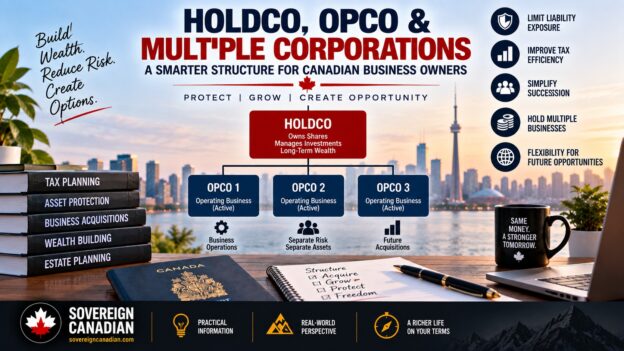
Individual → HoldCo → OpCo A / OpCo B / OpCo C
Perhaps OpCo A is an industrial business, OpCo B is software and OpCo C is an online media business. They can sit under common ownership without putting all three operating businesses into the same corporation.
That distinction matters because corporations are separate legal entities. If the businesses are genuinely separate economically, I would need a fairly compelling reason to deliberately put their assets and liabilities together.
There is also an important distinction between buying a business’s assets and buying its corporation. I covered that separately in Asset Purchase vs. Share Purchase in Canada. That decision can affect inherited liabilities, tax basis, financing and the seller’s tax treatment before HoldCo even enters the discussion.
A HoldCo Does Not Create the Basic Tax Deferral
One of the most common explanations for using a HoldCo is that it lets a business owner leave money inside the corporate system instead of withdrawing it personally and paying personal tax.
That is true, but incomplete. I do not need a HoldCo to leave money inside a corporation.
Suppose OpCo earns enough that, after paying corporate income tax and funding the business properly, it has another $200,000 that I do not need personally. I can simply leave that $200,000 in OpCo. I have not triggered personal dividend tax merely because the cash remains inside the operating corporation.
The basic tax deferral therefore comes from not paying the money to myself, rather than from creating HoldCo. What HoldCo changes is where that retained corporate capital can reside.
Under Canadian tax rules, a corporation can generally deduct taxable dividends received from taxable Canadian corporations, meaning taxable dividends can generally move between Canadian corporations without another layer of ordinary Part I corporate income tax. There are important qualifications, including Part IV refundable tax and anti-avoidance provisions, but the basic mechanism is what makes the conventional HoldCo structure work.
CRA — Taxable dividends from corporations resident in Canada
Suppose OpCo has accumulated $500,000 that it no longer needs to operate safely. I could keep it in OpCo, potentially move it to HoldCo, or distribute it to myself and pay the applicable personal tax. The first two choices keep the money inside the corporate system. The third brings it onto my personal balance sheet.
HoldCo does not manufacture the tax deferral between the first two choices. It potentially provides a better home for capital I have chosen not to withdraw.
Separating the Wealth From the Risk
This is where the HoldCo argument becomes much more persuasive to me.
Imagine an operating company that has been successful for ten years. It owns what it needs to operate, maintains adequate working capital and has also accumulated $1 million of cash and investments. That $1 million may represent years of successful business ownership, but it is still sitting inside the corporation that signs customer contracts, employs people, borrows money, sells products or services and otherwise accepts the normal risks of doing business.
The nature of those risks changes with the business. A machine shop has workplace, equipment and product exposures that an online content business probably does not. An e-commerce company may have product, supplier and consumer liabilities. A SaaS business can have contractual, privacy, cybersecurity and intellectual-property exposures. Online does not mean liability-free; it just changes the liability.
If surplus assets can appropriately be moved from OpCo to HoldCo, the roles become cleaner. OpCo contains what the operating business needs. HoldCo contains capital that has already been extracted from the operating business.
That is a much more compelling argument for HoldCo than simply saying it “saves tax.”
Corporate separation is not an impenetrable wall. Banks may demand guarantees. One corporation may pledge assets or guarantee obligations elsewhere in the group. Directors can have personal liabilities in certain situations, and moving assets after creditor problems have already arisen is a completely different legal issue. The separation has to exist in practice, not merely on an organizational chart.
But the underlying principle remains useful: if an asset does not need to remain exposed to the risks of an operating business, there should be a reason for leaving it there.
HoldCo as a Capital Allocation System
The second reason I find the structure attractive is what happens next.
Suppose Business A becomes successful and produces meaningful surplus cash. Some of that money could eventually come to me personally. Some could be invested. But if my longer-term objective were to acquire Business B, distributing all of the surplus personally could be inefficient. I could trigger personal tax only to turn around and invest what remains into another business.
A HoldCo potentially creates another path. Business A earns the profit and pays the applicable corporate tax. Once its own capital requirements are satisfied, surplus capital can potentially move to HoldCo. HoldCo can accumulate and invest that capital or eventually deploy it toward Business B. If Business B later generates surplus cash, some of that capital can potentially flow upward as well.
Eventually HoldCo becomes the centre of the structure rather than any individual operating company.
That is particularly interesting to me in the context of building and acquiring businesses in Canada. The first acquisition is no longer necessarily the final destination for all the capital it produces. A successful operating company can become one source of equity for future acquisitions.
The concept works across physical and online businesses. Capital generated by a profitable industrial company could eventually help fund a SaaS acquisition. A successful online business could contribute capital toward a physical acquisition. The businesses do not need to look alike simply because they share an ultimate owner.
At that point HoldCo starts looking less like a tax strategy and more like a private capital allocation system.
That is much closer to how I would want to use one.
Why Not Put Everything Into One Corporation?
Business A could simply acquire Business B directly and operate both businesses inside one corporation. Sometimes that may be perfectly sensible, particularly where the second operation is really an extension of the first. If a distributor acquires a complementary service operation with the same customers, employees and management, maintaining separate corporations indefinitely may create complexity without accomplishing much.
I would look at an unrelated acquisition differently. Suppose one corporation owns a machine shop, a SaaS business and an online media company. A serious liability arising from one operation is potentially sitting in the same legal entity as the assets of the other two. A future sale also becomes less clean. A buyer interested in the SaaS business does not necessarily want to acquire a corporation that also owns industrial machinery and a media site.
Separate OpCos can create cleaner compartments.
That does not mean every website needs its own corporation. If I owned ten content sites that functioned as one online media business, putting every domain into a separate corporation would probably be absurd. The meaningful unit is the business and its risk, ownership, financing and eventual exit characteristics, not the number of assets.
Different operating risks can justify separation. Different owners can. Different financing can. A realistic possibility of selling one business separately can. Simply liking complicated organizational charts cannot.
Three Corporations Do Not Mean Three Small-Business Limits
There is an obvious tax idea worth killing early.
If I owned three corporations, could each one receive the preferential small-business tax rate on its first $500,000 of active business income?
Not simply because I created three corporations.
The federal small-business deduction generally provides qualifying CCPCs with a lower federal corporate tax rate on eligible active business income up to the business limit. Associated CCPCs, however, generally share the $500,000 business limit.
CRA gives a straightforward example. If associated corporations earn $400,000 and $300,000 of active business income respectively, they do not each receive their own $500,000 small-business limit. The associated group has a combined $500,000 limit to allocate.
CRA — How relationships affect the small-business deduction
So this:
One corporation = $500,000 business limit
does not automatically become:
Three corporations = $1.5 million business limit
because I filed three sets of incorporation documents.
The association rules can become complicated, particularly where ownership is divided among family members or other shareholders. But for the straightforward structure I am considering—a commonly controlled HoldCo with several operating subsidiaries—I would plan on the basis that adding corporations does not manufacture additional small-business limits.
Separate corporations should exist because they perform separate jobs.
HoldCo Does Not Make the Passive-Income Problem Disappear
A profitable CCPC may eventually accumulate a substantial investment portfolio. At that point federal passive-income rules can start reducing access to the small-business limit.
The federal business limit begins to be reduced when the adjusted aggregate investment income, or AAII, of a CCPC and corporations associated with it exceeds $50,000. The reduction is $5 for each $1 of AAII above $50,000, so the $500,000 federal business limit reaches zero at $150,000 of AAII.
| Adjusted aggregate investment income | Remaining federal business limit |
|---|---|
| $50,000 | $500,000 |
| $75,000 | $375,000 |
| $100,000 | $250,000 |
| $125,000 | $125,000 |
| $150,000 | $0 |
The tempting solution is obvious: move the investment portfolio into HoldCo and keep it out of OpCo.
That may make excellent sense for risk separation. It does not normally make the federal passive-income calculation disappear, because the calculation considers passive investment income across associated corporations.
This is an important distinction. The same structure can solve one problem without solving another. Moving $1 million of investments from an operating company into HoldCo may improve risk separation while doing little to avoid the federal passive-income grind.
CRA — Passive-income business-limit reduction
There is also an important Ontario wrinkle. Ontario does not apply the federal passive-income business-limit reduction to its provincial small-business deduction. Eligible Ontario small businesses can therefore remain eligible for Ontario’s small-business deduction despite passive income that has reduced or eliminated the federal business limit. Ontario’s lower corporate rate was reduced from 3.2% to 2.2% effective July 1, 2026, while its general corporate rate remains 11.5%.
The exact provincial calculation differs across Canada, which is another reason not to speak as though there is one universal “Canadian small-business tax rate.”
Corporate Investing Is Not a Giant TFSA
The $50,000 passive-income threshold also becomes easier to understand when translated into capital. A $1 million investment portfolio producing taxable investment income equal to 5% of its value would produce $50,000. At the same illustrative 5%, $2 million produces $100,000 and $3 million produces $150,000.
Those are illustrations, not forecasts of AAII. Different investments generate different combinations of interest, dividends, rent and realized capital gains, and AAII has its own tax definition. A portfolio with substantial unrealized appreciation is not equivalent to one generating large amounts of interest or realized gains.
But the scale is useful. A successful owner who leaves substantial capital inside the corporate system can eventually reach a point where corporate investing starts interacting materially with taxation of the operating businesses.
That does not mean corporate investing is unattractive. It means HoldCo is not a giant TFSA.
Private-corporation investment income operates under its own tax regime, including refundable corporate taxes, eligible and non-eligible dividends and the capital dividend account. Those mechanics deserve their own article. The important point here is simpler: keeping investment capital inside the corporate system can defer personal tax, but it does not make the eventual personal tax disappear.
That distinction affects where I would want the capital. Money intended to fund another acquisition has a strong reason to remain corporate. Money I expect to spend personally has a different destination.
The Exit Could Matter More Than All of This
The second-order consequence I would be most reluctant to ignore is the eventual sale of the business.
Canada’s Lifetime Capital Gains Exemption can shelter a substantial amount of an individual’s qualifying capital gain on the disposition of qualified small-business corporation shares. The qualification rules matter. Among other requirements, the shares must satisfy ownership and asset-use tests over the 24 months preceding the disposition, and the corporation must meet the small-business-corporation test when the shares are sold.
CRA — Qualified small-business corporation shares
This is one reason excessive passive assets inside OpCo can become a problem. A company that began as a pure operating business can gradually become part operating company and part investment portfolio. Removing surplus passive assets from an operating company can be part of planning around the QSBC asset tests, but the details matter and simply inserting a HoldCo does not automatically preserve LCGE eligibility.
There is another issue that matters even more.
The LCGE is an individual tax benefit. If I personally own qualifying OpCo shares and sell them, I may potentially claim my available LCGE if all of the conditions are satisfied. If HoldCo owns OpCo and HoldCo sells the OpCo shares, I have not personally disposed of those OpCo shares and HoldCo does not simply claim my personal LCGE.
That is a major distinction.
It does not mean HoldCo ownership is wrong. Corporate reorganizations, different share classes, estate freezes, trusts and pre-sale planning can materially change the eventual result. It means I would not choose the ownership structure while thinking only about where next year’s surplus cash will sit.
A business worth $500,000 when I buy it could conceivably be worth several million dollars when I sell it. The tax consequences of that exit can dwarf years of accounting fees.
The exit deserves a seat at the table when the initial structure is designed.
This is also why asset purchases and share purchases matter well beyond closing day. If I am buying with the intention of eventually building something valuable enough to sell, I want to understand from the beginning what exactly I own and what a future buyer might actually acquire.
Online Businesses Belong in the Same Framework
Corporate structure is particularly easy to underestimate with online acquisitions.
A physical business looks like a company. It has a building, employees, trucks, machines or inventory. The instinct to give it its own legal entity comes naturally.
An online business can feel more like an investment.
But imagine buying a SaaS company for $500,000, growing it for several years and eventually selling it for $2 million. Ownership of those shares suddenly matters a great deal. So does whether the business qualifies for favourable share-sale treatment, whether the buyer wants assets or shares, where the intellectual property resides and whether unrelated investments have accumulated inside the operating company.
The same applies to a valuable content, e-commerce or online media business.
I would therefore distinguish between an online asset and an online operating business. A collection of small websites might reasonably sit together in one operating company. A substantial standalone SaaS acquisition with employees, customers, liabilities and realistic independent sale value may deserve exactly the same structural thought as a physical company.
Digital does not mean structurally irrelevant.
Complexity Still Has to Earn Its Keep
It would be easy at this point to conclude that everything should have its own corporation.
I don’t think that follows.
Every corporation creates work. It requires corporate records and tax filings. It generally needs separate accounting. Bank accounts have to be managed. Intercompany balances have to reconcile. Dividends, loans and management charges cannot simply be shuffled around informally because all of the corporations happen to have the same ultimate owner.
Financing can also cut through the neat boxes on the organizational chart. A lender financing OpCo B may want a HoldCo guarantee or security elsewhere in the group. That may be commercially reasonable, but it changes the practical degree of separation.
Then there is professional cost. If another corporation costs thousands of dollars over time in accounting, tax preparation, legal maintenance and administration, it should accomplish something worth paying for.
That gives me a simple rule: complexity should earn its keep.
I would not create a HoldCo merely because owning one sounds more sophisticated than owning one corporation. I would create one when I could explain exactly what job it performs.
If I bought a relatively small business, withdrew most of its available earnings personally and had little surplus capital accumulating inside it, I would not see an urgent need for an elaborate corporate group. The same would apply to a modest online business.
The calculation changes as the balance sheet changes. If OpCo begins accumulating hundreds of thousands of dollars beyond what it needs for working capital, reinvestment and a sensible operating reserve, I would become increasingly uncomfortable allowing years of accumulated capital to remain exposed to operating risk merely to avoid the administration of another corporation.
If a second acquisition becomes realistic, the argument strengthens again.
At that point I am no longer structuring one business. I am beginning to structure a group.
How I Would Approach the First Acquisition
My current planning bias is toward a structure capable of accommodating more than one business without forcing everything into the same operating company.
That does not mean I would create five empty corporations before buying anything. It means I would structure the first acquisition with the possibility of a second one in mind.
If I ultimately owned several genuinely separate businesses, I find this basic architecture appealing:
Me → HoldCo → Physical OpCo / Digital OpCo / Future Acquisition
Each OpCo would have a reason to exist. HoldCo would have a reason to exist. The operating companies would conduct the businesses. HoldCo would provide common ownership and, where appropriate, a place for surplus corporate capital to accumulate and eventually be reallocated.
If Business A failed, I would want as little unnecessary exposure to Businesses B and C as reasonably possible. If Business B were sold, I would want that transaction to be reasonably clean. If Business C needed equity capital, I would want to understand whether surplus capital generated elsewhere in the corporate group could help fund it without first being distributed personally.
That is a coherent system.
Before the first acquisition, though, I would want answers to four questions: who should acquire the business or its shares; where should future surplus capital accumulate; how could another business eventually fit into the structure; and how might the structure affect an eventual sale?
Those questions are connected. A structure optimized only for today’s acquisition financing may be poor for accumulating investments. A structure optimized entirely around liability separation may create an awkward exit. A structure designed entirely around the LCGE may not be the best platform for owning several businesses.
There is no universal diagram that solves all of those problems.
There is a much better starting principle than “everyone should have a HoldCo.”
Every corporation should have a job.
The Bottom Line
I started looking at HoldCos primarily for two reasons: separating accumulated wealth from operating liability and creating a possible umbrella for multiple future acquisitions. After working through the structure, I still think those are the strongest reasons.
The tax deferral matters, but HoldCo does not create it. An OpCo can already retain after-tax earnings without immediately distributing them personally. HoldCo potentially gives those retained earnings somewhere else to go.
That distinction becomes increasingly valuable as the business succeeds. If I eventually acquire a business that generates capital beyond what it needs to operate, I do not necessarily want years of accumulated wealth permanently sitting inside the same corporation that carries the operating risk. If I later acquire a second or third genuinely separate business, I do not necessarily want those businesses buried inside the first OpCo either.
I would rather separate the functions.
Let OpCo operate. Let HoldCo hold and allocate surplus corporate capital where appropriate. Let separate OpCos contain genuinely separate businesses when the benefits of separation justify the cost.
But I would design the structure with the exit in mind from the beginning. Associated corporations still share the small-business limit. Moving investments to HoldCo does not make the federal passive-income grind disappear. And putting OpCo beneath HoldCo changes who owns—and potentially who eventually sells—the operating-company shares.
Those are not reasons to avoid HoldCo. They are reasons to understand what it actually does.
The objective is not to own as many corporations as possible. It is to build enough structure to separate risks, preserve flexibility and put capital where it can be most useful without creating complexity that serves no purpose.
One corporation can operate a business.
A properly designed corporate group can eventually do something broader: own businesses, separate their risks and allocate the capital they produce.