
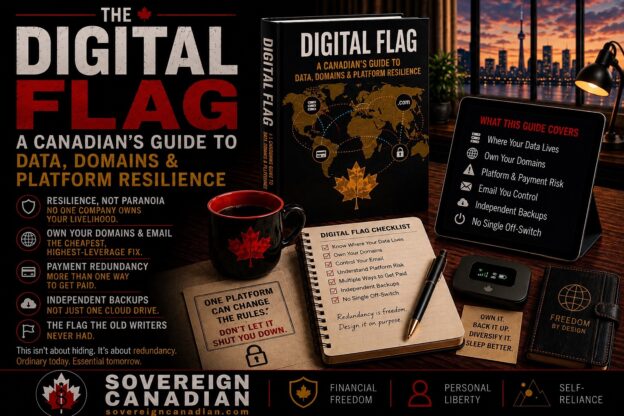
This is the sixth and final deep dive in my flag theory series — the flag Harry Schultz and the old writers never had to think about, because it didn’t exist yet. If your income runs through a laptop, this one quietly became real while nobody was watching. (Series introduction — coming soon.)
What the digital flag is
The digital flag is where your online life is anchored: where your data lives, where your domains are registered, where your servers sit, and which country’s laws govern the platforms you depend on to earn and communicate.
The old five flags all assumed your assets were physical — passports, property, bank vaults, plane tickets. But a modern life runs on infrastructure that lives in the cloud, and the cloud lives somewhere, under some jurisdiction. The digital flag asks the same rude question flag theory always asks, just pointed at your infrastructure: why should all of it sit under one government’s control by default?
The flag the old writers never had
Think about how much of a modern income depends on things you don’t physically hold.
Your email account. Your domain names. The platform that pays you. The processor that moves your money. The host that serves your site. The cloud drive with every important document in it. None of that is in a vault you control. It’s on someone else’s servers, governed by someone else’s laws, subject to someone else’s terms of service.
For most people that’s invisible right up until it isn’t. And the moment it becomes visible is usually the worst possible moment.
Platform and payment jurisdiction risk
Here’s the failure mode that makes this flag concrete.
A single company decides you’ve violated a policy — sometimes correctly, sometimes by algorithm, sometimes by mistake — and suddenly your account is frozen. If your email, your domain, your payment processing, and your customer relationships all run through platforms tied to one ecosystem or one jurisdiction, a single decision can knock out your entire operation at once.
This isn’t paranoia. Frozen payment accounts, de-platformed businesses, and locked-out founders are ordinary news now. The risk isn’t that any one platform is evil. It’s concentration — the same single-point-of-failure problem the asset haven flag solves for money, pointed at your digital life instead. (Asset haven flag deep dive — coming soon.)
Where your domains and data live
Two anchors deserve special attention, because they’re the ones people never think about until they lose them.
Domains. Your domain name is the front door to your business, and it’s registered through a registrar under a specific jurisdiction. If that’s an afterthought, it’s a vulnerability. Owning your domains through a stable registrar you control is one of the cheapest, highest-leverage moves on this entire flag.
Data. Where your files and backups physically live determines which laws apply to them and who can compel access. You don’t need to be doing anything wrong to want your own data under a jurisdiction you’ve actually chosen rather than one you defaulted into.
Neither of these is exotic. Both are just decisions most people never consciously make.
Resilience, not paranoia
I want to be clear about the mindset here, because this flag attracts a certain doom-tinged crowd and I’m not in it.
The digital flag isn’t about hiding from the government or preparing for the apocalypse. It’s about not having a single company or a single jurisdiction hold a switch that can turn off your livelihood. That’s the same ordinary risk-management instinct behind keeping a backup, insuring your house, or not putting all your savings in one bank. Boring, sensible redundancy — pointed at the infrastructure a modern income actually depends on.
Framed that way, it’s not fringe at all. It’s just catching up to how much of life moved online.
Practical redundancy
So what does planting this flag actually look like? Mostly unglamorous housekeeping.
It looks like owning your domains somewhere stable and controlling them yourself. It looks like your critical email running on infrastructure you’d trust with your business surviving. It looks like real, independent backups of anything you can’t afford to lose — not just a single cloud drive. It looks like more than one way to get paid, so one frozen processor is an inconvenience rather than an extinction event. And it looks like knowing, roughly, which country’s laws govern each critical piece.
None of that requires a bunker. Most of it is a weekend of deliberate setup you’ll be grateful for exactly once — on the day something you depended on goes dark.
What I’d Actually Do
Here’s my order for the digital flag.
I’d start with domains and email, because they’re the cheapest to fix and the most painful to lose. Owning my domains through a registrar I control, and running critical email somewhere resilient, is a weekend of work and a decade of peace of mind.
I’d build payment redundancy next — more than one way to receive money — so no single processor’s decision could end my income. Concentration there is the risk I’d least want to discover the hard way.
I’d sort out real backups, independent of any one provider, for anything irreplaceable.
And I’d keep the whole thing in proportion. This is resilience, not a survival bunker. The goal is simply that no single company and no single jurisdiction gets an off-switch on my life.
That closes the series. Six flags — citizenship, residency, business base, asset haven, playgrounds, and digital. If you’ve read all six, the meta-point is the same one from the introduction: you don’t plant them all at once, and you don’t need to. You just stop assuming one government has to provide everything. (Series introduction — coming soon.)
This post is personal documentation of how I think about my own situation. It is not legal, financial, or cybersecurity advice. Platform terms and jurisdictional rules change — confirm anything material to your business with a qualified professional before you act.