October 31, 2026 | Sovereign Canadian | European Affairs
Poland has long stood apart from much of Western Europe. Its relatively restrictive immigration policies, strong emphasis on national identity, and willingness to challenge European Union institutions have earned it both admiration and criticism.
For Canadians concerned about border security, national sovereignty, and the social challenges facing parts of Western Europe, Poland is a country worth watching.
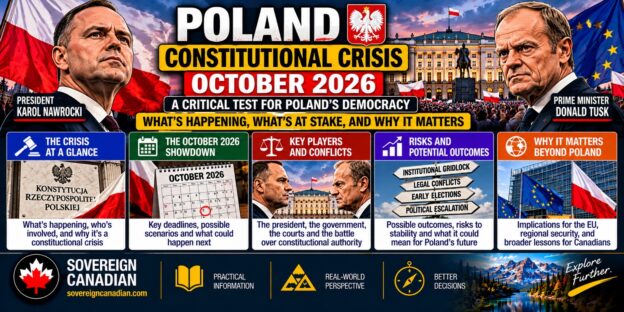
But overnight, Poland found itself confronting a different kind of threat to stability: a constitutional crisis at the highest levels of government.
President Karol Nawrocki abandoned an international trip, riot police surrounded the country’s Constitutional Tribunal, and protesters clashed with authorities in Warsaw.
Both sides are accusing the other of undermining Poland’s constitutional order.
What Happened Overnight?
On Friday, October 30, a group of judges moved to suspend Constitutional Tribunal President Bogdan Święczkowski and his deputy, Bartłomiej Sochański.
The two officials are associated with Poland’s former governing Law and Justice party (PiS), which held power from 2015 to 2023.
The decision triggered an extraordinary confrontation.
- Riot police deployed around the Constitutional Tribunal in Warsaw.
- Hundreds of protesters gathered, including opposition politicians.
- Police reported objects thrown at officers and detained three people.
- President Nawrocki turned his aircraft around while travelling to Senegal.
- The president returned to Warsaw and entered the court building during a tense confrontation.
By Saturday morning, Nawrocki was accusing Prime Minister Donald Tusk’s government of forcibly taking control of a constitutional institution.
He called urgent consultations with political leaders.
This was not a military coup. It was an escalating constitutional confrontation in which the legitimacy of the country’s highest constitutional court is being contested.
Sources: Reuters, October 31 and The Guardian, October 31.
Two Governments, Two Interpretations of the Constitution
The roots of this crisis extend back more than a decade.
When Law and Justice governed Poland, it introduced controversial judicial reforms and appointments that drew criticism from European institutions.
Critics argued that the reforms compromised judicial independence. Supporters viewed them as part of a legitimate effort to reform institutions they considered politically entrenched.
When Donald Tusk’s pro-European coalition took office in 2023, it promised to restore judicial independence and repair relations with Brussels.
But that process has created its own constitutional questions.
President Nawrocki, elected in 2025, has resisted several judicial appointments supported by the current parliamentary majority.
Now, judges aligned with the government’s effort to restructure the tribunal have suspended its leadership.
Tusk maintains that restoring the rule of law requires decisive action.
Nawrocki argues that the government’s actions violate the constitutional order.
Even some legal experts critical of the previous PiS government have questioned the legal foundation for suspending the tribunal’s president.
The central question is whether a government can restore judicial independence through measures whose own constitutional legitimacy is disputed.
That question matters well beyond Poland.
Further reading: Le Monde’s analysis of the constitutional confrontation.
Why Poland Matters to Sovereign Canadians
Poland deserves serious consideration in any discussion about Europe’s future.
Unlike several Western European governments, successive Polish administrations have maintained relatively restrictive positions on irregular migration, particularly along the country’s eastern border.
Poland has also demonstrated considerable determination in strengthening its national defence and maintaining its independence in an increasingly uncertain European security environment.
These are meaningful considerations for Canadians evaluating countries through the lens of personal sovereignty.
But there is an important distinction.
Strong borders do not automatically mean strong institutions.
A country can have effective immigration controls while experiencing serious internal political conflict.
For someone considering relocating, purchasing property, establishing a business, or eventually retiring abroad, the independence of the judiciary and predictability of the legal system are essential.
Political stability is not simply about which party governs. It is about whether institutions continue functioning when political opponents disagree.
Could Poland Be an Expat Destination for Canadians?
Poland was already on our list of countries worth investigating for potential Canadian expatriates.
Its appeal extends beyond immigration policy.
Poland offers established cities, European Union membership, extensive transportation infrastructure, and access to the broader European market.
Warsaw, Kraków, Wrocław, and Gdańsk each offer different lifestyles and economic opportunities.
But Canadians considering Poland need to examine several practical questions:
- What residency pathways are available to Canadians without European citizenship?
- How do Polish income taxes, capital gains taxes, and Canadian departure-tax rules interact?
- What are the costs of housing, healthcare, and everyday living?
- How secure are property rights and legal protections?
- How does Poland compare with Portugal, Spain, Italy, and other European destinations?
These questions deserve a dedicated investigation rather than assumptions based on political reputation.
Our existing Foreign Real Estate Roadmap provides a starting point for evaluating international property opportunities, while our Flag Theory Roadmap explores the broader principles of international diversification.
The Bigger Picture
Poland’s overnight confrontation is not evidence that the country has suddenly become an unsafe place to live.
Nor does it invalidate the country’s achievements or its appeal as a potential destination for Canadians seeking alternatives to Western Europe.
But it is a reminder that sovereignty involves more than controlling borders.
It also requires functioning institutions, predictable laws, and limits on political power.
For Canadians considering a second home or a second life abroad, those considerations should carry considerable weight.
Poland remains a country worth watching. The coming days will help reveal how resilient its institutions really are.
This article reflects developments reported through the morning of October 31, 2026. The constitutional dispute remains ongoing.