
October 31, 2026 | Sovereign Canadian | International News
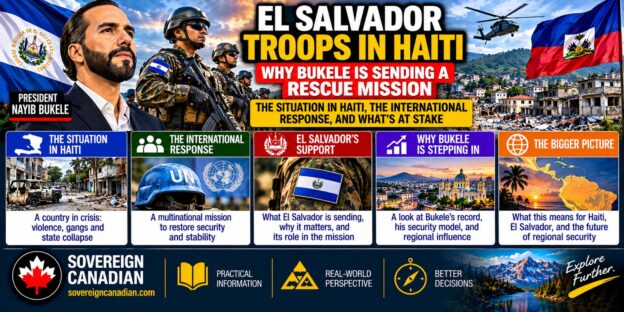
El Salvador’s President Nayib Bukele has deployed approximately 2,000 soldiers to Haiti following the disappearance of four Salvadoran military aviation technicians during a gang ambush on October 18.
What began as a rescue operation involving special forces has rapidly expanded into one of the largest foreign military deployments by El Salvador in recent history.
The operation is particularly significant because of the man directing it. Bukele transformed El Salvador from one of the world’s most violent countries into a nation with dramatically lower reported homicide rates through an uncompromising campaign against organized gangs.
Now, his approach faces its first major international test.
Haiti: A Country Overrun by Gangs
Haiti has experienced years of political instability, economic hardship, and escalating gang violence. The assassination of President Jovenel Moïse in July 2021 accelerated the deterioration of an already fragile state.
Armed criminal organizations subsequently expanded their control over the capital, Port-au-Prince, and surrounding communities. Kidnappings, extortion, killings, and attacks on public infrastructure have become widespread.
By October 2026, gangs controlled large portions of the capital, while approximately 1.5 million Haitians had been displaced by violence.
The Haitian National Police has struggled to contain increasingly powerful criminal organizations. International assistance has consequently become essential to efforts to restore security.
In October 2023, the United Nations Security Council authorized a multinational security mission led by Kenya. However, chronic shortages of personnel, equipment, and funding severely limited its effectiveness.
In September 2025, the Security Council authorized a replacement: the Gang Suppression Force (GSF), designed to operate alongside Haitian security forces and conduct more aggressive operations against organized criminal groups.
The force was authorized to include up to 5,550 personnel, although its actual strength remained far below that target in October 2026.
The mission is internationally authorized, but it is not a conventional United Nations peacekeeping operation.
Source: United Nations — Establishment of the Gang Suppression Force
Why Were Salvadoran Military Personnel in Haiti?
El Salvador was already participating in international security operations in Haiti before the October ambush.
Its initial contribution focused heavily on aviation support, including pilots, aircraft technicians, medical evacuations, and humanitarian assistance.
These personnel provided critical capabilities to international forces operating in dangerous areas where medical evacuation by road could be extremely difficult.
In April 2026, El Salvador’s Ministry of Defence announced the deployment of Fuerza de Tarea Libertad, a specialized military contingent supporting the Gang Suppression Force.
Its responsibilities included medical evacuations, search-and-rescue operations, aerial patrols, and technical assistance to Haitian security forces.
The four Salvadorans who disappeared in October were aviation technicians rather than soldiers assigned to frontline combat operations.
Their presence was part of a broader international effort to support Haiti’s security institutions.
Source: El Salvador Ministry of Defence — Fuerza de Tarea Libertad
October 18: Four Salvadorans Disappear
On October 18, four Salvadoran aviation technicians were travelling through Croix-des-Bouquets, an area northeast of Port-au-Prince known for extensive gang activity.
According to Salvadoran authorities, the men were returning to their base after purchasing food when their armoured vehicle came under attack.
Gunfire and explosives struck the vehicle, which subsequently caught fire.
The four men reportedly escaped the burning vehicle but disappeared in the surrounding territory.
Haitian authorities described the incident as a kidnapping, although the precise circumstances of their disappearance and their subsequent whereabouts have not been independently established.
The attack occurred in an area associated with powerful criminal organizations, including Chèn Méchan and 400 Mawozo.
Neither group had publicly accepted responsibility for holding the Salvadorans.
The incident represented a serious escalation against foreign personnel participating in Haiti’s international security mission.
Source: Associated Press — Salvadoran Special Forces Deploy to Haiti
Bukele Responds With Military Force
President Bukele’s response was immediate and unusually forceful.
On October 21, he announced military operations intended to recover the missing personnel.
Bukele demanded their safe return and warned the criminal organizations responsible that the consequences would escalate if the four Salvadorans were not released alive and unharmed.
His government initially deployed approximately 200 special operations personnel to Haiti.
Within days, however, the operation expanded considerably.
Reuters reported on October 27 that approximately 1,000 Salvadoran troops had arrived in Haiti, transported partly aboard American military aircraft.
By October 29, El Salvador had deployed approximately 2,000 troops, with its government confirming plans for a force exceeding that number.
The United States provided logistical assistance, including C-130 military transport aircraft.
The deployment was discussed between Bukele and Haitian Prime Minister Alix Didier Fils-Aimé, with Salvadoran authorities confirming that the rescue operation was proceeding with international support.
The scale of the deployment is remarkable considering that the original Salvadoran contingent consisted primarily of aviation and technical personnel.
What began as a limited support mission has become a substantial military intervention.
Sources:
Reuters — El Salvador Rushes Troops to Haiti, October 27
Reuters — Bukele’s Gang Offensive Goes Abroad, October 29
Why Bukele’s Response Matters
Bukele has become one of Latin America’s most closely watched political leaders.
When he assumed office in 2019, El Salvador had spent decades struggling with organized criminal gangs, particularly MS-13 and Barrio 18.
His government eventually introduced sweeping emergency security measures, dramatically expanding arrests and imprisonment while deploying military and police forces throughout the country.
The campaign produced an extraordinary reduction in reported homicides and restored freedom of movement to communities previously controlled by criminal organizations.
For ordinary Salvadorans who had lived under gang intimidation, the transformation was profound.
However, Bukele’s methods remain controversial internationally.
Human rights organizations have documented allegations of arbitrary detention, violations of due process, and deaths in custody. Critics also question the concentration of political power under his administration.
Those concerns deserve scrutiny. Nevertheless, the reduction in gang violence is a substantial achievement that helps explain Bukele’s popularity and his government’s confidence in confronting criminal organizations.
His response in Haiti also communicates a broader message: Salvadoran personnel serving overseas will not simply be abandoned when threatened.
Whether the deployment becomes a successful rescue operation or develops into a longer military commitment remains uncertain.
Can El Salvador’s Strategy Work in Haiti?
There are reasons to believe Salvadoran forces could contribute meaningfully to Haiti’s security operations.
El Salvador has accumulated extensive recent experience conducting operations against heavily armed criminal organizations, gathering intelligence, and coordinating police and military resources.
Its personnel may possess valuable practical knowledge that conventional international peacekeeping forces lack.
However, Haiti presents a substantially different challenge.
El Salvador’s anti-gang campaign occurred within its own territory, where the government could mobilize domestic institutions, intelligence networks, prisons, and security forces.
Haiti’s state institutions are considerably weaker, while criminal organizations have established territorial control over significant urban areas.
The international force also faces difficult questions concerning operational command, rules of engagement, civilian protection, and coordination with Haitian authorities.
The newly deployed Salvadoran contingent’s command arrangements remain unclear.
A successful rescue would be an important achievement. Restoring lasting security to Haiti would require a much broader effort involving functioning institutions, reliable policing, and political stability.
Military force can suppress criminal organizations. It cannot independently rebuild a failed state.
The Canadian Connection
Canada has been involved in international efforts to stabilize Haiti for decades.
It also participated in the group of countries supporting the creation of the Gang Suppression Force, alongside the United States, El Salvador, Guatemala, Jamaica, Kenya, and the Bahamas.
Canada’s involvement reflects both regional security concerns and its longstanding relationship with Haiti.
The situation raises a broader question for Canadians: what constitutes an effective international intervention?
Financial assistance, diplomatic pressure, institutional development, and security training all have legitimate roles.
But when criminal organizations control territory, intimidate civilians, and attack international personnel, restoring basic security becomes a prerequisite for many other reforms.
The difficulty is ensuring that military operations produce sustainable improvements rather than temporary victories.
For Canadians interested in international security, governance, and national sovereignty, Haiti provides an important case study in the consequences of institutional collapse.
What Happens Next?
As of October 31, the four Salvadoran aviation technicians remain missing, with no independently verified confirmation of their rescue or deaths.
Salvadoran authorities continue to pursue their recovery.
Meanwhile, Haiti’s political difficulties have deepened. On October 28, electoral authorities postponed the first round of presidential and parliamentary elections from December 2026 until July 18, 2027.
The delay underscores how difficult it has become to restore functioning democratic institutions while armed organizations retain substantial territorial control.
Three questions now matter.
First, can Salvadoran forces locate and recover their missing personnel?
Second, will the deployment remain focused on the rescue mission, or expand into sustained operations against Haitian gangs?
Third, can Haiti’s government and international partners establish enough security to restore effective national institutions?
The answers will determine whether this operation becomes a limited rescue mission or the beginning of a much larger Salvadoran role in Haiti.
Sovereign Canadian Perspective
Bukele’s response demonstrates a quality increasingly uncommon in international politics: a willingness to back public commitments with decisive action.
Four Salvadoran aviation technicians disappeared while supporting an international mission. Rather than limiting his response to diplomatic statements, Bukele committed substantial military resources to recovering them.
That determination deserves recognition.
However, admiration for decisive leadership should not prevent scrutiny of the operation itself. Its success must ultimately be measured by the safe recovery of the missing personnel, the protection of civilians, and whether the deployment improves security without creating an indefinite foreign commitment.
El Salvador’s domestic transformation has made Bukele an influential figure far beyond his country’s borders.
Haiti will test whether that experience can translate into effective action abroad.
For a country once defined internationally by gang violence, El Salvador’s emergence as a regional security contributor is itself a remarkable development.
Whether this particular intervention succeeds remains to be seen.
For more on El Salvador as a destination for Canadians, explore our El Salvador country coverage. A separate Sovereign Canadian profile of President Nayib Bukele will examine his political rise, security reforms, economic policies, and international influence.