
November 4, 2026
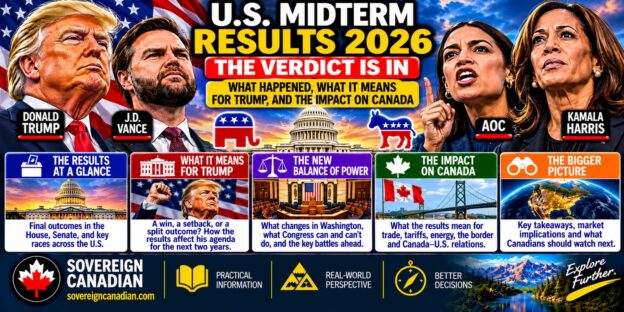
American voters have delivered a significant change in Washington. In Tuesday’s midterm elections, Democrats won control of both the House of Representatives and the Senate, ending Republican control of Congress and substantially changing the political environment for the remaining two years of Donald Trump’s presidency.
The results went beyond the competitive districts and states where Democrats had been expected to challenge Republican incumbents. Democratic candidates won Senate races in traditionally Republican states, including Kansas, South Carolina, and Texas, while the party made substantial gains in the House and in state-level elections.
For President Trump, the result means that his administration will face congressional opposition with the power to block legislation, investigate executive actions, and reject presidential appointments. For Democrats, it creates an opportunity to challenge the administration’s policies, although the president retains his veto and considerable executive authority.
For Canadians, the consequences are less straightforward. A Democratic Congress does not automatically mean lower tariffs, a more favourable trade agreement, or a stronger Canadian dollar. However, it changes the political institutions through which American economic and trade policy must operate.
At Sovereign Canadian, the objective is not to celebrate or condemn an American election result. It is to understand how the changes affect Canadians seeking financial independence, international diversification, and greater control over their personal and economic circumstances.
Yesterday, we examined what the US midterm elections are and why Canadians should pay attention. With the results now establishing a new balance of power in Congress, we can examine what changes next.
The Results: Democrats Win Both Chambers
The most important outcome of November 3 is that Democrats have secured control of both chambers of Congress.
Before the election, Republicans held a narrow majority in the House and a 53–47 advantage in the Senate, counting the two independents who caucused with Democrats on the Democratic side.
Democrats needed a net gain of four Senate seats to overcome the Republicans’ advantage and Vice President JD Vance’s ability to break a 50–50 tie.
They exceeded that requirement.
According to the Associated Press election coverage, Democrats flipped at least seven Republican-held Senate seats, including victories in Kansas, Iowa, Texas, Ohio, Maine, North Carolina, and South Carolina.
Several of these results were historically significant.
In Kansas, Democrat Adam Hamilton defeated Republican Senator Roger Marshall, delivering the state’s first Democratic Senate victory since the 1930s. In Texas, James Talarico won a Senate seat for Democrats for the first time in 38 years. South Carolina also elected a Democratic senator after decades of Republican dominance.
Democrats simultaneously captured the House, winning more than two dozen additional seats and securing the majority needed to control its legislative agenda and committees.
The party also gained several Republican-held governorships and made advances in state legislatures.
The final composition of Congress may still change slightly as outstanding races are counted, but control of both chambers has been established.
The breadth of the result is important. This was not simply a handful of competitive suburban districts changing parties. Democratic gains extended into states and communities that had supported Trump decisively in the 2024 presidential election.
Reuters’ election results analysis documents the scale of these changes, including significant shifts in traditionally Republican areas.
Why Did Republicans Lose?
Midterm elections frequently produce losses for the president’s party, but the scale and geographic distribution of the 2026 results suggest that several issues contributed to the outcome.
Cost of living was a major concern.
Despite the administration’s economic priorities, many Americans continued to express dissatisfaction with prices and household affordability. Voters also identified government corruption and the ongoing war with Iran as important concerns.
Exit polling conducted for major American news organizations indicated that approximately half of voters viewed the election as an opportunity to express opposition to Trump. Around 70% said they wanted Congress to exercise greater checks on presidential power.
These findings do not establish that every Democratic voter supported the same policies or voted for the same reasons. Economic concerns, dissatisfaction with the administration, candidate-specific issues, and local circumstances all contributed to individual races.
Nevertheless, the election demonstrates how quickly American political conditions can change.
Trump won the presidency in 2024 and entered office with Republican control of Congress. Two years later, voters have transferred legislative control to the opposition.
The president remains in office, but the political environment in which he governs has changed considerably.
What Changes for Donald Trump?
The new Congress takes office on January 3, 2027.
Until then, Republicans retain control of the outgoing Congress. After that date, Democrats will control the House and Senate for the final two years of Trump’s presidency.
This creates several immediate consequences.
Trump’s Legislative Agenda Faces a Democratic Congress
The president cannot ordinarily pass federal legislation without congressional approval.
With Democrats controlling both chambers, major new Republican tax, spending, and regulatory proposals will require Democratic support.
The administration will therefore face greater difficulty advancing legislation that Democrats oppose.
Conversely, Democrats will be able to introduce and pass their own legislation through Congress, subject to Senate procedural rules and the president’s veto.
Trump retains the ability to veto legislation. Overriding that veto requires a two-thirds majority in both chambers, making bipartisan agreement necessary for legislation that the president strongly opposes.
The practical result is a government in which major legislative changes will generally require negotiation, compromise, or confrontation between the president and Congress.
Congressional Investigations Will Expand
Democratic control also means control of congressional committees.
The House and Senate can investigate executive branch decisions, hold hearings, demand documents, and issue subpoenas.
Democratic leaders have indicated that oversight of the Trump administration will be an important priority.
Potential subjects include government spending, executive actions, foreign policy decisions, and the administration’s handling of federal agencies.
These investigations can influence public opinion and government operations, but they do not automatically overturn executive decisions.
Their effectiveness will depend on the scope of congressional authority, legal challenges, and the willingness of executive officials to cooperate.
Presidential Appointments Become More Difficult
Control of the Senate is particularly important.
The Senate confirms federal judges, cabinet officials, ambassadors, and numerous other presidential appointments.
With Democrats holding the majority, Trump will no longer have Republican control of the institution responsible for confirming his nominees.
The administration may face delays, rejections, or pressure to nominate candidates acceptable to a broader political coalition.
This could be especially consequential for judicial appointments, where decisions made during a presidency can influence American law for decades.
Government Funding Becomes a Major Negotiating Issue
Congress controls federal appropriations.
A Democratic Congress and Republican president will need to negotiate spending legislation to keep the federal government operating.
Disagreements could produce funding delays or government shutdowns.
Federal debt and borrowing authority may also become contentious issues.
The United States already carries substantial government debt, and political disagreements over spending can introduce additional uncertainty into financial markets.
However, divided government does not inevitably produce shutdowns or fiscal crises. Both parties have incentives to negotiate, and the actual consequences will depend on the legislation and agreements that emerge.
What Does This Mean for Canada?
The American election matters to Canadians because the two economies are deeply interconnected.
The United States is Canada’s largest export market, a major source of investment, and an important destination for Canadian travellers, property owners, and businesses.
Changes in American trade, taxation, industrial, and immigration policy can therefore have consequences well beyond the United States.
The most immediate questions concern trade and tariffs.
1. CUSMA and the Future of North American Trade
The Canada–United States–Mexico Agreement, known as CUSMA in Canada and USMCA in the United States, remains one of the most important economic arrangements affecting Canadian businesses.
The agreement underwent its first scheduled six-year joint review in July 2026.
The United States declined to extend the agreement in its existing form, meaning the three countries must continue the review process rather than automatically extending the agreement for another 16 years.
CUSMA remains in force, with its current term extending to 2036 unless the parties agree to extend it or other provisions alter that timeline.
The next annual review is scheduled for 2027.
For Canadian exporters, manufacturers, and investors, the uncertainty surrounding the agreement is significant.
North American supply chains have developed over decades. Automotive manufacturers, agricultural producers, energy companies, and industrial suppliers frequently operate across all three countries.
Changes to tariffs, rules of origin, or market access can affect investment decisions long before any agreement formally expires.
Will a Democratic Congress Reduce Trump’s Tariffs?
Not necessarily.
The American Constitution gives Congress authority over international commerce, but Congress has delegated significant trade powers to the president through existing legislation.
Consequently, many tariff decisions can be made by the executive branch without requiring a new congressional vote.
Democrats could attempt to restrict those powers, demand greater oversight, or introduce legislation changing the rules under which tariffs are imposed.
They could also use congressional hearings to challenge the administration’s trade policies.
However, the president would retain his veto, and any legislative effort to restrict his authority would need sufficient support to overcome it.
There is another important consideration for Canadians.
Support for American domestic manufacturing and trade protection is not confined to the Republican Party.
Democratic politicians also represent industrial states, organized labour, and communities concerned about foreign competition.
A Democratic Congress may challenge Trump’s approach to tariffs without necessarily supporting unrestricted trade with Canada.
For Canadian businesses, the distinction matters.
The objective should be a predictable and commercially workable trade environment, not an assumption that changing political parties automatically produces more favourable trade policy.
The Office of the United States Trade Representative and Global Affairs Canada’s CUSMA resources remain important sources for monitoring the negotiations.
2. The Canadian Dollar and Financial Markets
Financial markets must now assess a different American political environment.
The administration retains executive authority, but major fiscal legislation will require negotiations with a Democratic Congress.
This could affect expectations for government spending, taxation, federal borrowing, and economic growth.
For Canadians, those developments can influence both investment returns and currency exposure.
A Canadian investor holding American equities is exposed to two variables: the performance of the underlying investment and changes in the exchange rate between the Canadian and American dollars.
A rising American stock market does not necessarily produce an equivalent return when measured in Canadian dollars.
Similarly, a weakening Canadian dollar can increase the Canadian-dollar value of American investments even when their underlying share prices remain unchanged.
The election result does not establish which direction either market will move.
Interest rates, inflation, corporate earnings, energy prices, and economic growth will remain important influences.
There is also a tendency for investors to associate particular political parties with favourable or unfavourable stock market performance.
Such assumptions are unreliable.
American companies operate across different political administrations, and their long-term investment returns depend on far more than congressional control.
For Canadians building diversified portfolios, the relevant lesson is to understand currency exposure, business fundamentals, and the economic assumptions underlying their investments.
Political developments matter, but they should not replace investment analysis.
3. Energy, Manufacturing, and Canadian Industry
Canadian energy and industrial companies are particularly exposed to American policy decisions.
The United States is the principal market for Canadian oil and natural gas exports, while manufacturers on both sides of the border participate in highly integrated supply chains.
Federal policy concerning pipelines, energy development, environmental regulation, and industrial incentives can therefore influence Canadian companies.
A Democratic Congress could attempt to modify the administration’s energy and industrial policies.
However, the president retains substantial authority over federal agencies and regulatory implementation.
The outcome will depend on the specific legislation, regulations, and executive actions involved.
It would be a mistake to assume that the election automatically benefits or harms the entire Canadian energy sector.
Oil producers, pipeline operators, electricity utilities, equipment manufacturers, and transportation companies have different business models and different exposure to American policy.
For investors, those distinctions are more useful than broad assumptions about which political party is favourable to a particular industry.
The same principle applies to Canadian infrastructure investments and nationally significant development projects.
Canada’s long-term economic interests depend partly on its ability to develop competitive industries, transportation networks, and export markets regardless of changes in Washington.
4. American Real Estate and Relocation
The United States remains an important destination for Canadians seeking investment properties, winter residences, business opportunities, or eventual relocation.
The election does not automatically change a Canadian’s right to enter, work, or reside in the United States.
Those rights depend on immigration legislation, regulations, and the applicable visa or admission category.
Nor does a Democratic Congress automatically change the tax treatment of Canadian-owned American property.
Any material changes would require legislation, regulatory action, or other legally authorized measures.
For Canadians considering American real estate, many of the most important issues remain state-specific.
Property taxation, insurance, landlord regulations, estate planning, and business structures can vary considerably between jurisdictions.
A property investment in Florida operates under a different legal and economic environment from one in Texas, Arizona, or Michigan.
The election reinforces the importance of understanding the actual rules governing an investment rather than relying on assumptions about the political direction of the country.
For Canadians considering international relocation, it also illustrates why residency rights, taxation, and property ownership should be evaluated separately.
Owning a property in another country does not necessarily provide the right to live or work there.
5. Canada Cannot Control Washington
There is a broader economic issue that deserves attention.
Canada’s relationship with the United States creates enormous commercial advantages, but it also produces significant dependence.
American decisions concerning tariffs, trade agreements, industrial incentives, and border policy can affect Canadian businesses even when Canada has little direct influence over those decisions.
The 2026 election changes the institutions responsible for making those decisions, but it does not eliminate Canada’s exposure to American politics.
Canada must still negotiate with the administration and Congress, maintain access to American markets, and develop policies that support domestic investment and competitiveness.
Diversifying export markets may reduce some risks, although geography and existing supply chains mean that the United States will remain central to the Canadian economy.
For individual Canadians, the same principle applies on a smaller scale.
International diversification can create additional opportunities and reduce dependence on a single economy or jurisdiction.
However, diversification also introduces currency, taxation, legal, and political considerations that must be understood.
The objective is not simply to move investments outside Canada.
It is to understand where assets are held, which laws apply, and how different political or economic developments could affect them.
What Happens Between Now and January?
The election has established the direction of congressional control, but the new Congress does not take office until January 3, 2027.
Until then, Republicans retain control of the outgoing Congress.
This creates a transition period during which the existing congressional leadership may still attempt to advance legislation or confirm presidential appointments.
The incoming Democratic majority will also begin establishing its leadership, committee priorities, and legislative agenda.
For Canadians, the most useful developments to monitor will be concrete policy announcements rather than speculation about political personalities.
Particularly important will be any changes in American trade negotiating positions, tariff authority, federal spending priorities, energy policy, and immigration regulations.
The Associated Press and Reuters are continuing to report the results and the transition to Democratic congressional control.
The Sovereign Canadian Perspective
The 2026 midterm elections provide another example of how quickly political circumstances can change.
In 2024, Donald Trump returned to the presidency with Republican control of Congress.
Two years later, Democrats have captured both chambers, changing the institutional balance of power without changing the president.
This is a defining feature of the American constitutional system.
The presidency and Congress operate under separate electoral mandates, and control of government can be divided between competing political parties.
That arrangement can restrain executive authority, but it can also produce legislative conflict and uncertainty.
For Canadians, the result is a reminder that our economic environment is influenced by political institutions and elections over which we have no vote.
Canadian investors, businesses, and households cannot determine American trade policy.
They cannot control the value of the Canadian dollar, the direction of American interest rates, or the regulatory environment facing Canadian exports.
They can, however, make decisions about their own financial exposure.
Diversified investments, manageable debt, multiple income sources, and an understanding of international opportunities can provide greater flexibility when political or economic circumstances change.
That flexibility is central to the philosophy of Sovereign Canadian.
It does not require predicting the next election, supporting a particular political party, or assuming that one country will always provide the most favourable environment.
It requires understanding the risks and opportunities associated with different jurisdictions and maintaining the ability to respond when circumstances change.
The election has produced a significant change in Washington.
Whether that translates into more predictable trade relations, different economic policies, or prolonged political confrontation will depend on the decisions made by the administration and the new Congress.
For Canadians, those decisions will matter more than the celebrations and disappointments of election night.
The goal is not to build a financial future that depends on the right politicians winning elections. It is to build one that remains resilient when the political environment changes.
That is the more durable form of personal and financial sovereignty.