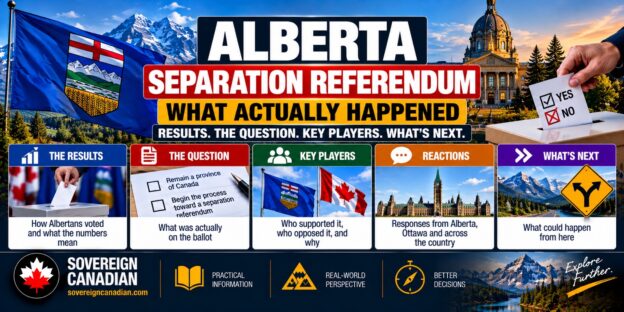
Albertans voted on Monday, and the answer wasn’t close. In the province’s first-ever referendum touching on separation, roughly three out of four voters chose to remain a province of Canada. The count is still unofficial and final results are expected October 29, but the margin is far too large for the remaining ballots to change the story.
This post covers what was actually on the ballot, why the question existed at all, who was pushing on it from inside and outside the country, and what the numbers do and don’t tell us.
What Albertans Were Actually Asked
The separation question wasn’t a vote on independence. Question 10 asked whether Alberta should remain a province of Canada, or whether the provincial government should begin the legal process the Constitution requires to hold a binding referendum on separating. A win for the second option would have started a process, not ended Alberta’s place in the country. Critics called it a referendum on a referendum, and the vote itself was non-binding.
It was one of ten questions. Five dealt with immigration and access to provincial services for non-permanent residents. Four dealt with constitutional change, including abolishing the Senate and letting provinces opt out of federal programs without losing the money.
The Result
With about 84% of voting places reported, the unofficial count had remain at 75.5% and the separation process at 24.5%, or roughly 1.41 million votes to 0.46 million. About 1.87 million ballots had been counted, and Elections Alberta had been preparing for record turnout. Official results come October 29, and a vote this lopsided is unlikely to move far.
Two details matter. First, the final polls were directionally right. An average of the last five published polls, with undecided voters excluded, had remain near 72%, so the result landed a few points better for the remain side than the polling suggested. Second, support for separation was concentrated. It led in only two electoral divisions, Central Peace-Notley at 51.0% and Rimbey-Rocky Mountain House-Sundre at 50.4%, with the next closest, Drumheller-Stettler, at 48.1%. The federalist side led everywhere else.
The process wasn’t clean. More than 100 polling stations had to extend voting hours after late openings, and a First Nations chief said voters were forced to wait hours in line. Those are fair issues to raise about administration. At this margin, they don’t change the outcome.
Reaction split the way you’d expect. Prime Minister Mark Carney called it a great result for Canada. Premier Danielle Smith said she was very pleased. Jeffrey Rath, a top figure in the Alberta Prosperity Project, said the push for an independent Alberta would absolutely continue.
Why Separation Was on the Ballot at All
The honest answer is grievance, plus a political system that made it cheap to force the question.
The grievances are long-standing: federal energy and environmental policy, pipeline approvals, and equalization. Smith turned them into a deadline in 2025 when she put nine demands to Carney, including eliminating the oil and gas emissions cap, and warned of an unprecedented national unity crisis if they weren’t addressed within six months. Several of those complaints, including the emissions cap and the clean electricity regulations, were removed or eased by the Canada-Alberta memorandum of understanding signed November 27, 2025, which aims to advance a new bitumen pipeline to the British Columbia coast. An MOU is not a pipeline, but it changed the tone from Ottawa, and Carney grew up in Edmonton, which didn’t hurt.
The mechanics did the rest. The Smith government lowered the signature threshold under the Citizen Initiative Act. Two petitions followed. The separatist Alberta Prosperity Project and Stay Free Alberta collected roughly 300,000 signatures for a referendum on leaving. Thomas Lukaszuk’s Forever Canadian campaign collected more than 400,000 for the opposite question. A judge then threw out the separatist petition question after First Nations argued it ignored their constitutionally protected treaty rights.
That left Smith with a choice. She announced in a televised address on May 21 that the October ballot would add a remain-or-start-the-process question. She has said she opposes separation and wants a sovereign Alberta within a united Canada, and she has also said separatists aren’t fringe voices. Her critics read the move as an attempt to manage her own party’s hardliners, who had threatened a leadership review unless the question was changed. Her defenders read it as respecting 700,000 petition signatures from both camps. Both readings can be partly true.
The Internal Pressure
Inside Alberta, this was as much a United Conservative Party story as a national unity story. The base that pushed Smith to the top is the same base that produced the separatist energy. Federalists were frustrated that she wasn’t more visible on the remain side, and the party president had to reassure members that the government’s roughly 4 million CAD ad campaign was focused on the first nine questions rather than the separation one.
The result has already shifted the pressure. Separatists are now turning on Smith and the UCP, and Rath said the province will never be independent as long as an avowed federalist leads the party. A UCP member of the legislature who backed the separatist petition has said he won’t seek re-election. Former premier Jason Kenney had warned before the vote that low turnout was the separatists’ best path. Turnout wasn’t low.
The External Pressure
The outside influence is harder to measure and easier to overstate.
The backdrop is the U.S. trade war and Donald Trump’s repeated talk of Canada as a 51st state. Treasury Secretary Scott Bessent said in January that Alberta would be a natural partner for the United States. The Financial Times reported that Alberta Prosperity Project leaders met State Department officials in Washington three times since April 2025, and separatist figures described the discussions as high level. The State Department said it regularly meets civil society groups, that no senior officials were involved, and that no commitments were made. The U.S. ambassador to Canada said the administration isn’t meeting with separatists to strategize. Reports of a requested credit line were never confirmed by U.S. officials.
What’s established is that meetings occurred, that U.S. officials downplayed them, and that Ottawa treated them as a sovereignty concern. What isn’t established is any U.S. support for the separatist campaign. The more practical external effect ran the other way. Lukaszuk asked Smith to defer the vote because of the trade war, and the result is being read as a unity win at a moment when Carney needed one.
What the Other Nine Questions Say
This is where the result gets more interesting. Provisional results had eight of the nine other measures passing, several narrowly.
On immigration, control over immigration to reduce it to more sustainable levels was in the mid-50s and slipping as the count progressed, limiting provincial programs to citizens, permanent residents and those with approved status was around 57%, and proof of citizenship to vote was around 63%. On the constitutional side, provincial selection of provincial court justices sat at 50.7% and provincial laws taking priority over conflicting federal laws in provincial or shared areas was near 51%.
The one that failed was the opt-out question, which would let provinces leave federal programs like health care, education and social services without losing the associated federal funding. About 52% opposed it. These figures are unofficial and several were still moving, so treat them as direction rather than final numbers.
What I Take From It
Albertans rejected leaving, and they did it by about three to one. They also voted, narrowly and unevenly, for more provincial power, more control over immigration and a harder line on who gets provincial services. Separation was never the whole product. It was leverage, and the leverage message was sent through the other nine questions rather than the tenth.
The failed opt-out question is the tell. Albertans were willing to ask for more control, but not to the point of a no-strings exit from federal programs. That reads to me as people wanting a better deal inside Canada, not a different country.
The grievance behind the vote hasn’t gone away, and the pipeline, though now a designated national interest project, is still only a proposal. The credible separation threat that gave Alberta leverage has now been tested and lost, which changes the bargaining position for both Edmonton and Ottawa. Whether that ends up helping or hurting Alberta depends on what Ottawa does with a win it didn’t expect to be this big.
What I’d Actually Do
- Treat the result as the removal of a tail risk, not as a reason to trade. A 76% remain vote doesn’t create an opportunity that wasn’t priced in the day before.
- Check the official count on October 29 and the UCP leadership fallout, because those are the next real data points on how much political risk is left.
- Follow the pipeline MOU through to actual approvals and construction milestones. That, not the referendum, is what moves Alberta energy economics.
This article is for general information and discussion only and is not financial, tax, legal or investment advice. I’m not a licensed advisor, and your situation is different from mine. Figures reflect unofficial Elections Alberta results as of October 20, 2026 and may change when official results are released. Speak with a qualified professional before acting.