
For most of Canada’s history, the idea of joining the European Union would have sounded absurd. Canada is a North American country, deeply integrated with the United States and separated from Europe by an ocean.
Then, in September 2026, European Commission President Ursula von der Leyen stood in the European Parliament and proposed opening the door for Canada to become the EU’s first “associate member.” Donald Trump called the idea laughable and threatened heavy tariffs. A status that does not exist in EU law was suddenly dominating the headlines.
The Montreal summit has now ended, and the picture is clearer. Canada and the EU launched an Alliance for the Future. They did not create associate membership. They agreed to define something called “an ever-closer association” by 2027. Negotiations on several economic agreements were reported as concluded. And they said very little that changes your personal rights in Europe.
Canada is moving closer to European institutions. Canadians are not gaining the rights of European citizens.
That was true before the summit and it is still true. What has changed is how much more detailed the institutional side has become.
Updated October 30, 2026: The Montreal summit has ended. Canada and the EU launched an “Alliance for the Future,” a political framework rather than a treaty. The final declaration did not create associate membership; instead, both sides committed to define an “ever-closer association” short of full membership by the 2027 summit. Several economic arrangements advanced, and talks on narrow mobility tracks for young people, skilled workers and researchers are starting. Nothing in the declaration gives Canadians general rights to reside, work or retire in Europe.
What is the Alliance for the Future?
The best way to read the joint statement is to pay attention to its verbs. Leaders “launch,” “aim,” “welcome,” “will work towards” and “will explore.” Those are the verbs of a work programme, not a treaty.
As far as I can tell from the text, the Alliance is a political framework with a list of ambitions attached. It does not create enforceable rights for individuals, and it does not say what its own legal status is. It presents itself as building on the 2016 Strategic Partnership Agreement, the existing treaty-level framework for regular summits and joint committees.
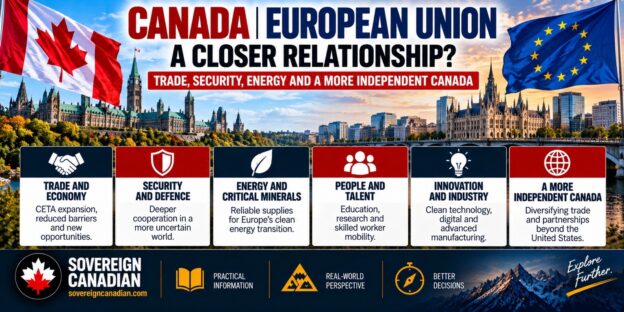
The statement organizes the work into six areas: trade and regulatory cooperation, digital and research technology, critical raw materials and energy, financial services and markets, security and preparedness, and people-to-people exchanges. It sets a principle of reciprocity in industrial sectors where both sides agree to cooperate more deeply, and it promises regular summits, joint ministerial committees, sectoral roadmaps and a business council.
What it does not contain, as far as I could find, is a new treaty body, a court, a budget contribution for the Alliance itself, or a timetable for Canada’s Parliament. Prime Minister Mark Carney said in September that the final structure of the alliance will go to a vote in Parliament. That vote hasn’t been scheduled, and there is nothing yet to vote on.
Costa, announcing the summit, said it would take the partnership “to the next level”. That’s fair. It is also a reminder that a framework is where relationships start, not where they finish.
What happened to associate membership?
Short answer: the phrase did not make it into the final statement, and no new membership category was created.
The joint statement never says associate member. Reporting from the German news agency dpa says the term was removed from the final declaration. The Canadian Press reports that Carney, von der Leyen and European Council President António Costa each said they would like to see Canada become an associate member eventually, and the Globe and Mail says Carney held the label up as the designation he is working toward. I wasn’t able to retrieve Carney’s own words from today, so treat that as reporting, not a quotation.
Meanwhile Germany’s Chancellor Friedrich Merz again rejected the term. Euronews reported before the summit that Germany, France, Italy and Greece objected to a draft declaration that cited von der Leyen’s offer, partly over legal uncertainty and the precedent it might set for other countries.
Here’s what the leaders did commit to. By the 2027 summit they will work to define the concept of “an ever-closer association of Canada to the EU, short of full membership itself.” Von der Leyen described the idea to reporters as association without accession, including closer coordination of policies and administrative structures and exchanges between parliaments and courts. Those are her words about her aspiration, not text in the statement.
So the right way to think about it is this. The label is a fight over a name. The substance is a homework assignment: over the next year, Canada and the EU have to work out what a general association would contain and who in Europe has to approve it.
The legal backdrop hasn’t changed. Article 49 of the Treaty on European Union lets a “European State” that respects the EU’s founding values apply for membership. Canada is not a European state. Full membership would require changing the treaties themselves, with agreement among all 27 members and national ratification. Nobody has proposed that, and Canadian officials have said Canada isn’t seeking it.
What was signed, what was concluded, and what’s still just a plan?
This is the distinction that matters most. Politicians use “agreement” loosely, and a signing ceremony is not the same thing as a legally binding treaty. Here is how the summit’s outcomes sort out.
| Item | Status as of October 30 | What that means |
|---|---|---|
| Alliance for the Future | Launched | Political framework; not a treaty |
| Digital Trade Agreement | Substantive negotiations concluded | Signing, final text and entry into force not independently verified |
| European Investment Bank agreement on critical resources | Negotiations concluded | Signing, final text and entry into force not independently verified |
| Second-generation competition agreement | Negotiations concluded | Cooperation between competition regulators; signing and entry into force not independently verified |
| EuroHPC supercomputing participation | Welcomed | Formal instrument not located; terms unverified |
| Erasmus+ | Negotiations to be launched | Nothing agreed yet |
| Galileo satellite navigation; IRIS2 secure satellite network | Negotiations (Galileo) and exploratory talks (IRIS2) to be launched | Nothing agreed yet |
| Labour, researcher and youth mobility | Discussions to be launched; youth partnership to be “explored” | Nothing agreed yet |
| Frontex–Canada Border Services Agency cooperation | Working arrangement agreed | Operational border-security cooperation; no new individual immigration rights |
| Ukraine Support Loan | Canada’s “intention” to join | Intention only |
| SAFE, Horizon Europe Pillar II, architects’ recognition agreement | Already in place before the summit | Not new |
| “Ever-closer association” | To be defined by the 2027 summit | A process, not an outcome |
Two cautions follow from that table.
First, “concluded negotiations” is not “signed,” and it is certainly not “in force.” Agreements typically go through legal review, signature and approval on both sides before they take effect. The statement doesn’t describe that path. The final signed instruments and implementation dates have not been confirmed in the official materials reviewed. Until those details are published, the three agreements should be treated as concluded in principle rather than operational.
Second, several pre-summit headlines described things that did not appear in the final statement. A leaked draft had Canada receiving “associated country status” under a proposed European cloud and AI law. The final text supports reciprocal access to each side’s digital markets, “in line with” their own regulations, but doesn’t mention that status. The draft also promised the joint purchase of 50 water bombers; the final text refers only to 24 aircraft announced at the previous summit. And the Defence, Security and Resilience Bank is treated as a separate initiative between Canada and some member states, not an EU–Canada outcome.
Draft documents are not outcomes. Only the published statement counts.
Canada’s growing participation in European programs
The most useful way to understand this relationship hasn’t changed. Canada is not becoming an EU member. It is becoming an associated participant in a growing list of European programs, each negotiated on its own terms.
What already existed before the summit:
- Defence. Canada became the first non-European country to participate in SAFE, the EU’s €150-billion defence-procurement financing instrument, in exchange for fees and conditions.
- Research. Canada’s association to Horizon Europe’s Pillar II, signed in 2024, lets Canadian researchers participate on the same terms as their European counterparts, with a financial contribution.
- Professional recognition. The architects’ mutual recognition agreement is in force.
- Digital. The statement refers to signed memoranda of understanding on artificial intelligence and on digital credentials. They are non-binding political documents, and their precise signing dates were not confirmed in this review.
What the summit added, with the caveats above: a digital trade agreement and an EIB investment agreement reported as concluded in substance; Canadian participation in the European supercomputing partnership (welcomed, though the formal terms haven’t been published); negotiations to be launched on Galileo and Erasmus+; and a long list of studies and dialogues, including a feasibility study on Canadian liquefied natural gas exports to Europe, modernization of the Canada–Euratom nuclear agreement, and new dialogues on the Arctic, transport and climate security.
For Canadian companies, researchers and defence suppliers, that is genuine opportunity. The European Commission’s trade page puts the two-way relationship in context: CETA removed duties on 99% of tariff lines, 98% of them when it began provisionally applying in 2017. The next layer is digital rules, financing, procurement and shared infrastructure.
But notice what it is. Each piece is a separate agreement with separate conditions. That is a much more realistic model than any form of EU “membership,” and it’s the model Canada is already using.
What does this actually change for ordinary Canadians?
Strip away the geopolitics and ask the practical question: does this give me more freedom to travel, live, work, invest, own property or retire in Europe?
For travel, residence, work, retirement, property, taxes, pensions and health care, the honest answer today is no. Here is how each area looks after the summit.
| Area | Status | Explanation |
|---|---|---|
| Travel in Europe | No change | The 90-days-in-180 rule stands. The statement doesn’t mention it. |
| Residence | No change | National residence visas still apply. Nothing in the statement creates residence rights. |
| Employment | No change today; discussions launching | Talks on mobility for young people, highly skilled workers and researchers. No general right to work. |
| Retirement | No change | No retiree visa or residence right. |
| Real estate | No change | Property rules remain national. |
| Taxation | No change | Canadian tax residency, departure tax and each country’s tax rules are untouched. |
| CPP, OAS, RRSP/RRIF | No change | Existing bilateral social-security agreements and tax treaties continue. |
| Health care | No change | The statement’s health items concern pandemic preparedness, not patient access or insurance. |
| Education | Negotiations to be launched | Erasmus+ talks; no tuition or visa change yet. |
| Business and investing | Mixed | Digital trade, EIB financing and competition negotiations concluded; signing and implementation status not independently verified. |
The rest of this article explains the reasoning behind each line.
The mobility question: can Canadians live and work in Europe?
This is what many readers want to know, and the answer is more nuanced than “no” but still a clear no for the general case.
What the statement says. The two sides will “launch discussions” on cooperating on skills development and on enhancing labour and researcher mobility and talent attraction. The focus is on reducing barriers for young people and facilitating mobility for highly skilled workers and researchers, along with greater recognition of professional qualifications. They will also explore a next-generation Youth Mobility Partnership, tied to programs like Erasmus+.
What it does not say. There’s nothing about visa-free residence, general freedom of movement, retiree residence, family reunification or moving between member states after settling in one. Nothing touches the Schengen 90/180 rule. The only immigration-related item is a promise to explore better information sharing between the two sides.
How that fits what Canadian officials said. Canada’s ambassador to the EU, Jonathan Wilkinson, said on October 27 that Canada and the EU were not talking about free movement of labour between Europe and Canada, only specific areas where shared labour pools might help. The statement is consistent with that, and a bit more specific: it frames the track by type of worker rather than by industry, and it names no sectors. Costa said on Thursday that he wants to see greater labour mobility, and Carney said in September that any new mobility programs would be limited and would require consultation with the provinces.
The anonymous reports in September that Carney had floated visa-free living and working in Europe have never been confirmed, and nothing in the final statement supports them.
What this probably means. The realistic outcome is a set of narrow, negotiated pathways: perhaps easier work permits for certain technical professionals and researchers, expanded youth-exchange arrangements and more mutual recognition of qualifications. Canada already runs youth-mobility arrangements with many European countries, and CETA already allows limited temporary entry for certain business categories. Expanding those would help specific people. It would not give a Canadian retiree, remote worker or family the right to settle in Portugal or Spain.
And any real mobility deal will be reciprocal. If Canadians gain easier access to European labour markets, Europeans will want comparable access to Canada, which raises political questions about immigration, labour markets and provincial jurisdiction. The Conservative immigration critic has already demanded transparency on that point.
For now, if you want to live in Europe, the route is still the one it was last month: a national residence permit in the country you choose. I walk through what that looks like in Living in Portugal as a Canadian.
Travel and Schengen: nothing has changed
Canadians can visit the Schengen Area without a visa for up to 90 days in any rolling 180-day period, according to the European Commission’s visa-policy page. The limit is shared across the whole zone. Travelling from France to Spain or Portugal to Italy does not reset the clock.
Europe’s biometric Entry/Exit System began a phased rollout in October 2025 and, according to the European Commission, became fully operational on April 10, 2026. It electronically records entries, exits and refusals of entry, replacing passport stamping, and it supports the calculation of permitted stays and the detection of overstays. ETIAS, the pre-travel authorisation for visa-exempt visitors, is a separate system. The European Commission’s ETIAS page says the system is not yet in operation and that no applications are being accepted. The EU has not announced a confirmed launch date. When it arrives, it will be a screening requirement with a planned fee of €20, not a visa. It does not allow work, and it does not extend the 90-day limit.
The joint statement doesn’t mention the 90/180 rule, and I found no proposal to change it. A Canadian who wants more than 90 days in Europe still needs a national long-stay visa or residence permit. If you’re planning a long European winter, Expat Living for Canadians walks through the spectrum of options between a long holiday and emigration.
Real estate and residence: still national
The word association can create unrealistic expectations about property. There is no single EU property market governed by one set of foreign-buyer rules. Each country sets its own.
Some countries distinguish between EU/EEA citizens and buyers from outside Europe. Croatia applies extra conditions to certain non-EU purchases, and Denmark and parts of Austria keep restrictions in some circumstances. Many of the countries most popular with Canadians, including Portugal, Spain, France, Italy and Germany, generally let Canadians buy ordinary residential property.
Portugal illustrates why national rules matter. Property-transfer taxes, foreign-buyer rules and residence requirements are determined by Portuguese law, not by Canada’s relationship with the European Union. I cover those considerations in Portugal Real Estate Investing for Canadians.
The core distinction is the one I keep returning to: you can often buy the property already. The harder question is whether you’re allowed to live in it. Ownership and immigration status are separate legal questions, and nothing in the summit statement affects either.
Taxes, pensions, retirement and health care
Taxes. The EU does not run a single personal income-tax system, even for its own citizens. France taxes residents under French law, Portugal under Portuguese law, and so on. Ceasing to be a Canadian tax resident can trigger a deemed disposition of certain assets under Canada’s departure-tax rules, which I explain in Departure Tax Canada. The country you move to then decides whether you’re its tax resident, and the bilateral tax treaty sorts out overlaps. None of that changes under the Alliance for the Future. Closer economic integration may reduce commercial friction, but it does not create a common Canada–Europe tax regime. Even Norway, deep inside the single market, keeps its own tax system.
Pensions and retirement. CPP can generally be paid to eligible recipients living abroad. OAS is more conditional: continued payment abroad generally depends on Canadian residence history and, in some cases, a social-security agreement. Canada has bilateral social-security agreements with numerous European countries. These agreements can help coordinate eligibility and contributions, but their provisions differ by country and benefit. They do not place Canadians within the EU’s internal social-security coordination system, and the summit statement doesn’t propose joining it. How RRSP and RRIF withdrawals are taxed abroad depends on the specific treaty and the type of payment, so it needs country-by-country checking.
Health care. Canadians haven’t been offered European Health Insurance Card rights or automatic access to a member state’s public system. The statement’s health language concerns pandemic preparedness and cooperation between public-health agencies. It says nothing about patients. Anyone retiring in Europe still has to work through the residence, insurance and public-coverage rules of the country they choose.
Education and professional opportunities: the one area that could become tangible
If any part of this deal is going to be noticed by an ordinary Canadian family, education is the most likely candidate.
The statement launches negotiations toward “deeper participation” in Erasmus+, the EU’s education, training, youth and sport program. That phrasing suggests Canada already has some access, though I haven’t verified its scope. It also talks about expanding Canadian uptake of the Marie Skłodowska-Curie Actions and European Research Council grants, and about greater recognition of professional qualifications. The architects’ recognition agreement already shows how that can work for one profession.
But keep expectations in check. Joining an exchange program doesn’t make a Canadian student equivalent to an EU citizen for tuition. It doesn’t remove national student-visa requirements, and it doesn’t create residence rights for students or their families. These are negotiations that are only beginning, and the outcome could be anything from modest exchange funding to something broader.
Why Canada is doing this, and the US dimension
The obvious answer is Donald Trump and the deterioration in Canada–US relations. There’s truth in that. In the first half of 2026, roughly two-thirds of Canadian merchandise exports went to the United States, an extraordinary concentration that reflects geography, integrated supply chains and the sheer size of the American market. Europe cannot replace that, and it would be foolish for Canada to try.
A better way to understand the strategy is as a hedge. A business that depends on one customer for most of its revenue doesn’t need to abandon that customer. It needs a second and third one, so a bad quarter with the first isn’t fatal. Europe wants secure supplies of critical minerals, energy and industrial inputs, trusted technology partners and defence-industrial capacity. Canada wants customers, investment and alternative procurement relationships. Those interests overlap, and they would overlap even if relations with Washington improved.
That’s why I don’t think this is purely political theatre. The timing is political and the rhetoric is inflated, but the economic logic is real. It’s also why the summit produced so many practical items (digital rules, EIB financing, satellite navigation, supercomputing) and so little about the headline label.
Washington noticed the idea early. On September 16 Trump called an associate membership for Canada “laughable” and threatened “very heavy tariffs” on Europe if he judged it a hostile act. I haven’t found a US response to the final statement. The statement barely mentions the United States at all; its one explicit reference is regret over American sanctions on the International Criminal Court. Carney, for his part, has argued the alliance would make Canada a better partner for the US, not a rival.
The sensible objective is diversification, not separation. Canada doesn’t need to replace the United States with Europe. It needs to become harder to corner.
What would Canada have to give up?
Deeper integration is rarely free, and this statement shows where the costs could come from.
The statement says the Alliance rests on the principle of reciprocity in industrial sectors where both sides agree to cooperate more deeply. It talks about bringing standards closer through CETA, strengthening regulatory and standards cooperation, promoting interoperability of AI systems and digital regulatory frameworks, and working toward mutual recognition in digital identity, AI conformity assessment and cybersecurity. Each of those can be beneficial, and each can also narrow Canada’s room to set different rules later.
Canada has already accepted real conditions in the programs it has joined: participation fees and content conditions for SAFE, and a financial contribution for Horizon Europe. The concrete commitments in the statement include Canada’s stated intention to join the Ukraine Support Loan and a joint commitment to timely ratification of the Canada–EU agreement on airline passenger data. I found no quantified financial commitment for the Alliance itself, no immigration reciprocity commitment and no agreement to submit to EU institutions.
At home, the politics matter. The Conservatives have said Canada will never be an EU state and oppose EU taxes, laws and “European-style immigration.” Provincial jurisdiction over labour and education means the provinces have to be at the table, and the new Parti Québécois government in Quebec has already clashed with Ottawa over its role at the summit. Carney’s promised parliamentary vote on the final structure is the right safeguard.
A stronger international partnership can enhance sovereignty by reducing dependence on one country. It can also constrain sovereignty if Canada accepts rules it has little say in writing. The challenge is to capture the first without drifting into the second.
How far could Canada–EU integration realistically go?
I find it useful to think of the relationship as a ladder.
| Level | Relationship | Current assessment |
|---|---|---|
| 1 | CETA and existing political cooperation | In place; provisionally applied, 18 of 27 member states ratified |
| 2 | Defence, research and professional-recognition participation | In place (SAFE, Horizon Pillar II, architects’ recognition) |
| 3 | Alliance for the Future: wider digital, financing, space, supply-chain and education cooperation | Launched October 30; some agreements concluded in substance, others still to be negotiated |
| 4a | A defined “ever-closer association” (general framework) | To be defined by the 2027 summit; content unknown |
| 4b | Targeted labour mobility and wider qualification recognition (separate track) | Discussions launching; young people, highly skilled workers, researchers |
| 5 | Partial participation in selected parts of the single market | Possible sector by sector; no broad arrangement |
| 6 | EEA-style integration, including general freedom of movement | Highly unlikely |
| 7 | Full EU membership | Effectively unavailable under the existing treaties |
Canada has now clearly arrived at level 3. Levels 4a and 4b are separate tracks, not steps in a sequence: the general association concept is due by 2027, while the targeted mobility discussions are launching on their own. The statement sets no order between them, and progress on one doesn’t depend on finishing the other. Beyond that, the legal, political and sovereignty obstacles grow quickly. I’d put an EEA-style arrangement well out of reach: it would require accepting a large body of EU law, financial contributions and reciprocal free movement, which Canada has shown no sign of wanting.
What happens next?
The next stage is slow, procedural and easy to miss:
- Digital trade, EIB and competition agreements. Watch for published texts, confirmed signatures and the approval steps on each side.
- Erasmus+ and Galileo negotiations. Both are scheduled to launch, and neither has a published timetable.
- Mobility discussions. Which categories of workers, which countries and which conditions? So far these are all unanswered.
- The 2027 summit. This is the deadline for defining the “ever-closer association” concept, and the point where the label question returns.
- CETA ratification. Nine member states still haven’t ratified: Belgium, Bulgaria, Cyprus, France, Greece, Hungary, Ireland, Italy and Poland, according to the European Commission. The statement sets no timetable.
- Canada’s Parliament. Carney has promised a debate and vote on the final structure.
- ETIAS. No launch date is confirmed.
Conclusion: association isn’t citizenship
Canada is not becoming the 28th member of the European Union. The term associate member did not survive the summit, and no new legal category was created.
What emerged is more modest and arguably more useful: a framework for a deeper relationship, several agreements reported as concluded in substance whose signing and publication have not been confirmed, a list of negotiations about to begin, and a commitment to work out what an “ever-closer association” means by 2027.
For Canadian companies, researchers, defence suppliers and eventually students, the opportunities are growing. For an individual Canadian thinking about Europe, the rules that matter are exactly the ones that mattered last month. The Schengen 90/180 rule remains. National residence and retirement visas remain. Property laws remain national. Health-care access remains tied to national systems. And taxation remains governed by Canadian law, each country’s laws and bilateral treaties.
The strategic relationship matters, and I’d rather judge it by what it delivers than by what it’s called. If Canada ends up with better access to European markets, technology, financing and defence programs, that is a valuable hedge. If it eventually produces meaningful mobility rights for more than a narrow group of workers, it becomes something more personal: a genuine expansion of where Canadians can choose to live and work.
We aren’t there. But Canada is building a closer relationship with Europe one agreement at a time, and having more options looks considerably more valuable than it did a few years ago.
What I’d Actually Do
I wouldn’t change any plan because of this summit. If I wanted time in Europe, I’d plan around the existing rules: 90 days in 180 for a visit, a national residence route for anything longer, and professional cross-border advice before any move that affects my Canadian tax residency.
I’d treat property as a separate decision from residence, and I’d never buy European real estate on the theory that “association” will eventually deliver residence rights. It hasn’t, and nothing in this statement says it will.
And I’d keep an eye on three things over the next year: the published texts of the digital trade and EIB agreements, the Erasmus+ negotiations, and which categories of workers the mobility talks actually name. If those turn into specific, enforceable rights for people like me, I’ll update this article. Until then, the optionality worth building is the kind you can use today.
This article is for general information only and does not constitute legal, tax, immigration or investment advice. Canada–EU arrangements, immigration rules and tax law can change, and the signing, publication and implementation status of several agreements discussed here could not be independently verified. Before making decisions about residency, taxation or property, consult a qualified immigration lawyer and a cross-border tax adviser. This article reflects information available on October 30, 2026..