
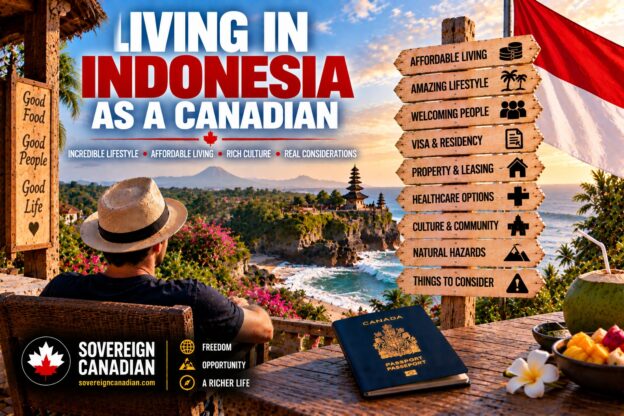
Every country in this series eventually reveals a single sentence that explains it. Thailand offers dependability without belonging. Vietnam offers presence without permanence. Malaysia offers a formalized temporariness that is honest about what it is. The Philippines, to my surprise, turned out to offer durable legal permission over a life whose dependability you have to build privately. Indonesia is the hardest of the group to reduce to a sentence, because it does something none of the others quite manage: it makes you feel at home almost immediately, and then, the more seriously you try to make that feeling permanent, the more expensive and structurally awkward the whole thing becomes.
That is the argument of this article. Indonesia makes a temporary life feel permanent while making permanent commitment increasingly expensive. A Canadian can become deeply attached to Indonesia in a single long winter – the villa, the household help, the community, the food, the extraordinary cheapness of a good day. What that Canadian cannot easily acquire is tenure, in either sense of the word: security of holding, and permanence of position. You can lease and occupy, and you can hold real registered use rights, but not freehold title in the ordinary sense a citizen enjoys. You can hold a five- or ten-year residence permit, but the path from residence to a citizenship most Canadians would actually accept is effectively blocked by Indonesia’s general prohibition on adult dual nationality. You can settle, but the act of settling is precisely what exposes your worldwide income to Indonesian tax. The attachment is real and fast. The tenure is withheld, and it recedes as you reach for it.
So the question this article answers is not “should a Canadian move to Bali.” It is harder than that. What does Indonesia give a Canadian that Thailand, Malaysia, Vietnam and the Philippines do not, what does it quietly demand in exchange, and is Bali the country’s greatest advantage or merely its easiest entry point? If you want the wider map first, the Expat Living for Canadians hub and the Most Popular Expat Destinations for Canadians survey set the context. This is the deep read on the one country in the series that is easiest to love and hardest to hold.
Start with Indonesia, not Bali
It is worth saying plainly at the outset that most Canadians who think they are evaluating Indonesia are evaluating Bali, and Bali is not Indonesia. Bali is a Hindu island of roughly 4.5 million people inside a Muslim-majority nation of about 280 million. Its openness to foreigners, its temple culture, its particular social contract with tourism – none of that describes Jakarta, Surabaya, Lombok or Yogyakarta. The national architecture, though, applies everywhere. The visa rules, the tax rules, the property law, the banking system, the disaster exposure and the healthcare ceiling do not change when you cross from Denpasar to Java. So the honest way to read Indonesia is to understand the country first, then watch how that single national frame produces very different lived answers in Sanur, Canggu, Ubud, Jakarta, Lombok, Yogyakarta and Surabaya. The country writes the rules; the location decides how they land on you.
Reconnaissance: Indonesia is easier to test than its reputation suggests
The first practical question is how cheaply and legally a Canadian can scout Indonesia before committing to anything, and here Indonesia is stronger than most people assume. Canadians can enter on a visa on arrival, currently a 30-day permit extendable once for another 30, giving 60 days. That is the number most guides quote, and it undersells the country badly.
The instrument that matters for a serious scout is the C1 single-entry visit visa, applied for online before travel. It grants 60 days on arrival and can be extended twice, 60 days at a time, for up to 180 continuous days without a border run. In plain terms, a Canadian can spend an entire winter – November to April – living legally in Bali on a single visa, no monthly visa runs, no residence permit, no tax registration. For a snowbird testing the country, or a family taking a trial season, that is close to ideal. Above that sits the D-series multiple-entry visit visa, valid for one to five years with stays of up to 60 days per entry (now extendable toward 180 per visit), which suits the recurring seasonal visitor who wants to come and go for years without reapplying.
This matters for the thesis. The front end of the Indonesian proposition, the reconnaissance and seasonal experience, is generous, cheap and administratively light. You can build attachment on a tourist footing for years. The friction only appears when you try to convert that attachment into settlement. Which raises a working idea worth carrying through the rest of this article: Indonesia may be a better country to spend five months a year in than to move to. Not as a tax trick – I will get to why 180 days does not neatly solve your tax position – but as a structural observation. The Indonesian case may peak before settlement.
The residence architecture: renewable permission dressed as permanence
When a Canadian does decide to settle, Indonesia’s 2026 residence system is stranger and more permissive than the old “retirement KITAS” folklore suggests. The framework was rewritten under Law No. 63 of 2024 and a run of ministerial regulations, and it is now administered by a dedicated Ministry of Immigration and Corrections. The routes a Canadian would actually use fall into a family of long-stay permits indexed under E33 and its cousins.
The base Second Home Visa (index E33) gives up to five years, extendable, against proof of roughly USD 130,000 held in an Indonesian state bank or a property purchase around USD 1,000,000. No sponsor, no age floor. For retirees there are now two distinct products, and the distinction matters. The E33E, marketed as the Silver Hair visa and a category within Indonesia’s Golden Visa programme, is for applicants 55 and over, requires a deposit of roughly USD 50,000 in a state bank plus proof of income around USD 3,000 a month, needs no local sponsor and no domestic-helper obligation, and runs for five years, renewable. The older E33F retirement KITAS is the annually renewed one: it needs a local sponsor, carries an income requirement around USD 3,000 a month, allows some visitor-type business activity but no employment, and must be renewed year after year. For remote workers, the E33G requires a foreign employment contract and income of at least USD 60,000, runs one year and is renewable, and forbids any Indonesian-source work. At the top, the Golden Visa offers five or ten year residence against investment – roughly USD 350,000 to USD 700,000 in government bonds for an individual, far more to establish a company.
Here is the point that reshapes the old narrative, and it strengthens the thesis rather than weakening it. Indonesia’s residence tiers are worth separating. There is limited-stay permission, the KITAS or ITAS, historically annual and renewable; there are the long five- and ten-year Second Home and Golden Visa permissions; and there is the KITAP, the permanent-stay permit. Several categories genuinely do reach KITAP – a spouse of an Indonesian citizen after about two years of marriage, and investors, retirees and Second Home holders after roughly three continuous years, each with a Statement of Integration – and the KITAP is a five-year card, renewable indefinitely, that carries a foreigner identity card and broader access. But Indonesia itself is clear that it does not grant permanent residence in the Western sense. The KITAP is indefinitely renewable conditional permission, not an unconditional status: it is still revocable, it still depends on maintaining the qualifying basis, and it is emphatically not citizenship. So the honest description of Indonesian residence is not a ladder that ends in ownership of your own status. It is permission – sometimes very long permission, even indefinitely renewable permission – that always remains tethered to a condition you must keep satisfying. That is the first face of attachment without tenure. Indonesia will let you feel resident for a decade at a time, and even call it permanent. It will not let that feeling become a right you hold outright.
Tax: the country that taxes you for settling
If reconnaissance is where Indonesia is most generous, tax is where settlement is most punished, and this is the single most important section for a Canadian who is genuinely considering a move rather than a season.
Indonesia taxes its tax residents on worldwide income at progressive rates rising to 35 percent, and it treats capital gains as ordinary income. You become a tax resident by being present more than 183 days in any rolling twelve-month window, or by being present in a fiscal year with an intention to reside. That intention test is fact-specific and documented: the indicators Indonesian rules look at include a home in Indonesia at your disposal for ongoing use rather than mere transit lodging, your centre of personal, social, economic and financial interests, your habitual abode and daily activities, a lease running beyond 183 days, the movement of your family, and residence documentation such as a KITAS or KITAP. This is why the “five months a year” idea is a conceptual point and not a formula. Day-counting alone does not protect you if your whole life visibly points at Indonesia. But the structural fact stands: the act of settling, of crossing from seasonal visitor to resident, is exactly what pulls your global income into the Indonesian net.
Do not be misled by the widely marketed “territorial” or four-year foreign-income concession. It is real, but it is narrow and specific. Under Government Regulation 55 of 2022, a foreign national who becomes an Indonesian tax resident and holds certain expertise – defined around science, technology and mathematics fields, proven by qualifications or work experience, tied to a qualifying employment position and carrying a knowledge-transfer obligation to an Indonesian – can apply to the tax office to be taxed on Indonesian-source income only for their first four tax years. It is better understood as a four-year limitation of worldwide taxation for approved skilled workers than as a general foreign-income exemption. It must be applied for and approved, it is tied to the qualifying job, and it is forfeited if the person instead claims treaty benefits for their foreign income. Retirees, passive-income investors and ordinary remote workers do not qualify. For the Sovereign Canadian reader, assume it does not apply.
Now layer Canada on top. When you become a non-resident of Canada and a tax resident of Indonesia, Canada withholds at source on what it pays you, and the Canada-Indonesia tax treaty caps those rates. Qualifying periodic pension payments, including periodic RRIF payments, are generally subject to a Canadian treaty ceiling of 15 percent, and annuities are also generally capped at 15 percent, subject to the treaty’s specific rules. Not every RRIF withdrawal automatically qualifies as periodic simply because it comes from a RRIF, and a lump-sum collapse of an RRSP is generally subject to Canada’s default non-resident rate, currently 25 percent, so exactly how a given withdrawal is treated is something to model rather than assume. Canadian dividends are capped at 15 percent, interest at 10 percent (and Canada already exempts most arm’s-length interest domestically). CPP and OAS fall outside the treaty’s 15 percent pension ceiling and are generally subject to Canada’s default non-resident withholding, currently 25 percent, with a section 217 election worth reviewing for retirees whose total income is modest. Before any of this, remember that leaving Canada usually triggers departure tax, a deemed disposition of most of your property at fair market value – the mechanics are covered in the Canadian departure tax article and they matter a great deal here.
The trap is what happens next. Indonesia, as your country of residence, then taxes that same income on a worldwide basis and merely credits the Canadian tax already paid. Because Indonesian rates climb to 35 percent, an affluent Canadian does not escape with the 15 percent Canadian withholding – they top up to the Indonesian rate. And crucially, the income that escapes both Canadian and much of Southeast Asian tax – ordinary portfolio capital gains after departure, and everything sheltered inside a TFSA, which Indonesia simply does not recognize – is fully exposed to Indonesian worldwide taxation. That single fact reorders the retiree calculus and separates it sharply by profile.
Which Canadian does the tax system punish, and which does it tolerate
The modest pension retiree – CPP, OAS, a small workplace pension – comes out least badly. Indonesian progressive rates start at 5 percent, personal reliefs exist, and the treaty-capped Canadian withholding plus a possible section 217 election keeps the top-up manageable. This is livable.
The large pension retiree feels it. A generous periodic pension pushes into Indonesia’s 25 to 35 percent brackets, and the 15 percent Canadian credit leaves a real Indonesian balance to pay every year.
The affluent portfolio-funded retiree is where Indonesia is genuinely, structurally unattractive – and this is the one most likely to be blindsided, because they have read that Bali is cheap and assumed cheap means tax-light. Their capital gains, which Canada does not tax after departure and which the Philippines and Malaysia would largely leave alone, are ordinary taxable income in Indonesia at rates to 35 percent. Their TFSA becomes a fully taxable foreign account. For this profile, Indonesia is close to the worst tax residence in the Southeast Asian set. The country that feels like the cheapest place to live can be the most expensive place to be wealthy.
The remote worker deserves a specific warning. The “tax-free Bali nomad” is a myth for anyone honest and tax-literate. An E33G holder present past 183 days is an Indonesian tax resident, and their foreign salary is worldwide income taxable in Indonesia. Enforcement has historically been light, but light enforcement is not a plan, and CRS reporting (below) is closing that gap. This, then, is the core of the tax section and a phrase worth keeping: Indonesia is the country that taxes you for settling. It is not the country’s overall identity, but it is the mechanism that proves it.
Social security: no agreement, and it matters
Canada has social security agreements with more than fifty countries. Indonesia is not one of them. In Southeast Asia, the Philippines has such an agreement and Indonesia, like Thailand, Malaysia and Vietnam, does not. The practical consequence is specific. To keep receiving OAS abroad beyond six months you generally need 20 years of Canadian residence after age 18, and Indonesian residence does nothing to help you reach that threshold – there is no totalization to lean on. CPP is different: it is contributory and paid to you wherever you live. But the OAS gap is a real, quiet erosion for a Canadian who left before banking 20 adult years at home, and it is one of the cleanest points on which the Philippines simply beats Indonesia for a certain kind of retiree.
Property: you buy occupancy, not title
Indonesian property law is where “attachment without tenure” stops being a metaphor and becomes a land title. Freehold in the strict Indonesian sense – Hak Milik, the strongest, hereditary title – is reserved for Indonesian citizens. A foreigner cannot hold it, and neither can a foreign-owned company. What a foreigner can hold is a set of lesser rights, none of which is Hak Milik and none of which gives a citizen’s freehold, but several of which are real, registrable interests rather than mere contracts.
The most common is a leasehold (Hak Sewa): a contract, typically 25 to 30 years with negotiated extensions, requiring no residence permit, which is exactly why it dominates the Bali villa market. But a lease is a contract that decays, and its extension decades out depends on a landowner’s goodwill and solvency you cannot guarantee. Next is Hak Pakai, a right of use that is a real registered land right held in a foreigner’s own name, not a private contract. It runs in substantial terms – on state land, an initial period of up to 30 years, extendable by up to 20 and renewable by up to 30 – but it is available only to a foreigner who holds a valid residence permit, and it is tethered to that residency. Apartments can be held under a registered strata title above minimum values. And the structure closest to ownership is a foreign-owned company (PT PMA) holding a right to build (Hak Guna Bangunan, or HGB), itself a registered right that can run for decades through renewals, with the company’s name on the certificate, at the cost of establishing and maintaining the company. These are registered proprietary interests, then, not mere leases; the point is not that they are worthless but that none of them is the citizen’s freehold. Minimum purchase values for foreigners apply and vary by region under the current ministerial decision (Kepmen ATR/BPN 1241/2022), in the range of roughly IDR 5 billion for a landed home in Bali, Jakarta and the major Java cities, with lower thresholds for apartments and in other provinces – confirm the figure at signing, as these move.
Then there is the nominee arrangement, in which an Indonesian holds the freehold title “on your behalf.” Be blunt about this: it is illegal, it violates the Basic Agrarian Law and the Civil Code, and Indonesian courts have voided such arrangements. The foreigner does not become the registered Hak Milik owner – the nominee does – and agreements designed to circumvent the statutory ownership restriction can be unenforceable or void, which is precisely the exposure. This is one of the most dangerous structures a foreign buyer can accept in Bali, and widespread use does not convert a legally vulnerable nominee arrangement into secure title.
Distinguish, then, four different things people loosely call “buying”: economic control, contractual lease rights, a residency-tethered registered use right, and true freehold. A foreigner in Indonesia can get the first three and never the fourth. Compare the peers and Indonesia sits last on title in the freehold sense: Malaysia lets foreigners hold freehold above a value threshold; Thailand and the Philippines allow freehold condominiums within foreign-ownership quotas; Indonesia gives foreigners registered use and build rights but never Hak Milik, the citizen’s freehold. And buying property does little for your immigration status, and immigration does little for your title, except at the two narrow points where they touch – Hak Pakai’s residency requirement, and the roughly USD 1,000,000 property route into the Second Home Visa. In the typical Bali villa purchase you end up owning, in law, a decaying lease or a company, or at best a registered use right that lives and dies with your visa. That is real legal tenure, but conditional tenure. It is not the citizen’s freehold, and it does not give a Canadian the same security of holding.
Banking and capital mobility: fine to live from, weak to concentrate in
For a foreign resident, ordinary Indonesian banking becomes substantially easier once you hold the appropriate residence documentation. Some banks and products may accommodate non-residents under additional identification and documentation requirements, but a KITAS or KITAP opens the mainstream resident-banking system, where you can hold multi-currency accounts and run the QR-code, bank-transfer daily life that Indonesia does well. Deposit insurance through the national scheme (LPS) covers up to IDR 2 billion per depositor per bank – a broadly similar order to the Second Home Visa deposit, though the visa figure is set in US dollars and the two are not identical – so a larger balance wants spreading across institutions.
The important nuance, and one worth stating precisely rather than dramatically: the rupiah is a restricted currency. Indonesia limits the offshore and international use of the rupiah and requires documentation for various foreign-exchange transactions above certain monthly thresholds. That is not the same as saying lawful capital is trapped. A Canadian who earns legally, pays Indonesian tax, and documents the source of funds can move money out. What Indonesia is not is a place to concentrate a global portfolio. Its rules regulate rupiah and foreign-exchange transactions more tightly than the jurisdictions a Canadian would normally choose as a banking base, with documentation required for larger outward flows, in a currency you would not choose to hold long-term savings in. The sensible conclusion is therefore split: Indonesia is functional as the place you run your local financial life, and weak as a jurisdiction in which to hold your global capital. For a Canadian thinking in flags, this is a lifestyle-and-residence base, not a banking base, and it does not compare with Singapore or even Malaysia as a place to concentrate wealth.
One more point closes the loophole some people still imagine exists. Indonesia participates in the Common Reporting Standard and automatically exchanges reportable financial-account information with partner jurisdictions, Canada included, and its domestic tax administration has become increasingly digitized through the Coretax platform. Reportable financial-account information can therefore flow between the Indonesian and Canadian tax authorities. Whatever you decide about Indonesian residence, plan on transparency, not secrecy.
Healthcare: real capability, a clear ceiling, and a long flight
Healthcare is where the thesis turns from money to mortality, and it needs describing precisely rather than with a comforting percentage. Bali has genuinely capable private hospitals for the great majority of what expatriate life throws at you: routine and chronic care, infectious disease, orthopaedic injuries, general surgery, childbirth in normal ranges, and emergency stabilization. BIMC and Siloam serve the foreign community, Siloam’s Bali hospitals hold international (JCI) accreditation and function as the island’s private referral apex, and the new Bali International Hospital in Sanur, which opened in 2025, with centres of excellence in cardiology, oncology, neurology, gastroenterology and orthopaedics and formal partnerships with Singaporean, Australian and Japanese institutions, has materially widened the island’s ceiling. The honest framing is not that Bali cannot perform a given procedure. It is that the deepest and most complex tertiary and quaternary care – the hardest cardiac surgery, major neurosurgery, complex oncology, transplantation – still has a thinner bench than a major regional medical centre, and that regional referral or evacuation remains part of an affluent expatriate’s contingency plan. The most serious cases move up the chain, to larger centres in Jakarta or across a 2.5-hour flight to Singapore, and an uninsured medical evacuation can cost tens of thousands of dollars, and substantially more in complex circumstances. The planning point is the coverage, not the price tag.
Jakarta is a real step up, and it deserves a careful distinction that is easy to get wrong. Jakarta has genuine tertiary capability: internationally accredited private hospitals, a national cardiovascular centre, dedicated cancer hospitals, and the country’s deepest concentration of specialists. When affluent Indonesians and expatriates nonetheless fly to Singapore or Kuala Lumpur for the most serious cases, that is partly a genuine capability gap at the very top of the difficulty curve and partly a matter of preference, trust and track record rather than pure necessity. It is wrong to say Jakarta cannot treat serious disease. It is fair to say that for the most complex procedures, the affluent often choose to leave, and that the option to leave is doing quiet work in the system.
Two structural weaknesses sit underneath all of this. Indonesia has a low physician density – around 0.7 doctors per thousand people in the most recent World Bank data, roughly a quarter of Canada’s ratio – and pre-hospital emergency medicine and ambulance response are materially less integrated and dependable than a Canadian would expect, particularly outside the strongest urban and private systems. So the private, insured, evacuation-ready bubble is not a luxury in Indonesia. It is much of the actual healthcare plan, and the quality of your late life depends on whether that bubble holds.
The age-75 test: a structural problem, not a date
Take the standard test in this series. An affluent Canadian couple moves to Bali at 60, intending never to leave. Walk them forward. Through their 60s they do very well: Bali handles their routine and acute needs, private care is good and affordable, and cheap, warm live-in help makes daily life easier than it would be in Canada. The trouble is not a birthday. It is an intersection that tightens through the 70s.
Four things converge. The probability of a serious cardiac, stroke, cancer or neurological event rises. The system’s response to those events depends on medical evacuation to Singapore, which is expensive, time-sensitive and weather-dependent. International health insurance, the thing that funds the evacuation, becomes harder to obtain and more expensive with age and, once you have a condition, may exclude the very thing you now need – and new coverage past roughly 70 to 75 is a genuine problem, not a formality. And Indonesia has very little formal long-term care of the Western kind: skilled nursing, dementia and memory care, custodial facilities. What exists instead is the family-and-hired-help model, which is excellent for physical frailty and thin for skilled or cognitive decline.
So the honest age-75 answer is that for many retirees Bali becomes progressively less self-sufficient as a complete late-life base somewhere through the 70s, not because of a single failure but because those four pressures compound at once, and there is no birthday at which it objectively fails everyone. The right response is structural. Jakarta is only a marginal medical improvement bought at the cost of a worse daily environment. Singapore or Kuala Lumpur function as the real regional backstop for acute events, if you can afford to reach them. And returning to Canada becomes rational – but as a strategic backstop, not an instant entitlement. A returning Canadian would still have to re-establish provincial residency and satisfy the applicable eligibility rules. In Ontario there is currently no OHIP waiting period for an eligible returning resident, though residency requirements still apply, including making Ontario the primary residence and being physically present for 153 of the first 183 days. Institutional long-term care is a separate question entirely: eligibility, assessment, placement and wait times do not disappear merely because you have returned to Canada. Healthcare, in other words, is usually the trigger that ends the Indonesian chapter. It is not the whole reason, and the difference between trigger and reason is the spine of this article.
Natural hazards: diversification, or a swap for larger tail risks
Indonesia sits on the Pacific Ring of Fire and records among the highest natural-disaster rates on earth, and the hazards are not uniform across the country – which is exactly why they belong in a discussion of where, not just whether, to live. Lombok, often sold as the quieter alternative to Bali, sits on a materially higher seismic risk; the 2018 earthquake sequence there killed more than 500 people. Bali’s own profile is volcanic (Mount Agung’s activity has closed the airport for days at a time), moderately seismic, and locally exposed to flooding and water stress in fast-developing zones. Jakarta’s danger is different in kind: not a sudden tail event but chronic monsoon flooding and severe land subsidence, with rates that vary enormously by district – roughly a centimetre a year in the south rising to far higher along the northern coast in the worst-affected areas – a problem that, together with congestion and the wider environmental stress on the city, is among the reasons Indonesia is developing a new capital, Nusantara, in Kalimantan. Yogyakarta lives under an active volcano and took a deadly earthquake in 2006.
For a Canadian thinking about geographic diversification, this is the sobering part. Canada has serious wildfire, flood, severe-weather and cold-weather risks of its own. Indonesia adds a very different hazard stack – major earthquakes, tsunamis and volcanic eruptions alongside flood and climate exposure – with potentially severe tail events and uneven resilience across early-warning systems and building standards. Moving to Indonesia does not obviously diversify a Canadian’s geographic risk. In many respects it swaps a set of familiar, manageable risks for a smaller set of larger, rarer ones. The geographic-diversification flag should not score highly just because the beach is warm.
Safety and legal risk: read the map before the headline
Indonesia’s safety picture rewards precision and punishes generalization. The Government of Canada holds the country at an elevated but not prohibitive caution, with a specific instruction to avoid non-essential travel to mainland Papua – which is nowhere near Bali or Jakarta, and should not be smeared across them. In Bali, the actual day-to-day risk is petty: bag-snatching from scooters, ATM skimming, drink-spiking, and the very real danger of scooter and ferry accidents. Terrorism is a genuine part of the history – the 2002 and 2005 Bali bombings killed and maimed many – but Indonesia’s counterterrorism has substantially suppressed that threat in recent years.
Two legal realities deserve a Canadian’s attention. Indonesia’s new Criminal Code took effect in January 2026, and it criminalizes extramarital sex and unmarried cohabitation, applying to foreigners as well as citizens. Enforcement is complaint-based – only a legal spouse, parent or child of one of the individuals can file – so the practical risk to an unmarried Canadian couple living quietly in Bali is low, but it is a real cultural and legal shift. Indonesia’s national law does not criminalize homosexuality as such, and there is no national sodomy provision, but because same-sex couples cannot marry, same-sex intimacy falls within the same extramarital-sex offence if one of that narrow class of complainants files, and the province of Aceh separately criminalizes same-sex acts under Sharia. That distinction matters for LGBT residents. And Indonesia’s drug laws are severe, including long sentences and the death penalty for trafficking, with small quantities punished far beyond Canadian norms. This is a country where legal-cultural carelessness carries consequences a Canadian would find disproportionate, and where “I did not know” is not a defence.
Infrastructure and the private bubble
A useful test in this series is how much of a good life depends on privately buying around public weaknesses, and Indonesia scores as a country where money solves a great deal and cannot solve everything. Money buys reliable power backup, fast home internet, bottled and filtered water, private drivers, and household staff at a cost that genuinely changes how a family lives – parents present in the evenings because someone else is cooking and cleaning. What money does not buy is the absence of traffic, which in Jakarta rivals the worst in Southeast Asia and in south Bali has thickened badly with overtourism; the reliability of public infrastructure during a disaster; clean urban air in Jakarta; or a functioning ambulance and emergency-response system. So the Indonesian good life is a private-bubble life, more so than most places, and the honest question for any location is how thick the public weaknesses are that your money has to paper over, and what happens on the day the bubble is not enough.
Integration and belonging: comfortable foreignness
Here is where I want to be careful, because it is the reason I did not let this article become “belonging without ownership.” Bahasa Indonesia is a genuinely learnable language, and learning it materially deepens the experience, especially outside Bali. English is usable in Bali and in Jakarta’s expat corridors and thinner elsewhere. But the deeper truth is about belonging, and it cuts against the easy story. Bali’s foreign ecosystem is so developed that a foreigner can live comfortably for years while barely touching Indonesia at all – an English-speaking, foreigner-serving world of villas, cafes, coworking spaces and international schools sitting on top of a Balinese Hindu culture that is itself unrepresentative of the wider country. That comfort is real. It is also a kind of anaesthetic. It makes foreignness painless, and in doing so it can quietly prevent the genuine integration that a Canadian might have imagined was the whole point of moving abroad. Long-term foreigners in Indonesia often remain, in law and in daily social fact, guests – welcomed, comfortable, attached, and never quite of the place. Learning Bahasa changes the texture of that. It does not change the underlying status. This is the human face of attachment without tenure: the country lets you love it without ever quite letting you in.
Remote work: the cleanest permit, not the cleanest tax
For the location-independent Canadian, Indonesia’s remote-work architecture is now legitimately strong, and it is worth comparing directly with the neighbours. The E33G is a proper, purpose-built remote-work residence permit: a foreign employment contract, income of at least USD 60,000, one year and renewable, dependants now allowed, and a mature Bali coworking ecosystem underneath it. On legal clarity and lifestyle, Indonesia arguably leads the region. But two things temper it. First, the time zone: Bali is convenient for Asia and Australia and brutal for Toronto, which is a genuine consideration for a Canadian keeping North American hours. Second, and more important, the tax exposure already described – become resident and your foreign salary is inside the Indonesian worldwide net.
Against the peers, this produces a clean split. Thailand’s DTV is cheaper and more flexible but less settled, and Thailand taxes foreign income on a remittance basis – money brought into the country – following its 2024 change; the Thailand expat article covers that shift. Malaysia’s advantage is not the DE Rantau visa itself but a separate rule: foreign-sourced income received by resident individuals is exempt, and Budget 2026 extended that exemption to the end of 2036, as the Malaysia expat article explains. The Philippines’ newer nomad visa pairs a modest income bar with the cleanest tax position of the group, because alien individuals are generally taxed there only on Philippine-source income – see the Philippines expat article. Vietnam still has no dedicated remote-worker route, matching its “presence without permanence” identity in the Vietnam expat article. Indonesia wins on legal architecture and lifestyle; the Philippines and Malaysia win on tax; Thailand wins on cost and flexibility. A Canadian remote worker who values Bali’s ecosystem and can absorb the tax and time-zone costs should choose Indonesia. One optimizing for tax should not.
The operator case: real market, narrow advantage
Indonesia is enormous – the fourth most populous country on earth, with a rising middle class, a large digital economy, real resources, and a serious tourism sector – so the operator question deserves better than Bali cafes. The framework has genuinely opened: the old Negative Investment List was replaced in 2021 by a Positive Investment List, with more than 200 sectors open to full foreign ownership, though eligibility is determined by precise five-digit business codes rather than broad sector labels. A foreign-owned company (PT PMA) generally requires a planned investment above IDR 10 billion excluding land and buildings, with minimum paid-up capital around IDR 2.5 billion (about USD 160,000) – the investment plan and the paid-up capital are separate figures, and the specifics can turn on the business line – and it can hold building and use rights though never freehold, and can sponsor its own residence permits.
But the strategic question is where a Canadian gains an actual competitive advantage from being in Indonesia rather than merely enjoying living there, and the honest answer is narrow. The genuine advantage cases – selling into the domestic consumer market at scale, digital and e-commerce plays that need local presence, resource and manufacturing ventures – reward physical presence, serious capital, capable local partners, and tolerance for bureaucracy and corruption that a Canadian should not underestimate. The Bali cafe, villa-rental or boutique-hospitality business, by contrast, is usually lifestyle dressed as enterprise: thin margins, oversupply, and the property-title fragility already discussed sitting under the whole thing. Indonesia can absolutely be a place to build a real business. For most Canadians, though, “operating in Indonesia” will be justified by wanting to live there, not by an edge they could not get elsewhere.
Permanence and citizenship: what to realistically plan on
Separate three things that get blurred: indefinitely renewable residence, permanent residence, and citizenship. Indonesia offers the first readily, the second conditionally, and the third almost never in a form a Canadian would want. Naturalization is difficult, requires long residence and language, and – decisively – Indonesia does not permit ordinary adult dual citizenship, so becoming Indonesian would mean renouncing your Canadian citizenship. For essentially every reader of this publication, that is disqualifying. Even permanent residence (KITAP) remains revocable and conditional on maintaining the qualifying basis. So the realistic plan for an ordinary Canadian is not a passport and not true permanence. It is renewable long-stay residence, held at five- or ten-year durations, kept alive by keeping its conditions satisfied, and understood as permission rather than belonging. Plan for that, and Indonesia is honest with you. Plan for eventual citizenship or unconditional permanence, and Indonesia will disappoint you slowly. This is the flag-theory reality, and it is why the Flag Theory for Canadians and residency flag frameworks treat a place like this as a residence and lifestyle flag, not a citizenship one.
The locations, where the national rules collide
Now watch the single national frame produce different answers in different places. This is the part that matters, because the tax, property, healthcare and hazard rules above do not land the same way in Sanur as they do in Canggu or Jakarta.
Bali is not one market, and the most useful thing I can do is test a hypothesis rather than assert it: Sanur may be the rational retiree’s Bali while Canggu is the internet’s Bali. The evidence supports it more than I expected. Canggu, with Berawa and Pererenan, is the digital-nomad capital – coworking, cafes, beach clubs, community, energy – but its traffic now rivals Denpasar, its rents have jumped 18 to 30 percent in two years, and its overtourism and water strain are real. It is superb for a younger remote worker who wants the scene and poor for anyone whose daily life depends on calm and hospital proximity. Sanur is the opposite: calm, flat and walkable, an older and more settled foreign community, sitting next to BIMC and the new international hospital and near the island’s cluster of international schools. Every attribute that makes Sanur unfashionable is an attribute a retiree or a settling family actually needs. Ubud offers culture, greenery and value but is inland and further from the hospitals that decide a late life. Uluwatu and the Bukit deliver cliffs and surf but sit far from serious care and wrestle with water on the limestone peninsula. Nusa Dua and Jimbaran give a resort calm with airport proximity that suits an affluent second-base owner. Denpasar is the real city, less charming and more functional, with the island’s main public referral hospital. Notice what is happening: the same national healthcare ceiling makes hospital-adjacent Sanur the sensible retiree base and makes beautiful, remote Ubud or the Bukit a harder place to grow old, purely because of where the ambulance has to drive.
Jakarta is the place tourists skip and families and operators should not. It has the country’s best hospitals, the widest choice of international schools (with fees to match – JIS in the mid-tens to high-thirties of thousands of USD a year, British School Jakarta somewhat lower), the deepest professional job market, and the best air connectivity. An expatriate family lives well there for roughly USD 7,000 to 13,000 a month all in, most of it housing and school fees, clustered in the southern expat corridor around Pondok Indah and Kemang. The price is the environment: brutal traffic, serious air pollution, annual flooding, the subsidence problem, and no nature. Jakarta is where the national rules reward you if your priorities are medicine, schooling and a working parent’s career, and punish you if your priority is the outdoor, unhurried life people imagine when they picture Indonesia.
Lombok is the cautionary case. It is genuinely quieter than Bali and genuinely cheaper, and it is emerging as an investment and lifestyle location around the Mandalika development. But it is medically thin – serious cases route to Bali, Jakarta or Singapore – and it carries the higher seismic risk already noted. Lombok suits the healthy, self-sufficient and adventurous, and it is the wrong place to retire into or to raise a family that needs schools and hospitals. Yogyakarta is the low-cost cultural and academic heart of Java, wonderful for immersion and a serious Bahasa-learning life, with real universities and reasonable regional healthcare, but thinner tertiary care and Merapi overhead. Surabaya, the big eastern-Java business city, is cheaper than Jakarta with decent hospitals and schools, but for a Canadian it solves little that Bali or Jakarta do not, unless a specific East Java business anchors them there.
Bali versus Indonesia
So are Canadians evaluating Indonesia, or are they really evaluating Bali? Overwhelmingly the latter, and it is worth being clear about what Bali gives you that the rest of the country does not, and what it hides. Bali gives you the softest possible landing: a Hindu culture unusually open to foreigners, a mature expatriate ecosystem, English usability, schools and private hospitals, community, and a lifestyle that stops feeling foreign within weeks. That is the attachment engine, and it is genuinely exceptional. What Bali hides is Indonesia itself – the Muslim-majority nation, the harder bureaucracy, the thinner infrastructure, the real integration challenge, and the fact that the national tax, property, banking and permanence rules apply to you just as fully in a Seminyak villa as they would in Surabaya. Living entirely inside Bali’s foreign bubble also quietly defeats part of the reason a Canadian goes abroad in the first place: the diversification and genuine reintegration into another society that the Flag Theory for Canadians logic is supposed to produce. Bali is not the country’s greatest structural advantage. It is the country’s easiest entry point, and the two are not the same thing.
Forcing the location winners
With the collisions on the table, force the choices.
The one-year family should choose Sanur. For a single trial year, quality of life, calm, school access and hospital proximity outweigh Jakarta’s deeper schooling and career benefits, and a family gets the gentlest possible landing.
The three-to-five-year family splits, and I will not pretend otherwise. A corporate or career family, where a parent needs the professional job market and the family wants the deepest schooling and medical options, should choose Jakarta and accept the environmental costs as the price of the substance. A location-independent, financially secure family whose income does not depend on being in Jakarta should test Sanur seriously and will often prefer it – Bali’s daily life is simply better, the schools are adequate for most, and the medical ceiling is a manageable risk for a healthy family over a bounded number of years. The winner depends on whether a parent’s career is in the equation. If it is, Jakarta. If it is not, Bali.
The healthy retiree at 60 should choose Sanur – hospital-adjacent, calm, walkable, community-rich. The retiree at 75 and beyond has no good single Indonesian answer; the honest recommendation is to treat Singapore or Kuala Lumpur as the medical backstop and to have a Canadian return plan. The remote worker should choose Canggu for community or Sanur for a calmer long-term base, with the tax caveat understood. The entrepreneur or operator should choose Jakarta, narrowly and only with a real business. The seasonal Canadian should choose Sanur or a Bali winter on a C1 visa. The affluent second-base owner should choose Sanur, Nusa Dua or the Bukit by taste – understanding it as a lifestyle base, not an asset base. The cultural-immersion and lowest-cost-high-quality-life Canadian should choose Yogyakarta.
Flag Theory: a strong lifestyle flag, a weak sovereignty flag
Score Indonesia as separate flags and the pattern is stark. As a residence flag it is good: long-duration permits, easy reconnaissance, a genuine life. As a lifestyle flag it is exceptional. As a geographic-diversification flag it is questionable, for the tail-risk reasons above. But as a tax-residence flag it is poor for anyone with real income, because settlement triggers worldwide taxation. As a property flag it is weak, because foreigners can obtain registered property rights but not the citizen’s Hak Milik freehold. As a banking flag it is weak, fine for local life and wrong for global capital. As a business flag it is real but narrow. And as a citizenship or passport flag it is close to zero, given the dual-citizenship bar. The discipline this publication tries to enforce is not to let a wonderful lifestyle inflate a sovereignty score, and Indonesia is the country that most tests that discipline. It is somewhere a Canadian might genuinely want to live. It is not somewhere a Canadian should concentrate assets, base capital, or expect durable legal permanence. Live there, in other words; do not anchor your sovereignty there.
Five Canadians, five verdicts
- The seasonal snowbird, two to five months a year: strong yes. This is Indonesia at its best – a long Bali winter on a single visa, deep attachment, and a much stronger case for remaining outside Indonesian tax residence where the facts genuinely continue to show that Canada, rather than Indonesia, is home. The settlement penalties largely disappear. The case peaks here.
- The one-year family: qualified yes. Sanur delivers a superb bounded experience. The qualification is the medical ceiling and the reality that a single year is not enough to justify buying anything.
- The remote worker: qualified yes. The E33G is a clean permit and Bali is a superb base, but understand the worldwide-tax exposure and the Toronto time-zone cost before committing, and do not believe the tax-free-nomad story.
- The retiree: mixed, and sharply split by wealth. A modest pension retiree can make Indonesia work financially and will love the daily life through their 60s. An affluent portfolio-funded retiree faces the worst tax residence in the regional set and should think hard, or keep their tax residence elsewhere. And every retiree faces the age-75 structural problem. Strong on life, weak on late life, and weak on the economics of wealth.
- The second-base or Flag Theory Canadian: weak as sovereignty, strong as lifestyle. Indonesia is a place to hold a life, not assets. If your second base is meant to diversify capital, title or citizenship, look elsewhere. If it is meant to be the place you love, Indonesia is hard to beat and honest about the fact that it will never be legally yours.
Scorecard
Grades reflect a Canadian’s realistic experience, not Bali’s pleasantness.
| Dimension | Grade |
|---|---|
| Reconnaissance and extended travel | A |
| Seasonal and snowbird | A |
| Cost and value | A- |
| Food and daily life | A |
| One-year family | B+ |
| One-to-five-year family | B |
| Pension retirement, modest | B |
| Pension retirement, large | C+ |
| Portfolio retirement, affluent | C- |
| Asia-facing remote work | A- |
| North-America-facing remote work | C+ |
| Entrepreneur and operator | B- |
| Second base | B |
| Flag Theory and asset sovereignty | C- |
| Tax residence | C- |
| Visa architecture | A- |
| Property ownership | C |
| Banking and capital mobility | C+ |
| English and usability | B+ |
| Healthcare, acute | B |
| Aging past 75 | C- |
| Durable residence | B+ |
| Citizenship | D |
| Permanent relocation to end of life | C |
The shape of that column is the thesis. Everything about the temporary and the attached grades high. Everything about the permanent, the owned and the sovereign grades low.
Regional comparison: who should choose Indonesia, and who should not
Against Thailand – dependability without belonging – a Canadian who wants the smoothest systems and the most efficient expatriate infrastructure should choose Thailand, and one who wants a place that emotionally attaches faster and more deeply, and will accept more friction to get it, should choose Indonesia.
Against Vietnam – presence without permanence – a Canadian who wants raw energy and value for a few years should consider Vietnam, and one who wants a longer, more settled and more livable base with real long-stay visas should choose Indonesia.
Against Malaysia – formalized temporariness – a Canadian who prioritizes English, real freehold property, a stronger capital base and honest long-stay mechanics should choose Malaysia, and one who prioritizes lifestyle, culture and attachment over legal and financial tidiness should choose Indonesia.
The Philippines contrast is the sharpest and the most useful, because the two countries are near mirror images. The Philippines – durable permission, conditional dependability – hands a Canadian unusually durable legal permission, an easy near-permanent residence, and a social security agreement, over a daily life whose dependability you have to construct privately. Indonesia – attachment without tenure – hands a Canadian an unusually attaching lifestyle while withholding much of the legal, fiscal and institutional permanence that commitment normally seeks. Choose the Philippines if you want secure permission over a life you will have to build. Choose Indonesia if you want a life that will hold you emotionally while never quite becoming legally yours. That is the choice, stated as plainly as the research allows.
What eventually makes the rational Canadian leave
This is the mandatory question, and the answer is not the easy one. Take a Canadian who genuinely loves Indonesia and is not leaving out of disappointment. What eventually makes leaving the rational move at 70, 75, 80?
The trigger is almost always medical: a serious health event colliding with the four-way squeeze of evacuation dependence, declining insurability, and near-absent formal long-term care. But the trigger is not the reason. The reason is structural, and it is the whole thesis arriving at its conclusion. Indonesia never let the commitment consummate. There is no freehold home to age into, only a decaying lease or a company. There is no citizenship to secure care rights or status held as of right, and no dual-citizenship option that would have let you hedge. There was worldwide taxation with no broad retiree concession the entire time you were settled, making Indonesia a progressively expensive jurisdiction in which to remain wealthy even while the daily cost of living stayed remarkably low. When the medical event comes and you need the things a home provides – institutional care, ownership, secure status that does not depend on renewing a permit – Indonesia has little of that to give, because it never gave it. So a rational Canadian leaves, not because Indonesia failed them, but because Indonesia was always, structurally, a place that let them build a life without ever giving that life the legal, fiscal and institutional tenure they increasingly needed. The deepest weakness is not healthcare alone. It is that attachment was always easier to acquire than tenure, and late life is exactly when tenure starts to matter more.
What I’d Actually Do
- Scout in the wet season, not the dry, and stay long enough – a C1 winter if you can – to see the traffic, the flooding, the water pressure and the daily reality behind the villa listing, not the honeymoon.
- Decide your immigration status deliberately before assuming anything is legal. If you will work remotely, plan for the E33G and its USD 60,000 threshold; do not freelance on a tourist visa and do not believe the tax-free-nomad story.
- Model both tax systems before you become resident. Sit down with a cross-border advisor and price what Indonesian worldwide taxation does to your specific mix of pension, portfolio, TFSA and capital gains – and be especially careful if you are portfolio-funded and affluent.
- Treat 183 days as a real line and understand the intention test. If your plan depends on staying under it, make sure the rest of your life genuinely supports non-residence, because a lease and a permit can be read against you.
- Rent before you buy, for at least a full year, and buy nothing until you have lived through a location’s worst season and understood its hospital drive time.
- If you buy, verify the exact title with an independent Indonesian lawyer, insist on the real structure behind the word “freehold,” and walk away from any nominee arrangement no matter how normal it is said to be. Occupancy is not ownership, and illegal occupancy is a way to lose everything.
- Buy international health insurance that explicitly covers medical evacuation to Singapore, secure it while you are young and healthy, and understand its age cutoffs and pre-existing-condition exclusions before you rely on it.
- Test your actual hospital pathway – drive the route, learn the referral chain, know the evacuation number – and choose your location partly on that, which is much of why Sanur beats Ubud for anyone thinking about aging.
- Keep your capital base outside Indonesia. Bank locally for your local life; hold your global portfolio in Canada or a genuine capital jurisdiction, and assume full CRS transparency in both directions.
- Decide, in advance and in writing to yourself, what age or medical event triggers relocation – to Singapore, Kuala Lumpur, or home to Canada – and remember that a Canadian return still requires you to re-establish provincial health eligibility and does not hand you long-term care on arrival. Have the backstop planned before you need it.
This article is general information for Canadians researching life abroad, not legal, tax, immigration, financial or medical advice. Immigration classifications, tax rules, treaty treatment, property regulations and health-system details in Indonesia and Canada change frequently and depend on your specific circumstances. Verify current rules with the relevant Indonesian and Canadian authorities and qualified professional advisors before making any decision. Sovereign Canadian is not a law firm, tax practice or licensed advisor, and nothing here creates a professional relationship.