
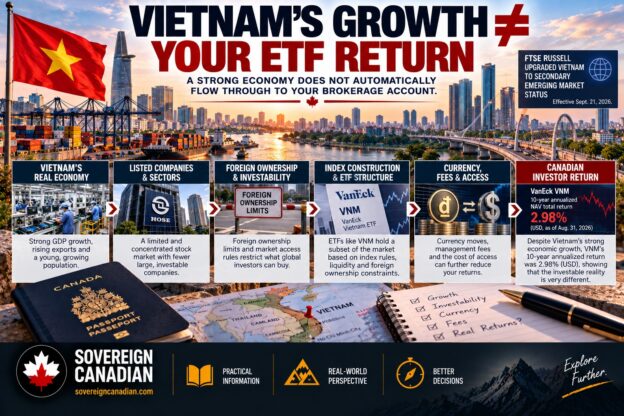
Vietnam is the country that gets waved around at every “de-risk from China” panel discussion. Samsung builds phones there. Apple’s suppliers have been moving assembly lines there for years. The population is young. The middle class is expanding. GDP has been growing at rates that would make most finance ministers weep with envy. And in September 2026, FTSE Russell finally did what index watchers had been expecting for years: it moved Vietnam out of frontier-market status and into Secondary Emerging Market status, alongside China, India, Indonesia and the Philippines. FTSE Russell’s Vietnam reclassification
On paper, this is exactly the kind of story that should have made patient foreign investors rich.
So here is the number that started this whole project. VanEck’s VNM, the oldest and largest dedicated Vietnam ETF available to a North American investor, reported a ten-year annualized NAV total return, in US dollars, as of August 31, 2026, of 2.98 percent. VanEck VNM performance and holdings
Not 2.98 percent in a bad year. Two point nine eight percent per year, compounded, for a decade, during which Vietnam’s economy grew at real rates in the high single digits, occasionally topping 8 percent – one of the fastest sustained growth records anywhere in the world.
That gap is the entire article. Everything else here is an attempt to explain it honestly, without pretending I’ve solved it completely, and without falling into the two lazy conclusions that are equally wrong: “Vietnam is a scam” and “the ETF just hasn’t caught up yet, buy now.”
The real answer is more interesting than either of those. It’s about what happens between an economy growing and a foreigner’s brokerage statement showing a return. There are more leaks in that pipe than I expected when I started this.
Vietnam really is growing
Let’s not build a straw man. The Vietnamese economy is not a story that needs debunking.
Real GDP growth ran at 8.02 percent in 2025 and 8.18 percent through the first half of 2026, with the second quarter alone at 8.39 percent. Registered foreign direct investment jumped 61 percent year over year in the first half of 2026 to roughly USD 34.7 billion, while disbursed FDI reached about USD 13.0 billion, up 11.2 percent. Computers, electronic products and components alone generated more than USD 107 billion of exports in 2025, while the broader electronics export complex was estimated at more than USD 165 billion. Samsung’s Vietnamese operations generated USD 54.4 billion in exports in 2024 – about 14 percent of the country’s total exports that year. Vietnam National Statistics Office — 2025 GDP Vietnam National Statistics Office — H1 2026 GDP and FDI Vietnam Customs electronics export data Bac Ninh government — Samsung Vietnam operations
This is not a country coasting on a favourable headline. It’s a country that has spent three decades building a genuine, capital-intensive manufacturing base, and it’s currently one of the most obvious beneficiaries of multinationals building additional production capacity outside China.
None of that is in dispute. What’s in dispute is what happens to that growth once it tries to pass through a stock exchange and into a foreigner’s account.
The stock market tells a stranger story
Here’s where it gets interesting, and where my first attempt at explaining this needed a real correction, because my initial theory didn’t survive scrutiny.
The VN-Index, Vietnam’s headline stock benchmark, closed 2016 at 664.87 points. By late September 2026 it was trading around 1,780. Do that math and you get a price-return compound annual growth rate of roughly 10 to 11 percent in Vietnamese dong, and something close to 9 percent once you adjust for a decade of dong depreciation against the US dollar.
Nine percent a year, compounded for a decade, in US dollars. That’s a very respectable emerging-market return.
And then there’s VNM’s own reported number: 2.98 percent annualized, in US dollars, net of fees, for the same ten years. VanEck VNM performance table
My first instinct was to blame dividends – specifically, the fact that Vietnamese companies pay a lot of shareholder distributions as stock dividends and bonus shares rather than cash, and a price index doesn’t capture that kind of distribution. Vinhomes paid a hundred-percent stock dividend in 2026, for instance. I assumed a price index would understate the real return in a market that leans this heavily on paying shareholders in shares rather than cash.
That instinct turns out to be wrong, and it’s worth explaining why, because the correction points toward the real answer. A properly calculated, capitalization-weighted price index shouldn’t lose anything from a stock dividend or a split. When a company doubles its share count and halves its price, its total market value – price times shares outstanding – doesn’t change, so a cap-weighted index shouldn’t move either. Index providers adjust their divisors specifically to stop these mechanical, non-economic events from distorting the number.
The thing that genuinely does separate a price index from a total-return index is cash dividends, and here’s where my first pass had the logic backwards: if cash dividends were the whole story, a total-return series should sit above the price-only series, not six percentage points a year below it. Dividends get added on top of price appreciation in a total-return calculation. They don’t usually erase most of a decade’s worth of return. So the dividend explanation, taken on its own, makes this puzzle harder, not easier.
The real explanation, as far as the evidence lets me take it, is about what each of these numbers is actually measuring, not about how either one handles dividends.
The VN-Index is Vietnam’s headline Ho Chi Minh Stock Exchange benchmark. It is not the country’s entire stock market – Vietnam also has securities trading through HNX and UPCoM – and it is not constructed around the same foreign-investability rules as an offshore Vietnam ETF.
VNM’s actual benchmark works differently, and it’s worth being precise about what that benchmark actually is, because there are really four different things that could get confused here: the fund’s own return, the benchmark comparison VanEck itself publishes, the live history of that benchmark, and any back-tested history published for it before it existed.
Since March 17, 2023, VNM has tracked the MarketVector Vietnam Local Index. MarketVector’s methodology uses constituent-weight constraints, including an 8-percent maximum weight at index reviews. That does not mean a holding can never trade above 8 percent between rebalances – market movements can push actual portfolio weights higher before the next rebalance.
The MarketVector Vietnam Local Index itself began live calculation on November 22, 2022, so it wasn’t running for the earlier years of VNM’s ten-year window. Before VNM adopted it in March 2023, the fund tracked the related but distinct MVIS Vietnam Index. VanEck is unusually clear about this in the footnote underneath its performance table: before the market close on March 17, 2023, the benchmark data shown there reflects the MVIS Vietnam Index; after that date it reflects the MarketVector Vietnam Local Index. The resulting ten-year benchmark return VanEck publishes is 3.92 percent annualized, versus VNM’s 2.98 percent NAV return. VanEck VNM benchmark methodology and performance
Put those facts next to what actually happened in this market over the past couple of years, and a real mechanism starts to emerge. VinaCapital estimated in June 2026 that the Vingroup family – Vingroup itself, plus Vinhomes, Vinpearl and Vincom Retail – had grown from about 8 percent of the VN-Index two years earlier to nearly 30 percent. It also calculated that the VN-Index rose about 41 percent in 2025 but only around 10 percent with the Vingroup-related effect stripped out. Another Vietnamese fund report reached a similar conclusion, estimating that the index would have risen only about 12.6 percent in 2025 without Vingroup-affiliated stocks. VinaCapital analysis of Vingroup’s VN-Index weight SSI fund report on the 2025 VN-Index rally
An index with an 8-percent constituent cap at rebalancing structurally limits that concentration relative to the headline VN-Index. You can see the result in VNM’s actual portfolio. On September 25, Vinhomes and Vingroup were each just under 8 percent of VNM, while earlier in September market movements had temporarily pushed Vingroup above 10 percent between index reviews. VanEck VNM daily holdings
I want to be honest about what this does and doesn’t establish. It’s a real, sourced mechanism, and it points in the right direction to explain a meaningful part of the gap. It is not a full decomposition. I can’t hand you a table that says a certain number of percentage points came from index capping, a certain number from foreign-ownership screening, a certain number from fund fees, and have that table add up cleanly.
What I can tell you is that VanEck’s own published benchmark return over these same ten years – 3.92 percent annualized – already sits far closer to VNM’s own 2.98 percent than to the VN-Index’s roughly 9 percent. Whatever’s driving the big gap, the evidence points to index construction and investability as important parts of the explanation, rather than the fund simply failing to track the benchmark it was assigned. VNM trailed VanEck’s published benchmark series by about 0.94 percentage points a year over the period. Its 0.66-percent expense ratio explains part of that difference, with tracking costs and other implementation frictions potentially accounting for some of the remainder. VanEck VNM performance and expense data
The much larger gap – between that benchmark and the headline VN-Index – reflects the foreign-investable, capped universe represented by VNM’s benchmark being structurally different from the domestic benchmark investors usually see quoted. I’ve identified credible mechanisms behind a meaningful part of that larger gap. I haven’t quantitatively decomposed all of it, and I’m not going to pretend otherwise.
The more I sat with that distinction, the more I realized I’d been asking the wrong question. The question isn’t whether Vietnam grew. It obviously did. The question is how much of that growth survives the journey from a Vietnamese factory floor, through a listed company, through whatever foreigners are actually allowed to own of that company, through whatever an index or a fund is built to hold, through a currency conversion and a fee schedule, and finally into a Canadian’s brokerage statement. At every one of those steps, something can leak out. The rest of this piece is really just following that chain, one link at a time.
An ETF isn’t Vietnam
Vietnam’s foreign-ownership rules are more complicated than the old shorthand that foreigners can own only 49 percent of a Vietnamese company. Under the current securities framework, the maximum depends on Vietnam’s treaty commitments, sector-specific laws and market-access restrictions; companies outside those restrictions can have no general foreign-ownership ceiling, while companies can also adopt lower limits in their own charters. Banks remain a special case, with foreign ownership generally capped at 30 percent unless a specific regulatory exception applies. Vietnam’s current foreign-ownership framework under Decree 155
That alone wouldn’t necessarily distort a passive index much, except for one more rule that I hadn’t appreciated before this research. FTSE Russell defines something it calls “foreign headroom”: the proportion of a company’s foreign-ownership limit that remains available to foreign investors. Its rulebook is specific about the threshold. For a new security subject to a foreign-ownership limit, at least 20 percent of that limit generally needs to remain available for index inclusion. Existing constituents get more tolerance: when headroom falls below 10 percent, FTSE begins reducing the security’s investability weight at subsequent reviews. FTSE Russell foreign-headroom methodology
Here’s what that produced in practice. When FTSE finalized the September 2026 review, 27 Vietnamese large-, mid- and small-cap stocks qualified for the FTSE Global All Cap Index. Techcombank and MB Bank were not among them. Vietnamese market analysis attributed their exclusion to foreign ownership sitting too close to their respective ceilings: Techcombank’s foreign ownership was around 20.5 percent against a ceiling of roughly 22.5 percent, while MB Bank was around 22.2 percent against a ceiling of roughly 23.2 percent. Final FTSE Vietnam constituent list Analysis of TCB and MBB foreign headroom
Techcombank’s lower ceiling is deliberate rather than simply the statutory banking maximum. Its own corporate disclosures show it setting its maximum foreign ownership at roughly 22.5 percent. Techcombank foreign-ownership limit disclosure
Other major Vietnamese stocks have faced similar foreign-room constraints at different points. The important thing isn’t that every constrained stock is automatically superior to every unconstrained one. It’s that foreign ownership capacity itself can determine whether an otherwise large and liquid company fits inside an international index.
Meanwhile, securities companies operate under a different regulatory framework that can permit much higher foreign ownership, including majority and potentially full foreign ownership subject to the applicable approval requirements. Vietnam securities-company foreign ownership rules
Put those facts together and you get a genuinely strange outcome: passive and quasi-passive foreign capital doesn’t necessarily flow to the companies that look best on a scorecard. It flows through a universe partly defined by which companies have enough room.
Pull up VNM’s actual holdings on September 25, 2026 and you can see the pattern. Vingroup, Vinhomes, Vinpearl and Vincom Retail together made up roughly a fifth of the fund. Securities brokerages represented another substantial block. Masan, Masan Consumer and Vinamilk were all major positions. Vietcombank was about 5 percent. FPT, the country’s best-known technology company, was only 2.63 percent. Techcombank, MB Bank, ACB, VPBank, HDBank, VietinBank and BIDV were absent as flagship bank holdings, while VNM did hold a small position in VPBank’s brokerage subsidiary. Mobile World wasn’t in the portfolio either. VanEck VNM holdings, September 25, 2026
It’s worth seeing how differently another Vietnam ETF can end up looking, built off a different index. Global X’s VNAM, a smaller US-listed fund tracking the MSCI Vietnam Select 25/50 Index, held 24.85 percent in Vingroup alone as of September 21, 2026. Two funds, both honestly named “Vietnam,” both tracking reputable index providers, can therefore produce meaningfully different bets out of the same market. Global X VNAM holdings
I want to be careful about the causal claim here, because it’s easy to overstate. The fact that some companies have less foreign headroom doesn’t prove foreign investors are wrong to want more of them, and it doesn’t prove Vingroup and the brokerages are lower-quality holdings just because they’re more available.
What it does establish, fairly cleanly, is that a Vietnam ETF’s portfolio is shaped as much by ownership mechanics and index methodology as by anyone’s judgment about business quality. A useful way to put it: a Vietnam ETF is not necessarily buying the best companies in Vietnam. It’s buying companies that satisfy the investability rules of its particular index, including whatever foreign-ownership capacity those rules demand. Those are not always the same list, and they’re not even the same list from one ETF to the next.
The access problem may also be the opportunity
If the constraint is structural rather than a matter of taste, the natural next question is whether anyone has built a way around it. It turns out someone has, and the workaround is clever enough that it’s worth explaining properly rather than in a footnote.
Vietnam has locally domiciled ETFs specifically built around stocks with constrained foreign room. The DCVFM VN Diamond ETF is the best-known example. A foreign investor can buy units of that fund and thereby obtain economic exposure to a portfolio containing companies whose underlying shares may themselves have little or no foreign room remaining.
VNM itself held a token 0.02-percent position in the Diamond ETF on September 25, which tells you it’s aware of the mechanism without having built its strategy around it. VanEck VNM holdings
KraneShares’ newer entrant, KPHO, is a different story. Launched on December 2, 2025 and sub-advised by Dragon Capital, its underlying index explicitly substitutes the largest Diamond ETF for securities classified as having foreign-ownership limitations. As of September 22, 2026, KPHO had about USD 11.4 million in net assets and a 1.02-percent total annual fund operating expense. Its SEC-filed prospectus breaks that 1.02 percent into a 0.78-percent management fee, 0.01 percent of other expenses and 0.23 percent of acquired-fund fees and expenses. KraneShares KPHO fund information KPHO SEC prospectus
That is a meaningfully different design philosophy from VNM’s, and the kind of structural difference that should matter more to an investor than a simple comparison of headline fees would suggest.
I want to be honest about where I land on KPHO, though. It doesn’t have anything close to a decade of live performance behind it, and at its current size it’s a very small fund. There’s no way yet to know whether its structural advantage in accessing foreign-room-constrained stocks actually translates into a better return, or whether it just trades one set of frictions for another.
I’m not presenting KPHO as the fix for what ails VNM. I’m presenting it as proof that in Vietnam, fund construction is not a minor detail. It’s arguably one of the most important variables in whether an investor’s return looks anything like the underlying market’s.
China plus one: who actually captures the value
Step back from fund mechanics for a moment and ask a more basic question. Vietnam is one of the most obvious beneficiaries of companies diversifying their manufacturing away from China. Fine. Who owns the factories?
In the first seven months of 2026, foreign-invested enterprises accounted for 80.1 percent of Vietnam’s export value. Not forty. Not sixty. Eighty percent. Vietnam National Statistics Office — seven-month 2026 trade data
The Vietnamese economy is growing enormously on the back of manufacturing capacity that is, in a very real sense, substantially foreign-owned.
Samsung is the cleanest illustration, mostly because its Vietnam-specific numbers happen to be disclosed with unusual precision. Its six Vietnamese manufacturing plants generated USD 62.5 billion of revenue and USD 54.4 billion of exports in 2024. That export figure represented about 14 percent of Vietnam’s total exports that year. Bac Ninh government — Samsung Vietnam 2024 figures
That is a staggering amount of economic activity happening inside Vietnam’s borders.
Samsung Electronics, the company behind those operations, is listed in Korea. The profits attributable to Samsung’s Vietnamese manufacturing ultimately accrue inside a Korean-listed multinational rather than a Vietnamese-listed Samsung subsidiary available to a Vietnam equity fund.
This is the distinction I keep coming back to, and it’s the one I think matters most for anyone thinking about Vietnam as a growth story rather than as a specific set of listed companies: economic activity happening in Vietnam is not the same thing as value accruing to Vietnamese-listed minority shareholders.
It’s tempting to jump from there to “so just buy Samsung instead of a Vietnam ETF,” and I’d resist that too. Samsung’s valuation reflects a global business spanning semiconductors, smartphones, displays and other operations across many countries. Buying Samsung is not a clean way to isolate Vietnamese economic growth either.
The point isn’t a stock tip. It’s that when you’re trying to work out where Vietnam’s growth actually accrues, a meaningful share of it doesn’t accrue to anything a Vietnam-focused fund can hold at all.
The companies I’d actually want to understand
I don’t have a list of stocks to recommend, and I wouldn’t publish one if I did. But three companies, plus a fourth category, came up repeatedly in this research as genuinely useful lenses on the different ways the Vietnam thesis can succeed or fail. Understanding why each one is complicated is more valuable than knowing whether any of them is currently a buy.
FPT: quality running into a headwind nobody can fully price yet. FPT is, on paper, close to the best version of what a Vietnam bull wants: it’s genuinely Vietnamese, genuinely profitable, with substantial international operations across markets including Japan, the United States and Europe, and management positioning artificial intelligence as an opportunity rather than purely a threat.
Its 2026 results continued to show double-digit revenue and profit growth. Through the first seven months, FPT reported revenue growth of 13.6 percent and profit-before-tax growth of 18.3 percent, while AI/Data Analytics service revenue grew 54 percent. FPT 2026 operating update
And yet foreign investors had spent a significant period selling the stock, opening foreign room that had previously been scarce.
The question worth sitting with is why. One plausible explanation is a rethink of what artificial intelligence does to the economics of outsourced software development, which is a meaningful part of FPT’s business and of the global IT-services industry more broadly. Wipro, an Indian company competing in the same global market, has itself disclosed pricing pressure related to competitive intensity and AI-driven productivity expectations.
But FPT’s own reported numbers, as of the most recent results available, don’t show the margin collapse a simple version of that story would predict. Its AI-related business was growing quickly and overall profit growth remained healthy.
I’m not going to resolve this. I don’t think anyone can, yet. What I can tell you is that the stock has been meaningfully re-rated, which is a different claim from “the stock is now cheap.” A falling multiple against strong reported earnings usually means the market has priced in more risk to future earnings than the past few quarters have shown up in the income statement. That could mean the market is early and correctly worried about something that hasn’t hit the numbers yet. It could mean the market has overreacted to a narrative. Both of those are live possibilities, and I’d be lying if I told you I knew which one is right.
Banks: the quality you want may be the quality you can’t buy. Vietnamese banks, as a group, have generated strong profitability, but that headline comes with real qualifications. Credit growth has been running ahead of deposit growth. FiinRatings put system credit growth at roughly 19 percent in 2025 against deposit growth of 11.4 percent, while analysis of 28 listed banks in the first half of 2026 found loans growing 18.2 percent year over year against customer-deposit growth of 11.9 percent. Market-based funding consequently became a larger part of the funding mix. FiinRatings Vietnam Banking 2026 Outlook Guotai Haitong 1H 2026 banking-sector review
Asset quality deserves nuance too. The listed-bank NPL ratio was about 2.0 percent in the second quarter of 2026, while the absolute balance of non-performing loans was still rising. Different banks have very different reserve positions, so a system-wide headline can hide substantial variation underneath. Guotai Haitong Vietnam banking update
And then there’s the access wrinkle again. Techcombank and MB Bank were absent from the 27-stock FTSE Global All Cap list, with Vietnamese market analysis pointing to their limited remaining foreign headroom. FTSE Vietnam constituent list TCB/MBB foreign-headroom analysis
Contrast that with Vietcombank, the state-controlled giant, whose disclosed asset-quality metrics are genuinely strong. At the end of Q1 2026, Vietcombank reported an NPL ratio of 0.99 percent and loan-loss coverage of roughly 178 percent. Vietcombank Q1 2026 results
The broader point isn’t “buy the private banks” or “avoid the state bank.” It’s that in Vietnam, identifying the company you’d most want to own and actually being able to own a meaningful position in it can be two entirely separate problems. That’s an unusual thing to have to say about a market this size, and it’s a big part of why passive vehicles here can behave so differently from the headline market.
Vingroup: extraordinary value creation next to extraordinary complexity. Vingroup, Vinhomes and VinFast are worth a section not because I think you should own or avoid them, but because the Vingroup family occupies such a large share of the headline market and of what foreign passive money can access. Understanding what you’d be buying matters here more than most places.
Vinhomes is a large, profitable property developer. At the same time, the wider group has committed an extraordinary amount of capital to VinFast, its electric-vehicle arm.
VinFast’s audited 2025 annual filing reported revenue of roughly USD 3.59 billion, up about 105 percent from 2024, alongside a net loss of roughly USD 3.96 billion. Gross margin, while still deeply negative, improved to negative 45.4 percent from negative 57.4 percent the year before – real progress, even if it started from a very bad place. VinFast 2025 Form 20-F filed with the SEC
VinFast has continued to rely on substantial financial support from Vingroup and founder Pham Nhat Vuong. This remains a company consuming large amounts of capital while attempting to build scale in one of the world’s most competitive manufacturing industries.
Here’s where I want to be careful about a temptation I noticed in myself while researching this. Foreign investors were major net sellers of Vietnamese equities during the same period in which Vingroup-family shares helped drive the VN-Index dramatically higher. That’s a real fact. But it does not prove the rally was hollow or fundamentally unjustified. Foreign investors selling into a rally tells you foreign investors weren’t the primary source of that buying pressure. It doesn’t, by itself, tell you the rally was undeserved. Those are different claims. VinaCapital analysis of Vingroup and the VN-Index
The question worth asking about Vingroup isn’t whether the group is good or bad. It’s how much controlling-shareholder complexity and capital-allocation risk you’re willing to accept in exchange for exposure to genuinely valuable underlying assets, when the people making those capital-allocation decisions have also demonstrated an extraordinary appetite for funding a currently unprofitable subsidiary.
Industrial parks, briefly. One more category is worth a paragraph rather than a full section. Companies that own and lease the industrial land underneath Vietnam’s manufacturing boom, names like Becamex IDC and Kinh Bac, look like a more direct way to capture the China-plus-one story than owning consumer or bank stocks, because their economics are tied more directly to factories and industrial development.
But land-sale accounting is lumpy by nature, expansion requires capital, several major companies in the sector have meaningful state involvement, and their tenants are precisely the export manufacturers exposed to the trade-policy uncertainty discussed below. The industrial-park thesis doesn’t eliminate the “who captures the value” problem; it just swaps it for a different question: whose land bank, balance sheet and capital allocation are you trusting instead.
The dong is a headwind, but less so for Canadians
Most English-language writing on Vietnamese equities thinks in US dollars, which makes sense given where most of the ETFs are listed. It also quietly misleads a Canadian reader, because the US dollar and the Canadian dollar have not moved together over the relevant period.
Over roughly the decade ending in 2026, the Vietnamese dong depreciated against the US dollar by around 1.5 to 1.6 percent a year. Against the Canadian dollar, the depreciation over a comparable period was closer to roughly 1.1 to 1.2 percent annually. The difference exists because the Canadian dollar itself weakened against the US dollar over much of this period, partially offsetting the dong’s decline from a Canadian holder’s point of view.
That’s a real, useful, and somewhat underappreciated fact. It’s also not a reason to feel good about currency risk in Vietnam. The dong still weakened materially against the Canadian dollar over the period. It’s a genuine headwind, just a smaller historical one than the US-dollar framing implies.
And I want to be explicit that every figure in this section is historical. Nothing here should be read as a forecast for how the dong or the loonie will move going forward.
Put together with everything above, currency alone doesn’t explain VNM’s disappointing decade. It’s a contributor, and historically a smaller one for a Canadian than for an American, but it isn’t close to the whole story.
FTSE changes the market, not the access problem
I want to separate two things that get blurred together constantly in coverage of this upgrade, because the blur creates real confusion about what actually changed.
Fact: FTSE Russell reclassified Vietnam from Frontier to Secondary Emerging Market status, effective from the market open on September 21, 2026. Twenty-seven Vietnamese large-, mid- and small-cap stocks entered the FTSE Global All Cap universe, while another 90 micro-cap securities entered the broader Total Cap universe. FTSE September 2026 Vietnam constituent review
And the implementation isn’t happening all at once. FTSE’s transition uses four tranches: 10 percent of the relevant investability weight in September 2026, another 20 percent in March 2027, 35 percent in June 2027 and the final 35 percent in September 2027. FTSE implementation schedule reported by Reuters
This is a genuine, meaningful change in how Vietnam sits inside the architecture of global index investing, and it followed real market reforms. Vietnam’s State Securities Commission says Circular 08/2026 introduced a mechanism allowing foreign investors to place orders through global brokerage institutions without first opening a domestic securities trading account, while extending mechanisms that allow qualifying foreign institutional investors to purchase shares without having sufficient cash fully prefunded before the trade. Vietnam State Securities Commission on Circular 08/2026Official English text of Circular 08/2026
Estimate, and this is where a lot of coverage gets sloppy: analysts and asset managers have floated very different numbers for how much foreign capital the upgrade could eventually bring in. Those figures are estimates, not promises from FTSE. FTSE announced a classification and an index implementation schedule, not a guaranteed dollar amount of future capital.
And here’s the part that matters most for a Canadian reader specifically: none of this automatically gives an individual Canadian brokerage account direct access to HOSE-listed shares. The institutional market-access reforms and FTSE index classification are separate questions from retail brokerage availability.
Worth adding, because it tempers the excitement: MSCI did not announce a comparable Vietnam reclassification in its June 2026 Market Classification Review. I’m not going to guess when or whether MSCI follows FTSE’s lead. Nobody outside MSCI genuinely knows, and I’d rather say that plainly than manufacture false confidence either way. MSCI 2026 Market Classification Review
How can a Canadian actually invest
If you have an ordinary Canadian discount brokerage account, direct access to HOSE- and HNX-listed shares remains difficult. Even Interactive Brokers’ extensive global products-and-exchanges directory does not currently list HOSE or HNX among its directly supported stock exchanges. Interactive Brokers products and exchanges directory
I would stop short of claiming that literally no Canadian-accessible broker can arrange Vietnamese market access, because institutional, full-service and specialized arrangements can change and I haven’t verified every possible intermediary. But this is clearly not a market where the typical Canadian investor can type a Vietnamese ticker into an ordinary discount-brokerage account and place the trade.
That leaves two practical routes for most people.
The first is a foreign-listed ETF, which I’ll get to in a moment.
The second is establishing Vietnamese market access directly through the local financial system. Foreign investors operate under Vietnam’s securities-registration and custody framework and generally need the appropriate securities trading registration, brokerage/custody arrangements and a Vietnamese-dong indirect-investment account through which investment-related cash flows are handled. Vietnam rules governing foreign securities investors Vietnam indirect-investment account requirements
This isn’t something you do over a weekend, and I’m not going to pretend it’s a realistic move for most readers of this publication. The friction itself is the point I want to make, not the procedure.
You’ll sometimes see Circular 08 described as having “opened up” foreign access. It did, but the most important changes are aimed at the institutional plumbing of the market. The State Securities Commission explicitly describes the reform as allowing orders to be routed through global brokerage institutions and facilitating foreign institutional participation. That’s exactly the kind of reform that helped make the FTSE upgrade possible. It is not the same thing as giving every Canadian retail brokerage customer direct Vietnamese-market access. Vietnam State Securities Commission — Circular 08 reforms
The ETF shelf
So, realistically, for most readers, it comes down to what’s available on an exchange they can already reach.
VanEck’s VNM remains the largest and most established dedicated US-listed option: a 0.66-percent expense ratio, roughly USD 500 million in assets in late September 2026, and 60 holdings on September 25. It tracks the MarketVector Vietnam Local Index and is about as close to pure Vietnam exposure as you’ll find in a liquid North American exchange-traded wrapper. VanEck VNM fund page
Its problem isn’t that VanEck is secretly failing to run the fund properly. It’s the composition problem this whole article has been building toward: an investable Vietnam portfolio built under foreign-access and index-construction constraints can look very different from the headline domestic index.
Global X’s VNAM is a smaller US-listed alternative, tracking the MSCI Vietnam Select 25/50 Index. As of September 21, 2026, Vingroup alone represented 24.85 percent of the portfolio – a dramatically different concentration from VNM. Global X VNAM
KraneShares’ KPHO, discussed above, is the newest and structurally most interesting entrant precisely because its index uses the Diamond ETF mechanism for foreign-ownership-constrained stocks. But at roughly USD 11 million in net assets and a 1.02-percent expense ratio in late September 2026, it’s tiny compared with VNM and doesn’t have a meaningful long-term track record yet. KraneShares KPHO
There’s no dedicated Canadian-listed Vietnam ETF that I could identify on the major Canadian exchanges. The closest practical Canadian-listed route is broad emerging-market exposure. Vanguard Canada’s VEE, for example, follows a FTSE emerging-markets framework and should acquire some Vietnam exposure as FTSE’s implementation phases in.
But I want to be precise about the word “some.” Research based on FTSE’s planned post-transition weights put Vietnam at only around 0.35 percent of the FTSE Emerging All Cap universe once fully phased in. At the initial September 2026 tranche, the effective weight is smaller still. FTSE Vietnam projected index weights and phase-in schedule
If you already hold a diversified emerging-market ETF, you’re therefore going to end up with token Vietnam exposure, not a meaningful Vietnam allocation. Don’t let a headline about the FTSE upgrade convince you that your existing emerging-market fund has suddenly become a Vietnam play.
I’m not going to rank these options, because “best” depends entirely on what you’re trying to express, and this article has spent a lot of words explaining why “Vietnam exposure” isn’t one single thing.
Taxes and friction
I’ll keep this section tight, because the goal is to show that the vehicle you choose changes how much of your return leaks away, not to write you a personalized tax plan.
If you somehow hold Vietnamese shares directly, Vietnam applies a 5-percent personal-income-tax rate to investment income such as dividends under its domestic rules. Vietnam also taxes securities transfers at 0.1 percent of the transfer price for each transaction rather than simply taxing the investor’s net capital gain. Vietnam government — tax on investment income Vietnam government — securities-transfer tax
The Canada-Vietnam tax treaty doesn’t contain anything analogous to the special Canada-US pension-account treatment Canadians associate with RRSPs holding US securities. The treaty permits Vietnam to tax dividends paid to Canadian residents, subject to its treaty limits, while Canada generally provides foreign-tax relief under its domestic rules and the treaty’s double-taxation article. Canada-Vietnam tax treaty
The precise treaty treatment of Vietnam’s 0.1-percent gross-proceeds securities-transfer tax is technical enough that I would not make a definitive claim about it without advice specific to the investor and transaction.
If you’re holding foreign securities directly in a non-registered account, remember the usual T1135 reporting obligation. CRA says Form T1135 is required when the total cost amount of specified foreign property exceeds CAD 100,000 at any time during the year. Specified foreign property held inside registered plans such as RRSPs, RRIFs and TFSAs is excluded from that reporting requirement. CRA — Form T1135 questions and answers
If you hold VNM instead, the picture has two potential tax layers, and they shouldn’t be merged together. Any Vietnamese tax borne within the US fund is economically reflected inside the fund before money reaches the Canadian investor. Separately, distributions from a US-domiciled ETF to a Canadian investor are subject to the Canada-US treaty framework.
Under the Canada-US treaty, ordinary US-source dividends paid to a Canadian resident are generally subject to a 15-percent treaty withholding rate, while qualifying pension and retirement arrangements receive special treaty treatment. That distinction is why US-listed ETFs are generally more tax-efficient in an RRSP or RRIF than in a TFSA when it comes to the US withholding layer. Canada-US Tax Convention
The important conceptual point is simpler than the tax code: an RRSP can potentially solve the US-to-Canadawithholding layer on a US-listed fund. It does not reach backward through the fund and refund taxes already incurred at the Vietnam-to-fund layer.
Two layers. Different rules. Don’t conflate them.
The bear case, gathered in one place
I’ve scattered risks throughout this piece as they came up, but it’s worth pulling them together once, because no single one of them is what makes Vietnam hard. It’s all of them stacked on top of each other.
Access is genuinely constrained for an ordinary Canadian retail investor before you even get to picking a vehicle. Foreign-ownership limits and foreign-headroom rules mean the investable universe can differ from the companies you’d choose based purely on business quality.
Governance concerns are real, not hypothetical. Vietnam’s enormous Van Thinh Phat/SCB fraud involved Truong My Lan’s control of Saigon Commercial Bank through nominee shareholders and fraudulent lending structures. Vietnamese courts convicted her of embezzlement and banking offences involving hundreds of trillions of dong, and her 2022 arrest triggered a run on SCB that required extraordinary central-bank support. Vietnam prosecutors on the SCB/Van Thinh Phat case Reuters on the SCB rescue and fraud
That’s the kind of governance failure a foreign minority shareholder has very little ability to identify from the outside before it surfaces.
Currency is a persistent, if moderate, historical headwind, smaller over the past decade for a Canadian than for an American but never zero.
Trade policy remains a live risk. Vietnam is subject to the United States’ current Section 301 tariff actions, and USTR also opened a Vietnam-specific Section 301 investigation into intellectual-property protection and enforcement in May 2026. Vietnam is separately among the economies covered by USTR’s March 2026 investigation into structural excess capacity and production in manufacturing sectors. USTR Vietnam intellectual-property Section 301 investigation USTR manufacturing excess-capacity investigation
That matters because Vietnam’s export model is deeply integrated with regional supply chains, including China. It does not mean Chinese inputs automatically constitute illegal transshipment; rules of origin, substantial transformation and evasion are different legal questions. But it does mean US scrutiny of origin, industrial policy and supply-chain structure remains a material risk for an export-led economy.
Credit growth in the banking system has been running ahead of deposit growth, increasing reliance on other funding sources. Vietnam banking-system liquidity analysis
State ownership remains significant in major banks and industrial companies, which means minority-shareholder interests can coexist with broader policy objectives.
Controlling-shareholder complexity, most visible in the Vingroup family, means a meaningful slice of the market comes bundled with capital-allocation decisions concentrated in a controlling shareholder.
Fund construction itself, as this whole piece has argued, means the vehicle you buy may not track the market you think you’re buying.
And on top of every one of those, ordinary fees, taxes and currency movement take another bite before you ever see the return.
None of these is disqualifying on its own. Together, they’re a plausible explanation for why an economy growing at extraordinary rates can coexist with a foreign-accessible investment vehicle producing far less extraordinary returns.
So what are you actually betting on
If you strip away the narrative and ask what specific bet each version of “invest in Vietnam” actually requires to work, you get something like this.
| Thesis | What actually expresses it | What can break it |
|---|---|---|
| Vietnam keeps gaining global manufacturing share | Industrial-park landlords, selected exporters, or the foreign multinationals actually running the factories | Tariff policy, continued China dependence for inputs, a global manufacturing slowdown |
| Domestic Vietnamese consumption keeps compounding | Banks, retailers, consumer-goods franchises | Foreign ownership limits capping how much you can actually own, a credit-cycle turn, valuation already reflecting the growth |
| A Vietnamese technology company scales globally | FPT specifically | AI-driven pricing pressure on outsourced software services, execution risk at scale |
| Capital-market reform keeps improving investability | Broad Vietnam or emerging-market index exposure | Reform stalls, MSCI does not follow FTSE, foreign-ownership constraints remain significant |
| Access constraints themselves create a mispricing opportunity | Direct share ownership, or Diamond-structure vehicles like KPHO | The complexity and illiquidity that come with that access route, unproven long-run performance |
| Vietnam broadly outperforms over the next decade | A diversified Vietnam ETF such as VNM | The fund’s own construction means it may not hold the specific companies actually driving the outperformance |
I’m not ranking these. Each one requires something specific and falsifiable to be true, and the honest exercise, before you put money anywhere near this market, is figuring out which of these six bets you actually believe, rather than defaulting to the vaguest and most comfortable version: “Vietnam is growing, so Vietnam stocks will do well.”
Where this leaves me
Vietnam’s GDP growth rate, on its own, is not an investment thesis. That’s really the whole point of everything above. An economy can be one of the fastest-growing on earth and still hand a foreign shareholder something far less impressive, not because the growth was fake, but because so much of it never had a clear path to a foreign-owned, foreign-eligible, fund-includable share in the first place.
VNM is only useful to someone who understands what its portfolio actually contains: a fund following a capped index methodology, tracking a benchmark that changed partway through its own reported ten-year history, and operating inside the foreign-investability constraints of the Vietnamese market. That’s not a flaw in VanEck’s execution. It’s what one foreign-investable version of this market looks like once you build it honestly.
VNAM, built on a different index with different concentration rules, shows how much that “honest” construction still depends on which rulebook you use.
KPHO is a genuine attempt to solve the access problem this article keeps circling back to, and I think that attempt is worth watching. It is not yet evidence that solving the access problem produces a better return – a clever structure and a proven track record are two different things, and right now there’s only one of them here.
A broad emerging-market fund gives you almost none of this exposure yet, and won’t give you a large allocation even after FTSE’s phase-in is complete.
Direct ownership solves much of the fund-composition problem and replaces it with a different one: real, meaningful friction in account opening, custody, currency conversion and repatriation that most investors have no everyday reason to take on.
What I keep coming back to is that the most interesting version of this story probably isn’t “Vietnam” as a single trade at all. It’s specific companies, or specific access structures, that happen to sit on the right side of the foreign-ownership and index-eligibility lines – and whether enough capital and enough structural work eventually flows toward fixing that access gap that the next decade looks less like the last one.
Vietnam does not leave me thinking I need to buy Vietnam. It leaves me thinking I need to understand exactly what I would be buying, at every single step between the factory floor and my brokerage statement, because this research turned up more leaks in that pipeline than I expected going in.
Growth happens in Vietnam. A huge amount of export activity happens inside foreign-owned multinationals. Listing happens on exchanges where foreign-investability constraints still matter. Index inclusion happens according to rules that have nothing to do with business quality alone. Fund construction happens according to whatever is actually eligible and available to buy, and differently depending on which index provider built the rulebook. And only after all of that does a return, minus fees, minus currency movement, minus tax, finally show up in a Canadian’s account.
An economy can compound at 8 percent while an investor compounds at 3, and both numbers can be telling the truth. That’s the whole lesson.
This article is for informational purposes only and does not constitute investment, tax or legal advice. Investing in foreign and emerging markets carries risks, including currency risk, liquidity risk and regulatory risk, that may not apply to Canadian or US markets. Vietnamese tax rules, foreign ownership limits and index classifications referenced here are current as of the time of writing and are subject to change. Consult a qualified financial advisor, accountant or tax professional before making investment decisions based on this article.