
Tag Archives: Vietnam

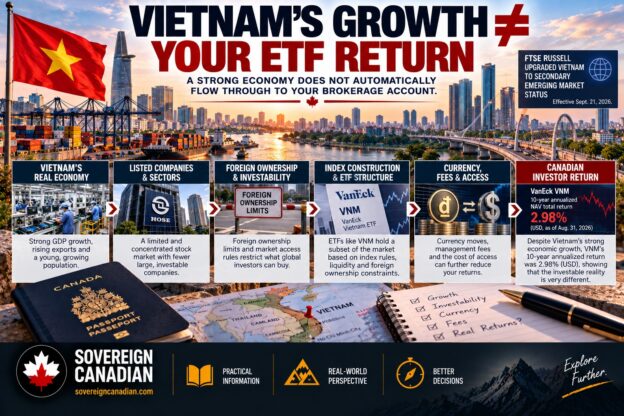
Investing in Vietnam for Canadian investors showing economic growth, foreign ownership limits, ETF structure and investor returns

Investing in Vietnam: Can Canadian Investors Actually Capture Vietnam’s Growth?

Vietnam is the country that gets waved around at every “de-risk from China” panel discussion. Samsung builds phones there. Apple’s suppliers have been moving assembly lines there for years. The population is young. The middle class is expanding. GDP has been growing at rates that would make most finance ministers weep with envy. And in September 2026, FTSE Russell finally did what index watchers had been expecting for years: it moved Vietnam out of frontier-market status and into Secondary Emerging Market status, alongside China, India, Indonesia and the Philippines. FTSE Russell’s Vietnam reclassification

On paper, this is exactly the kind of story that should have made patient foreign investors rich.

Continue reading →
Living in Vietnam as a Canadian with a lantern-lit Vietnamese riverside, Vietnam flag and Canadian passport

Living in Vietnam as a Canadian: Why a Country This Easy to Live In Is So Hard to Formalize

Vietnam is the easiest country in this series to fall for and one of the hardest to build a permanent life inside. That is the whole story, and it is worth saying plainly before the enthusiasm sets in. You can land in Da Nang with a portfolio, a warm-weather plan and a genuine love of the place, live extraordinarily well for very little, and still discover a year later that the country has given you almost nothing you can hold. No retirement visa. No route to permanent residence that fits you. No ownership of the land under your apartment. No realistic citizenship. What Vietnam gives freely is access. What it withholds, almost systematically, is architecture.

The single line I kept returning to during the research is this: Vietnam is easier to afford than to formalize. Every attractive fact about the country, and there are many, survives the affordability test and stumbles on the formalization test. And there is a smaller, stranger truth sitting underneath it that captures the mismatch better than anything else I found. Under the Personal Income Tax Law that took effect on 1 July 2026, spending most of a year in Vietnam makes you a Vietnamese tax resident on worldwide income, whether or not the immigration system has given you any status at all. So you can be a Vietnamese taxpayer and an immigration tourist at the same time. The tax net catches you the moment the residence system refuses to.

Continue reading →
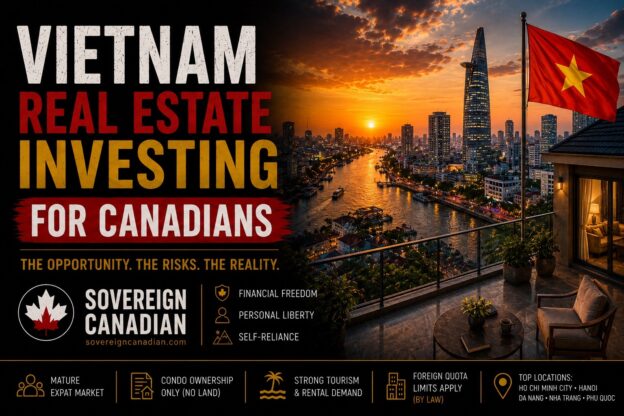
Vietnam real estate investing for Canadians - Ho Chi Minh City skyline and Saigon River at sunset from a high-rise apartment terrace with a Vietnamese flag

Vietnam Real Estate Investing for Canadians

This is a country deep-dive in the Sovereign Canadian international real estate series. Like everything here, it is personal documentation of how I am working through my own portfolio decisions, not financial or legal advice. The mechanics that sit above every country – the CRA reporting, the financing reality, the four reasons anyone does this – live in the foreign real estate pillar post. And when I went looking for where Canadians are actually buying in my offshore real estate survey, Vietnam turned up as “an emerging low-entry option.” That is exactly the kind of line that earns a country its own post, so here it is.

Vietnam is the frontier bet of this series, and I want to be honest about that from the first paragraph. This is not Mexico, where a Canadian can fly down, buy near the beach through a routine bank trust, and be a snowbird by Christmas. It is not Spain, where a non-resident can get a mortgage and a clean freehold title. Vietnam is the most structurally different market I have looked at so far: you cannot own the land, and your ownership of the home itself is time-limited; local banks will not lend to you; and the short-term-rental rulebook has been rewritten twice in eighteen months. It is a genuine growth story wrapped around a real Canadian-reporting tail and a slow currency headwind.

Continue reading →