
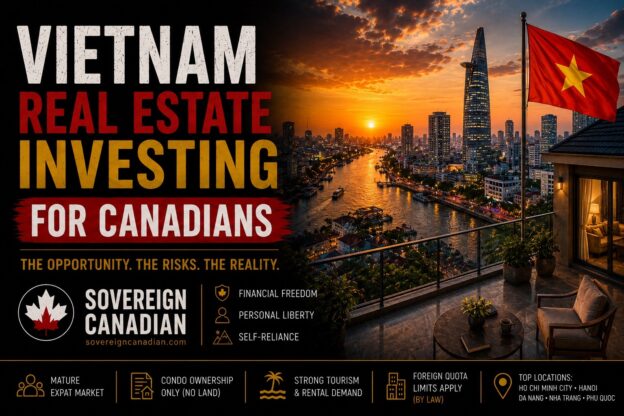
This is a country deep-dive in the Sovereign Canadian international real estate series. Like everything here, it is personal documentation of how I am working through my own portfolio decisions, not financial or legal advice. The mechanics that sit above every country – the CRA reporting, the financing reality, the four reasons anyone does this – live in the foreign real estate pillar post. And when I went looking for where Canadians are actually buying in my offshore real estate survey, Vietnam turned up as “an emerging low-entry option.” That is exactly the kind of line that earns a country its own post, so here it is.
Vietnam is the frontier bet of this series, and I want to be honest about that from the first paragraph. This is not Mexico, where a Canadian can fly down, buy near the beach through a routine bank trust, and be a snowbird by Christmas. It is not Spain, where a non-resident can get a mortgage and a clean freehold title. Vietnam is the most structurally different market I have looked at so far: you cannot own the land, and your ownership of the home itself is time-limited; local banks will not lend to you; and the short-term-rental rulebook has been rewritten twice in eighteen months. It is a genuine growth story wrapped around a real Canadian-reporting tail and a slow currency headwind.
None of that makes it a bad buy. It makes it a specific one. So let us do what the glossy Asian-property sites never do and work through what a financially serious Canadian should actually do with this market, section by section.
Popular Areas: Where the Money Actually Goes
Foreign buying in Vietnam concentrates in three cities and a couple of coastal outliers, and the split between them is really a split between yield and lifestyle.
Ho Chi Minh City is the commercial heart and the deepest foreign-buyer market. The action for foreigners is in the eastern and southern districts: Thao Dien and the wider District 2 (An Phu, the Thu Thiem new urban area), District 7 around Phu My Hung, and Binh Thanh. Thu Thiem is the premium play and prices there now run at genuinely rich-world levels per square metre (verify at publish). This is where the expat-tenant rental demand actually lives.
Hanoi is the political capital and a slightly higher-yielding, slightly less liquid foreign market than the south. Tay Ho (West Lake), Cau Giay, and Ba Dinh are the expat-facing pockets. It absorbed the largest share of foreign apartment purchases historically, but it trades more on domestic demand than HCMC does.
Da Nang is the value pick and the one coastal city I would actually take seriously as an investor. Prices per square metre run a fraction of HCMC’s, gross yields look better on paper, and it is transitioning from a purely seasonal beach town into a year-round hub. The catch is tourism-linked vacancy, which I will come back to in the rental section.
For lifestyle and lower entry prices, Nha Trang, Phu Quoc (island resort and condotel stock), and Hoi An / Quang Namnext to Da Nang round out the map. Treat these as tourism plays, not rental-income plays.
Rental vs Lifestyle: Which Job Are You Hiring Vietnam For?
The pillar post breaks every offshore purchase into four reasons – snowbird, second flag, asset haven, pure investment. Vietnam is unusual because it is strong on two of them and weak on the other two, and confusing that is where Canadians will lose money here.
As a snowbird or retirement market, Vietnam is a poor fit for a Canadian. It is the better part of a day in the air from Toronto, there is no retirement visa to anchor a long winter stay, and what you own is time-limited rather than a home you hold and pass to your kids. If warmth and a place to overwinter is the goal, this whole series points you back to Mexico, not Southeast Asia.
As a pure-growth investment, it is a legitimate, if demanding, bet. You are buying exposure to a country of 100 million people urbanizing quickly and pulling manufacturing out of China. That is a real thesis. It just pays off in appreciation over a decade, not in cash flow next year.
As an asset-diversification or second-flag holding, it is quietly interesting: a hard asset outside Canada, denominated in a different currency and exposed to a completely different economic cycle. But be honest about the flip side – Vietnam’s capital controls and repatriation friction make it a poor place for money you may need quickly. If that is your angle, read it alongside the asset-haven flag post, because the currency and repatriation friction below is the whole ballgame.
Name the job before you look at a listing. It disqualifies most of the country instantly.
Legal Ownership: What You Are Actually Buying
Here is the sentence that reframes everything: in Vietnam, nobody owns land – not even Vietnamese citizens. All land is collectively owned and administered by the state, and what changes hands is a Land Use Right. For a foreigner, that right is narrower still.
What you can buy, under the Housing Law 2023 and the Land Law 2024 (both in force since August 1, 2024), is an apartment or a qualifying house inside an approved commercial development, held under foreign ownership for up to 50 years, with an extension available under the Housing Law. This is worth getting exactly right: the statute uses ownership language, not lease language. You genuinely own the home for the term – your “pink book” certificate states the ownership term – you just do not own the land underneath, and the ownership clock eventually runs out unless extended. That makes Vietnam neither freehold like the Mexican fideicomiso (which behaves much more like renewable freehold) nor a simple building lease. It is its own strange structure, and unpicking it is the single biggest mental adjustment for a Canadian buyer.
On top of the ownership term, there are hard foreign-ownership quotas (verify at publish):
- Foreigners can collectively own no more than 30% of the apartments in any one condominium building or block.
- For landed houses in an area equivalent to a ward (a population of roughly 10,000), foreign ownership is capped at 250 houses, and as little as 10% of a single project.
One genuinely positive change in the 2023 law: foreigners can now legally sell to other foreigners, which used to be a grey area and which matters a great deal for your exit. You need a valid passport and legal entry to buy, and you must transact inside a project that has been cleared for foreign ownership – always get that quota confirmed in writing before you put money down.
Financing: Assume Cash
This is the quiet dealbreaker, and it is worse in Vietnam than almost anywhere else in the series.
For a non-resident foreigner, a local mortgage is effectively off the table. Vietnamese banks lend comfortably to citizens and to resident foreigners who hold a work permit, a Temporary Residence Card, and locally earned income. If you are a Canadian flying in to buy a condo, you do not fit that box. The obstacle is legal, not just commercial: enforcing a mortgage against a foreign-owned home with a time-limited ownership term is uncertain enough that domestic banks simply decline. A couple of international banks operating locally will look at qualifying foreigners, but this is a thin, resident-oriented market, not a non-resident mortgage product.
Compare that to Spain or Portugal, where a Canadian non-resident can realistically finance 60 to 70% of the purchase. In Vietnam, plan on one of three things:
- Cash. The default, and the cleanest.
- Developer installment plans, common on new stock. Read them three times – the payment schedule, the handover date, and the pink-book timeline are where the risk hides.
- Home-country leverage. Borrowing against Canadian assets – a HELOC, sometimes structured as a Smith Manoeuvre – is how most Canadians realistically fund an all-cash foreign purchase.
Whichever you choose, every dollar crosses into dong, so budget for currency risk on the way in and, more importantly, on the way out.
The Current Regulatory Landscape
Vietnam rewrote its housing, land, and real-estate-business laws together, effective August 2024, and implementation has continued evolving since. That is the point that matters: regulatory change here is not an edge case. It is part of the asset class. You are buying into a system that is still settling, so anything you read – including this – has a shelf life.
The market cycle sits underneath that. The 2023 downturn was rough – stalled approvals, tight developer financing, cautious buyers – but sentiment stabilized through 2025 and 2026 looks like a measured supply recovery rather than a glut, which for a buyer means more choice and more room to negotiate (verify at publish).
The concrete risk to underwrite is developer and off-plan risk. The most common way to get hurt here is not a market crash – it is buying off-plan from a developer who runs years late on handover or on issuing the pink book. Check completed projects, verify the foreign quota in writing, and favour developers with a real track record. This is the reconnaissance-year discipline I wrote about in the after-the-cottage post, and it applies double when the paperwork is in another language.
Short-Term vs Long-Term Rental
This is the section that should decide your property type, because the STR rules in Vietnam have been a moving target and the brochure yields quietly assume a business you may not legally be allowed to run.
Start with the national rule: the Housing Law 2023 prohibits using a residential apartment for non-residential purposes. That single clause is the legal basis for everything that followed. Ho Chi Minh City acted on it first, banning short-term rentals in residential condo buildings outright in early 2025 (Decision 26/2025), which stranded thousands of Airbnb hosts overnight. Then, from April 25, 2026, HCMC replaced the blanket ban with a conditional regime (Decision 19/2026): short stays are allowed in an apartment only where the building’s approved function permits it, the owner registers as a licensed accommodation provider, and the operation complies with tourism and fire-safety law (verify at publish). Hanoi has no specific STR regulation and enforces loosely, but the national prohibition still hangs over it.
Translated into a buying decision:
- A residential condo is a long-term-rental asset. Buy it for a 12-month lease to a professional or an expat, accept the yield, and sleep well. Trying to run it as an illegal nightly Airbnb is how you end up in a dispute with a building management committee – and, as the safety section explains, disputes here carry sharper consequences than they do at home.
- If you actually want short-term income, buy the licensed vehicle for it: a condotel or a mixed-use tourism development where nightly letting is the approved use, or a landed house or townhouse operated with proper business registration. Da Nang and the resort islands are where this model makes the most sense.
Net of all this, Vietnam has a messier STR picture than Mexico‘s tourist corridors, where the nightly-rental path is clean. Model long-term rental as your base case and treat any short-term premium as something you have to earn a licence for.
Local Taxes
Vietnamese transaction taxes are refreshingly light on the way in and deceptively simple on the way out. Roughly (verify all figures at publish):
At purchase:
- 0.5% registration fee to get the pink book in your name.
- 10% VAT on new units bought from a developer, though this is usually already inside the quoted price – get that in writing.
- 2% maintenance / sinking fund on new apartments, paid once.
- Small notary and admin charges, plus optional legal fees of roughly 0.3 to 0.7%.
All-in, budget around 2.5 to 3% on a new build, and closer to 1% on a resale (no VAT, no maintenance-fund contribution). Annual holding costs are trivial by Canadian standards – a token land-related charge plus your building management fee.
On rental income: this is where you plan carefully, because Vietnam overhauled the taxation of individual business and rental income during 2026 – the exemption threshold and the calculation mechanics both moved, and they moved more than once during the year. I would not underwrite a property using the old “5% VAT plus 5% personal income tax on gross” rule pulled from a pre-2026 guide, and I would not repeat a specific threshold here that might be stale by the time you read it. Verify the current rental-specific VAT and PIT threshold and calculation method immediately before publishing, and again before buying. The investment takeaway does not change with the fine print: rental here is taxed as a business, largely on gross rather than net, so model it with the current local rules – not a generic net-income assumption borrowed from how Canada does it.
On exit: the seller pays 2% personal income tax on the full sale price – not on the gain. There is no capital-gains regime, no relief for a long hold, and no allowance for having sold at a loss. Sell for 3 billion dong and the tax is 60 million, whether you bought at 2 billion or 2.9 billion. Price that 2% into every exit scenario from day one.
One more thing that is really a tax-adjacent survival rule: keep every receipt and every inbound-transfer record.Legally repatriating your sale proceeds depends on being able to show the original money came in through documented bank channels.
Canadian Tax Treatment
Owning the property is the easy part. Being a Canadian resident who owns it is where the real work lives, and it is identical in structure to every other country in this series – so I will keep it tight and point you to the pillar post for the full machinery.
- You report worldwide income in Canada. Vietnamese rental income goes on Form T776 regardless of the fact that you already paid Vietnamese tax on it.
- T1135 almost certainly applies. The Foreign Income Verification Statement is required once the cost of your specified foreign property tops CAD $100,000. The personal-use carve-out that helps a pure snowbird does not really help you here, because a Vietnamese condo is almost always a rental, which makes it reportable. Penalties start at $25 a day for missing it.
- No Principal Residence Exemption. Gains on sale are taxable capital gains in Canada, and if you claimed depreciation (CCA) against the rental income, expect recapture when you sell.
- The foreign tax credit (Form T2209) is what stops you being taxed twice on the same rental dollar. Canadian residents can generally claim it for qualifying foreign income tax paid on income also reported in Canada – it does not depend on a treaty existing. What a treaty adds is a clearer set of rules on top, and Vietnam happens to have one, which is more than you can say for several markets in this series. That is the next section.
The Canada-Vietnam Tax Treaty
Vietnam and Canada have a full income tax treaty. It was signed in Hanoi on November 14, 1997 and has been in force since December 16, 1998. I am giving it its own section – the way I give the absence of a treaty its own section for places like Panama, Costa Rica, Belize, and Albania – because the presence of one is a genuine, underrated advantage.
Here is the part people get wrong, though. The treaty is not what lets you claim a foreign tax credit – as the last section noted, Canadian residents can generally claim that credit for qualifying foreign income tax whether or not a treaty exists. What the treaty gives you is something valuable on top of that basic machinery: agreed rules for which country gets to tax particular kinds of income, treaty limits on certain withholding taxes, residency tie-breaker rules if your situation ever gets complicated, and a formal mechanism for resolving double-tax disputes between the two tax authorities. It makes the whole cross-border framework more predictable. That predictability is worth real money and real peace of mind, and it is a point in Vietnam’s favour against the no-treaty markets in this series.
What it does not do is eliminate Canadian tax. A treaty prevents you from being taxed twice on the same income – it does not lower your total bill below the higher of the two countries’ effective rates. And watch one structural mismatch with your accountant: Vietnam taxes rental largely on gross revenue while Canada taxes net, so the foreign tax you paid and the Canadian tax you owe are calculated on different bases, and squaring them for full credit takes care and paperwork. Keep the receipts, and always check the current in-force treaty list rather than any blog’s memory of it – including this one.
Residency: Buying Property Buys You Nothing
If any part of your interest in Vietnam is the second-flag idea – a property that also hands you the right to stay – stop here, because this is the market’s clearest weakness.
Buying real estate in Vietnam grants no residency whatsoever. And despite a lot of breathless coverage, Vietnam has no enacted golden visa as of 2026. A residency-by-investment scheme has been proposed and studied, aimed at investors, retirees, and digital nomads, but it has not passed into law and would require a legislative amendment to exist. Treat any consultant selling you a “Vietnam golden visa application” today as selling something that does not legally exist yet (verify status at publish).
The real long-stay route is the DT investor visa, and it is tied to a business investment, not a property purchase. The tiers run from DT1 at the very top (a capital contribution around VND 100 billion, buying a multi-year residence card and a path to permanent residence after five continuous years) down to DT4 at roughly USD 50,000 to 70,000 for a one-year stay (verify at publish). There is no retirement visa. For short visits, Canadians can use the 90-day e-visa.
Stacked against the series, this is a bottom-tier residency market. Greece still grants residency through real estate. Panama has its Pensionado. Thailand and Malaysia’s MM2H are built for retirees. Vietnam asks you to run a business. If residency is the point, plant that flag somewhere else and read the flag theory introduction for how these decisions fit together.
Safety and the Risk You Will Not See Coming
Global Affairs Canada rates Vietnam “Exercise a high degree of caution,” driven by a high rate of petty crime (last updated July 29, 2026 – verify at publish via the official Vietnam travel advisory). That is the same yellow tier as Spain or Sweden, and pickpockets are not what should worry a property investor.
The investor-grade risks are quieter and more specific:
- Exit bans. Vietnamese authorities can bar an individual from leaving the country over business disputes, unpaid debts, and civil or criminal matters – and you may not learn about it until you are standing at the airport. For someone with a property, a tenant dispute, or a developer disagreement, this is a real and underappreciated exposure.
- Slow, costly dispute resolution. Business and contract disputes take time and money to resolve, and a travel ban can hang over you until they are. Choose your own local lawyer, and get every agreement translated so you understand the terms.
- Capital controls and repatriation friction. You must declare cash over roughly USD 5,000 entering or leaving, and getting sale proceeds out of the country cleanly depends on that documented paper trail of inbound funds. This is the mechanical reason the “keep every receipt” rule matters.
- A one-party legal system with frequent rule changes and no expectation of internet privacy.
And underneath all of it, currency. The dong is a managed float that has depreciated against the US dollar for four straight years, sitting around 26,000 to 26,300 VND per USD in 2026 (verify at publish). That is orderly, not a crisis – but for a Canadian it is a slow, persistent erosion of returns on the way back to loonies. Your condo can rise in dong and still hand you a mediocre result in Canadian dollars. This is the section that separates a Vietnamese buy from a Mediterranean one, and it is the reason to size the position with discipline.
What I’d Actually Do
Here is my honest position, framed the way I actually think about my own capital rather than as research.
Would I buy? Yes, but only in a narrow configuration, and never as my first offshore move. Vietnam is a satellite holding, not a cornerstone.
Where. Da Nang for value and a clearer path to legitimate tourism income, or eastern and southern Ho Chi Minh City (Thao Dien, District 2, District 7) for the deepest expat-tenant demand. New-build from a top-tier developer with completed projects on the ground – I would be very reluctant to buy off-plan from a name I could not verify.
Property type. One of two things, chosen deliberately: a residential condo bought for long-term rental, where I accept the compressed yield and hold for growth; or a licensed condotel or landed property if I genuinely want short-term income. What I would never do is buy a residential condo and run it as an illegal nightly rental – the rules moved twice in two years and the downside is a dispute in a legal system that is not on my side.
Financing. Cash, or a Canadian HELOC against Canadian assets. I would assume zero local mortgage and be pleasantly surprised if I got one.
Biggest risks. The 50-year ownership clock, the four-year currency slide, exit and repatriation friction, and regulatory whiplash on short-term rentals. In that order.
Biggest opportunities. A real growth story – 100 million people urbanizing, manufacturing shifting in from China – at an entry price a fraction of the Mediterranean, with higher headline yields than Portugal or Spain’s core, and the underrated comfort of an actual tax treaty.
Who Vietnam suits. The pure-growth investor with a decade-plus horizon who can stomach illiquidity and currency risk, or the asset-haven Canadian who wants a small, hard, non-dollar holding for genuine diversification and treats the yield as incidental.
Who should look elsewhere. Snowbirds – it is too far and there is no retirement visa, so buy Mexico. Anyone who needs financing – buy Spain. Anyone who needs the property to also deliver residency – buy Greece or Panama. And anyone who needs current income – the yields here are the consolation prize, not the point.
My summary in one line: I would size it small, buy it clean, hold it long, and never confuse Vietnam’s growth story with permanent ownership.
Sovereign Canadian is personal documentation of my own financial and lifestyle research. It is not financial, tax, legal, or investment advice. Vietnamese property law, tax thresholds, residency programs, and foreign-ownership rules change frequently – several of the figures above are flagged to verify at publish for exactly that reason – and everything varies by jurisdiction and by your personal circumstances. Verify it all with a qualified cross-border accountant and a local Vietnamese lawyer before you act. I am a peer sharing research, not an advisor.