
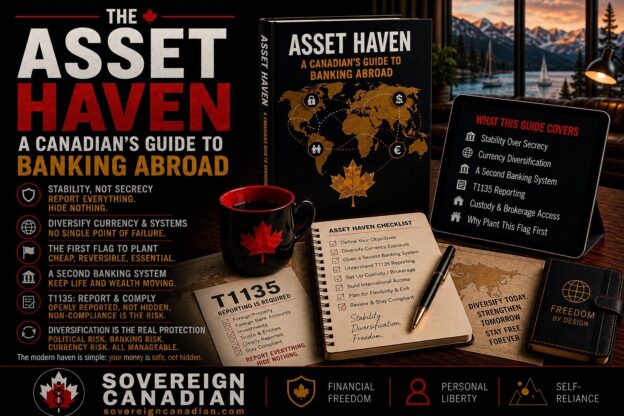
This is the fourth deep dive in my flag theory series, and it’s the one I’d tell most people to plant first. Not because it’s the most powerful flag, but because it’s the cheapest, the most reversible, and the best teacher. If you’re going to learn the discipline flag theory requires, offshore banking done right is where you learn it.
New to the series? Read the Flag Theory introduction first — it lays out the full six-flag framework.
What the asset haven flag is
The asset haven is where you bank, invest, and store wealth. The old flag theory writers called it a “haven” for a reason that no longer applies the way they meant it — and that shift is the most important thing to understand about this flag.
For decades, the pitch was secrecy. Numbered accounts, no questions, money the taxman couldn’t see. That world is gone. Between international information-sharing and modern compliance, the secret account is a fantasy — and thank goodness, because chasing it is how people end up in handcuffs.
So if secrecy is dead, what’s the point? Stability.
Secrecy is dead. Stability is the point.
Here’s the reframe. The value of an asset haven today isn’t hiding money. It’s not keeping every egg in one country’s basket.
If all your wealth sits in one banking system, one currency, and one country’s political climate, you’re exposed to that one system’s problems — capital controls, currency swings, a bank freeze, a policy shock. Diversifying across jurisdictions is the same logic as diversifying across asset classes. You’re not evading anything. You’re refusing single points of failure.
That’s a flag any law-abiding Canadian can plant, out in the open, fully reported.
Currency, system, and political diversification
Three kinds of diversification stack inside this one flag.
Currency. Holding assets in more than the Canadian dollar means one currency’s bad decade doesn’t take your whole net worth with it.
Banking system. An account in a second, stable banking system means one bank’s — or one country’s — freeze doesn’t lock you out of everything at once.
Political. Different countries have different appetites for capital controls and confiscation. Spreading assets means no single government’s mood governs all of your money.
None of that requires exotic destinations. Stable, boring, well-regulated jurisdictions are exactly what you want here. Boring is a feature.
T1135 and the reporting discipline
Now the part that makes this a legal flag rather than a criminal one.
As a Canadian resident, if you hold specified foreign property above the reporting threshold, you file a T1135 — the Foreign Income Verification Statement. Foreign accounts are not hidden accounts. You report them, you pay tax on the income, and you sleep fine.
And you should assume the CRA already knows. Under international information-sharing arrangements, financial institutions report account information across borders automatically. The idea that an offshore account is invisible is not just wrong — it’s the exact assumption that turns a legal strategy into an illegal one. (Residency flag deep dive — coming soon.)
So the discipline this flag teaches is simple: report everything, hide nothing. Master that here, on a low-stakes account, and you’ll carry it into every other flag.
What “haven” means now
Let me redefine the word, because it’s doing damage.
A modern asset haven isn’t a place that helps you disappear. It’s a place with the rule of law, a stable currency, sound banks, and a government that doesn’t casually seize deposits. The “haven” is safety, not secrecy. You’re looking for somewhere your money is safe, not somewhere it’s hidden.
Judged that way, some of the best havens are the least exotic places on Earth. That’s the point.
Beyond bank accounts: custody
The asset haven flag isn’t only about chequing accounts.
It extends to where you hold investments — a brokerage in a second jurisdiction, for instance — and to alternative stores of value like allocated precious metals held abroad. For the crypto-inclined, self-custody is its own form of jurisdictional independence, though it comes with its own reporting questions and its own risks, and it’s not a loophole around any of the rules above.
The common thread: custody diversification. Not everything you own should sit in one place, under one custodian, subject to one country’s whims.
Why I’d plant this flag first
Everything about this flag makes it the ideal starting move.
It’s cheap — opening an account isn’t a life decision. It’s reversible — you can close it. It’s low-stakes — you’re not renouncing anything or triggering departure tax. And it’s the perfect place to build the reporting muscle you’ll need everywhere else. You get real diversification and a free education at the same time.
Compare that to the residency flag, which is expensive, slow, and hard to reverse. Starting with assets lets you practicebeing a flag-planter before you bet anything real.
What I’d Actually Do
Here’s my order for the asset haven flag.
I’d start with one account, in one stable second jurisdiction and currency, opened properly and reported fully from day one. The goal of the first account isn’t returns. It’s learning the process and proving to myself I can run this cleanly.
I’d file the T1135 without drama the moment I crossed the threshold, and I’d treat that filing as normal, not as something to dread. Reported is safe.
I’d diversify custody gradually — a second brokerage, maybe metals held abroad — rather than all at once, and I’d keep every piece of it boring and above-board.
And I’d never, under any circumstances, treat this flag as a way to hide. The instant an asset flag depends on secrecy, it stops being a diversification strategy and becomes a liability with a countdown on it.
Next, we leave the money behind and talk about where you actually spend your time — the playgrounds flag. (Playgrounds flag deep dive — coming soon.)
This post is personal documentation of how I think about my own situation. It is not tax, legal, or financial advice. Foreign-account reporting rules including the T1135 change and apply differently to every case — confirm your reporting obligations with a qualified professional before you act.