
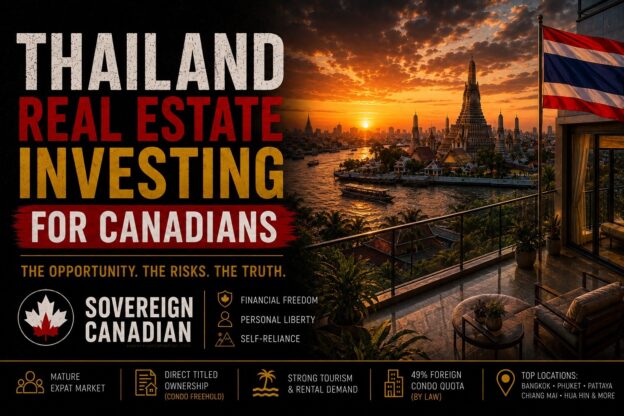
A country deep-dive in the Sovereign Canadian international real estate series, sitting under the foreign real estate investing pillar that covers the Canadian-side mechanics in full. This is personal documentation of how I’d approach the decision, not advice. Thailand’s rules are moving fast in 2026, so verify the live numbers the week you transact.
Here’s the decision that comes before every other decision in Thailand: you will never own the land, so buy the one thing you can actually hold in your own name – a condominium, in freehold, inside the 49% foreign quota.Everything else on offer – the beach villa, the pool house, the “company-owned” plot – is a workaround, and every workaround trades away control for lifestyle. If you internalize only one line from this post, make it that one. It disqualifies half the listings you’ll be shown and saves you from the single most common way Canadians get quietly fleeced here.
Thailand earns its spot near the top of the Asian offshore radar on cost of living and lifestyle, not on ownership rights. So the whole game is buying the controllable asset, in the right city for your reason, with both tax systems sorted before you fly. Let’s make those calls one at a time.
Which City? Match the Market to Your Reason
Don’t shop Thailand as one market. It’s two, and buying the wrong one for your purpose is the expensive mistake.
If you want yield, buy in Bangkok. It’s the deepest, most liquid condo market in the country, with real international-tenant demand and an actual resale exit – the Sukhumvit corridor (Thonglor, Ekkamai, Phrom Phong, Asoke) is the safe core. Phuket is the resort-yield alternative (Bang Tao, Laguna, Kamala), but you’re buying into holiday-rental cyclicality and heavier management. Pattaya is cheaper and higher-turnover, and I’d treat it as a trading market, not a store of value.
If you want a retirement or lifestyle base, go inland or coastal-calm. Chiang Mai is the long-stay expat capital (Nimman, Santitham, the Ping River) and stretches a Canadian pension furthest. Hua Hin is the quieter, more-Thai seaside option; Koh Samui gives you island living with enough infrastructure to actually settle.
The practical read: retirees report living well on roughly CAD $2,000-2,800 a month in the cheaper cities (verify at publish – the exchange rate does most of the work), with private healthcare that rivals home for a fraction of the cost. That healthcare edge is real and it compounds the case – it’s the same infrastructure I covered in the medical-tourism piece, anchored by hospitals like Bangkok’s Bumrungrad. If you’re a pure investor, none of that matters and you should be in Bangkok. If you’re a snowbird, ignore the yield talk entirely.
How to Hold It So You Actually Own It
One structure is clean. The others cost you control, and my verdict on each is below.
Buy condo freehold, in your own name. Under the Condominium Act, foreigners can hold up to 49% of a building’s floor area in freehold, on the title deed (the chanote). The mechanical requirement that actually matters: import the purchase money from abroad in foreign currency and get the Foreign Exchange Transaction (FET) form from the receiving Thai bank. No acceptable bank proof of the qualifying foreign-currency remittance, no foreign-freehold registration. And confirm the building’s remaining foreign quota in writing before any real deposit – in hot Phuket and Pattaya projects the foreign side fills first.
Leasehold is a fallback, not a plan. A registered 30-year lease is enforceable and consumes no quota, which is why sold-out buildings keep selling on lease. But renewal past 30 years is a contractual promise, not a statutory right, and you should price it as exactly that. Fine for a lifestyle villa you’ve made peace with. Not something I’d underwrite as an investment.
Avoid the Thai-company land structure. Holding land through a Thai-majority company on nominee shareholders is the classic “own a villa” trick, and Thailand spent 2026 dismantling it – the Department of Business Development now demands genuine source-of-funds proof and cross-checks corporate ownership against land titles. If your control depends on Thai nominees holding shares they never paid for, you don’t own an asset, you own a liability with a fuse on it. Walk away.
The Regulatory Bets – Don’t Underwrite on Promises
Two reforms get dangled to foreign buyers constantly. As of now, neither is law, and you should model as if they never pass:
- Raising the foreign condo quota from 49% to 75% – in cabinet study since late 2024, heavy political pushback, not enacted.
- Extending leases from 30 to 99 years – studied, not legislated, not enacted.
The actionable point: if a developer’s pitch only works assuming one of these passes, it doesn’t work. The real 2026 trend runs the other way – tighter enforcement on nominee companies, quota compliance, and short-term rentals. Underwrite the rules that exist today, and treat any loosening as upside you didn’t pay for. (Status of both is a verify-at-publish item.)
How You’ll Pay For It
Default assumption: cash. More true in Thailand than almost anywhere else in this series, and the sooner you accept it the cleaner your plan gets.
Canadian banks won’t mortgage a Thai condo, and Thai retail banks won’t touch a non-resident foreigner. Your real options, all with rates and loan-to-value that move year to year (verify at publish):
- UOB (Thailand) is the one structured programme for Western buyers – roughly 50-70% LTV, loans in SGD or USD (so you carry currency risk on every payment), floating rates well above Thai-national pricing, and proof of home-country income. Worth it only if the leverage genuinely changes your allocation.
- ICBC (Thai) lends mostly to Chinese and Hong Kong buyers, completed units only, but accepts other nationalities and certified offshore income.
- MBK Guarantee is private and asset-based – no income test, no work permit, up to ~50% LTV, short term, high rate. Easy approval, expensive money.
- Developer financing on off-plan is often interest-free through construction and is frequently the best deal on the table for a pre-completion unit. Read the contract three times.
For most financially serious Canadians the smart move is to finance at home: pay cash, or borrow against Canadian assets via a HELOC (sometimes structured as a Smith Manoeuvre) and deploy that. Just remember every dollar across the border is a currency bet stacked on the real estate bet. Budget for it explicitly.
The Rental Reality Check: Model It as Monthly-Plus or Don’t
This is where most “Thailand Airbnb” spreadsheets die, so run it before you fall for a yield number.
Under the Hotel Act, renting for stays under 30 days is running an unlicensed hotel – fines, a daily penalty for continuing, up to a year of potential jail, and an individual condo essentially can’t get the licence. A 2023 rule exempts tiny operations (broadly eight rooms, 30 guests), which does nothing for a normal condo doing nightly bookings. On top of that, most condo buildings ban short stays in their own bylaws, and juristic offices in Bangkok, Phuket, and Pattaya now monitor listings and cross-check them against hotel registrations.
So for a normal foreign-owned residential condo, the only model I’d underwrite is 30-day-plus rental: set a 30-night minimum, stay outside the Hotel Act, and target the long-stay market of retirees, remote workers, and snowbirds – lower turnover, less wear, less legal exposure. Underwrite Thailand rentals as monthly, never nightly. If a pro forma needs resort-style nightly occupancy in a condo to clear your hurdle, throw the pro forma out.
The Tax Math That Decides the Deal
Thailand’s property tax is genuinely light – the surprises are all in the transaction and the Canadian side. Here’s what actually hits your return.
Buying and selling (Thailand): budget the standard 2% transfer fee (the reduced-fee stimulus is aimed at Thai nationals and lower-value homes – as a foreigner, budget the full 2% and treat relief as a bonus), plus 3.3% Specific Business Taxif the seller exits within five years or 0.5% stamp duty if not – never both – and a withholding tax on the sale. There’s no separate capital gains tax; the gain is captured in that withholding at the Land Office. Realistic buyer-side transaction budget: 3-5% of value. The five-year line is the lever – Thailand punishes fast flips and rewards medium-to-long holds, so plan your exit accordingly. (All rates verify at publish; 2026 currently appears to be a full-rate year for the annual Land and Building Tax, though that annual carrying tax remains very low by Canadian standards.)
Renting (Thailand): a non-resident owner sees 15% withholding on gross rent, but it is not a final tax. File a Thai return, apply the available deductions and progressive bands, and the final liability can be materially lower than the 15% withheld, with excess withholding potentially refundable. Owning in your own name is usually the tax-efficient move for a residential rental.
The Canadian side is where people trip:
- Rent is taxable in Canada on your worldwide income, reported on Form T776 in Canadian dollars, no matter what you paid in Thailand.
- T1135 kicks in the moment it’s an investment. Pure personal-use never rented out isn’t reportable; rent it, and once cost tops CAD $100,000 you’re filing, with penalties from $25/day.
- No Principal Residence Exemption. Your Thai condo doesn’t get the shelter your Ontario home might. The gain is a taxable Canadian capital gain, and CCA you claimed comes back as recapture on exit.
Your Edge: Canada and Thailand Have a Tax Treaty
In every no-treaty country in this series – Panama, Belize, Albania – I flag the missing treaty as its own section, because it wrecks the after-tax math. Thailand is the opposite case, and it’s a genuine reason to prefer it over those markets.
Canada and Thailand have an in-force income tax convention (signed 1984). Practically, that makes the foreign tax credit on Form T2209 work cleanly: the tax you pay in Thailand on rental income generally credits against the Canadian tax on that same income, so you’re not taxed twice on the same dollar. It doesn’t make Thailand tax-free – two systems, two filings – but it removes the ugliest outcome, double taxation with no relief. Keep every Thai receipt; the credit is only as good as your records. Confirm the treaty is still listed on Canada’s in-force treaty list and read the convention text itself if your situation is anything past a simple rental.
The Remittance Trap If You Actually Move There
One Thailand-specific rule catches Canadians who become Thai tax residents (180+ days) – and it’s live the moment you wire in a property-sized sum. Since 1 January 2024, Thailand taxes foreign-source income that a tax resident remits into Thailand, at rates up to 35%, for income earned from 2024 on. Pre-2024 savings are outside the net. The famous same-year exemption everyone cites is still a draft, not yet in the Royal Gazette as of mid-2026 – so the 2024 rule is what actually applies. This is the single most important verify-at-publish item in the post. The moves: keep dated records of the source of every baht you bring in, keep pre-2024 savings in a separate traceable account, and get cross-border advice before you move the money. Note that LTR-visa holders are exempted from this entirely – which is why residency and the money question aren’t separate.
Residency Is a Separate Purchase
Buying a condo buys you a condo, not the right to stay. If a second flag is part of your reason, you plant it through the visa system, on its own merits (thresholds verify-at-publish):
- Retirement (Non-O / O-A): age 50+, ~800,000 THB in a Thai bank or 65,000 THB/month income, insurance mandatory on the O-A; the O-X runs 10 years against a larger (~3M THB) balance.
- LTR: the 10-year “Thailand golden visa” for higher earners and higher-net-worth applicants (broadly USD 80,000/year or USD 1M in assets on the wealthy track) – and it carries the foreign-income tax exemption, which is the one that matters for the money.
- Thailand Privilege (formerly Elite): pay a lump sum for 5-20 years of stay, no income test, no tax perks, no work rights.
The discipline is the same as the pillar: buy the property because it’s a good property, pick the visa separately. It’s also why Thailand fits the playgrounds flag – somewhere you spend your time – better than the asset-haven flag, since a condo you can’t easily liquidate is a poor place to park capital you might need.
Safety: The Real Risk Is Title, Not Crime
For a foreign resident, Thailand is a low-violent-crime environment – the day-to-day risks are petty theft, scams (rental-deposit and passport-as-collateral cons), and the roads. Bangkok, Chiang Mai, Phuket, Krabi, and Samui all sit in the normal-caution band.
For completeness: Global Affairs Canada’s advisory is currently elevated – “exercise a high degree of caution” overall, with “avoid all travel” to the four southernmost provinces (Narathiwat, Pattani, Songkhla, Yala) and within 50 kilometres of the Thailand-Cambodia border after a late-2025 flare-up. None of that touches the condo markets above, but check the current advisory before you commit to travel. The bigger threat to your capital isn’t crime – it’s title and structure. Use an independent Thai lawyer, verify the chanote, and never buy land through a nominee company you don’t control.
What I’d Actually Do
- Name the reason, then let it pick the city. Yield means Bangkok. Retirement means Chiang Mai or Hua Hin. Snowbird personal-use is also the cleanest Canadian tax position – no T1135, no T776.
- Buy a condo, freehold, in my own name, funded by a clean FET transfer. The one structure I control. No nominee-company land. A villa only on a 30-year lease I’ve priced honestly.
- Run the reconnaissance year first. Rent, live a low season, meet a Thai lawyer and a cross-border accountant before any realtor – the scout-before-you-commit rule matters double in another legal system.
- Model rentals at 30-day-plus, full stop. If it needs nightly occupancy to pencil, it’s not a deal.
- Sort both tax sides before falling for a unit – T1135/T776/T2209 at home, treaty confirmed, remittance-rule status confirmed if I’m moving there, financing (cash or Canadian HELOC) lined up before the viewing trip.
- Treat residency as its own decision – retirement, LTR, or Privilege on the merits, not as something the condo bought me.
Thailand rewards the disciplined buyer and quietly fleeces the impulsive one more than almost anywhere in this series, precisely because the lifestyle sells itself and the land rules are so easy to paper over. Buy the asset you actually control, report it cleanly on both sides, and Thailand can still be one of the more compelling combinations of lifestyle and offshore property exposure available to a Canadian. Unlike a trust-based market like Mexico, Thailand makes you give up the land outright – and pays you back in cost of living, healthcare, and a genuinely world-class place to spend your time.
Sovereign Canadian is personal documentation of my own financial and lifestyle decisions. It is not financial, tax, legal, or investment advice. Thai ownership rules, visa thresholds, and tax treatment – especially the foreign-income remittance rules and the pending quota and lease reforms – change frequently and vary by your circumstances. Verify everything with a qualified cross-border accountant and an independent Thai lawyer before you act. I’m a peer sharing research, not an advisor.