
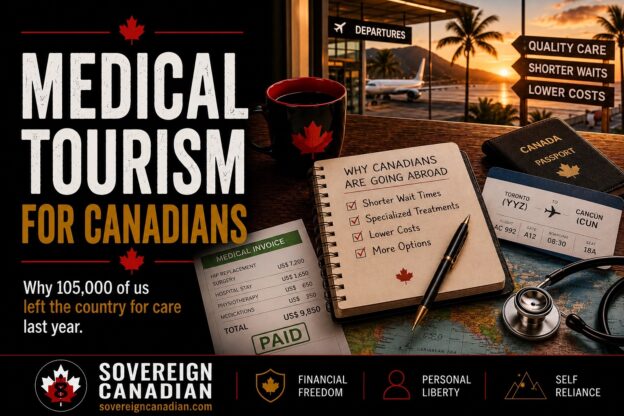
Medical tourism for Canadians is no longer a fringe topic. In 2025, an estimated 105,529 Canadians travelled outside the country for non-emergency medical treatment — a 66% jump from a decade earlier. That’s not a statistic about desperate people making bad decisions. That’s a market signal. When six figures’ worth of your fellow citizens quietly pay out of pocket — after already paying taxes into a universal system — to get a hip, a scan, or a mouth full of implants somewhere else, the rational response isn’t outrage. It’s research.
This post kicks off a new series on Sovereign Canadian, running parallel to our real estate investing series. Same approach: country by country, procedure by procedure, with real numbers, honest risk assessments, and none of the brochure language. This introduction covers the landscape – why Canadians leave, the procedures that make the most sense to get abroad, the ten destinations that matter, and how to think about the whole thing like an adult managing a portfolio rather than a patient hoping for the best.
One thing up front: I’m not a doctor, and this isn’t medical advice. It’s a framework for evaluating a decision that more than a hundred thousand Canadians made last year, and one that I’m sure my family and I will need ourselves.
Why Canadians Leave: The 28.6-Week Problem
The core driver is time, not money. Canadians already have “free” healthcare. What we don’t have is timely healthcare.
The Fraser Institute’s 2025 Waiting Your Turn survey put the national median wait from GP referral to actual treatment at 28.6 weeks — the second-longest ever recorded and roughly triple the 1993 figure. That’s the median. The provincial spread is brutal: Ontario came in shortest at 19.2 weeks, while New Brunswick patients waited a median of 60.9 weeks. Over a year, for treatment physicians themselves consider medically necessary.
Diagnostics — the thing you need before anyone will even put you in a treatment queue — are their own bottleneck: a median wait of 8.8 weeks for a CT scan and 18.1 weeks for an MRI. Four and a half months to find out what’s wrong with you, before the clock even starts on fixing it.
Now layer on the second problem: coverage gaps. Your provincial plan doesn’t cover dental. It doesn’t cover most vision correction. It doesn’t cover cosmetic work, most fertility treatment beyond limited provincial programs, or anything Health Canada hasn’t approved — which includes most stem cell and regenerative therapies. For these categories, every Canadian is already a private-pay patient. The only question is whether you pay Toronto prices or Bangkok prices.
So the medical tourist splits into two profiles, and it’s worth knowing which one you are:
- The queue-jumper. The procedure is covered at home, but the wait is unacceptable — a knee replacement, an MRI, a specialist consult. You’re paying to buy back time.
- The arbitrageur. The procedure was never covered anyway — dental implants, LASIK, IVF, executive health screening. You’re paying either way; abroad you pay 40–80% less.
There’s a third profile — the person seeking treatments not available in Canada at all — and that’s where things get interesting, and riskier. More on that below.
The Procedures: Where Medical Tourism for Canadians Makes Sense
Not every procedure travels well. Here are eight categories where the math, the quality, or the access case is strong enough to justify a flight. Each of these gets a deep dive later in the series.
1. Dental Work
The workhorse of medical tourism, and for Canadians the easiest entry point because none of it was ever covered (outside of the meagre Canada Dental Plan which many people don’t qualify for). A single dental implant runs $3,000–$5,000+ in Canada. In Mexico, Costa Rica, Hungary, or Vietnam, the same implant from an internationally trained dentist runs $900–$1,500. Full-mouth restorations — All-on-4s, complete smile reconstructions — are where the savings get serious: five figures saved on a single trip, even after flights and hotels. The catch: implants are a two-stage process (placement, then crown months later), so budget for two trips or the savings shrink.
2. Orthopedic Surgery (Hips, Knees, Spine)
This is the queue-jumper’s category. Orthopedic waits are among the worst in Canada — in some provinces the median stretches past a year — and every month of delay on a degenerating joint costs you mobility you may not fully get back. A knee replacement that would cost $35,000+ if purchased privately in North America runs $7,000–$12,000 in India, Turkey, or Malaysia at internationally accredited hospitals whose surgeons do these procedures at enormous volume. The critical caveat: you cannot safely board a long-haul flight days after joint surgery. Budget 10–14 days of local recovery and physio before flying; the DVT risk is very real.
3. Diagnostics and Executive Health Screening
This one deserves more attention than it gets. An 18-week MRI wait isn’t just an inconvenience — it’s 18 weeks of not knowing, and 18 weeks of delay before treatment can even be scoped. Abroad, diagnostics are a product, not a queue. Hospitals in Thailand, Malaysia, South Korea, and India sell executive health packages: full blood panels, cardiac stress testing, full-body MRI or CT, colonoscopy, cancer marker screening — often completed in one or two days, with results reviewed by a specialist before you leave, for $1,000–$3,500 depending on depth. For a Canadian in their 40s or 50s who wants a genuine baseline picture of their health rather than a rushed annual physical, this is arguably the single best value in all of medical tourism. It also pairs naturally with travel you were doing anyway.
4. Stem Cell and Regenerative Therapies
Here’s where I’m going to be more careful than most of the industry wants me to be. Stem cell therapy for orthopedic conditions, autoimmune disease, and anti-aging is a booming medical tourism category — Mexico, Panama, Colombia, and parts of Asia host clinics that treat thousands of foreign patients a year, at price points from $5,000 to $50,000+. Canadians go because Health Canada hasn’t approved most of these treatments, meaning you literally cannot buy them at home at any price.
The honest picture: the science is genuinely promising in some applications and genuinely unproven in others, and the offshore clinic industry does not sort itself neatly into those two piles for you. Some clinics run legitimate protocols with published data and physician oversight. Others sell hope at luxury prices. The regulatory absence that makes these treatments accessible abroad is the same absence that makes quality control your job entirely. This category gets its own deep dive precisely because the diligence burden is 10x that of getting a crown in Los Algodones. If a clinic’s marketing promises to fix everything from your knee to your immune system to your hairline with the same injection, you already have your answer.
5. Bariatric Surgery
Gastric sleeve and bypass procedures are covered in Canada — with waits that routinely run years and eligibility criteria that exclude many patients. Tijuana has become the highest-volume bariatric destination in the hemisphere, with all-inclusive packages in the $4,500–$7,000 range against $20,000+ private pricing north of the border. Volume cuts both ways: the best Mexican bariatric surgeons are among the most experienced in the world, and the worst clinics are chasing the same Google traffic. Surgeon-specific diligence, not clinic marketing, is what matters.
6. Cosmetic and Plastic Surgery
Never covered, always expensive at home, and the category where roughly a quarter of all global medical tourists spend their money. Colombia, Turkey, Thailand, South Korea, and Mexico all have deep specialization here — Turkey alone performs more hair transplants than the rest of the world combined, with all-inclusive packages at $2,500–$4,500 versus $12,000–$20,000 for the procedure alone in North America. South Korea is the global technical leader in facial work. The quality ceiling abroad is as high as anywhere on earth; the floor is lower. Same rule as bariatric: diligence the surgeon, not the Instagram account.
7. Fertility and IVF
An IVF cycle in Canada runs $15,000–$20,000+ with medications, and provincial funding programs are limited, oversubscribed, or both. Clinics in Spain, Greece, the Czech Republic, Mexico, and Panama offer complete cycles at 40–60% less, and some European clinics post success rates that match or beat Canadian averages. For couples facing multiple cycles, the savings compound fast — and the emotional math of doing this somewhere warm, on your own schedule, rather than in a fluorescent-lit queue, is not nothing.
8. Vision Correction and Eye Surgery
LASIK, lens replacement, and cataract work (another long-wait category at home) are mature, high-volume, low-complication procedures abroad. Turkey, Thailand, and Mexico do enormous volume at 50–70% below Canadian private pricing. Short recovery windows make this one of the most travel-compatible procedures on the list.
The Destinations: Ten Countries That Matter for Canadians
Same logic as the real estate series — not an exhaustive list, but the markets where the combination of quality, price, accessibility, and specialization actually works for someone flying out of Toronto, Vancouver, or Calgary. Each gets its own deep dive.
1. Mexico. The volume leader for North Americans and the obvious starting point. Los Algodones — “Molar City” — has more dentists per capita than anywhere on earth. Tijuana owns bariatric. Cancun and Puerto Vallarta have full-service private hospitals serving the same neighbourhoods our real estate series covers. Proximity is the killer feature: four-hour flights, no jet lag, familiar territory. Stem cell clinics cluster here too, with all the caveats above.
2. Costa Rica. The quality play in Latin America. San José’s private hospitals (CIMA, Clínica Bíblica) hold international accreditation, dental and cosmetic work run 45–65% below North American prices, and the country’s stability and tourism infrastructure make recovery logistics easy. Pairs with the same investor-familiar ecosystem from our Costa Rica real estate coverage.
3. Colombia. Medellín and Bogotá have quietly built serious medical infrastructure — several Colombian hospitals rank among Latin America’s best. Cosmetic surgery is the headline specialty, but cardiology, dental, and orthopedics are strong. Prices sit below Costa Rica’s. The safety question is real but manageable with the same neighbourhood-level thinking we apply to real estate.
4. Panama. Johns Hopkins-affiliated Hospital Punta Pacífica anchors the market. Strong in IVF (complete programs around US$5,600), dental, and increasingly stem cell therapy. Dollarized economy, direct flights, and a legal/banking environment Canadians in our audience already know from the residency and real estate side.
5. Cayman Islands. The outlier. Health City Cayman Islands was built by India’s most famous cardiac surgeon specifically to serve North American medical tourists — tertiary-level cardiac, orthopedic, and oncology care, accredited to international standards, an hour and change from Miami. Not the cheapest option, but the shortest-haul serious surgery destination in the hemisphere.
6. Turkey. The global heavyweight — roughly two million medical tourists a year. Owns hair transplants outright, and Istanbul’s hospital groups are major players in dental, cosmetic, bariatric, and eye surgery at 50–70% below Western pricing. The flight from Canada is long, but the price-to-infrastructure ratio is arguably the best in the world.
7. Hungary. Europe’s dental capital. Budapest has entire districts built around dental tourism, with EU-regulated care at Mexican prices. The play for Canadians is combining it with European travel — or with the expat-year scouting our audience is already doing.
8. India. The deep-value destination for major surgery. Cardiac procedures at 6–10% of North American cost, from surgeons whose case volumes dwarf anything in the West. Joint replacements, spinal work, and oncology follow the same pattern. The trade-off is distance and the wider variance outside the top-tier hospital groups (Apollo, Fortis, Max) — stay inside the accredited system.
9. Thailand. The most polished patient experience in medical tourism. Bumrungrad International in Bangkok treats over half a million international patients a year with nursing ratios that match or beat Western hospitals. Strong across cosmetic, orthopedic, cardiac, and — critically for our purposes — executive health screening, where Thai hospitals essentially invented the category. Recovery in Thailand is a feature, not a chore.
10. Malaysia. The value-conscious alternative to Thailand: 60–80% savings, over 70 internationally accredited facilities, English-speaking medical staff as the default, and a government agency (the Malaysia Healthcare Travel Council) that actively regulates the industry. Penang and Kuala Lumpur are the hubs. Less famous than Bangkok, frequently better value.
Honourable mentions that will surface in the deep dives: South Korea (the technical ceiling for cosmetic and advanced diagnostics), Spain and the Czech Republic (fertility), and Vietnam (the emerging dental value play undercutting Thailand by 20–30%).
General Thoughts: How to Think About This Like an Investor
A few principles before the series gets granular — because the difference between medical tourism working for Canadians and going badly is almost entirely in the diligence.
Accreditation is your minimum viable filter, not your diligence. Joint Commission International (JCI) accreditation is the standard baseline — it tells you a hospital meets international protocols for safety and quality. It does not tell you whether your surgeon is good. Procedure volume, surgeon-specific outcomes, and independent patient references matter more than the plaque in the lobby. Treat clinic marketing the way you’d treat a pre-construction condo brochure.
Total cost of ownership, not sticker price. Flights, accommodation, a companion’s travel, 10–14 days of post-op recovery in-country for anything surgical, follow-up trips for multi-stage work, and specialized medical travel insurance (your regular travel policy almost certainly excludes elective procedures). A 15–20% contingency on top. The savings usually survive all of this — but run the full model, not the headline number.
Complications come home with you. This is the genuinely hard part of medical tourism for Canadians and the thing the industry underprices. If something goes wrong three weeks after you’re back in Ontario, the surgeon who did the work is 8,000 km away, and the Canadian system that didn’t do the surgery now has to manage the aftermath — which it will, but without enthusiasm and without records unless you brought complete documentation home. Get every scan, note, and protocol in writing before you leave the destination country. Continuity of care is your job.
Know what’s reimbursable — mostly nothing, with a tax asterisk. Provincial plans rarely reimburse out-of-country care unless it was pre-approved because the service genuinely wasn’t available in Canada. Don’t plan around reimbursement. There is, however, a federal Medical Expense Tax Credit angle worth understanding: the CRA’s own guidance confirms you can generally claim eligible medical expenses even when they weren’t paid in Canada, provided the service was performed by a licensed practitioner at a licensed facility in that jurisdiction — and reasonable travel and transportation costs to obtain the treatment can qualify too. The technical folio even contemplates experimental procedures not available locally. It’s a non-refundable credit above an income threshold, not a rebate — but on a five-figure procedure it takes a real edge off the net cost. The full mechanics deserve their own post; flagging it now so you keep every receipt, in English, with the provider’s licensing details.
The regulatory gap cuts both ways. The same light-touch environment that lets a Panamanian clinic offer a stem cell protocol Health Canada hasn’t approved is the environment that won’t protect you if that protocol is junk. In Canada, regulation is the diligence. Abroad, you are the regulator. That’s not a reason to stay home — it’s a reason to do the work.
The Verdict
Medical tourism for Canadians is exactly what real estate investing abroad was fifteen years ago: a rational strategy with a sketchy reputation, practiced quietly by a growing number of people who did their homework, and dismissed loudly by people who didn’t. The 2025 numbers ended the debate about whether Canadians do this. A hundred and five thousand of us did it last year. The only remaining question is whether you’d do it well or badly.
Done well, it looks like this: an executive health screen in Bangkok that catches something your rushed annual physical would have missed. Dental work in Costa Rica at a third of the Toronto quote. A knee replaced in month two instead of month fourteen. Done badly, it looks like a discount surgeon found on Instagram and a complication managed over WhatsApp.
The rest of this series is about making sure you’re in the first group.
What’s Next in This Series
Deep dives are coming on both axes — by procedure (dental, orthopedics, diagnostics and executive screening, stem cell therapy, bariatric, cosmetic, fertility, vision) and by destination (starting with Mexico, the natural companion to our real estate coverage there). If there’s a procedure or country you want prioritized, say so.
Disclaimer: This article is for general information only and is not medical, legal, or tax advice. Medical decisions should be made with qualified physicians, including your Canadian care team. Costs, wait times, and regulations cited are estimates as of mid-2026 and will change. Verify accreditation, credentials, and pricing directly before committing to any treatment abroad.