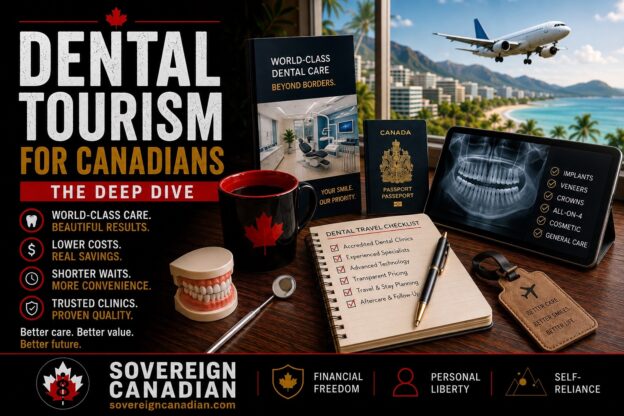
Dental tourism for Canadians is the natural place to start this series, and not by accident. In the medical tourism overview that kicked things off, I called dental work “the workhorse of medical tourism” and “the easiest entry point” for Canadians. This post is where I back that up with real 2026 numbers, the destinations that actually work, and the traps that quietly eat your savings if you don’t see them coming.
Here’s the thesis in one line: for most Canadians, a mouth full of implants was never covered anyway, so you are already a private-pay patient. The only real question is whether you pay Toronto prices or Los Algodones prices. Let’s do the math like adults.
Why Dental Is the Easiest Entry Point for Canadians
Start with the coverage reality, because it’s the whole argument. Your provincial plan doesn’t touch routine dental. And the federal Canadian Dental Care Plan — the one many Canadians assume solves this — specifically does not cover implants, bridges, veneers, or adult orthodontics. It’s a real program, now open to all age groups, but it caps out at $90,000 in adjusted family net income, requires that you carry no private dental insurance, and pays on a federal fee schedule for basic and preventive work only. Implants get covered solely when medically necessary and pre-approved through an appeals process. In practice, that’s almost nobody.
So the profile splits cleanly. Either you earn too much to qualify, or you qualify but need exactly the expensive work the plan excludes. Both roads lead to the same place: you’re paying out of pocket regardless. That’s what makes dental the cleanest case in all of medical tourism. There’s no “but it’s free at home” counterargument, because it isn’t. Nobody is queue-jumping here — everybody in this category is an arbitrageur, buying the identical procedure somewhere cheaper.
Meanwhile, most dental work is low-drama from a travel standpoint. A crown or a couple of implants doesn’t carry the deep-vein-thrombosis flight risk of a fresh knee replacement. Recovery is measured in days, not weeks — the same short-recovery logic that makes vision correction abroad so travel-compatible. You can, quite literally, fly down, get the work done, and fly home inside a week for many procedures. That combination — never covered, high savings, travel-friendly — is why dental tourism for Canadians is the entry drug of the whole category.
What Dental Work Actually Costs: Canada vs. Abroad
Now the numbers. I’ve pulled these from 2026 clinic price lists and independent cost indices, and I’ve used ranges rather than the suspiciously round figures clinics love to advertise. Treat every number as a starting point for a written quote, not a promise.
Single Implants
A single dental implant in Canada — meaning the titanium post, the abutment, and the crown on top — runs roughly $3,000 to $6,000 per tooth, with a national average landing around $4,475 and Toronto and Vancouver sitting at the high end. Abroad, the same three-part restoration looks like this in 2026:
- Mexico (Los Algodones): $900–$1,950 all-in; the bare post starts near $750 for a Korean-made brand and $1,200–$1,500 for premium Straumann or Nobel Biocare.
- Costa Rica: $850–$2,000 for a complete single-tooth restoration.
- Hungary: roughly $950–$1,400 (about €880–€1,300), EU-regulated.
- Vietnam: $700–$1,200, the value floor among the serious destinations.
- Turkey: $400–$1,000 for the implant, with strong package pricing.
Even at the top of these ranges, you’re saving 50–70% per tooth. And the materials aren’t the difference — reputable clinics abroad use the same Straumann, Nobel Biocare, and BioHorizons hardware your Canadian dentist does. The gap is labour, overhead, rent, and malpractice insurance, not the titanium.
Full-Mouth Restorations (All-on-4 and All-on-6)
This is where dental tourism stops being a nice saving and becomes a genuinely large financial decision. A full-arch All-on-4 in Canada is commonly quoted at $20,000 to $35,000 per jaw. Do both arches and you’re staring down a mid-size-car price tag. Abroad, per arch:
- Vietnam: roughly $4,000–$7,500 (about CAD $5,500–$10,300) — the best All-on-4 value on the board.
- Mexico: $7,000–$10,000.
- Turkey and Hungary: from roughly $5,000–$9,000.
- Costa Rica: $8,500–$12,000.
On a two-arch reconstruction, the spread between a Canadian quote and a top-tier clinic abroad can clear $30,000 or more — even after you’ve paid for flights, hotels, and a companion. This is the case where the trip pays for itself several times over, which is precisely why full-mouth work drives so much of the dental tourism traffic.
Crowns, Veneers, and Everything Else
The savings hold across the smaller stuff, too, though the math gets less compelling once travel enters the picture. In Los Algodones, porcelain and zirconia crowns run $250–$400 against $1,000–$1,500 at home; veneers start around $350–$450; root canals land near $200–$280 versus $900–$1,400 in North America.
Here’s the honest caveat: a single crown is rarely worth a flight on its own. The trip economics only work when you’re bundling — several crowns, a couple of implants, or a full smile makeover in one visit. If you need one filling, get it in Canada. If you need $18,000 of work, get on a plane.
The Two-Trip Problem Nobody Prices Into the Brochure
This is the single most important thing in this post, so I’ll be blunt about it. Implants are a two-stage procedure. The surgeon places the titanium post, and then your jawbone has to fuse to it — a process called osseointegration that takes three to six months. Only after that heals does the permanent crown go on.
That biology doesn’t care about your flight schedule. It means a proper implant is realistically two trips, months apart: one to place, one to restore. Some clinics offer immediate-load “teeth in a day” protocols, and for the right candidate they’re legitimate, but they aren’t appropriate for every case, and a clinic that promises them to everyone is telling you something.
Budget accordingly. Two sets of flights, two hotel stays, two chunks of time off work. The savings almost always survive the second trip — a $30,000 gap doesn’t close because you bought one more plane ticket — but the person who budgets for one trip and gets surprised by the second is the person who feels burned. Run the two-trip model from the start and there’s no surprise. And if you’re already making a second trip, that’s the moment to think like a portfolio: some Canadians fold a diagnostic or executive health screen into the same visit, since the flight is already sunk.
The Destinations That Matter for Dental Tourism
Six destinations do most of the meaningful work for Canadians. Each earns its place for a different reason.
Mexico (Los Algodones). The default. “Molar City” has more dentists per square block than anywhere on earth, over 90% of patients are American and Canadian, and it sits two minutes from the U.S. border. Proximity is the killer feature — for a Western Canadian especially, this is the shortest path to a chair. It pairs naturally with the same territory our Mexico real estate coverage walks through.
Costa Rica. The quality play in Latin America. San José and Escazú clinics like those attached to CIMA and Clínica Bíblica hold international accreditation, dentists frequently trained in the U.S., and the country’s stability makes recovery logistics genuinely easy.
Hungary (Budapest). Europe’s dental capital, drawing 60,000–100,000 international patients a year for two decades. The pitch is EU-regulated care — inspected clinics, Swiss and German hardware — at 40–70% below Western European pricing. For Canadians, the play is bundling it with European travel you were doing anyway.
Turkey (Istanbul). The heavyweight, with 400-plus clinics chasing foreign patients and aggressive package pricing. Savings run deep, but so does the quality variance. This is a destination where diligencing the specific surgeon matters more than anywhere else on the list.
Vietnam. The emerging value leader I flagged in the overview. It undercuts Thailand by 20–30% on most procedures while using the same implant brands, which puts it at the very bottom of the price range for full-arch work without an obvious drop in clinical standard.
Thailand. The premium patient experience. Bangkok’s top clinics deliver Western-hospital polish, and while prices sit above Vietnam’s, some patients happily pay the difference for the infrastructure and the recovery-as-vacation angle.
Total Cost of Ownership, Not Sticker Price
Same principle as the overview: model the whole thing, not the headline. A realistic dental tourism budget includes the treatment, round-trip flights, accommodation for the full stay, a companion’s travel if you want one, any second trip for multi-stage implant work, and specialized medical-travel insurance — because your standard travel policy almost certainly excludes elective procedures. Add a 15–20% contingency for the bone graft or sinus lift that shows up on the X-ray you didn’t have at home.
Run a quick example. Say a Canadian faces a $28,000 quote for an upper-arch All-on-4 in Toronto. In Vietnam, the arch itself might be CAD $8,500. Add two people’s flights, ten nights of hotel, meals, insurance, and a contingency, and call it $7,000 in travel. Total: roughly $15,500 against $28,000 — a saving north of $12,000, and that’s the conservative version. The savings scale with the size of the case, which is exactly why you travel for the big work and stay home for the small.
The Tax Angle: Your Crown Might Be a Credit
Here’s the piece the industry never mentions, because it isn’t their money. Canada’s federal Medical Expense Tax Creditgenerally lets you claim eligible medical expenses even when they weren’t paid in Canada — provided the work was done by a licensed practitioner at a licensed facility in that jurisdiction. The CRA’s own guidance confirms it, and reasonable travel costs to obtain the treatment can qualify too.
It’s a non-refundable credit above an income threshold, not a rebate, so don’t overstate it. But on a five-figure procedure it can take a real bite out of the net cost — roughly 15% federal plus provincial credits on the eligible amount. The catch is documentation. Keep every receipt, in English, with the provider’s licensing details on it. The full mechanics deserve their own post, but flag it now so you don’t throw away the paperwork that funds part of your trip.
How to Diligence a Dental Clinic Abroad
Accreditation is your minimum filter, not your diligence — the same rule from the overview applies here. A plaque in the lobby tells you the clinic meets a baseline; it says nothing about whether your dentist is good. So do the work:
- Confirm the implant brand and model in writing. Straumann, Nobel Biocare, and BioHorizons are the names you want to see. “Premium imported implant” is not a brand.
- Ask about the dentist specifically — their volume of your exact procedure, their training, and independent patient references that aren’t clinic testimonials.
- Get the warranty in writing. Reputable clinics back implants for 5–10 years and crowns for 3–5. No warranty is a red flag.
- Take your records home. Every scan, every note, every protocol, in writing, before you leave. If a complication surfaces back in Ontario, your Canadian dentist needs those records to help you — and continuity of care is your job, not theirs.
The regulatory gap cuts both ways, and dental is the gentlest version of it — the diligence burden here is a fraction of what it is at the other end of the spectrum, where stem cell therapy abroad demands ten times the homework for a fraction of the certainty. In Canada, regulation is your diligence. Abroad, you are the regulator. That’s not a reason to stay home. It’s a reason to spend an evening reading reviews before you spend $15,000.
The Verdict
Dental tourism for Canadians is the safest, cleanest, highest-volume category in the entire medical tourism landscape, and it’s the right place to start if you’re testing the waters. The work was never covered here, the savings are large and well-documented, the procedures travel well, and the downside — a redo, a refit — is recoverable rather than catastrophic. Get it right and you save five figures on a full-mouth case while combining it with a trip you’d half-enjoy anyway. Get it wrong and you’ve bought a discount crown that needs replacing, which is a bad afternoon, not a disaster.
Do the two-trip math, model the total cost, keep the receipts for the tax credit, and diligence the surgeon rather than the Instagram feed. Do those four things and dental tourism stops being a gamble and starts being what it actually is: a rational purchase, made by adults, at a fair price.
Disclaimer: This article is for general information only and is not medical, dental, legal, or tax advice. Dental decisions should be made with qualified practitioners, including your Canadian care team. Costs and regulations cited are estimates as of mid-2026 and will change. Verify accreditation, credentials, pricing, and tax eligibility directly before committing to any treatment abroad.
Next in the series: the orthopedic medical tourism deep dive — the queue-jumper’s category, where the math changes because the procedure is covered at home, if you’re willing to wait past a year for it. If there’s a procedure or destination you want prioritized, say so in the comments.