
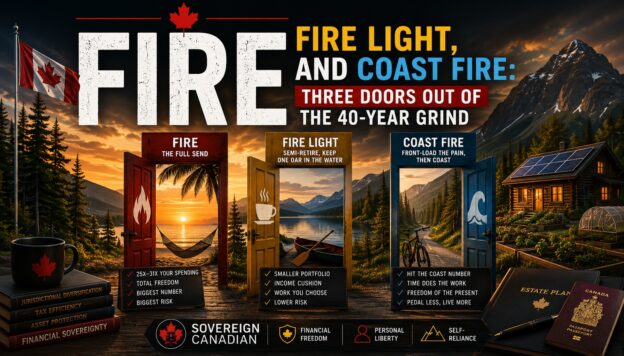
Most people hear “FIRE” and picture a 34-year-old in a hammock who will never touch a spreadsheet again. That version exists. But it’s one door out of three, and for a lot of higher-earning Canadians it’s the wrong one to walk through first. Financial independence isn’t a single finish line — it’s a spectrum of how much freedom you’re willing to buy now versus how much you’re willing to defer.
I treat FIRE in Canada the same way I treat jurisdictional diversification: it’s about optionality. The goal isn’t to quit — the goal is to make quitting irrelevant as a source of fear. Once your survival no longer depends on your employer’s mood, you negotiate differently, you parent differently, you take risks differently. That’s sovereignty, and it comes in three flavours: the full send, the light version, and the one where you front-load the pain and coast.
Let’s pull each one apart — the math, where your RRSP fits, whether the Smith Manoeuvre earns its keep, the lifestyle each actually buys, and what changes the moment you have kids.
The One Number That Rules All Three: Your FI Number
Before we split the doors apart, understand the number they all share. Your FI number is your annual spending multiplied by 25. That “25” is the inverse of the famous 4% rule — the finding from the 1998 Trinity Study that a portfolio of stocks and bonds could sustain a 4% inflation-adjusted withdrawal for a 30-year retirement in the vast majority of historical cases.
Here’s the catch nobody frames properly: the 4% rule was built for a 30-year retirement. If you’re pulling the ripcord at 45 and planning to live to 95, that’s a 50-year horizon, and the research from people like Wade Pfau and Karsten Jeske (Early Retirement Now) suggests a safer rate lands closer to 3.25%–3.5% — which pushes your multiple from 25x up toward 28x–31x.
Spend $70,000 a year? At 4% you need ~$1.75M. At a more honest early-retirement 3.5%, you need ~$2.0M. That $250K gap is the price of the extra decades.
And this is where the Sovereign Canadian angle bites: the fastest way to shrink your FI number is to shrink the denominator, not grow the portfolio. Cut your spending, or geographically arbitrage it. A $70K Ontario lifestyle can become a $40K lifestyle in Mexico — and suddenly your FI number drops by nearly half. Physical self-sufficiency does the same thing from the other direction: every dollar of food, heat, or repair you produce yourself is a dollar you don’t have to fund at 25–31x. Your homestead is a stealth FIRE accelerator.
Door One: FIRE (The Full Send)
Traditional FIRE is the pure version — accumulate 25x–31x your annual spending, stop working entirely, live off the portfolio. Full stop, full autonomy, full nest egg.
Who it’s for: High savers with a genuine surplus, people who are done with paid work as an identity, and anyone willing to run a serious jurisdictional or lifestyle arbitrage to keep the number reachable. If you’re a business owner who can sell or systematize the business, this is your lane.
The honest trade-off: You need the biggest number, and you carry the most sequence-of-returns risk — a bad market in your first five years of retirement can permanently damage a portfolio you have no wage income to defend. Full FIRE demands either a fat cushion, a flexible spending plan, or both. The “one more year” syndrome is real, and it’s rational: the cost of getting this wrong at 45 with no income is severe.
Door Two: FIRE Light (Semi-Retire, Keep One Oar in the Water)
FIRE Light — often called Barista FIRE — is the pragmatist’s version. You build a portfolio that covers most of your expenses, then use light, low-stress, part-time, or seasonal income to cover the rest. Your investments and your effort split the bill.
The math is simple and forgiving. If you spend $70K and can reliably earn $30K doing something you don’t hate, your portfolio only needs to fund the remaining $40K — roughly $1.0M at 4% or ~$1.14M at 3.5%, versus the $1.75M–$2.0M for the full send. That part-time income does two enormous things: it slashes the portfolio you need, and it lets you throttle back withdrawals in bad markets — the single best defence against sequence risk that exists.
The Canadian footnote: the American “Barista FIRE” obsession with a coffee-shop job for health insurance largely doesn’t apply here — we have public healthcare. What you’re actually buying with FIRE Light in Canada is an income cushion plus, if you want it, employer dental, vision, and drug benefits, plus the psychological structure some people genuinely miss when they quit cold turkey.
Door Three: Coast FIRE (Front-Load the Pain, Then Coast)
Coast FIRE is my favourite for high earners in their 30s and early 40s, because it exploits the one thing you can never buy back: time in the market.
The idea: pedal hard early — stuff your registered and taxable accounts until you hit your “coast number,” the amount that, with zero further contributions, will compound into your full FI number by a normal retirement age. Once you hit it, you stop saving entirely. You only need to earn enough to cover today’s expenses. Compounding does the rest.
Ride a bike up a steep hill. All the work is the climb. Reach the top — your coast number — and you can freewheel the rest of the way, pedalling only enough to steer.
Illustratively: park ~$300K by age 35, earn a 5% real return, add nothing, and you’re near $1.3M by 65 — a full retirement funded without another dollar saved. Everything you earn after that is yours to spend, because the future is already handled.
Purists sneer that Coast FIRE “isn’t really FIRE — you still work.” They’re missing the point. Coast FIRE isn’t about not working. It’s about never again working out of fear. You can take the lower-paying job you actually want, start the business, go part-time, or coach your kid’s team — because retirement is already locked.
Where Your RRSP Fits in Each Approach
The RRSP behaves very differently depending on which door you take, and this is where a lot of Canadian FIRE writing goes quiet. The 2026 numbers to anchor on: the RRSP dollar limit is $33,810 (18% of prior-year earned income up to that cap), and at Ontario’s top combined marginal rate of roughly 53.5%, every dollar you deduct at the top is worth a lot.
RRSP for full FIRE
The deduction is gold during your high-earning accumulation years. The problem is access — pull from an RRSP before you have low-income years and you’re taxed at your full rate. The elegant fix for early retirees is the RRSP meltdown: in the low-income years after you quit but before CPP/OAS kick in, you draw the RRSP down at rock-bottom brackets. FIRE’d at 45 with a modest taxable income? Those are the cheapest RRSP withdrawals you’ll ever make. Pair the RRSP with your TFSA for tax-free, penalty-free access in the years the meltdown can’t cover.
RRSP for FIRE Light
Careful here. Because you’re still earning part-time income, RRSP withdrawals stack on top of it and can push you into a higher bracket than you expected. FIRE Light usually favours leaning on the TFSA for the flexible portion and treating the RRSP as the long-game account you meltdown later, once the part-time income stops.
RRSP for Coast FIRE
This is the cleanest fit of all. Coast FIRE is front-loading, and front-loading your RRSP while your marginal rate is at its peak is exactly right — you’re claiming deductions at ~53.5% now, then coasting. The nuance: once you downshift to a lower income to “coast,” future RRSP deductions are worth far less. So the play is to max the RRSP hard while the bracket is high, then pivot new savings to the TFSA once you throttle down. Deduct high, withdraw low.
Can the Smith Manoeuvre Help? (Yes — But Not Equally)
The Smith Manoeuvre deep-dive converts non-deductible mortgage interest into deductible investment-loan interest by borrowing against home equity through a readvanceable mortgage and investing the proceeds. It’s a leverage-and-tax play, and leverage interacts with each FIRE door very differently.
Smith Manoeuvre + full FIRE: handle with care
In accumulation, the Manoeuvre accelerates you — more capital compounding earlier, refunds recycled back in. But leverage plus early decumulation is a dangerous cocktail: a market crash in year two of retirement, while you’re still servicing an investment loan and drawing on the same battered portfolio, is exactly the sequence-risk nightmare you’re trying to avoid. And once you’ve retired to a low income, the interest deduction loses most of its value. My rule: if you run the Manoeuvre toward full FIRE, have a concrete plan to neutralize or extinguish the leverage before you pull the trigger.
Smith Manoeuvre + FIRE Light: a natural fit
FIRE Light keeps you earning, which means you keep income to deduct the interest against and cash flow to service the HELOC. The deduction stays valuable, the leverage stays serviceable. Of the three doors, FIRE Light is where the Manoeuvre keeps working during semi-retirement rather than becoming dead weight.
Smith Manoeuvre + Coast FIRE: the strongest pairing
Coast FIRE is fundamentally about getting the maximum capital compounding as early as possible — which is precisely what the Manoeuvre does. Run it aggressively during your pedal-hard years to inflate the invested base, hit your coast number sooner, and keep the deduction valuable while your income is high. The caveat mirrors the RRSP one: before you stop pedalling, make sure the Manoeuvre debt is either self-sustaining or on a defined paydown path, because “coasting” means less income to service it. See the long-hold modelling in my Playa del Carmen vs. Smith Manoeuvre (coming soon) comparison for how leverage and time compound together.
The Lifestyle Each One Actually Buys
FIRE (the full send) costs you the biggest number — 25x to 31x your spending, plus either serious discipline or aggressive geographic arbitrage to keep it reachable. What it buys is total work-optionality: your time is 100% yours. It’s at its best paired with flag theory (coming soon) to stretch the same portfolio further abroad.
FIRE Light costs you a smaller portfolio but keeps you tethered to some income. What it buys is semi-retirement — freedom from the 9-to-5 without needing the full nest egg, work you actually chose on your own terms, and a withdrawal cushion that quietly neutralizes bad markets.
Coast FIRE costs you brutal front-loading early and a few more years of full-ish work. What it buys is the freedom of the present: once you hit the coast number you can spend today’s income guilt-free, take career risks, and stop white-knuckling every market downturn, because the finish line is already funded.
What Changes the Moment You Have Kids
Kids reprice everything — they raise your annual spending (and therefore your FI number), add the RESP as a savings priority, and make sequence risk scarier because you can’t exactly cut a child’s expenses in a down market. For 2026, the RESP lifetime cap is $50,000 per child, and the Canada Education Savings Grant matches 20% of contributions up to $500/year ($7,200 lifetime) — free money you build around, not into, your FIRE number.
But here’s the tailwind almost no one mentions: the Canada Child Benefit is income-tested. An early retiree living on TFSA withdrawals and return-of-capital keeps their taxable income low — which can unlock a substantial, tax-free CCB stream precisely during the child-raising years. Retire early, keep taxable income modest, and the CCB can quietly become one of the most valuable “salaries” you’ll ever earn.
FIRE with kids: Bigger number, harder to reach — but geographic arbitrage plus a fat CCB can make it work. Canadian FIRE families do this on a single income; it’s not fantasy, it’s discipline. Just respect that sequence risk cuts deeper with dependents. See my expat year with children post for the schooling-and-relocation side of the math.
FIRE Light with kids: The part-time income and any employer dental/drug benefits earn their keep here, and the income cushion is exactly what a family wants as a buffer. Watch how earned income interacts with your CCB — every extra dollar of taxable income claws a little back.
Coast FIRE with kids: Arguably the most kid-friendly of the three. You keep income, structure, and benefits, but with the freedom to take the lower-stress job, be present, and — yes — coach the soccer team. Front-load before the kids get expensive, then coast through the years when being there matters most.
What I’d Actually Do
If I were a high-earning Ontario professional or business owner mapping this today, I wouldn’t pick one door and marry it. I’d sequence them.
Pedal like hell toward my Coast FIRE number first — max the RRSP while my marginal rate is near 53.5%, run the Smith Manoeuvre during the high-income years to inflate the invested base, and get the compounding engine bought and paid for as early as possible. Hitting the coast number removes the fear, and fear is what keeps people chained to jobs and jurisdictions they’d otherwise leave.
From there, I’d downshift into FIRE Light — keep one oar in the water with work I actually chose, let the part-time income neutralize sequence risk and keep the Manoeuvre deduction alive, and use those low-taxable-income years to quietly harvest the CCB and start a gentle RRSP meltdown.
Full FIRE is the destination, not the starting line — and I’d reach it with the number cut nearly in half by geographic arbitrage and physical self-sufficiency, not by grinding to a $2M portfolio while paying full Ontario prices for a full Ontario life. Sovereignty isn’t the hammock. It’s the fact that by the time you reach it, quitting stopped being the point.
Want to model your own coast number and meltdown sequence against 15–20 year projections? That’s exactly what my personal financial planning web app (coming soon) was built for.
Compliance & disclaimer. Sovereign Canadian publishes general information and personal opinion for Canadian readers; nothing here is financial, investment, tax, accounting, or legal advice, and no advisor-client relationship is created. Figures (2026 RRSP limit $33,810, TFSA annual limit $7,000, RESP lifetime $50,000, illustrative withdrawal rates and returns) are current-source estimates for illustration only and will change; verify your own numbers against the CRA and your Notice of Assessment. Leverage strategies such as the Smith Manoeuvre carry real risk of loss and are not suitable for everyone. Ontario is used as the default provincial example; your province, bracket, and situation differ. Consult a qualified, licensed professional before acting. Andrew is not a licensed financial advisor.