
Picture two Canadians who both decide, at different points in their lives, that they want to retire in Taiwan.
The first moves at 45. She’s a product manager clearing a strong salary, and Taiwan’s Employment Gold Card lets her get a resident permit without a Taiwanese employer sponsoring her. She spends the next several years actually living there — building a career, paying Taiwanese tax, learning the neighbourhoods — and eventually converts that residency into permanent status. By the time she’s ready to slow down, Taiwan isn’t a retirement plan. It’s just where she lives.
The second Canadian spends his career in Canada, retires comfortably at 65, and only then decides Taiwan looks like exactly the kind of place he’d like to spend his later years — safe, walkable, cheap food, excellent hospitals, a short flight from the rest of Asia. He has the same net worth as the first Canadian. Possibly more.
Taiwan’s immigration system treats these two people completely differently. The first one built her right to be there while she still had something Taiwan’s system was designed to reward: an income, a skill set, an employer relationship, a professional category. The second one shows up with money and time and discovers that neither, on its own, is a currency Taiwan’s immigration architecture accepts.
That gap is the real subject of this article. Taiwan is not a country that’s hostile to foreigners — if anything, it’s unusually deliberate about attracting skilled immigrants. But it is a country whose most useful immigration pathways were built to attract economically active foreigners, not conventional retirees. If Taiwan is anywhere on your radar for the next decade or two of your life, the most important decision you’ll make about it might be one you need to make years before you’re ready to retire.
Why Taiwan Is So Interesting to Canadians
Most of the countries in this series force you to trade something for something else. Portugal gives you EU access and a genuinely pleasant climate, but the bureaucracy will test your patience for years. Mexico gives you proximity and warmth, but you’re managing a materially different personal-security environment. Thailand and Malaysia give you well-established retirement pathways, but neither offers quite the same combination of infrastructure, healthcare, transit and technology-driven economic depth.
Taiwan doesn’t ask you to make most of those trade-offs. It has developed-world infrastructure, an unusually accessible national health system, extremely low violent crime, one of the strongest public transit networks in Asia, extraordinary and genuinely cheap food, and a technology economy — TSMC and everything built around it — that’s about as economically serious as anything on the planet. Daily life, measured against a comparable Canadian city, is often strikingly affordable.
Here’s the catch, and it’s the one most generic expat coverage skips past: Taiwan’s residency and immigration system wasn’t built to be a retirement destination. It was built largely around work, professional talent, entrepreneurship and investment. The Employment Gold Card chief among its tools assumes the person on the other end of the application is still working, or building something, or bringing skills the state has decided it needs.
Once you understand that, most of what’s confusing about “can I actually live in Taiwan” resolves into a much clearer question: what can you still do economically, and when in your life are you asking?
Can a Canadian Actually Live in Taiwan?
Before getting into the details, it’s worth being precise about four completely different things that “living in Taiwan” can mean, because a lot of the confusion in generic expat content comes from blurring them together.
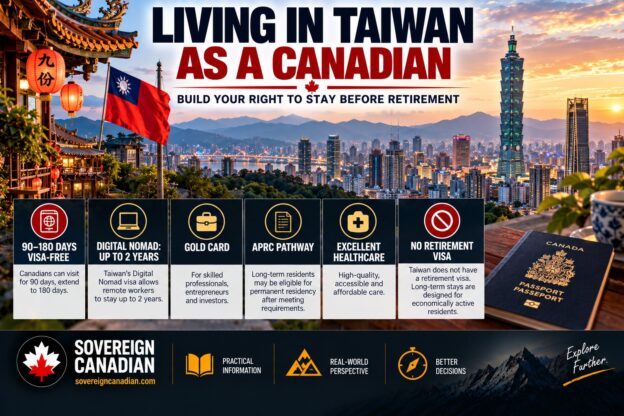
Visiting. Canadians get 90 days of visa-free entry, and — unusually, this is a real Canada-specific advantage — Canadian passport holders can apply to extend that stay to a total of 180 days. That’s a genuinely long runway for a serious look-around trip, but it’s still just a visit. It doesn’t create residence status or ordinary local work rights.
A temporary digital-nomad stay. Taiwan’s Digital Nomad Visitor Visa sits in this category. Under the current 2026 rules, it provides an initial stay of up to six months and can be extended in increments of up to six months, to a cumulative maximum stay of two years. Applicants must be working remotely by digital means without providing services to businesses or employers in Taiwan and meet the program’s eligibility requirements. For applicants relying on the income route, the current thresholds are broadly US$40,000 in annual income in either of the previous two years for someone 30 or older, or US$20,000 for someone aged 20–29.
There is an important 2026 change here that older guides will miss. Article 14 of Taiwan’s amended Act for the Recruitment and Employment of Foreign Professionals expressly allows the digital nomad to apply along with a spouse, minor children, and adult children who cannot care for themselves because of a physical or mental disability for the relevant visitor visas.
So the weakness of Taiwan’s Digital Nomad Visa is no longer that a family can’t accompany you. The distinction is more fundamental: this remains visitor status, not the same kind of residence status the Gold Card creates. It doesn’t put you automatically into Taiwan’s National Health Insurance, and it doesn’t itself build the same permanent-residence pathway. For someone wanting to test Taiwan for a year or two while maintaining a foreign remote income, that’s potentially excellent. For someone trying to establish a permanent legal base, it’s a different tool.
Ordinary work and investment-based residency. A standard employer-sponsored work permit and Alien Resident Certificate (ARC) is the conventional route — someone else has to want to hire you, and your status is tied much more closely to that employment relationship.
Entrepreneur and investor pathways exist too, and they’re genuinely distinct programs rather than interchangeable versions of the same thing. Taiwan’s ordinary Resident Visa for Investment requires proof of an approved investment of at least US$200,000. A separate Entrepreneur Visa has its own qualification and renewal criteria tied to startup investment, fundraising, incubators and subsequent business performance.
Then there is the much larger investment-immigration route associated with the Plum Blossom Card. That has two very different investment options: invest at least NT$15 million in a Taiwanese for-profit enterprise and create at least five jobs for Taiwanese nationals for three years, or invest NT$30 million in Taiwan central-government bonds for three years. The second is genuinely passive. The first emphatically isn’t.
Permanent residence. This is the strategic prize, and it’s worth understanding before we get to how you’d actually reach it.
The Gold Card Is the Route Worth Understanding Properly
If there’s one piece of Taiwan’s immigration architecture that changes the calculation for a Canadian professional, it’s the Employment Gold Card. It’s a combined work permit, resident visa, ARC and re-entry permit — one document, with no Taiwanese employer required to sponsor you.
The Gold Card currently covers twelve specified professional fields, including science and technology, economy, education, culture and arts, sport, finance, law, architectural design, national defence, digital, biotechnology and environment. Different fields have different qualification criteria.
But the cleanest, most legible path for a lot of Sovereign Canadian readers is the salary route available within qualifying fields: an average monthly salary of at least NT$160,000, documented from an annual tax statement from one of the three years preceding the application. Taiwan’s own Gold Card guidance explicitly names a Canadian T4 as acceptable proof.
For a Canadian earning somewhere in the CAD $150,000–$250,000 range, that threshold itself is very much within reach.
Here’s the qualifier that actually matters, and it’s the one thing I’d want every reader with a corporate structure to understand before assuming this route is open to them: salary means salary.
Taiwan’s Gold Card guidance explicitly says only income shown as salary on the tax statement counts for the salary test. Sole-proprietor income and dividend income don’t count. Freelance income only works where the relevant tax documentation actually characterizes it as salary.
If you’ve structured your Canadian income primarily through a personal corporation and pay yourself mostly in dividends — a common setup for exactly the kind of professional who might otherwise qualify — those dividends won’t simply substitute for salary.
That’s worth investigating well before you plan to apply, and it’s a genuinely cross-border question. Changing how a Canadian corporation pays its owner has Canadian tax and payroll consequences, while working from Taiwan can create entirely separate Taiwanese tax and corporate issues. Any restructuring should go through a cross-border tax advisor rather than being treated as a simple switch you flip to solve an immigration problem.
The alternative, for some applicants, is qualifying through one of the other professional criteria instead of relying on the salary test at all.
Once you clear whichever bar applies to you, the Gold Card gives you genuinely open work rights — you can change employers, freelance or work remotely — and qualifying family members can obtain dependent residence status. The card can be issued for one, two or three years and renewed.
None of that is contingent on remaining with one sponsoring employer, which is the single biggest practical advantage over an ordinary employer-tied work permit.
The Tax Break Everyone Talks About — and Why the Real Version Is More Interesting
A huge amount of Gold Card content online leads with the tax benefit, and much of it oversimplifies it into something close to “Gold Card holders don’t pay Taiwan tax on foreign income.”
That’s not quite what the law says.
For a qualifying foreign special professional approved to reside in Taiwan for work for the first time, Taiwan’s current tax rules provide a five-year window beginning with the first qualifying tax year in which the person resides in Taiwan for at least 183 days and earns more than NT$3 million in salary income.
During qualifying years:
- half of the salary income above NT$3 million can be excluded from gross income for Taiwan individual income-tax purposes; and
- qualifying overseas income that would ordinarily enter Taiwan’s Income Basic Tax calculation is excluded from basic income.
That second piece connects to a broader feature of Taiwan’s tax system that matters whether or not you ever touch the Gold Card.
Taiwan-source income is taxed under the regular individual income-tax system. Foreign-source income generally sits outside that ordinary progressive calculation but can be pulled into Taiwan’s separate Income Basic Tax regime.
For an individual filing household, foreign-source income becomes relevant when aggregate overseas income reaches NT$1 million. If it does, the full qualifying overseas amount enters the basic-income calculation rather than merely the amount above NT$1 million. The basic-income exemption is NT$7.5 million under the current rules. Basic tax is then calculated at 20% on the amount above that threshold, and additional tax is payable only to the extent the resulting basic tax exceeds ordinary income tax.
That’s materially different from saying Taiwan simply charges 20% on foreign income.
It’s also why the shorthand “Taiwan doesn’t tax foreign income” can look roughly true for many ordinary residents while still being legally incomplete.
The Gold Card benefit is particularly interesting to the smaller group of high-income residents with substantial overseas investment or business income who might otherwise be pulled into that basic-tax calculation.
The benefit is claimed through Taiwan’s annual tax filing process, so this is something to coordinate deliberately with a Taiwan accountant rather than assuming the Gold Card itself automatically changes your tax return.
Permanent Residence Is Where the Strategy Actually Pays Off
An Alien Permanent Resident Certificate (APRC) is the thing that changes the long-term equation.
Ordinary foreign residents generally face a five-year continuous-residence requirement, with at least 183 days of physical presence in each qualifying year, along with the other applicable APRC conditions.
Gold Card holders have an accelerated route. Under the current Gold Card APRC guidance, the normal Gold Card pathway can reach permanent residence after three years, subject to the applicable presence and other requirements.
There is also now a much faster high-income route. Gold Card holders whose domestic salary and income from professional practice in the most recent year reaches NT$6 million or more may be eligible to apply for permanent residence at the earliest after one year of residence.
Two qualifiers matter.
First, that’s a specific income definition — domestic salary and professional-practice income — not simply “I made NT$6 million somewhere in the world.”
Second, becoming eligible to apply after one year isn’t the same as automatic approval. The other applicable permanent-residence requirements still matter.
The strategic point isn’t the exact timeline.
It’s that once you’ve secured APRC, you’ve largely solved the problem that dominates the beginning of this article: needing a continuing economic reason to maintain your immigration status.
This is precisely why establishing residency while you’re still working can be so much more valuable than it first appears. It’s not just a few years’ head start. It’s potentially the difference between entering retirement with a permanent legal base already established and trying to construct one after the easiest professional doors have closed.
Can You Retire in Taiwan?
Start with the fact that actually organizes this entire question: Taiwan has no purpose-built retirement visa.
Unlike countries with dedicated retirement programs — show us your pension, show us your bank balance, meet the insurance rules, here’s your long-stay status — Taiwan simply doesn’t have an equivalent product.
I want to be careful about what that does and doesn’t mean, because it’s tempting to overstate it into something categorical the evidence doesn’t support.
It is not true that a 65-year-old Canadian has no realistic route to Taiwan.
What’s true is narrower and more useful: the problem isn’t age itself. It’s that someone who has already stopped working may have eliminated the easiest pathways available to an economically active professional.
A financially independent 65-year-old could still potentially qualify through a legitimate business or investment pathway, through marriage or family circumstances, or — depending on their background and continued professional activity — through another qualifying category.
But there is no simple “I have a comfortable net worth and a pension; please issue me a retirement residence permit” option.
This is the concrete reason the sequencing argument at the top of this article matters so much in practice.
Move at 45 while you can still qualify for the Gold Card, spend several years actually living there, and you may enter later life already holding APRC. At that point Taiwan’s retirement proposition is simply your proposition, with the entry-door problem already solved.
Wait until 65 to look at Taiwan for the first time, and you’re choosing among the remaining professional, business, investment and family pathways, with fewer of them naturally fitting someone who doesn’t intend to keep working.
Once the immigration question is actually resolved, the retirement case for Taiwan on the merits is genuinely strong.
Healthcare is a real asset. Transit in the major cities can make car ownership unnecessary. Violent crime is very low. Food and daily convenience are hard to overstate. And Taiwan’s position in East Asia puts Japan, South Korea and much of Southeast Asia within easy regional reach.
Where the evidence genuinely gets thinner is what happens once a retiree’s health and mobility decline substantially.
Taiwan’s cities contain plenty of older walk-up apartment buildings without elevators, while inconsistent sidewalks and heavy scooter traffic can complicate mobility. What I don’t have good enough evidence for, in either direction, is the depth and English-language accessibility of home nursing, assisted living and dementia care for an elderly foreign resident specifically.
That’s a real open question, not a settled negative. Taiwan may handle parts of this extremely well. The evidence I have isn’t strong enough to tell you that confidently.
Healthcare: A Real Asset, With One Important Asterisk
Taiwan’s National Health Insurance system covers almost the entire population and sits on top of a substantial hospital and specialist-care network. For a Canadian considering a long stay, the important part isn’t a global ranking. It’s how you actually enter the system.
For foreign residents holding qualifying residency documents, the National Health Insurance Administration draws an important distinction.
If you’re legally employed by a specific employer in Taiwan, you’re enrolled in NHI from the first day of employment.
If you’re a resident but aren’t employed in that way, you generally become eligible after six full months of qualifying residence in Taiwan, subject to the rules governing absences during that period.
That creates an important Gold Card nuance.
A Gold Card holder working purely remotely for a Canadian company with no Taiwan employment relationship shouldn’t assume that holding the Gold Card itself means immediate NHI enrollment. Depending on the employment arrangement, the six-month resident rule can matter.
That’s an easy assumption to make and get wrong, and it’s a reason to arrange appropriate private medical coverage for the gap if it applies to you.
Once you’re enrolled, specific premiums and co-payments depend on the situation and can change. I’d check those directly against the National Health Insurance Administration when actually planning a move rather than freezing today’s fee schedule into a long-lived article.
The more interesting practical distinction is that good healthcare infrastructure and an effortless English-language healthcare experience are not the same thing.
Taipei has the country’s deepest internationally oriented medical ecosystem. Major hospitals in Taichung and Kaohsiung also operate at a high level, but the further you move from institutions accustomed to international patients, the more likely language becomes the source of friction rather than medicine itself.
That’s manageable. Plenty of foreign residents manage it.
It’s just different from assuming “excellent healthcare” means every interaction will function in English.
What Does Taiwan Actually Cost?
The honest answer is that Taiwan can be simultaneously inexpensive and expensive depending on which version of life you’re buying.
Treat the figures below as illustrative ranges rather than a precise household budget. Rents vary dramatically by neighbourhood and building quality, the underlying cost-of-living data isn’t as authoritative as the legal and tax sources in this article, and currency conversions move.
For daily life — eating out, local transport, mobile service and many routine services — Taiwan can be substantially cheaper than Toronto or Vancouver.
Housing is where the story starts to split.
A single professional renting a reasonably central one-bedroom apartment in Taipei can realistically find themselves somewhere around CAD $1,000–$2,000 a month for rent, depending heavily on building age, quality and location. An illustrative comfortable all-in monthly budget might land around CAD $2,300–$3,400.
That’s a real saving against Toronto or Vancouver, but it’s not the dramatic gap the phrase “Taiwan is cheap” implies once you’re specifically talking about newer or higher-quality central Taipei housing.
Move the same lifestyle to Taichung, Kaohsiung or Tainan and housing generally becomes considerably cheaper, while many of the daily costs that make Taiwan attractive remain low.
Then there’s the number that can undo the entire affordability story.
Taipei American School publishes 2026–27 tuition of NT$956,770 a year for pre-Kindergarten through Grade 5 and NT$1,055,105 for Grades 6 through 12.
At a representative exchange rate, that’s roughly CAD $42,000–$47,000 per child per year.
And tuition isn’t the whole first-year number. TAS also charges a one-time NT$350,000 capital fee for a newly enrolled student, plus a building fee and other applicable expenses.
TAS is Taiwan’s flagship international school, and its price should be read that way. It isn’t representative of every international-school option, and it certainly isn’t the unavoidable cost of raising a child in Taiwan.
But if a family specifically wants that flagship international-school experience, two children can easily mean something approaching CAD $90,000 a year in tuition alone, with substantially higher first-year costs once the one-time capital fees arrive.
That’s enough to overwhelm most of the savings created by cheaper restaurants, transit and groceries.
Put a single professional, a couple and a family with two children in a flagship international school side by side, and you can get three completely different answers to whether Taiwan is affordable — all of them describing the same country.
Housing: Why Taipei Can Feel Like Poor Value
There’s a genuine disconnect in Taipei between how wealthy and sophisticated the city obviously is and how old a lot of its housing stock can feel.
Walk-up apartment buildings without elevators are common even in desirable central neighbourhoods. Exterior tile and concrete buildings can look considerably older than their Canadian price equivalent, while the building envelope is designed for a subtropical climate rather than Canadian expectations around insulation and heating.
None of that makes Taipei housing bad.
It does mean that “expensive” and “new, large and luxurious” don’t automatically travel together the way a Canadian buyer might expect.
On ownership, Canadians have a meaningful advantage. Taiwan’s official reciprocal-country list classifies Canada, across its provinces, as fully reciprocal for purposes of foreigners acquiring land rights in Taiwan.
So Canadians can acquire qualifying Taiwanese real estate subject to Taiwan’s restrictions and approval requirements.
But here’s the sentence worth sitting with before getting excited about that:
Owning property in Taiwan does not create residency.
The two are separate legal questions. Buying an apartment doesn’t move you an inch closer to a Gold Card, ARC or APRC.
For most newcomers, renting is also the more defensible starting point independent of immigration.
Taiwan taxes short-term house-and-land gains aggressively. Under the current rules, a Taiwan non-resident selling qualifying house and land held for no more than two years faces a 45% tax rate on the applicable taxable transaction income; after two years, the non-resident rate is 35%. Residents have a more graduated holding-period schedule, starting at the same 45% for property held no more than two years and falling with longer holding periods.
That’s tax on the applicable transaction income, not 45% of the gross sale price, but it’s still enough to make short-term flipping an unattractive strategy.
None of that rules out buying for the right long-horizon owner. It simply deserves a dedicated Taiwan real-estate analysis rather than being treated as an automatic next step after deciding you like Taipei.
Where Should You Live?
Taiwan is not one city with some suburbs attached, and the right answer depends heavily on what’s actually fixing you in place — a job, a school, a professional network, or nothing at all.
Taipei has, by a wide margin, the country’s most developed ecosystem for a foreign newcomer: the deepest international-school options, the strongest English-language healthcare infrastructure, the densest transit network, and the greatest concentration of multinational and professional employment.
It’s also where the housing cost and older-building issues above concentrate most heavily.
For a family that needs a particular international school, or a professional whose career is Taipei-centric, Taipei can become the default — not because it’s intrinsically the “best” city, but because the infrastructure that particular newcomer needs exists disproportionately there.
New Taipei City isn’t a distant suburb so much as the enormous municipality surrounding Taipei proper. MRT-connected districts can function as cost-saving extensions of the same metropolitan living system; further-out districts increasingly trade housing cost for commute time.
Hsinchu is Taiwan’s semiconductor and technology powerhouse, anchored by Hsinchu Science Park and the wider semiconductor ecosystem. If your profession and employer are specifically tied to that industry, Hsinchu has an obvious reason to exist on your shortlist. Without that anchor, it isn’t automatically a general-purpose substitute for Taipei.
Taichung gets marketed constantly as Taiwan’s “balanced middle option”: meaningfully lower housing costs than Taipei, central geography and high-speed rail connections in both directions. That reputation is plausible, but “balanced” is ultimately subjective. The more defensible differences are the actual ones — housing, climate, urban form and a smaller international ecosystem.
Tainan offers lower costs, deep history and one of Taiwan’s strongest food cultures, alongside a hotter climate and a daily transportation environment that relies more heavily on scooters and cars than Taipei.
Kaohsiung has its own MRT and light-rail network, major-city infrastructure and a substantially different cost equation from Taipei. It becomes particularly interesting for someone whose income isn’t tied to Taipei’s labour market. A remote professional or financially independent APRC holder has less reason to pay Taipei’s premium than someone building a local career there.
The east coast — particularly Hualien and Taitung — makes the strongest scenery and slower-lifestyle case, but the trade is thinner employment, healthcare and international-school infrastructure plus greater exposure to some natural hazards. It makes more sense once you’ve already solved the practical questions than as the automatic first place to land.
None of these cities is objectively “best.”
They solve different constraints for different people.
Working in Taiwan vs. Bringing Your Income With You
One distinction is easy to lose in all of this: Taiwan’s affordability looks completely different depending on whether you’re earning Taiwanese money or bringing Canadian or other foreign professional income with you.
Local professional salaries in many sectors sit well below what an equivalent senior Canadian role would pay, even after accounting for Taiwan’s lower cost structure. The technology and semiconductor ecosystem is the obvious exception where Taiwan has unusually deep, high-value professional opportunities of its own.
This is part of why the Gold Card’s NT$160,000 salary criterion can be relatively accessible to an established Canadian professional while still sitting well above ordinary Taiwanese earnings.
The economics of “is Taiwan affordable for me?” therefore depend enormously on where the income originates.
A Canadian earning a Canadian senior-professional salary remotely and spending in New Taiwan dollars is solving a very different equation from someone arriving first and looking for an ordinary local job.
Taiwan With Children
For a family, schooling has a way of becoming the fixed point the entire map gets drawn around — a pattern that also shows up in my guide to living in Japan as a Canadian.
A Gold Card holder’s spouse and qualifying children can obtain dependent residence status. Under the revised 2026 law, a digital nomad can also apply together with a spouse and qualifying children for the corresponding visitor visas.
The difference is therefore not simply “one visa permits the family and the other doesn’t.”
It’s the underlying status.
The Gold Card is a residence and open-work framework that can form part of a long-term path toward permanent residence. The Digital Nomad Visa remains a temporary visitor framework for remote work, even though the family can now accompany the principal applicant under the amended rules.
From there, the family decision becomes public/local school versus international school.
Taiwanese public education can potentially be part of the solution for a legally resident foreign family, particularly one deliberately seeking Mandarin immersion, but the exact admissions, catchment, tuition and language-support arrangements are details I’d confirm with the relevant local education authority for the specific child and municipality rather than generalizing nationally.
International school solves much of the language and curriculum problem but can create a financial one instead.
And once you choose a particular school, it can effectively choose your neighbourhood for you.
Do You Need Mandarin?
Two clichés dominate this question, and neither is quite right:
“Everyone speaks English.”
“You can’t live there without Mandarin.”
The more useful frame is a gradient.
In central Taipei, on major transit systems, throughout much of the Gold Card process and at internationally oriented businesses, English can get you surprisingly far. Taiwan’s government-run English immigration resources are also considerably better than what you’ll find in many otherwise developed countries.
But landlords, tradespeople, smaller medical clinics, banking, local bureaucracy and life outside the most international parts of the major cities increasingly reward Mandarin.
And the reward compounds the deeper you want to integrate rather than simply function.
The useful question isn’t whether you can survive in Taiwan without Mandarin.
You can.
It’s at what point, for the specific life you’re trying to build, Mandarin stops being a convenience and starts becoming infrastructure.
Taiwan Is Very Safe — Except That Road Safety Deserves Its Own Conversation
Start with what’s genuinely true: ordinary personal security in Taiwan is strong, and Canada’s current travel guidance remains at its baseline level of take normal security precautions.
Now the part that generic expat content often gives much less attention.
Taiwan’s Ministry of Transportation and Communications recorded 2,950 road-traffic deaths in 2024 using its 30-day fatality measure. Pedestrian deaths alone were 366.
Motorcycles and scooters are particularly important to the risk picture. Transportation data cited by Taiwanese road-safety organizations put motorcycle-rider deaths at 1,858 in 2024 — more than 60% of the country’s total road deaths.
The point isn’t that Taiwan is broadly “dangerous.”
It’s that the word safe is doing too much work if it only describes crime.
A Canadian can reasonably feel extremely comfortable walking around Taipei late at night while simultaneously encountering a more demanding road environment than they’re accustomed to at home.
Those two things aren’t contradictory.
A serious relocation decision should hold both of them at once.
Earthquakes and Typhoons
The useful story about Taiwan and earthquakes isn’t simply that Taiwan has earthquakes. Obviously it does.
The April 2024 earthquake near Hualien was magnitude 7.4 according to the USGS and the strongest earthquake to hit the area in roughly 25 years. The 1999 Chi-Chi earthquake, also a major event, killed more than 2,000 people.
It would be too simplistic to compare the death tolls and credit the entire difference to building codes. The earthquakes differed in location, exposure and other important ways.
What is documented is that Taiwan substantially revised its seismic design requirements following the 1999 earthquake. Taiwan’s Central Weather Administration specifically notes the post-Chi-Chi revision of earthquake-resistant construction design standards, and Taiwan has continued to invest in assessment and reinforcement of vulnerable older structures.
That turns into a practical due-diligence question.
When you’re evaluating a particular building, its age, structural system, condition and any seismic assessment or retrofit history matter. A post-1999 building isn’t automatically safe and an older building isn’t automatically dangerous, but the building’s code era is a legitimate question to investigate before signing a long lease or buying.
Typhoons are the other recurring natural hazard. Their effect varies substantially by storm track and location, which is another reason not to treat “Taiwan climate” as one national experience when comparing Taipei, the south and the east coast.
What About China?
I’m going to be deliberately restrained here, because most coverage of this question is not.
I’m not going to predict what happens across the Taiwan Strait or assign a probability to a future conflict.
Here’s what’s actually documented.
As of the latest check for this article, the Government of Canada’s travel advice for Taiwan remains at take normal security precautions.
That is a statement about Canada’s current travel-advisory posture. It is not a forecast of future cross-Strait events.
Taiwan also conducts civil-defence and air-defence exercises that can affect people physically present in the country. Residents and visitors should follow local instructions when those exercises occur.
The useful framework is to keep three different kinds of risk separate.
Taiwan has low ordinary violent-crime risk.
It has a meaningful chronic road-safety risk.
And it has a potentially severe geopolitical tail risk associated with its position across the Taiwan Strait.
Those aren’t the same problem and shouldn’t be collapsed into a single verdict that Taiwan is either “safe” or “unsafe.”
What follows from that doesn’t need to be dramatic. Keeping passports current, using Canada’s registration service when appropriate, maintaining access to financial institutions outside Taiwan, and avoiding unnecessary concentration of your entire net worth in a single foreign jurisdiction are ordinary cross-border risk-management measures.
That’s my analytical view, not Taiwan-specific advice from the Canadian government.
Taxes for a Canadian Living in Taiwan
Taiwan’s tax architecture has one genuinely unusual feature worth understanding separately from the Gold Card incentive.
Spend at least 183 days in Taiwan during a tax year and you’re generally treated as a Taiwan tax resident. Taiwan-source income is taxed under its progressive individual income-tax system.
Foreign-source income works differently.
For Taiwan residents, qualifying overseas income can enter the separate Income Basic Tax regime. Aggregate overseas income below NT$1 million can be excluded from basic income. Once the overseas-income amount reaches that threshold, the relevant overseas income is included in the basic-income calculation.
The current basic-income exemption is NT$7.5 million, and basic tax is calculated at 20% on the amount above that threshold. Additional basic tax is payable only where that calculation exceeds regular income tax, with foreign-tax-credit rules potentially relevant where tax has already been paid abroad.
That’s why “Taiwan doesn’t tax foreign income” is directionally useful for some ordinary households and still too crude to rely on as tax advice.
Becoming a Taiwan resident does not automatically mean you’ve left Canada for tax purposes
This is the Canadian half of the equation, and it’s important enough not to bury.
Getting a Taiwanese Gold Card, ARC or even establishing a home in Taiwan does not, by itself, make you a non-resident of Canada for Canadian income-tax purposes.
Canada looks at your actual residential ties — particularly a home, spouse or common-law partner and dependants remaining in Canada, along with secondary ties and the overall facts.
If you’re considering an actual departure rather than simply a year or two abroad, I’ve covered that separately in The Residency Flag: How Canadian Tax Residency Actually Works. A genuine departure can also trigger Canada’s deemed-disposition or departure-tax rules on certain assets.
That’s a separate decision from Taiwanese immigration residency, and the two shouldn’t be conflated.
The Canada–Taiwan tax Arrangement
Canada and Taiwan don’t have a conventional government-to-government income-tax treaty.
Instead, the Canadian Trade Office in Taipei and the Taipei Economic and Cultural Office in Canada entered into a bilateral Arrangement for the Avoidance of Double Taxation and the Prevention of Fiscal Evasion, effective since 2016.
The diplomatic label is unusual. Functionally, the Arrangement performs many of the jobs Canadians normally expect a tax treaty to perform, including rules for withholding on dividends, interest, royalties and pensions.
For periodic pension payments arising in one territory and paid to a resident of the other, the source-territory tax is limited to the lesser of:
- 15% of the gross periodic pension payment; or
- the amount the recipient would otherwise be required to pay on the year’s total periodic pension payments under the Arrangement’s notional-resident calculation.
Canada’s current international-benefits table accordingly lists Taiwan at 15% for CPP/QPP and OAS, while other Canadian pension payments are generally shown at 25% absent a lower applicable periodic-pension treatment.
RRSP and RRIF planning gets more technical because Canadian law distinguishes periodic pension payments from lump-sum or certain larger withdrawals. Don’t assume every withdrawal from a registered retirement account automatically receives the same 15% treatment.
For someone genuinely planning retirement in Taiwan, this is an area worth modelling with the actual planned withdrawal schedule rather than applying one treaty rate to the entire RRSP.
Canada and Taiwan do not have a social-security totalization agreement
This is separate from the income-tax Arrangement.
Canada’s current official list of international social-security agreements includes countries such as Japan and South Korea but does not include Taiwan.
That means someone splitting a working career between the Canadian and Taiwanese systems shouldn’t assume contribution periods can be combined under a Canada–Taiwan totalization agreement.
The precise Taiwanese pension entitlement still depends on Taiwan’s domestic rules. The useful Canadian-side point is simply that there is no bilateral social-security agreement doing the aggregation work for you.
What happens to your TFSA?
On the Canadian side, the rule is straightforward.
You can keep an existing TFSA after becoming a Canadian non-resident, and Canada continues to exempt the account’s income and withdrawals. But if you’re a non-resident for an entire calendar year, you don’t receive the normal annual TFSA dollar limit for that year, and contributions made while non-resident can attract a 1% Canadian tax for every month the non-resident contribution remains in the account.
The Taiwan side is more interesting and less certain.
What’s confirmed is Taiwan’s general foreign-source-income architecture described above.
The reasonable inference is that foreign investment income generated inside a Canadian TFSA may receive considerably more favourable treatment in Taiwan than it would in countries that simply ignore the TFSA wrapper and tax its investment income annually.
But Taiwan doesn’t recognize a “TFSA” merely because Canada calls it one, and I would not tell a reader that a TFSA definitely remains tax-free in Taiwan.
Exactly when particular gains, distributions or withdrawals constitute Taiwan-reportable overseas income — and how the Income Basic Tax thresholds interact with a large account — is something I’d confirm with a Taiwan-side tax professional before relying on the favourable interpretation.
The same caution applies even more strongly to RESP and FHSA treatment.
Canadian corporations need their own analysis
If you’re running income through a Canadian corporation while physically living and working in Taiwan, get advice before you move rather than after.
Where corporate decisions are actually made, whether the activities create a taxable presence in Taiwan, payroll obligations, source-of-income rules and the interaction with your own compensation can all matter.
It’s also worth repeating the immigration point: dividends from that corporation don’t satisfy the Gold Card’s NT$160,000 salary test simply because they’re money coming from your business.
This is exactly the kind of interaction the broader Flag Theory for Canadians framework is meant to expose: where you live, where your business sits, where income is earned and where assets are held are related questions, but they aren’t the same question.
Taiwan at Different Life Stages
| Who You Are | What Makes Taiwan Work | Main Constraint |
|---|---|---|
| 20s worker or remote worker | Affordability, work and remote-work pathways | Local salaries can make the economics very different from bringing foreign income |
| High-income professional, 30s–40s | Gold Card, open work rights, accelerated APRC pathway | Whether you actually meet a qualifying professional category |
| Family with children | Safety, healthcare, convenience, family residence options | International-school costs can radically alter the budget |
| Entrepreneur | Entrepreneur or investor residence routes | The business has to satisfy real immigration and operating requirements |
| 55-year-old semi-retiree | Time to establish permanent status before fully stepping back | Maintaining a qualifying professional or business pathway |
| New 65-year-old retiree, no prior ties | Excellent lifestyle fundamentals once status is solved | No purpose-built retirement visa |
| Established APRC holder | Immigration problem largely solved | Ageing-in-place infrastructure becomes more important |
| Elderly resident with reduced mobility | Strong medical infrastructure | Older buildings, street conditions and uncertain foreigner-oriented elder care |
The table isn’t a ranking.
It’s a way of seeing that “is Taiwan good for retirement?” and “is Taiwan good for a 38-year-old engineer?” are structurally almost different questions wearing the same name.
Taiwan vs. Japan and Southeast Asia
This isn’t meant to be a full comparison piece — I’ve covered living in Japan as a Canadian separately, and this is deliberately the short version.
Against Japan, Taiwan’s skilled-professional immigration mechanics are comparable rather than obviously better or worse. Japan’s Highly Skilled Professional system can also accelerate permanent residence substantially for applicants who clear its points thresholds. Taiwan’s Gold Card uses a different qualification architecture, which means the same Canadian can fit one system much more naturally than the other.
The tax systems also differ materially, particularly around foreign-source income, while Japan has a notably stronger road-safety record and a dramatically larger range of cities and housing markets to choose from.
Against Thailand and Malaysia, the structural difference is the one this whole article has been circling: those countries offer explicit retirement-oriented immigration pathways. Taiwan doesn’t.
Taiwan’s case has to be made instead on institutions, healthcare, infrastructure, professional immigration and the possibility of establishing permanent residence before retirement.
That’s a genuinely strong case.
It’s just not the same case.
What I’d Actually Do
If I were a Canadian professional in my late 30s or 40s with a genuine long-term interest in eventually living in Taiwan — including possibly retiring there — I wouldn’t wait until retirement to investigate the immigration side.
I’d check whether my professional background and income qualify for a Gold Card today. If a corporate compensation structure made the salary route problematic, I’d get cross-border advice before changing anything and determine whether another Gold Card qualification fits instead.
And if I actually moved, I’d treat permanent residence as a deliberate objective rather than something to think about years later.
The value of that isn’t really the Gold Card tax break.
It’s removing an entire category of later-life uncertainty while you still have the professional tools to remove it.
If I were already retired, or close to it, with no prior Taiwan connection, I’d stop treating “I can afford to live there” and “I have a legal right to live there” as the same question.
I’d look honestly at whether a legitimate investment, business, professional or family pathway was available. If none was, I’d treat Taiwan as an extraordinary place to spend extended time as a visitor rather than assuming financial independence alone creates a relocation pathway.
If I were still genuinely working remotely, the Digital Nomad Visa could now provide a much longer test — including for a qualifying accompanying family — but a remote-work visitor visa still isn’t the same thing as permanent residence.
And if I had children, I’d run the international-school number before I ran almost anything else.
It’s the single line item in this entire analysis capable of quietly overwhelming most of Taiwan’s other cost advantages.
The Bottom Line
Is Taiwan actually a good place for a Canadian to live?
That was never going to have a clean yes-or-no answer, and by now it should be clear why.
A professional moving in their 30s or 40s can potentially use Taiwan’s immigration system exactly as it was designed to be used — building permanent status while still economically active and turning that into an open-ended later life on the island if they want one.
A family can access remarkable safety, healthcare and daily convenience, and then discover that one line item — international school — can erase much of the cost advantage the rest of the move delivered.
A financially independent professional might find Kaohsiung or Taichung remarkably affordable, only to discover that financial independence on its own doesn’t open an immigration door.
And a Canadian encountering Taiwan for the first time after retirement may find that having the money to live there and having the legal right to live there are two completely different questions.
Taiwan isn’t difficult because it’s unwelcoming to foreigners. Its immigration system contains some remarkably attractive pathways for the people it is deliberately trying to recruit.
The catch is that many of those pathways are easiest to use while you’re still economically active.
If Taiwan is genuinely part of your retirement plan, the most important decision you make about it might not happen when you retire.
It might need to happen years before.
This article is for general informational purposes and reflects research current as of October 2026. It is not immigration, tax, investment or legal advice, and Taiwan’s visa, tax and residency rules can change. Anyone seriously considering a move should confirm current requirements directly with Taiwan’s National Immigration Agency, Gold Card Office, tax authorities or a qualified cross-border professional before making decisions — particularly where Canadian corporate structures, registered accounts or permanent emigration are involved.