
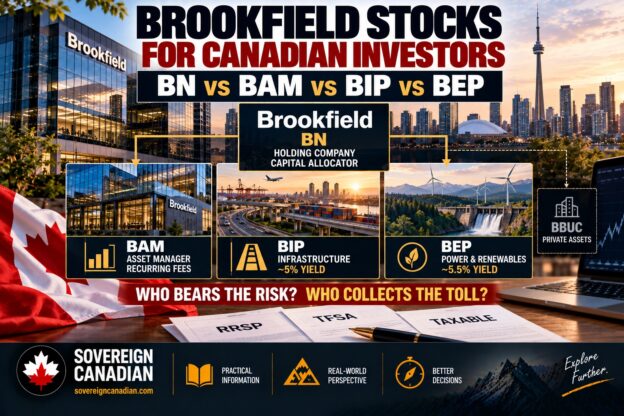
A Canadian investor who likes Brookfield can buy Brookfield Corporation, Brookfield Asset Management, Brookfield Infrastructure, Brookfield Renewable or Brookfield Business Corporation. On a brokerage screen that looks like a choice between five companies.
It isn’t.
It’s a choice about where you want to sit inside one capital-allocation system, and who gets paid first.
Here’s the short version. Brookfield Corporation (BN) owns about 74% of Brookfield Asset Management (BAM), the manager. BAM collects fees for running capital, including capital invested through Brookfield’s listed vehicles. Brookfield Infrastructure (BIP), Brookfield Renewable (BEP) and Brookfield Business Corporation (BBUC) own operating assets and carry much more of the financing, construction and operating risk.
BN sits above most of that. It owns most of BAM, substantial stakes in the operating vehicles, a large insurance business, real estate, direct fund investments and carried interest from Brookfield’s private funds.
That’s the organizing idea of this article.
Same sponsor. Very different economics. And each security answers a different question about who bears the risk and who collects the toll.
Now the hook.
On October 2, BN closed at about US$36.92. At its September Investor Day, Brookfield put its own “plan value” for the company at roughly US$67 a share.
You could stop there and call BN 45% undervalued.
I’m not going to, because a 45% discount isn’t automatically an opportunity. Sometimes the market simply doesn’t believe the NAV.
The more interesting number is this one.
Brookfield’s Q2 supplemental valued BN’s stake in BAM at about US$51.5 billion after financing against the position. On Brookfield’s own fully diluted share count, BN’s market value at the October 2 close is roughly US$87 billion.
So close to 60% of BN’s entire market value is represented by its stake in one publicly traded company whose price we can see every afternoon.
The rest of the price has to cover Brookfield’s insurance business, real estate, direct investments, stakes in BIP, BEP and BBUC, carried interest and corporate debt.
That’s where this gets interesting.
Is BN genuinely cheap, or is the market correctly refusing to accept Brookfield’s private-market valuations?
That question runs through everything below, alongside another one: why own any Brookfield security instead of simply buying a broad-market ETF?
I won’t assume Brookfield wins either one.
Brookfield is not one stock
Here is the basic structure as of early October 2026. Ownership figures come primarily from BN’s Q2 reporting and include BN and its insurance business where applicable.
| Ticker | What it is | What you’re buying | Brookfield’s stake |
|---|---|---|---|
| BN | Holding company / capital allocator | Manager, insurer, real estate, investments, carry | Parent |
| BAM | Asset manager | Fees on about US$672B of fee-bearing capital | ~74% |
| BIP / BIPC | Infrastructure owner | Utilities, transport, midstream, data | ~26% |
| BEP / BEPC | Power owner | Hydro, wind, solar, storage, nuclear services | ~45% |
| BBUC | Operating businesses / private equity | Industrial and service companies | ~69% |
There are also different wrappers.
BIPC and BEPC are Canadian-corporation versions designed to provide substantially equivalent economic exposure to BIP and BEP respectively. Brookfield is now proposing to simplify both structures further by combining each partnership/corporation pair into a single Canadian corporation.
BBU and the old BBUC have already gone through that process. They combined in March 2026, leaving BBUC as the publicly traded corporate vehicle.
The wrappers matter for tax reporting.
They don’t fundamentally change what the underlying businesses do.
How the Brookfield machine actually makes money
Follow the money.
Pension funds, sovereign wealth funds, insurers, institutions and increasingly wealthy individual investors commit capital to Brookfield. Brookfield deploys that money into infrastructure, power, real estate, private equity and credit.
Those investments eventually own real things: hydroelectric dams, toll roads, pipelines, data centres, utilities, industrial businesses, office towers and nuclear-service companies.
BAM sits in the middle and gets paid to manage the capital.
It earns management fees and other fee-related earnings, plus performance income as funds mature. Over the twelve months through June 2026, BAM generated roughly US$3.2 billion of fee-related earnings while managing about US$672 billion of fee-bearing capital.
That’s the attractive part of the model.
BAM doesn’t need US$672 billion of its own money to earn fees on US$672 billion.
BIP, BEP and BBUC sit on the other side of the arrangement. They own businesses and assets. That means they get the operating cash flows, but they also take far more of the capital requirements, refinancing risk, development risk and operating risk.
And they pay the manager.
Brookfield Infrastructure’s Q2 supplemental, for example, shows substantial management fees and incentive distributions flowing back through the Brookfield system.
BN sits above much of this.
It owns about 74% of BAM, substantial stakes in the listed affiliates, Brookfield Wealth Solutions, real estate, direct fund investments and carried interest.
This creates alignment and conflict at the same time.
The alignment: Brookfield invests large amounts of its own capital alongside clients, and BN buys back its own stock when management believes it is undervalued.
The conflict: Brookfield can simultaneously be manager, major shareholder, counterparty and source of capital.
That distinction became particularly visible in BAM’s second quarter.
BAM raised a record US$77 billion, but its own Q2 supplemental shows US$51.4 billion came through credit, including US$44.8 billion from Brookfield Wealth Solutions. That included the US$40 billion mandate associated with Just Group.
That isn’t improper.
It does mean some of Brookfield’s fundraising growth consists of one part of Brookfield providing capital for another part of Brookfield to manage.
That’s different from US$45 billion of unrelated institutions independently deciding to hand BAM new money.
None of this is a scandal.
It’s structure.
And if I’m going to own Brookfield, I want to understand whose pocket each dollar is coming from.
BN: buying the whole machine
I’ll spend the most time here because BN presents the central Brookfield question:
If I think Brookfield is an exceptional capital allocator, why shouldn’t I just own the parent?
What’s inside BN
Brookfield reports three main economic engines.
According to its Q2 supplemental:
Asset Management generated about US$740 million of distributable earnings in the quarter and roughly US$2.9 billion over the preceding twelve months.
Wealth Solutions, Brookfield’s insurance and retirement business, generated about US$480 million in the quarter and roughly US$1.8 billion over twelve months. Insurance assets reached about US$191 billion following the Just Group acquisition.
Operating Businesses, which include Brookfield’s interests in infrastructure, renewable power, private equity and real estate, generated about US$361 million in the quarter and roughly US$1.5 billion over twelve months.
After corporate costs, distributable earnings before realizations were approximately US$5.7 billion, or US$2.39 per share, over the last twelve months.
Including realized carried interest and other gains, total distributable earnings were about US$6.2 billion, or US$2.61 per share.
I prefer the before-realizations figure for valuation.
Selling an asset is part of Brookfield’s business model, but realized gains and carry arrive unevenly. I want to know what the underlying machine is earning before assuming a particular year of asset sales will repeat.
BN also pays a very small dividend. The quarterly dividend is US$0.07, or US$0.28 annually.
At a share price around US$37, that’s well under 1%.
BN isn’t an income stock. Brookfield keeps most of its cash and reallocates it.
It has also been buying its own shares. Brookfield reports roughly US$695 million of repurchases over the preceding twelve months, including about US$580 million during 2026 at an average price near US$42.
The fact that today’s share price is lower doesn’t make those purchases look brilliant in hindsight.
But buybacks below management’s estimate of value are exactly what I’d want BN doing if that estimate is credible.
Brookfield’s debt is large, but the location matters
Look at Brookfield’s consolidated balance sheet and the debt number is enormous.
That isn’t the useful number by itself.
Brookfield’s Q2 supplemental shows about US$14.7 billion of corporate borrowings, compared with more than US$250 billion of subsidiary and property-specific non-recourse borrowings inside the entities it consolidates.
Brookfield says only about 6% of total leverage has recourse to BN.
That distinction matters.
If a leveraged property or infrastructure asset fails, lenders generally cannot simply move up the structure and claim unrelated Brookfield assets.
But “non-recourse” doesn’t mean harmless.
The equity invested in the failed asset can still be destroyed.
Non-recourse debt limits how far a problem spreads. It doesn’t make leverage disappear.
The BN valuation puzzle
This is the part of the Brookfield thesis I find most interesting.
Brookfield’s “plan value” is not audited NAV.
It isn’t an objective appraisal of intrinsic value either.
It’s management’s estimate, combining observable market values with Brookfield’s own valuation methods.
At June 30, that number was US$66.64 per share, down from US$68.08 at the end of 2025.
Brookfield’s 2026 Investor Day presentation breaks the value into roughly these pieces:
| Piece | Approximate value |
|---|---|
| Listed holdings, including BAM, BIP, BEP and BBUC | US$73B |
| Direct fund investments | US$11B |
| Carried interest | US$34B |
| Wealth Solutions | US$30B |
| Real estate | US$28B |
| Debt and preferred shares | -US$18B |
| Plan value | ~US$158B / ~US$67 per share |
The listed securities are easy.
They have market prices.
The private holdings are where judgment enters.
So I tried looking at the valuation backwards.
At US$36.92, using Brookfield’s fully diluted share count, BN’s market value is roughly US$87 billion.
Brookfield’s listed holdings were worth around US$73 billion at June 30. Deduct roughly US$18 billion of debt and preferred shares and, very approximately, the market is leaving only about US$32–35 billion for private assets Brookfield values at around US$103 billion.
In other words, the market is valuing that private side at roughly a third of Brookfield’s marks.
Now make the calculation harsher.
Throw out Brookfield’s entire US$34 billion carried-interest value.
The remaining private holdings are worth roughly US$69 billion under Brookfield’s assumptions.
The market-implied value is still only around half of that.
That’s why BN interests me.
The market doesn’t require Brookfield to be precisely right for there to be value here.
It does, however, require Brookfield to be directionally right.
Why the market might be right about BN
A big discount doesn’t automatically mean the market is making a mistake.
Carried interest deserves a discount
Of Brookfield’s roughly US$34 billion of carried-interest plan value, approximately US$27 billion represents a multiple on target future carry, while roughly another US$7 billion represents accumulated unrealized carry net of costs.
That is not the same thing as US$34 billion sitting in cash.
Brookfield’s Investor Day materials show a major increase in expected carry realization over the coming decade compared with the last one.
Maybe it happens.
But I would absolutely discount an estimate of future performance fees more heavily than a publicly traded shareholding.
The growth plan is ambitious
Brookfield’s plan takes value from roughly US$67 today to US$140 per share by 2031.
Brookfield itself describes that path as illustrative.
It assumes strong growth from BAM, Wealth Solutions and the rest of the organization.
If it happens, the current share price will look extremely cheap.
But the US$140 is a management target, not an independent valuation.
Real estate is still a private mark
Brookfield puts roughly US$28 billion of value on its real estate.
Private real estate can be genuinely valuable while still appearing less volatile than it really is because appraisal and model-based valuations adjust more slowly than public markets.
That’s the same issue I examined in Private REITs and Real Estate Syndicates in Canada.
A smooth valuation isn’t necessarily a safe valuation.
Insurance introduces another valuation layer
Brookfield values Wealth Solutions at around US$30 billion using a multiple of annualized earnings.
The business is increasingly important to BN, and its investment portfolio is heavily exposed to public and private credit.
That’s potentially a very good business.
It’s also another piece of BN whose value cannot be checked on a public exchange.
Realization matters
Ultimately, private value becomes much more convincing when it turns into cash.
That’s the line I keep coming back to:
The discount is real. Whether all of Brookfield’s stated value is real is the investment question.
BN is cheap relative to Brookfield’s marks.
It isn’t necessarily cheap relative to what every asset would fetch tomorrow.
BAM: possibly the best business, but is it the best stock?
BAM has the cleanest business model in the family.
Its second-quarter results showed:
- US$672 billion of fee-bearing capital, up 19% year over year.
- US$808 million of quarterly fee-related earnings, up 20%.
- About US$3.2 billion of fee-related earnings over twelve months.
- Quarterly distributable earnings of US$707 million, up 15%.
- US$163 billion of fundraising over twelve months.
- A record US$77 billion raised in Q2.
BAM also says 95% of its fee revenue comes from long-term or perpetual capital.
That’s important.
The more capital is locked up for long periods, the less exposed BAM is to investors simply demanding their money back during a bad quarter.
The attraction is straightforward.
BAM earns fees on enormous amounts of capital without needing to supply most of that capital itself.
That’s a much less capital-intensive model than owning power plants, pipelines and railroads.
BAM’s problem is price
At the October 2 close of about US$44.85, BAM trades around 23 times trailing fee-related earnings and roughly 26 times trailing distributable earnings.
That’s not absurd for a high-quality asset-light business growing earnings at a double-digit rate.
It also isn’t obviously cheap.
The market understands that BAM is the cleanest business in the Brookfield family.
You’re paying for that knowledge.
BAM’s dividend is different from BN’s
BAM pays US$0.5025 quarterly, or about US$2.01 annually.
At US$44.85, that’s a yield around 4.5%.
That looks unusually high for a growing asset manager, particularly because trailing distributable earnings were below the annualized dividend.
But Brookfield explicitly targets a payout of roughly 90% or more of distributable earnings. BAM is designed to distribute most of what it earns rather than retaining huge amounts of capital.
The current dividend therefore depends on earnings continuing to grow.
If DE stalls, coverage becomes uncomfortable.
If DE continues compounding, the high payout is simply part of the design.
Why buy BAM if BN already owns it?
This is the most interesting Brookfield portfolio question.
Buying BAM directly removes a lot of things you might not want:
- insurance;
- private real estate;
- operating-company exposure;
- much of the balance-sheet complexity;
- and some of the uncertainty around private marks.
The thesis becomes simpler:
Brookfield raises more capital → fee-bearing capital grows → fees and earnings grow.
You also get a roughly 4.5% dividend instead of BN’s sub-1% yield.
The problem is valuation.
BAM may be the best business in the Brookfield family.
BN may still be the more interesting stock because you’re paying much less for the complicated pieces around it.
Those statements aren’t contradictory.
BIP: infrastructure, but not necessarily a Canada bet
Brookfield Infrastructure owns utilities, transportation, midstream and data infrastructure around the world.
Its Q2 supplemental reported:
- US$702 million of FFO, or US$0.89 per unit, up 10%.
- A US$0.455 quarterly distribution, up 6%.
- A 66% payout ratio, inside Brookfield’s 60%–70% target.
- A long-term distribution-growth target of 5%–9% annually.
Transport remains the largest operating segment. Utilities and midstream remain major contributors, while data infrastructure is the fastest-growing piece.
That last category gives BIP genuine exposure to the AI and data-centre buildout without turning BIP into an AI stock.
At the October 2 price of about US$36.52, the annualized US$1.82 distribution gives a yield close to 5%.
The leverage matters
Infrastructure is capital intensive.
BIP uses substantial debt, mostly at the asset level. The structure reduces the risk that one failed asset infects the entire organization, but it doesn’t eliminate the equity risk at that asset.
That’s why I wouldn’t translate “non-recourse” into “safe.”
If a highly leveraged infrastructure investment fails badly enough, lenders can still take the asset and Brookfield shareholders can still lose their equity.
Don’t confuse BIP with Canadian infrastructure
This is particularly important for a Canadian investor.
The word “Brookfield” is Canadian.
The word “Infrastructure” is in the name.
That doesn’t make BIP a Canadian infrastructure fund.
Its assets are global. In Q2, only about 18% of its pre-corporate FFO was earned in Canadian dollars.
BIP can certainly benefit from Canadian projects.
It just isn’t a clean bet on them.
BEP: renewable energy is becoming a broader power company
Brookfield Renewable is increasingly difficult to describe as simply a renewable-energy company.
Its Q2 results reported about US$421 million of FFO, or US$0.62 per unit, up 11% per unit.
Over the preceding twelve months, FFO was roughly US$1.44 billion, or US$2.14 per unit.
Hydroelectricity remains the largest contributor. Wind and solar form another large block. The remaining business includes distributed energy, storage and sustainable solutions, including exposure to Westinghouse.
That’s why I increasingly think of BEP as:
a global power company with a renewable core and a nuclear option.
Brookfield Renewable and its partners acquired Westinghouse alongside Cameco, giving the platform exposure to nuclear technology and services in addition to generation.
The timing is interesting because electricity demand is becoming one of the major infrastructure themes of the next several decades.
AI data centres, electrification, industrial growth and reshoring all require power.
Canada’s own regulator illustrates the range of possibilities. The Canada Energy Regulator’s 2026 outlook projects end-use electricity demand increasing 44% from 2023 to 2050 in its Current Measures scenario. Across its scenarios, the increase ranges from roughly 26% to 84%.
That’s a powerful tailwind.
It isn’t a guarantee of attractive shareholder returns.
If everyone recognizes the need for more electricity but developers build projects at poor returns using expensive capital, demand can boom while shareholders still have a mediocre experience.
That’s why BEP’s cost of capital matters so much.
The numbers
BEP pays US$0.392 quarterly, or US$1.568 annually.
At the October 2 price around US$28.35, the yield is approximately 5.5%.
Brookfield’s distribution policy targets roughly 70% of FFO, with long-term distribution growth of 5%–9% annually.
Using twelve-month FFO of US$2.14, the units trade around 13 times FFO.
That’s considerably less demanding than BAM.
But BEP is also far more capital intensive and rate sensitive.
The business constantly needs capital to build and acquire generating assets. If financing stays expensive, some of the benefit from rising electricity demand gets eaten by the cost of funding the projects needed to serve it.
That’s the trade.
BBUC: publicly traded private equity
Brookfield Business Corporation is essentially the listed operating-business/private-equity piece of the Brookfield system.
It owns industrial, business-service and infrastructure-service companies. Brookfield’s strategy is familiar: buy businesses, improve operations, increase cash flow and eventually sell or recapitalize them.
That makes the results inherently lumpier than BAM’s management fees or an infrastructure utility’s regulated cash flow.
BBUC also pays only a modest distribution, around US$0.25 annually.
I don’t think conventional P/E is especially useful here. Gains, impairments and asset sales can move accounting earnings dramatically from one period to another.
The more relevant questions are what the underlying businesses are worth, how much leverage sits against them and whether Brookfield can eventually sell them at attractive returns.
That’s difficult for an outside investor to evaluate.
And that’s the biggest problem I have with BBUC.
BN already gives you substantial indirect exposure to Brookfield’s private-equity activity. Owning BBUC directly gives you a more concentrated and opaque version of it.
I can see the case if that’s specifically what you want.
I don’t see a compelling reason for most investors to start there.
Owning several Brookfields doesn’t necessarily diversify you
This is where Brookfield portfolios can quietly become much more concentrated than they look.
BN + BAM
The overlap is enormous.
BN owns about 74% of BAM, and the BAM stake represents roughly 60% of BN’s current market value.
Owning both isn’t diversification.
It’s an intentional overweight to BAM.
That can still make sense. Maybe you want BAM’s dividend or specifically want more exposure to the asset-management business.
Just call the position what it is.
BN + BIP
This adds direct infrastructure exposure and a much larger distribution.
There is overlap because Brookfield owns roughly 26% of BIP, but the economics are different.
A direct BIP investor receives the operating-asset cash flows while accepting asset-level leverage and capital requirements.
BN participates more broadly through ownership, fees and the rest of the Brookfield ecosystem.
BN + BEP
Same principle.
You add direct power exposure and a roughly 5.5% yield, but you also increase your sensitivity to interest rates and capital costs.
BN already owns a large stake in Brookfield Renewable.
This is an overweight, not independent diversification.
BAM + BIP or BEP
This is more nuanced.
BAM is the manager.
BIP and BEP are managed asset owners.
BAM benefits when more capital gets raised and managed.
BIP and BEP benefit when the underlying assets produce attractive returns, but their shareholders also bear the leverage, capital expenditure and financing risk.
Those aren’t identical exposures.
But they remain positions inside the same Brookfield ecosystem.
If you own BN, BAM, BIP and BEP together, you haven’t created four independent investment theses.
You’ve made one very large bet on Brookfield.
Which Brookfield benefits most from Canada’s infrastructure boom?
This is where the answer gets counterintuitive.
Canada really does have a massive infrastructure requirement
The federal government now says it wants to double Canada’s electricity supply by 2050.
Natural Resources Canada’s National Electricity Strategy says meeting emerging electricity demand will require at least a doubling of electricity-system infrastructure and forecasts the expansion and modernization at more than C$1 trillion through 2050.
That means generation, transmission, distribution, storage and grid modernization.
Federal priorities already include nuclear, hydroelectric projects, major transmission lines and wind development.
I’ve looked at the broader capital pipeline separately in Canada’s $1 Trillion Investment Boom.
The opportunity is real.
But Brookfield is enormous too.
A trillion dollars spread across roughly a quarter-century, multiple provinces, public utilities, pension funds and dozens of developers doesn’t suddenly turn a global Brookfield security into a Canada pure play.
I wouldn’t buy Brookfield simply because Canada is building infrastructure.
The Maple Fund shows where BAM fits
The clearest example arrived in September.
CPP Investments and BAM announced the C$50 billion Maple Fund.
Despite the name, this isn’t C$50 billion sitting in a fund waiting to be spent.
It’s a cooperation framework through which CPP Investments and Brookfield can pursue up to C$50 billion of equity investment, split 50/50, over an initial five-year period. Individual investments still require approval.
I looked at what that actually means for retail investors in Brookfield’s $50 Billion Maple Fund: Can Individual Canadians Invest Alongside It?.
For this article, the important point is simpler:
BAM can earn economics from huge infrastructure pools without having to finance every dollar itself.
That is why the obvious answer to “which Brookfield benefits most from Canadian infrastructure?” isn’t necessarily BIP.
My ranking would be:
- BAM. Potentially the best economics per dollar of shareholder capital because it can manage third-party infrastructure money and collect recurring fees.
- BEP. Probably the most interesting direct listed-asset exposure to Canada’s electricity buildout through hydro, power development and broader nuclear exposure.
- BN. Benefits through BAM, BEP, BIP and its own investments.
- BIP. Absolutely an infrastructure business, but mostly a global one rather than a Canadian infrastructure proxy.
- BBUC. Has Canadian businesses but isn’t really an infrastructure thesis.
That’s the counterintuitive result.
The stock with “Infrastructure” in its name isn’t necessarily the best Brookfield security for Canada’s infrastructure boom.
Where should Canadians hold Brookfield?
This is the part where Brookfield’s structure can create unnecessary confusion.
The first distinction is between the current partnership units, BIP and BEP, and Brookfield’s Canadian corporate securities.
For the larger account decision itself, I cover the mechanics separately in RRSP vs TFSA: The Decision Changes as Your Income Rises.
Here I’m only asking where the Brookfield securities fit.
BIP and BEP partnership units
BIP and BEP are Bermuda-based limited partnerships treated as partnerships for Canadian tax purposes.
Canadian investors receive a T5013 rather than a T5.
Distributions can contain different types of income and return of capital. That creates more adjusted-cost-base bookkeeping in a taxable account than simply owning an ordinary Canadian corporation.
There is also a common misconception worth correcting.
Brookfield explicitly states on both its BIP tax page and BEP tax page that the units are not specified foreign property for T1135 purposes.
So owning BIP or BEP units does not itself create a T1135 reporting requirement.
That surprised me, and it’s exactly why I wouldn’t infer tax treatment simply from the fact that the partnerships are domiciled in Bermuda.
Foreign withholding can still arise on some income flowing through the partnerships, depending on its source and account type. Brookfield reports foreign taxes through the T5013, which can support a foreign tax credit in a taxable account where applicable.
Registered accounts avoid the annual T5013 reporting problem at the investor level, although withholding treatment can still depend on the source of the underlying income and the account.
BN, BAM, BIPC, BEPC and BBUC
These are corporate shares.
Brookfield’s current tax pages confirm that BN, BAM and BBUC dividends are designated eligible dividends for Canadian residents and reported on T5 slips.
BIPC and BEPC also use corporate reporting rather than partnership allocations; Brookfield’s current BIPC and BEPC tax pages confirm T5 reporting and that neither is specified foreign property.
That makes the corporate versions substantially simpler in a taxable account.
| Security | RRSP / RRIF | TFSA | Taxable |
|---|---|---|---|
| BN | Straightforward; tiny dividend | Good fit for long-term growth | Small eligible dividend; capital gains dominate |
| BAM | Straightforward, but dividend credit unused | Attractive for tax-free compounding | Eligible dividend; potentially attractive depending on tax bracket |
| BIP / BEP | Often a clean place for partnership units | Qualified investments, but foreign withholding can still matter | T5013 and more ACB complexity |
| BIPC / BEPC | Straightforward | Straightforward | Simpler corporate/T5 treatment |
| BBUC | Straightforward | Straightforward | Eligible dividend; returns likely driven more by capital appreciation |
I wouldn’t declare that an RRSP is a bad place for BAM simply because BAM pays an eligible Canadian dividend.
That’s too simplistic.
The opportunity cost is that the dividend tax credit has no value inside the RRSP. Whether that matters enough to prefer BAM in a taxable account depends on your marginal tax rate, available TFSA/RRSP room and what else you own.
Asset location is a portfolio problem, not a ticker-by-ticker rule.
Brookfield is simplifying the structure
This tax discussion may soon become simpler.
BBUC has already converted to a single corporate structure.
BIP/BIPC and BEP/BEPC are next.
As of October 4, the transactions have not closed.
BIP and BIPC securityholders are scheduled to vote on October 14, 2026, with BEP and BEPC voting the same day. Brookfield expects the transactions to close in the fourth quarter if approved and the other conditions are met.
Under the proposed arrangements, the partnership units would be exchanged for shares of newly created Canadian corporations.
That should eliminate much of the partnership tax reporting going forward.
But there is an important wrinkle for Canadians holding the existing partnership units in taxable accounts.
The BIP transaction circular says an eligible taxable Canadian BIP unitholder generally needs to make a joint section 85 tax election to obtain tax-deferred treatment on the exchange. Without it, the holder is generally treated as disposing of the units at fair market value.
The BEP arrangement has similar mechanics.
By contrast, registered accounts such as RRSPs and TFSAs don’t create the same immediate taxable-disposition issue.
If you own BIP or BEP in a taxable account when these transactions close, this is something I’d deal with before the deadline rather than discovering at tax time.
BN is undergoing its own simplification.
BN and Brookfield Wealth Solutions are also expected to combine, subject to the remaining closing conditions.
All of this points in the same direction: Brookfield wants fewer complicated partnership and exchangeable-share structures and more conventional public corporations.
For individual Canadian investors, I think that’s an improvement.
Brookfield versus XEQT or VEQT
Before deciding which Brookfield stock is best, I’d ask whether I need a Brookfield stock at all.
A globally diversified all-equity ETF such as XEQT or VEQT solves a completely different problem.
With the ETF, I don’t need Bruce Flatt to be right.
I don’t need Brookfield’s private real estate marks to be right.
I don’t need its insurance underwriting to be right.
I don’t need the next infrastructure fund to raise US$30 billion.
I own thousands of companies across countries, sectors and management teams.
Brookfield is the opposite.
It’s a deliberate concentration based on a series of beliefs:
- Brookfield allocates capital better than average.
- Its private assets are valued reasonably.
- Its leverage remains manageable.
- Institutions continue allocating money to private markets.
- BAM continues raising capital.
- Brookfield can recycle mature assets into higher-return opportunities.
- Management finds good investments during stressed markets.
- And the organization can continue compounding after today’s leadership eventually leaves.
That’s a lot of things to get right.
But there is also something the broad-market ETF doesn’t give me.
Brookfield provides direct exposure to alternative-asset-management economics, private infrastructure, private credit, insurance, power assets and a capital-recycling model that isn’t well represented by simply owning the public equity market.
That’s why I don’t view this as Brookfield or an ETF.
They perform different jobs.
The ETF can be the portfolio.
Brookfield is a decision to concentrate part of it.
If I can’t explain exactly what I think Brookfield will do better than the market, the broad ETF already answers the question.
Bruce Flatt and succession
Bruce Flatt remains Brookfield Corporation’s CEO and the most recognizable capital allocator in the organization.
How much does that matter?
Quite a bit.
But I think Brookfield is more institutionalized than a company whose entire investing identity revolves around one person.
There is already a visible operating bench. Connor Teskey leads BAM. Nick Goodman is BN’s president. Sachin Shah leads Wealth Solutions. Justin Beber is BN’s chief operating officer.
The organization is also highly decentralized, with operating executives running businesses underneath the capital-allocation layer.
That doesn’t mean succession is solved.
I haven’t found a publicly designated successor to Flatt, and Brookfield’s culture and reputation remain closely associated with him.
I’d count that as a real risk.
I just wouldn’t treat it as an existential one.
What about Mark Carney and Brookfield?
Mark Carney’s relationship with Brookfield deserves a section because he’s now Canada’s prime minister and Brookfield is positioned to participate in areas receiving enormous amounts of Canadian government attention and capital.
It also deserves to be handled carefully.
Carney served as chair of Brookfield Asset Management and had been involved with Brookfield’s transition-investment activities. He left his Brookfield roles when he entered the Liberal leadership race in January 2025 and became prime minister in March.
The federal Conflict of Interest and Ethics Commissioner’s disclosure confirms that assets placed in Carney’s blind trust included options and deferred share units in both Brookfield Corporation and Brookfield Asset Management, along with a notional long-term incentive tied to the Brookfield Global Transition Fund.
Carney also agreed to a conflict-of-interest screen covering Brookfield Corporation, Brookfield Asset Management, Stripe and companies owned or controlled by them.
Parliamentary testimony subsequently referred to 103 companies named in the screen.
That number is important because it has sometimes been distorted online into 103 “conflicts.”
Those aren’t the same thing.
The list defines entities covered by a preventive ethics screen. It isn’t a list of 103 findings that Carney violated conflict-of-interest rules.
A House of Commons committee later recommended reviewing the Conflict of Interest Act, including whether blind trusts should be more limited and whether other measures should be strengthened.
Brookfield COO Justin Beber also testified before the committee. Brookfield said it had controls around interactions with public officials and that it had not had interactions with the prime minister concerning Brookfield or its businesses.
There are legitimate questions here about appearance, governance and whether a blind trust is sufficient when a public official knows the identity of assets he previously held.
There are also partisan claims that go considerably beyond the documented evidence.
I haven’t found a finding by the Ethics Commissioner that Carney committed wrongdoing in relation to Brookfield.
So I won’t imply one.
From an investment perspective, I view the relationship primarily as headline, governance and reputational risk, particularly when Brookfield-linked capital participates in Canadian infrastructure or energy projects.
I don’t currently see evidence that it materially changes Brookfield’s long-term earnings thesis.
The risks that actually matter
The political headlines aren’t what would stop me from owning Brookfield.
These are.
Private-market valuations
This is the biggest one for BN.
Public markets reprice assets immediately.
Private assets don’t.
Valuations based on discounted cash flows and appraisals can adjust more slowly when interest rates rise or transaction markets freeze.
If Brookfield’s marks systematically lag economic reality, part of BN’s apparent discount to plan value isn’t a bargain.
It’s stale valuation.
Leverage and refinancing
Brookfield does a good job of isolating much of its debt at the asset level.
That doesn’t mean the equity is protected.
A prolonged period of high rates can increase refinancing costs, reduce asset values and make new investments harder to justify.
BIP and BEP are particularly exposed because their business models require large amounts of capital.
Insurance and private credit
Brookfield is no longer simply a real-assets manager.
Insurance and credit are increasingly important.
That creates another engine of fee growth and permanent capital.
It also creates exposure to credit underwriting, asset-liability management and private-credit valuations.
A serious credit cycle would test that model.
Fundraising
BAM’s asset-light economics only remain wonderful if capital keeps arriving.
If institutions reduce allocations to alternatives, fundraising slows or fees compress, BAM’s premium valuation becomes harder to justify.
The increasing role of Brookfield Wealth Solutions also deserves monitoring.
Internal capital is still real capital.
It just isn’t the same signal as unrelated third-party fundraising.
Complexity and related-party transactions
Brookfield’s structure creates genuine economic advantages.
It also creates situations where Brookfield can appear on several sides of a transaction.
The manager, parent, insurance platform and listed affiliates can all have different minority shareholders.
That’s a reason for a valuation discount.
The question is how large that discount should be.
The permanent-discount problem
This one matters particularly for BN.
What if the market never gives BN full credit for Brookfield’s private marks?
Then the thesis cannot depend on multiple expansion.
Returns have to come from earnings growth, distributions and accretive buybacks.
I’d want to be comfortable owning BN under that outcome.
If the only reason to buy the stock is that US$37 eventually becomes Brookfield’s US$67 mark, I don’t think the thesis is strong enough.
So which Brookfield stock would I actually own?
I’m ranking these by what I would rather own at today’s prices, not by which company has the nicest business model.
1. BN — Brookfield Corporation
This is my first choice.
BN is the security where valuation itself forms a meaningful part of the thesis.
At around US$37, it trades near 15 times trailing distributable earnings before realizations while also carrying a substantial discount to Brookfield’s estimate of the private assets.
I don’t need to believe every dollar of the US$67 plan value.
In fact, I don’t.
The thesis works if Brookfield’s private businesses are worth materially more than the amount currently implied by the share price and if the underlying earnings continue growing.
The biggest risk is straightforward:
Brookfield’s private marks could be materially too high.
If they are, the discount isn’t as large as it appears.
2. BIP / BIPC — Brookfield Infrastructure
This is my second choice.
The roughly 5% distribution yield, 10% recent FFO-per-unit growth and 66% payout ratio make a reasonable combination.
It’s also easier for me to understand than BBUC.
The drawbacks are leverage, capital intensity and the fact that it isn’t nearly as Canadian as the name might make a Canadian investor assume.
I’d own it because I specifically wanted infrastructure and income.
I wouldn’t own it simply because I already liked Brookfield.
3. BAM — Brookfield Asset Management
This is probably the best business on the list.
It’s asset-light, highly scalable and funded largely with long-duration third-party capital.
If Brookfield continues growing alternatives, private credit, infrastructure, insurance assets and private wealth, BAM should collect a lot of the tolls.
My hesitation is price.
At roughly 26 times trailing distributable earnings, a lot of quality is already reflected in the valuation.
I’d be very comfortable owning the business.
I’m less convinced I’d choose it over BN at these particular prices.
4. BEP / BEPC — Brookfield Renewable
I like the underlying theme enormously.
Electricity demand is rising. Canada needs vastly more generation and transmission. AI is increasing the importance of reliable power. Nuclear has returned to the conversation. Hydro remains an exceptional long-lived asset class.
BEP touches all of those themes.
But it is also the most rate-sensitive and capital-hungry security here.
Demand growth only creates shareholder value if Brookfield can finance and build assets at returns comfortably above its cost of capital.
I’d own BEP because I specifically wanted that power exposure.
I wouldn’t buy it merely because electricity demand is going up.
5. BBUC — Brookfield Business Corporation
This is last.
That doesn’t mean it’s a bad business.
It’s simply the hardest one for me to analyze from the outside, pays very little income and produces inherently lumpy results.
And BN already gives me meaningful exposure to Brookfield’s private-equity activity.
I don’t see enough incremental benefit to justify starting here.
The simplest decision framework
- I want the whole Brookfield capital-allocation machine: BN.
- I want the cleanest asset-management business: BAM.
- I specifically want infrastructure and income: BIP/BIPC.
- I want electricity, hydro, renewables and nuclear exposure: BEP/BEPC.
- I specifically want Brookfield-style private equity: BBUC.
- I don’t want to analyze any of this: XEQT or VEQT.
And if I don’t want to spend thousands of words figuring out which Brookfield entity owns what, owes whom money, pays whom fees and sits above which partnership?
I’d buy XEQT or VEQT and get on with my life.
If I could own only one
If I could own only one Brookfield security today, it would be BN.
Not because Brookfield’s US$67 plan value is gospel.
It isn’t.
Not because BN is the simplest security.
It definitely isn’t.
And not because BAM is an inferior business.
I think BAM may actually be the superior business.
I’d choose BN because the combination of underlying earnings and valuation gives me the most interesting risk/reward.
The observable listed holdings already account for a large portion of BN’s market value. The market then appears to assign a very substantial discount to Brookfield’s insurance business, real estate, direct investments and carried interest.
Some discount is deserved.
Private marks aren’t cash. Carry isn’t guaranteed. Real estate valuations can lag reality. Insurance adds another layer of assumptions. Brookfield is complicated enough that the market may permanently refuse to give it full credit.
But the discount appears large enough that Brookfield doesn’t need to be perfectly right.
It needs to be directionally right.
That’s the distinction that puts BN first for me.
The thing that would change my mind isn’t a falling share price.
It’s evidence that Brookfield’s private marks, insurance valuation or carried-interest assumptions are materially overstated and aren’t converting into cash over time.
That’s what I’d watch.
Not whether BN gets back to US$45 next month.
Whether Brookfield keeps turning the values it reports into actual distributable earnings, realizations and cash.
If it does, today’s discount gets increasingly difficult to ignore.
If it doesn’t, the market may have understood the US$67 number better than Brookfield did.
And if you read all of this and still can’t explain what you’re betting on?
Owning the market is a perfectly good answer.
This article is for general informational purposes only and is not individualized investment, tax or financial advice. Brookfield’s proposed corporate reorganizations and their tax treatment remain subject to approvals and individual circumstances. Verify current company disclosures and consider qualified tax or financial advice before acting.