
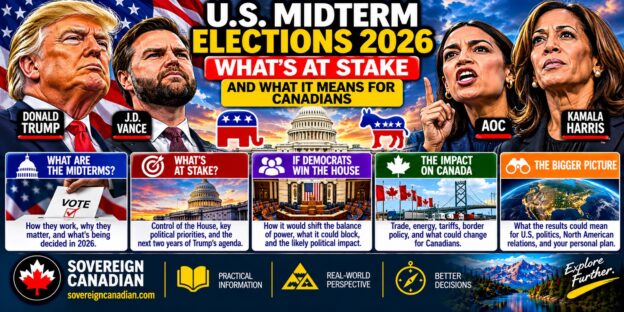
Americans head to the polls today for the 2026 midterm elections. President Donald Trump is not on the ballot, but the results could significantly change his ability to govern during the remaining two years of his presidency.
Every seat in the House of Representatives is being contested, along with 35 Senate seats and 36 governorships.
For Canadians, the implications extend well beyond American domestic politics. The election could influence trade negotiations, tariffs, financial markets, taxation, border policy, and the broader relationship between Canada and its largest trading partner.
At Sovereign Canadian, we are less interested in which political party celebrates on election night than in what the outcome means for Canadians seeking greater financial independence, personal sovereignty, and international optionality.
Here is what is at stake.
What Are the US Midterm Elections?
Unlike Canada, where federal elections determine which party forms the government, the United States elects its president and Congress separately.
The American president serves a four-year term. Members of the House of Representatives serve two-year terms, while senators serve six-year terms.
Congressional elections therefore occur every two years, including halfway through a president’s term. These halfway elections are known as the midterms.
The American Congress consists of two chambers:
- House of Representatives: All 435 voting seats are contested every two years. The House plays a central role in legislation, taxation, government spending, and congressional investigations.
- Senate: There are 100 senators, two from each state. Approximately one-third face election every two years. The Senate approves legislation, confirms presidential appointments and federal judges, and provides advice and consent on treaties.
The arrangement was deliberately designed to distribute political authority among institutions with different electoral cycles.
The House responds relatively quickly to changes in public opinion. The Senate provides greater continuity, while the president operates under a separate electoral mandate.
This system creates the possibility of divided government, where the president’s political party does not control one or both chambers of Congress.
That is precisely what could emerge from the 2026 elections.
For a useful explanation of the mechanics of this year’s vote, see Reuters’ November 2 election explainer.
What’s at Stake in 2026?
Republicans entered the election controlling the presidency, the House of Representatives, and the Senate.
Their congressional majorities, however, are narrow.
Immediately before the election, Republicans hold a 53–47 advantage in the Senate, counting the two independents who caucus with Democrats on the Democratic side.
Democrats need a net gain of four seats to secure a majority, since Vice President JD Vance can break a 50–50 tie in favour of Republicans.
The House is even more closely divided.
As Americans head to the polls, 219 House members caucus with Republicans, compared with 214 Democrats, with two vacancies. Democrats need a net gain of four seats to reach the 218 seats required for a majority.
The elections also include 36 governorships, state legislative races, and various state and local ballot measures.
These contests matter because American states exercise considerable independent authority over taxation, education, business regulation, property rights, and other policies affecting residents and investors.
For a Canadian considering American real estate, business ownership, or eventual relocation, state-level decisions can sometimes be more consequential than federal political developments.
Our United States country guide explores these differences, including immigration, taxation, property ownership, and the practical considerations of building a life in America.
Why Midterms Matter to a President
Historically, the president’s party frequently loses congressional seats during midterm elections.
Voters use the opportunity to express satisfaction or dissatisfaction with the administration’s performance without replacing the president himself.
During Barack Obama’s first midterm election in 2010, Republicans gained 63 House seats.
During Donald Trump’s first presidency, Democrats gained 40 House seats in 2018.
Both elections substantially changed the political environment in Washington.
The 2026 election will determine whether Trump continues governing with Republican control of Congress or faces a Democratic majority in one or both chambers.
What Happens if Democrats Take Control of the House?
A Democratic House majority would not remove Donald Trump from office, nor would it automatically reverse his administration’s policies.
It would, however, change the balance of power in Washington.
1. Greater Congressional Oversight
The majority party controls House committees, determines much of the legislative agenda, and possesses significant investigative authority.
A Democratic-controlled House could initiate investigations into Trump administration decisions, hold public hearings, and issue subpoenas seeking documents and testimony.
Democratic leaders have identified increased oversight as a priority.
The practical effectiveness of those investigations would depend on cooperation, legal challenges, and the administration’s willingness to comply.
2. Greater Difficulty Passing Legislation
A president cannot ordinarily enact new federal legislation without Congress.
If Democrats control the House while Republicans retain the Senate, passing major new tax, spending, or regulatory legislation would require negotiations between the parties.
Republicans would lose the ability to advance legislation through the House using only their own members.
Democrats could also refuse to advance legislation they oppose.
However, this would not eliminate the president’s executive authority.
Trump would retain substantial powers over federal administration, immigration enforcement, foreign policy, and trade measures authorized by existing legislation.
A Democratic House could constrain parts of his agenda without necessarily reversing policies already in place.
3. Budget Negotiations and Government Shutdowns
Perhaps the most immediate economic consequence would involve federal spending.
Congress must approve government funding, and disagreements can lead to partial government shutdowns.
Debt-ceiling negotiations present another potential source of conflict.
With the United States carrying substantial federal debt, prolonged political disputes over spending and borrowing could contribute to uncertainty in financial markets.
For investors, these negotiations may matter more than the political symbolism of which party controls the House.
4. The Possibility of Impeachment
A Democratic House could also initiate impeachment proceedings against President Trump.
However, impeachment by the House does not remove a president from office.
Removal requires conviction by a two-thirds majority of senators present.
Even if Democrats gain control of the House, that constitutional requirement would remain a substantial obstacle.
It is therefore important to distinguish between the ability to investigate, the ability to impeach, and the ability to remove a president.
They are three different things.
For additional context on how different congressional outcomes could affect the administration, see Reuters’ November 2 analysis.
What if Democrats Also Win the Senate?
Control of the Senate would introduce another important change.
The Senate confirms federal judges, cabinet officials, ambassadors, and numerous other presidential appointments.
A Democratic majority could delay or reject Trump administration nominees, potentially affecting the composition of the federal judiciary for years beyond his presidency.
Control of both chambers would also strengthen Democrats’ position in budget negotiations and allow them to advance their own legislative proposals.
However, Trump would retain his presidential veto.
Overriding that veto requires a two-thirds majority in both chambers, while most Senate legislation also faces a 60-vote threshold to overcome a filibuster.
Consequently, even Democratic control of Congress would not automatically translate into major changes in federal law.
The more immediate result could be greater legislative conflict and stronger congressional checks on presidential authority.
Conversely, if Republicans retain both chambers, they would preserve greater control over the legislative agenda and the confirmation process.
Either outcome would influence the direction of American government through the 2028 presidential election.
What Does This Mean for Sovereign Canadians?
Canada’s economic relationship with the United States is unusually deep.
Our economies are closely integrated through trade, manufacturing, energy, transportation, financial markets, and investment.
A political change in Washington can therefore have consequences for Canadians who never set foot in the United States.
There are several areas worth watching.
1. Trade, Tariffs, and the USMCA
The most immediate concern is trade.
The Canada–United States–Mexico Agreement (CUSMA, known as USMCA in the United States) underwent its first scheduled six-year joint review on July 1, 2026.
At that meeting, the United States declined to extend the agreement in its current form.
Importantly, this does not mean the agreement has expired.
CUSMA remains in force. Under its provisions, the three countries must now conduct annual reviews until they agree to extend the agreement or its existing term expires in 2036.
The next annual review is scheduled for 2027.
The United States has made clear that it wants changes to the agreement, while Canada and Mexico have expressed support for its continuation.
The uncertainty matters because CUSMA governs much of North America’s integrated trade relationship.
American tariffs and trade restrictions can affect Canadian manufacturers, agricultural producers, energy exporters, and consumers.
Would a Democratic House make a difference?
Potentially, although not necessarily in the way Canadians might expect.
Congress has constitutional authority over international commerce, but presidents exercise significant trade powers delegated through existing laws.
A Democratic House could scrutinize the administration’s trade policies, hold hearings, and attempt to change the legislative framework governing tariffs.
However, it could not simply cancel existing tariffs through a House vote.
Nor should Canadians assume that Democratic politicians necessarily favour unrestricted trade with Canada.
Both American political parties have constituencies that support domestic manufacturing protections and restrictions on foreign competition.
For Canadians, the relevant question is whether American trade policy becomes more predictable, not simply which party controls Congress.
Businesses making long-term investments need to understand the rules under which they will operate.
Political uncertainty can be costly even when tariffs themselves remain unchanged.
The Office of the United States Trade Representative’s July 1 statement confirms the American decision not to extend the agreement in its current form.
The Government of Canada’s CUSMA joint review page explains the review mechanism and the agreement’s continuing legal status.
2. The Canadian Dollar and Financial Markets
American fiscal policy, trade decisions, and economic performance can influence the Canadian dollar and the value of Canadian investment portfolios.
A divided Congress could make major fiscal legislation more difficult to pass.
It could also produce prolonged budget negotiations and periodic concerns about government funding or the federal debt ceiling.
Neither outcome guarantees a particular direction for stock prices or exchange rates.
Financial markets respond to interest rates, corporate earnings, inflation, economic growth, and many other variables.
Nevertheless, Canadians with substantial American investments should pay attention to how political developments affect the US dollar and financial conditions.
A Canadian holding American equities has exposure to both the underlying investment and the CAD/USD exchange rate.
These are separate sources of risk and opportunity.
For Canadians building internationally diversified portfolios, political developments are another reminder that geographic diversification and currency exposure deserve deliberate consideration.
This also connects to the principles discussed in our Coast FIRE Canada analysis.
A long-term financial independence plan should not depend on optimistic assumptions about market returns, political stability, or uninterrupted economic growth.
The objective is to build enough financial resilience that temporary political and market disruptions do not force permanent changes to your plans.
3. American Real Estate and Relocation
The United States remains an important destination for Canadians seeking warmer climates, vacation properties, investment real estate, or eventual relocation.
Federal political developments can affect immigration policy, taxation, financial regulation, and the treatment of foreign investors.
However, many of the most important considerations for a Canadian purchasing American property are determined at the state and local levels.
Property taxes, insurance costs, landlord regulations, estate planning, and business structures vary significantly across jurisdictions.
A change in congressional control would not automatically change a Canadian’s immigration status, permitted length of stay, or right to work in the United States.
These rights depend on existing law and applicable immigration classifications.
For anyone considering an American property or a second residence, the appropriate approach remains to evaluate the specific jurisdiction rather than make decisions based on a national election result.
Our United States Real Estate Investing for Canadians guide examines the ownership structures, tax implications, estate planning concerns, and practical considerations involved.
4. Border Policy and Freedom of Movement
Canadians enjoy relatively convenient access to the United States compared with citizens of many other countries.
That access should not be confused with an unconditional right to enter, reside, or work there.
Border enforcement, immigration procedures, and entry requirements can change through legislation, regulation, and executive action.
A Democratic House could increase oversight of immigration enforcement and attempt to change federal immigration legislation.
But the executive branch would continue to administer much of the immigration system.
For Canadians who frequently cross the border for business, maintain American investments, or spend extended periods in the United States, monitoring actual regulatory changes is more useful than reacting to campaign rhetoric.
The distinction between visiting, working, and establishing tax residency remains particularly important.
This is one reason Sovereign Canadian examines different countries through the lens of practical rights rather than political announcements.
Our recent article, Canada and the EU: What Closer Ties Mean for Canadians, explores a similar distinction.
Closer diplomatic relationships do not automatically create new rights to live, work, or own property abroad.
The same principle applies to Canadians considering the United States.
5. Energy and Industrial Policy
American energy and industrial policy can directly affect Canadian companies and investors.
The United States is a major market for Canadian oil, natural gas, electricity, manufactured goods, and industrial equipment.
Federal decisions involving pipelines, energy infrastructure, environmental regulation, and industrial incentives can therefore influence Canadian businesses.
A divided Congress could make sweeping legislative changes more difficult, although the administration would retain regulatory and executive authority.
For investors, the implications will vary considerably by industry.
A Canadian energy producer, an automotive supplier, and a utility company may experience the same policy change very differently.
This is another reason to focus on the underlying economics of an investment rather than assume that a particular election result will benefit an entire sector.
Three Outcomes Worth Watching
There are three broad possibilities following the election.
Republicans retain the House and Senate. Trump would continue with unified party control of the federal government. Republicans would retain greater control over legislation, congressional committees, and Senate confirmations, although narrow majorities could still complicate negotiations.
Democrats win the House while Republicans retain the Senate. Washington would return to divided government. Democrats would gain investigative authority and greater influence over legislation and spending, while Trump would retain executive powers and Republicans would control Senate confirmations.
Democrats win both chambers. Congressional oversight and legislative opposition to the administration would expand further. Democrats would also control the Senate confirmation process, although presidential vetoes and Senate procedural rules would continue to limit what Congress could accomplish without bipartisan agreement.
Each scenario has different implications for legislation, government spending, trade policy, and the functioning of American institutions.
None should be interpreted as a guaranteed direction for the stock market, the Canadian dollar, or the Canadian economy.
The Sovereign Canadian Perspective
There is a broader lesson in American midterm elections.
The United States has a constitutional structure specifically designed to distribute political authority.
The president, House, Senate, judiciary, and individual states exercise different powers.
This creates institutional checks, but it can also produce political deadlock.
For Canadians accustomed to a parliamentary system, where a majority government can generally advance its legislative agenda with considerable discipline, the American arrangement is an important distinction.
A president can remain in office while losing control of Congress.
A congressional majority can oppose the president without being able to remove him.
And individual states can maintain substantially different economic and regulatory environments under the same federal government.
For those pursuing greater personal and financial sovereignty, understanding these distinctions is useful.
It reinforces an important principle:
Political power is neither permanent nor unlimited, and long-term personal decisions should not depend entirely on the policies of any single administration.
Diversified investments, manageable debt, multiple sources of income, and an understanding of international residency and investment options can provide flexibility when political circumstances change.
This is also the foundation of Sovereign Canadian’s country research.
The objective is not necessarily to leave Canada, or to move your assets out of the country.
It is to understand what alternatives exist and retain the freedom to use them when circumstances justify it.
The objective is not to predict every election correctly.
It is to build a financial and personal position that can withstand different political outcomes.
What Happens Next?
Americans vote on November 3, 2026.
The results of individual races may become clear on election night, but determining control of Congress could take longer as close contests are counted.
The newly elected Congress will convene on January 3, 2027.
Between now and then, Canadians should watch not only which party gains control, but also the policy priorities that emerge.
Trade negotiations, federal spending, tariff authority, immigration rules, and the direction of American economic policy will remain relevant long after election-night coverage ends.
The Associated Press election coverage explains why determining congressional control can take several days, particularly when close races involve mail ballots or ranked-choice voting.
For Sovereign Canadians, the takeaway is straightforward.
American elections matter to Canada. But building your financial future around the outcome of a single American election is not a strategy.
Understand the institutions, follow the policies, and maintain the flexibility to adapt.
That is a more durable form of sovereignty than betting on the next political cycle.