
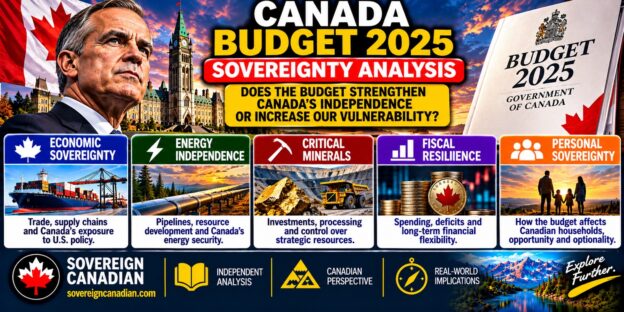
November 27, 2025 | Sovereign Canadian | Finance & Economics
On November 4, 2025, Finance Minister François-Philippe Champagne presented the first federal budget under Prime Minister Mark Carney. Titled Canada Strong, Budget 2025 represents a substantial shift in federal economic policy toward infrastructure, industrial investment, defence, and productivity, against the backdrop of a deteriorating trade relationship with the United States.
The government proposes approximately $280 billion in capital investments and incentives over five years, intended to help mobilize more than $1 trillion in total investment. It also projects a $78.3 billion deficit for the 2025–26 fiscal year.
These are substantial numbers, even by the standards of modern Canadian federal budgets.
For Sovereign Canadian, the important questions extend beyond the political debate over spending. Will these investments improve Canada’s productive capacity? Will they reduce our dependence on foreign governments and markets? Will they create opportunities for Canadian businesses and investors? And can the country finance these ambitions without compromising its future fiscal flexibility?
Economic sovereignty requires more than government announcements. It requires productive businesses, reliable infrastructure, competitive taxation, accessible capital, and public finances capable of withstanding the next crisis.
Budget 2025 addresses several of these issues. Whether its proposed approach produces the intended results will depend heavily on implementation.
A $78 Billion Deficit: The Fiscal Starting Point
The federal government projects a deficit of $78.3 billion in 2025–26, with substantial deficits continuing throughout its five-year planning horizon.
According to the Parliamentary Budget Officer’s November 14 analysis, projected deficits average approximately $64.3 billion annually between 2025–26 and 2029–30. That is more than double the average projected in the December 2024 Fall Economic Statement.
The government argues that borrowing to finance productive investment should be distinguished from borrowing to support ongoing operating expenditures.
There is an economic rationale for this distinction.
A government borrowing to construct infrastructure that increases productive capacity may generate economic benefits lasting decades. Borrowing to finance recurring expenditures creates a different fiscal obligation, particularly when those expenditures do not generate corresponding improvements in economic output.
However, the distinction becomes less useful when the definition of investment expands beyond conventional capital assets.
The Parliamentary Budget Officer has challenged the government’s capital classification, estimating that approximately $94 billion less spending would qualify as capital investment under the PBO’s narrower definition over the 2024–25 to 2029–30 period.
Under the government’s definition, capital investment includes spending intended to encourage investment by private businesses and other levels of government, including certain tax incentives and subsidies.
The PBO argues that such expenditures do not necessarily represent actual capital formation.
This matters because reclassifying expenditures does not change the government’s underlying borrowing requirements.
Canada’s public debt must ultimately be serviced through taxation and refinancing, supported by the government’s revenue base and the country’s economic growth.
The government’s fiscal framework targets a declining deficit relative to GDP and a balanced operating budget by 2028–29. These are measurable objectives, but they do not represent an overall balanced federal budget.
There is another important change.
The government has abandoned the previous fiscal commitment to reduce federal debt as a percentage of GDP over the medium term. Under Budget 2025, the debt-to-GDP ratio is projected to rise from 41.2% in 2024–25 to slightly above 43% over much of the planning horizon.
The PBO also estimates that there is only a 7.5% probability of the deficit-to-GDP ratio declining in every year from 2026–27 through 2029–30 under its fiscal stress-testing methodology.
For Canadians concerned about financial sovereignty, the distinction between productive investment and recurring expenditure deserves close attention.
Government debt is not directly comparable to household debt, but both involve commitments against future financial resources. Borrowing can expand future options when invested productively. It can constrain those options when the expected returns fail to materialize.
Productivity: Canada’s Underlying Economic Challenge
One of the more consequential elements of Budget 2025 is its recognition that Canada’s economic challenges cannot be solved through population growth and government spending alone.
Canada has experienced prolonged weakness in business investment and labour productivity. These problems affect wages, living standards, government revenues, and the country’s ability to compete internationally.
An economy cannot sustainably improve living standards simply by adding more workers if productive output per worker remains stagnant.
The budget introduces a Productivity Super-Deduction, a collection of accelerated depreciation and immediate-expensing measures intended to encourage businesses to invest in productive assets.
Eligible investments include manufacturing machinery, equipment, certain buildings, computers, data infrastructure, and other productivity-enhancing assets.
The government estimates that these measures will reduce Canada’s marginal effective tax rate on new business investment to approximately 13.2%.
This is an important distinction from simply lowering headline corporate income tax rates.
Accelerated depreciation improves the after-tax economics of capital investment, potentially encouraging businesses to modernize equipment, expand production, and adopt new technologies.
Consider a Canadian manufacturer evaluating a $5 million equipment purchase.
The investment decision depends on expected demand, financing costs, labour availability, operating margins, and the tax treatment of the equipment.
Allowing faster recovery of capital costs can improve the project’s after-tax returns and cash flow.
It does not guarantee that the manufacturer will proceed, but it can influence projects near the investment threshold.
For Canadian economic sovereignty, this is an important area to examine.
A country with a competitive industrial base is better positioned to maintain domestic supply chains, develop export markets, and retain skilled employment.
However, tax incentives alone cannot compensate for unreliable infrastructure, lengthy permitting processes, regulatory uncertainty, or weak demand.
The real measure of success will be whether private businesses invest more capital per worker and generate sustained productivity improvements.
The government’s economic growth and productivity measures provide the details of these proposed incentives.
Energy, Natural Resources, and Canada’s Strategic Advantages
Canada possesses substantial reserves of oil, natural gas, uranium, critical minerals, timber, and other resources essential to modern industrial economies.
These resources represent both economic opportunities and strategic assets.
Budget 2025 places greater emphasis on major infrastructure, resource development, and critical minerals as part of its industrial strategy.
The government proposes a $2 billion Critical Minerals Sovereign Fund, intended to support projects through investments, financing, and loan guarantees.
The budget also includes measures supporting low-carbon liquefied natural gas facilities and expanded investment incentives for selected energy and industrial projects.
These initiatives sit alongside the government’s broader Major Projects Office, established to help accelerate projects considered nationally significant.
The potential economic benefits are substantial.
Resource projects can generate export revenues, support domestic manufacturing, create employment, and diversify Canada’s commercial relationships.
However, their value depends on the ability to move projects from announcements through permitting, financing, construction, and ultimately production.
Canada has no shortage of natural resources or proposed projects. The more difficult challenge is developing them competitively and connecting them to customers.
From a sovereignty perspective, diversification is particularly important.
The United States will remain Canada’s largest and most important trading partner. Geography, integrated manufacturing, established transportation networks, and existing commercial relationships make that relationship economically significant.
But dependence on a single export market creates vulnerabilities when trade policy becomes unpredictable.
Additional access to European and Asian markets could improve Canada’s negotiating position and provide Canadian producers with more commercial options.
This does not require abandoning American markets. It requires developing alternatives.
For investors, the distinction between a promising resource and a profitable investment remains essential.
A government-supported project can still suffer from excessive capital costs, commodity-price volatility, poor management, or unattractive shareholder returns.
Canadian resource exposure should be evaluated through project economics, balance sheets, management quality, and valuation—not simply the presence of government incentives.
Defence Spending and National Sovereignty
Budget 2025 proposes a substantial expansion of Canadian defence spending.
The government outlines approximately $81.8 billion in defence-related spending over five years on a cash basis, including previously announced measures.
Canada intends to meet NATO’s 2% of GDP defence-spending benchmark in the current fiscal year while developing a longer-term path toward the alliance’s expanded defence investment commitments.
Defence spending is frequently discussed as a budgetary expense, but national security also has an economic dimension.
A country dependent on foreign suppliers for essential military equipment, communications systems, and critical infrastructure faces strategic limitations.
Developing domestic defence capabilities can support engineering, advanced manufacturing, cybersecurity, aerospace, shipbuilding, and other technically sophisticated industries.
The challenge is determining which capabilities should be developed domestically and which can be acquired more efficiently through trusted international partnerships.
Domestic procurement does not automatically create a competitive industry.
Without sufficient production scale, export opportunities, and commercial discipline, government procurement can produce expensive systems with limited broader economic value.
Nevertheless, a more developed Canadian defence industrial base could strengthen both national security and the country’s advanced manufacturing sector.
For Sovereign Canadian, national sovereignty includes the capacity to defend territory, maintain essential infrastructure, and preserve independent decision-making.
Defence policy therefore belongs in the broader discussion of economic resilience.
Housing: Supply, Affordability, and Government Intervention
Housing remains one of Canada’s most significant economic and household-finance challenges.
Budget 2025 includes approximately $25 billion in housing-related capital investments and incentives over five years, with Build Canada Homes serving as a central component of the government’s housing strategy.
The stated objective is to expand housing supply, particularly affordable and community housing, while improving construction productivity.
Increasing supply is important, but the underlying constraints are complex.
Land-use regulations, municipal development charges, infrastructure availability, construction costs, financing conditions, and labour shortages all influence housing production.
Federal spending may address some of these constraints, but provinces and municipalities retain considerable authority over planning and development.
There is also a distinction between increasing the number of homes and improving the financial accessibility of homeownership.
Higher construction volumes may moderate prices over time, but affordability also depends on household incomes, interest rates, taxes, and the cost of servicing debt.
For Canadians pursuing financial independence, housing deserves particular attention because it often represents their largest asset and largest financial obligation.
A primary residence provides stability and utility, but it also concentrates wealth in an illiquid asset.
A larger mortgage can reduce the flexibility to invest, start a business, relocate, or withstand a period of unemployment.
Government housing policy can influence market conditions, but individual financial resilience still depends on prudent borrowing and maintaining sufficient liquidity.
The objective should not simply be maximizing homeownership at any price. It should be expanding access to suitable housing without requiring households to accept unsustainable financial obligations.
Immigration: A Change in Direction
Budget 2025 accompanies a significant adjustment to federal immigration planning.
The government targets 380,000 permanent resident admissions annually from 2026 through 2028, alongside substantial reductions in planned new temporary resident arrivals.
This represents a change from the rapid population-growth approach of recent years.
Immigration can support economic development by expanding the labour force, attracting specialized skills, and encouraging entrepreneurship.
However, population growth also creates demand for housing, transportation, healthcare, education, and public infrastructure.
When population growth exceeds the capacity to expand these services, economic and social pressures can emerge.
The relevant question is not simply how many people enter Canada, but whether immigration levels and composition align with the country’s economic needs and capacity.
Budget 2025 also includes measures intended to attract highly skilled international researchers and specialized workers.
This creates two distinct policy objectives: moderating overall population pressures while competing internationally for highly productive talent.
Their effectiveness will depend on implementation, labour-market conditions, and the ability of Canadian employers and institutions to retain the people they attract.
For Canadians considering international mobility, immigration policy also illustrates an important principle of sovereignty.
Countries compete for human capital, investment, and entrepreneurship. Individuals with portable skills and financial resources may have greater flexibility to choose jurisdictions offering attractive economic opportunities and living conditions.
Government Operations: Spending Less or Spending Differently?
The government proposes approximately $60 billion in combined savings and additional revenues over five years, including measures associated with its Comprehensive Expenditure Review.
The review targets approximately $13 billion in annual savings by 2028–29.
Proposed measures include reducing the size of the federal public service, eliminating duplication, and adjusting program expenditures.
The government projects slower growth in direct program expenses than Canada has experienced over the preceding decade.
These objectives deserve careful examination because announced savings and realized savings are not the same thing.
Reducing administrative duplication can improve efficiency. Eliminating necessary capacity can instead create service delays or transfer costs elsewhere.
Similarly, restraining operating expenditures while increasing capital investment may improve the composition of government spending without reducing total borrowing.
The Parliamentary Budget Officer’s analysis raises questions about whether the government’s new operating measures are consistent with its fiscal objectives.
The PBO also notes that the expenditure review lacks sufficient program-level detail to assess the effects of planned savings on staffing, service delivery, and operational performance.
The key indicators will be actual program expenditures, staffing levels, service performance, and the annual fiscal results.
Fiscal discipline is demonstrated through outcomes rather than expenditure-review announcements.
What Budget 2025 Means for Canadian Investors
The budget creates several areas worth monitoring, particularly for investors interested in Canadian productive assets.
Infrastructure and transportation: Expanded infrastructure spending may support engineering, construction, equipment suppliers, railways, ports, utilities, and related service businesses. The benefits will depend on project selection, procurement, and execution.
Energy and critical minerals: Tax incentives, financing programs, and accelerated project development may improve the economics of selected projects. Commodity cycles and individual company valuations remain decisive.
Industrial manufacturing: Accelerated depreciation may encourage capital spending by manufacturers, potentially supporting machinery suppliers, industrial distributors, automation providers, and engineering firms.
Defence and aerospace: Increased procurement could create opportunities for Canadian contractors and specialized manufacturers, although government contracting introduces political, budgetary, and execution risks.
Financial services: Investment financing, infrastructure development, and business expansion may create opportunities for lenders and capital providers. Credit quality and financing costs remain important considerations.
These are areas for research rather than automatic investment recommendations.
The Canadian stock market already provides substantial exposure to financial institutions, energy, materials, transportation, and infrastructure.
Investors should consider their existing exposure before increasing allocations based on government policy announcements.
A favourable policy environment can improve business prospects without making every company in the affected sector an attractive investment.
Ultimately, shareholder returns depend on the price paid relative to future earnings and cash flows.
What Budget 2025 Means for Financial Independence
For individual Canadians, the budget reinforces several considerations that extend beyond any single government’s fiscal plan.
First, personal financial independence should not depend entirely on future government policy.
Tax rates, benefit programs, retirement rules, and public services can change over a working lifetime.
Registered accounts such as RRSPs and TFSAs remain useful components of long-term planning, but financial resilience also benefits from liquidity, diversified assets, manageable debt, and the ability to generate income.
Second, productive assets remain central to long-term wealth creation.
Businesses, infrastructure, real estate, and financial investments can provide income or capital appreciation, although each carries different risks.
Third, international diversification deserves consideration.
Canada offers substantial investment opportunities, but a portfolio concentrated entirely in Canadian assets may be exposed to domestic economic conditions, currency movements, and regulatory changes.
Holding international investments can reduce dependence on a single national economy.
Finally, government borrowing and taxation remain relevant to long-term financial planning.
Future governments will inherit today’s fiscal commitments. Their policy choices will influence the economic environment in which Canadians work, invest, and retire.
Maintaining personal flexibility is one way to prepare for that uncertainty.
The Sovereignty Question
Budget 2025 uses the language of national resilience, economic independence, and investment.
Those objectives connect directly to the principles behind Sovereign Canadian.
A country with diversified trade relationships, productive industries, reliable infrastructure, domestic energy resources, and credible defence capabilities possesses greater freedom to make independent decisions.
But national sovereignty also depends on fiscal capacity.
Governments facing high debt-servicing costs and persistent borrowing requirements may have less flexibility to respond to future economic shocks.
This creates a central tension in Budget 2025.
The government intends to strengthen Canada’s long-term economic capacity through significant public investment while simultaneously committing to future operating restraint.
The outcome will depend on whether the resulting economic activity produces sufficient productivity growth, private investment, employment, and tax revenues to support those commitments.
The Parliamentary Budget Officer’s concerns about the scale of future deficits and the classification of capital spending are therefore material to the debate.
Canadians should evaluate the budget through measurable results: completed infrastructure, private capital formation, productivity growth, export diversification, fiscal performance, and improvements in living standards.
Announcements and projected investment totals provide a starting point. They do not establish that the intended economic benefits have been achieved.
Final Thoughts: Sovereignty Requires Economic Capacity
Canada enters the final weeks of 2025 facing difficult economic choices.
Its traditional trading relationship with the United States is under pressure. Business investment and productivity require attention. Housing affordability remains strained, and national defence commitments are expanding.
Budget 2025 responds with a substantial program of public investment, industrial incentives, and proposed expenditure restraint.
The opportunities are significant, but so are the financial commitments.
For individual Canadians, the broader lesson is that economic independence cannot be delegated entirely to government.
Build productive assets. Maintain manageable financial obligations. Diversify sources of income and investment exposure. Develop skills that remain valuable across industries and jurisdictions.
These principles remain relevant regardless of which government holds office.
National sovereignty depends on economic capacity. Personal sovereignty depends on maintaining the resources and flexibility to make independent choices.
Both require looking beyond immediate promises toward long-term results.
Sources and Further Reading
- Department of Finance Canada — Budget 2025: Canada Strong. Official federal budget, November 4, 2025.
- Department of Finance Canada — Economic and Fiscal Overview. Detailed fiscal projections, investment classifications, and expenditure plans.
- Parliamentary Budget Officer — Budget 2025: Issues for Parliamentarians. Independent assessment published November 14, 2025.
- Department of Finance Canada — Building a Stronger Canadian Economy. Productivity incentives, industrial policy, and business investment measures.
Related Sovereign Canadian Reading
Editor’s note (November 2026): This article is preserved as an analysis of Budget 2025 from November 27, 2025. It reflects the budget proposals and independent assessments available at that time, rather than subsequent implementation or fiscal results.
Disclaimer: This article is provided for general information and commentary. It does not constitute personalized financial, investment, tax, or legal advice.