
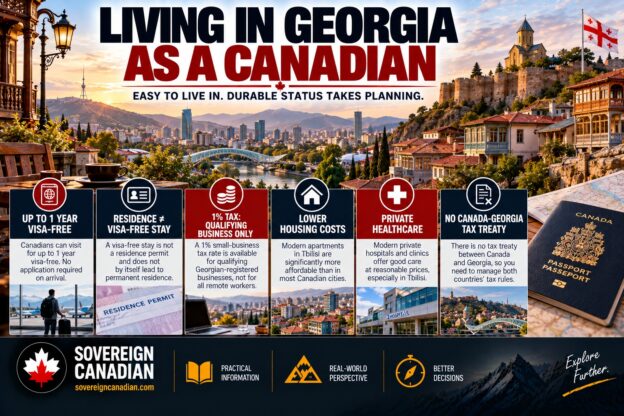
Picture a 35-year-old Canadian consultant who lands in Tbilisi with a laptop and a one-way ticket. Canadians can stay in Georgia visa-free for a year, so there is no application to file at the airport. The consultant rents a modern apartment in Saburtalo, signs up for fibre internet, learns the Metro and the Bolt app, and keeps working for Canadian and American clients exactly as before. Within a few weeks there is a favourite cafe, a gym, a bank card and a routine. By any ordinary measure, this person has moved to Georgia.
Legally, something quieter has happened. The visa-free stay is not a residence permit. Nothing about it starts the clock that eventually leads to permanent residence. The consultant’s Georgian life can look far more permanent than their Georgian status is, and, separately, nothing in that arrival has told the Canada Revenue Agency that this person stopped being a Canadian tax resident.
Now consider a second consultant, identical in every other respect, who spends the first months arranging a residence permit and a clean Canadian departure. The two apartments look the same and the two routines look the same. Their positions five years later are very different.
That gap is the subject of this article. Georgia is unusually easy for a Canadian to try living in, and it permits a surprisingly complete life while building very little permanent legal status unless you deliberately choose a route that does. Most expat content collapses four different ideas into one: living in Georgia, being a Georgian resident, accumulating permanent-residence eligibility, and ceasing to be a Canadian tax resident. They are four separate things, and each has its own rules, its own evidence and its own timetable. The longer you intend to stay, the more each of them needs to be planned rather than assumed.
This piece draws on Georgian legislation as published by the Legislative Herald (Matsne), Government of Canada and CRA sources, the Public Service Development Agency (PSDA), the Deposit Insurance Agency, WHO and OECD material, and a range of Georgian law-firm and operator sources where primary documents were not available. Where something could not be verified, the text says so.
Why Georgia keeps coming up
Georgia gets attention from Canadians for reasons that are mostly real. Canadian passport holders can enter without a visa and remain for up to one full year under Government Ordinance No 255, which lists Canada among the eligible countries. Rents in Tbilisi are well below those in Toronto or Vancouver, and everyday services such as transit, mobile data and internet are cheap. Foreign-client remote work now sits in a specific statutory carve-out. A small-business tax regime with a headline rate of 1% has become one of the most repeated lines in international-living content. Foreigners can buy most property, the capital is a functioning, sociable city with a large remote-working population, and the geography puts Istanbul, Eastern Europe, the Gulf and Central Asia within a short flight.
Each of those facts survives scrutiny, and each of them is narrower than the shorthand version. The shorthand version is “365 days, 1% tax, cheap apartments.” It describes why Georgia is easy to enter. It says almost nothing about whether a Canadian can build a durable life there, which depends on a different set of facts. Other country articles in this series, including Living in Japan as a Canadian, make a similar point from a different direction: a country can be extraordinary to visit and far harder to build a position in.
What a Canadian can actually do for a year
The one-year entitlement comes from Ordinance No 255, adopted under the Law on the Legal Status of Aliens and Stateless Persons. The Law itself defines the period of stay as running from the date the person first crosses the border, and it treats the one-year list as something the Government sets by ordinance, with 90 days in any 180 as the general default. What the retrieved text does not say is whether leaving and re-entering gives a fresh year, whether any calendar-year or rolling-window rule applies, or how long you must stay out. Repeated exit and re-entry is widely reported by expats and by Georgian commercial sources, but the exact reset practice is something the legal text leaves unresolved. It is worth keeping separate three things that internet guides routinely blur: what the statute permits, what a border officer may decide, and what other people say they have done.
On the second of those, the Law gives border authorities broad grounds to refuse entry even to someone who is formally eligible. The grounds include lacking health and accident insurance or sufficient funds, reasonable doubt that the person will leave when permitted, unpaid fines and foreign-policy considerations. Refusals on several of these grounds are not reasoned and cannot be appealed. Nothing suggests ordinary Canadians are being turned away, but a legal right that rests on officer discretion at the margin is not the same as a legal right to repeat the year indefinitely.
Since 1 January 2026, tourists entering Georgia, including visa-free visitors, also need health and accident insurance of at least GEL 30,000, roughly CAD 16,400, covering the whole stay including the arrival and departure dates. The Ministry of Foreign Affairs notice says the requirement comes from the Law on Tourism, that the policy may be in physical or electronic form and in Georgian or English, that it may come from a Georgian or foreign insurer, and that exemptions cover groups such as holders of diplomatic and special visas and passports. The rule is written for tourists. Whether it also reaches holders of Georgian residence permits is treated inconsistently in the sources, and the official notice does not settle it, so anyone who holds or is applying for a permit should confirm their own position.
Renting an apartment requires nothing beyond a passport and a willing landlord. A foreign driving licence remains valid for one year from your last entry, according to commercial sources, after which you need a Georgian licence, which is available to people holding a residence permit or those who have lawfully spent 185 days in Georgia in the past 12 months. Opening bank accounts is possible, although in-person requirements and documentation vary by bank. And foreigners can buy apartments, houses and non-agricultural land without a residence permit, as discussed below.
Working remotely
The part that changed most in 2026 is the right to work. Since 1 March 2026, foreigners without permanent residence who work for a local employer or carry on self-employed activity in Georgia generally need a “right to work” from Georgia’s labour-migration authority. Georgian law firms report fines of GEL 2,000 for a self-employed person working without it.
An April 2026 amendment, Law No 1509, carved out an important group. The Legislative Herald records the law as dated and published on 15 April 2026, and the consolidated text of the Law on Labour Migration incorporates the change. As the consolidated text reads, the regime does not apply to a foreigner who provides services in favour of a non-resident person where those services relate to the non-resident’s activities outside Georgia. A separate exclusion covers fully remote work for a local employer that never requires the worker to enter Georgia. Short-term professional activity tied to a specific temporary project is also outside the permit requirement.
Read plainly, a Canadian employee of a Canadian company, or a consultant who invoices only Canadian and American businesses, falls on the exempt side. That is the reading Georgian law firms published after the amendment, and it matches the text. It is still a reading of statutory wording. The research found no official guidance on edge cases, such as a client who is a private individual whose “activities” are not obviously business, or a practice that mixes foreign and Georgian clients. A Canadian with a Georgian client should confirm whether the work done for that client requires the right to work. One Georgian law firm also reports that later amendments let certain exempt self-employed people who need a residence permit obtain the work-activity permit voluntarily, a point that could not be matched confidently enough against the consolidated English text to rely on here.
Three things should stay separate. Being outside the right-to-work regime means a Canadian may work without that permit. It does not make the income foreign-source for Georgian tax purposes, which is a separate question covered below. And it does not create a residence pathway by itself: an exempt remote worker holds no work permit merely by doing foreign-client work, and therefore does not automatically obtain the work-based residence route. Permission to work, tax liability and eligibility for residence status are three different questions, and Georgian law answers each independently.
The strange part: a full life, almost no status
The unusual feature of Georgia’s one-year visa-free stay is that the time itself does not build toward permanent residence. The Law distinguishes a temporary residence permit from a visa-free stay, and its permanent-residence provision says that an alien who has resided in Georgia for the last 10 years on the basis of a temporary residence permit receives a permanent residence permit. The period excludes time spent for study, medical treatment or diplomatic employment. Time spent visa-free is not time on a temporary permit, and the PSDA’s published guidance repeats the 10-year rule. An older English text of the Law that still circulates says six years, which is why guides disagree. The current figure is 10.
So a Canadian who spends four consecutive years in Tbilisi on visa-free stays, with a lease, a bank account and a favourite barber, has accumulated nothing toward permanent residence on the face of the statute. The same Canadian holding a qualifying temporary permit for those four years may be in a very different position. The two lives can look identical from the street.
Beyond permanent residence sits citizenship. The ordinary naturalisation route generally requires 10 years of lawful residence plus knowledge of the Georgian language, history and basic law. Dual citizenship is possible in specified circumstances, but it is not automatic: Georgian law provides mechanisms for retaining Georgian citizenship when acquiring another citizenship and for granting Georgian citizenship by exception. For most Canadians, citizenship is not the realistic near-term target, and the practical question is whether to hold a residence status and what kind.
This is why the article’s distinction matters. Living in Georgia is something you can do from your first day. Being a Georgian resident is a legal status that someone has to apply for. Accumulating permanent-residence eligibility only begins once that status is of the right type. And none of the three says anything about whether you remain a Canadian tax resident. A person can do the first without the other three, and an unplanned stay tends to produce exactly that result.
The residence routes that matter to Canadians
The PSDA lists the permit categories, and the Law sets their conditions. For Canadians, four are realistic.
A work residence permit goes to people who hold the right to work, whether as employees of a Georgian employer or as entrepreneurs carrying on activity in Georgia. It requires a specified income level and, for employees, an employer with sufficient turnover. Since March 2026 the right to work generally has to come first. This route suits people who will actually work in Georgia for Georgian clients or employers, which is a different group from many foreign-client remote workers.
An IT residence permit is available to qualifying IT professionals, including people meeting experience and remuneration requirements and certain IT specialists operating through a Georgian individual entrepreneur structure. The Law also imposes a physical-presence requirement on this category.
The property route sits in the middle. Under the Law, a short-term residence permit goes to an alien who owns qualifying non-agricultural property worth more than USD 150,000, about CAD 213,600 at the exchange rate used in this research, established by an accredited assessor, together with qualifying family members. It is granted for a year at a time and ends if the qualifying ownership ends. The cost of that stability is a purchase, with the purchase’s own risks.
The investment route sits above it. An investment residence permit requires either a qualifying investment of USD 300,000, about CAD 427,300, or qualifying non-agricultural property worth more than USD 300,000. It can cover qualifying family members. The Law also provides a pathway to an unlimited residence permit for qualifying investors after five years, subject to the applicable property-retention or business-turnover conditions.
Two terms deserve care. The “unlimited residence permit” available through the investment route and the “permanent residence permit” available after the ordinary long-residence period are separate categories in the Law. Guides often use the terms interchangeably. They are not the same pathway.
The USD 150,000 question
The Law describes the short-term property permit within the residence-permit framework, while the ordinary permanent-residence provision refers to 10 years of residence on the basis of a temporary residence permit. Read together, that structure suggests that time on the property permit may count. It is an inference from the statute’s structure, supported by some commercial sources, and no sufficiently clear official PSDA interpretation was found confirming it.
Until it is confirmed, the USD 150,000 route is best described as a way to hold a renewable residence permit while keeping the permanent-residence question open, and not as a confirmed 10-year path. Anyone buying principally for residence should obtain written confirmation from the PSDA or a Georgian immigration lawyer first.
The 1% tax rate: real, but not what the internet makes it sound like
The 1% figure is genuine, and it applies to something narrower than most guides imply. Under the small-business provisions of the Georgian Tax Code, a registered individual entrepreneur with small-business status pays 1% on qualifying taxable income, with the regime built around gross income from the economic activity rather than net business profit. If gross income exceeds GEL 500,000, the 3% rate applies from the beginning of the month in which the threshold is exceeded through the end of that calendar year. The Code also contains rules under which repeated threshold breaches can lead to loss of the status.
Georgia’s ordinary personal income tax is 20%. And Georgia is territorial in a more specific way than the slogan suggests. Resident individuals can receive favourable treatment on genuinely foreign-source income, but Georgian-source income is defined partly by where activity takes place. Under Article 104 of the Tax Code, income from services actually rendered in Georgia can be Georgian-source, whoever pays and wherever the money lands. A Canadian consultant sitting in Tbilisi and performing the work there therefore should not assume that the income becomes foreign-source merely because the client is Canadian or American, the payment arrives from abroad, or the money goes into a foreign bank account.
The regime’s eligibility is where much of the internet version breaks down. Activities excluded from small-business status are set through Georgian secondary legislation, including Government Resolution No 415. The Georgian government’s published text, which is in Georgian, includes professional and advisory activities that can create problems for people who describe themselves as consultants. That matters a great deal to Canadian remote workers.
The label alone does not decide the question. Where the line falls between consulting, advisory work, management services and other services depends on the actual activity and how Georgian tax authorities classify it. Some advisers treat parts of general business consulting as a grey area; others warn that the authorities read the exclusions broadly. Someone who casually calls themselves a consultant is not automatically excluded, and a practice described using another label is not automatically eligible. Whether a given marketing, design, coaching, software or advisory practice qualifies is something to resolve with a Georgian accountant before registering, not after.
VAT adds one more layer. Georgia’s standard rate is 18%, and the Tax Code contains a GEL 100,000 registration threshold for taxable transactions. Georgian advisers report that many business-to-business services supplied to customers established outside Georgia fall outside Georgian VAT under the place-of-supply rules. That is not an unconditional rule. The treatment can depend on the service, customer, place of supply and registration position, and this research did not establish a sufficiently universal rule for foreign B2B and B2C services to reduce it to one sentence.
Consider the standard example. A Canadian consultant earns CAD 150,000 a year, about GEL 274,000 at the exchange rate used in this research, from foreign clients while living full-time in Tbilisi. If the activity qualifies for small-business status and the income falls within the regime, a 1% tax produces a Georgian bill of roughly GEL 2,700, about CAD 1,500, before accounting and any VAT consequences. If the activity instead falls under ordinary 20% Georgian taxation, the difference is enormous.
If the person remains a Canadian tax resident, however, Canada generally continues taxing worldwide income, with the foreign-tax-credit system potentially relieving qualifying foreign tax on the same income. The final Canadian result depends on the person’s province, deductions, CPP position, foreign tax credit and other facts. The central point survives without pretending the answer is a universal number: the 1% Georgian rate does not by itself make a Canadian tax resident a 1% taxpayer.
The headline number therefore requires several things to line up at once: a qualifying activity, the correct work-permit position, the correct Georgian source and VAT treatment, and, for someone seeking to escape Canadian worldwide taxation, an actual Canadian departure for tax purposes. Removing any of those assumptions can materially change the result.
The Canadian tax question is bigger than the Georgian one
For a Canadian, the more consequential question is not what Georgia taxes but whether Canada still does. Moving abroad does not by itself end Canadian tax residency, and spending more than 183 days in Georgia does not automatically make someone a Canadian non-resident.
The CRA’s residence-status folio treats residence as a question of facts, centred heavily on significant residential ties: a dwelling place in Canada, a spouse or common-law partner and dependants who remain there, together with secondary ties such as bank accounts, a driver’s licence and provincial health coverage. Keeping a Canadian home available for your use while a spouse and dependants remain in Ontario strongly points toward continuing Canadian factual residence, although CRA says the determination is ultimately case-by-case.
Someone who genuinely ceases Canadian residence may face a deemed disposition of certain property on departure. After departure, Canada generally continues taxing specified Canadian-source income and certain dispositions of taxable Canadian property rather than the person’s worldwide income. The CRA also publishes Form NR73 for someone who wants the agency’s opinion on residency status; filing it is not what creates non-residence.
Sovereign Canadian’s guide to Canadian tax residency and the Residency Flag, part of the wider Flag Theory series, covers the ties, the departure tax and the myths in more detail, and it is the right place to start before anything else in this article.
No treaty
As of October 2026, Canada and Georgia have no income-tax treaty in force. Georgia does not appear on the Department of Finance’s list of tax conventions in force, nor on Canada’s current list of signed-but-not-yet-in-force bilateral tax treaties. Georgia’s Ministry of Finance publishes its own treaty information, and Canada is likewise absent from Georgia’s bilateral treaty network. Earlier reporting described Canada-Georgia treaty negotiations as under way, but negotiations create no treaty protection.
Canada and Georgia also do not currently have a bilateral social-security agreement. Georgia is absent from Service Canada’s international social-security agreement information, unlike countries such as Serbia, Portugal and Türkiye.
That matters for several reasons. Without a bilateral income-tax treaty there is no Canada-Georgia treaty tie-breaker for someone who is treated as resident under both countries’ domestic rules, so establishing the Canadian residence position cleanly becomes particularly important. The ordinary Canadian Part XIII withholding rate on many payments to non-residents is 25% unless Canadian law or an applicable treaty provides otherwise, as the CRA’s non-resident withholding guidance explains. Canadian foreign-tax-credit relief comes from the Income Tax Act rather than a Canada-Georgia bilateral treaty.
The absence of a treaty does not automatically mean unavoidable double taxation. It means you cannot assume the treaty mechanisms and reduced withholding rates that exist between Canada and many other countries.
Section 217
For retirees the 25% headline is not necessarily the final Canadian tax cost. The CRA’s guidance on electing under section 217 explains that a non-resident receiving certain Canadian-source income can elect to file a Canadian return under section 217 and may recover some or all of the non-resident tax that was withheld.
Eligible income includes OAS, CPP and QPP benefits, most superannuation and pension benefits, and most RRSP, PRPP and RRIF income. The calculation also incorporates worldwide income in determining the tax and credits available, which is one reason the result can differ significantly from person to person. A separate CRA process, Form NR5, can allow someone who expects to make a section 217 election to apply in advance for reduced withholding.
Where the tax calculated under section 217 is lower than the otherwise applicable withholding, the election can materially reduce the effective Canadian tax burden. It does not always improve the result. Whether it does depends on the household, the mix of pension, RRIF, OAS and other income, worldwide income, available credits and which payments actually qualify.
For that reason this article does not offer a percentage. The useful point is narrower: a retiree who assumes that leaving Canada means a flat 25% final Canadian tax on every retirement payment has not finished the calculation. Anyone planning around a no-treaty country should model section 217 for their own numbers. Sovereign Canadian’s snowbird versus full relocation analysis looks at how non-residency changes the tax treatment of a RRIF more broadly.
What Tbilisi actually costs
The claim that Georgia is 80% cheaper than Canada does not survive a comparison of verified rents. Statistics Canada’s first-quarter 2026 data put average asking rent for a two-bedroom apartment at CAD 2,660 in Toronto, CAD 3,100 in Vancouver and CAD 1,900 in Calgary. London, Ontario comes from a different source, a commercial listings index that put its two-bedroom rent near CAD 2,160 in mid-2026, so it is a rougher comparison than the Statistics Canada figures.
For Tbilisi, commercial estimates built from local market research imply a two-bedroom of about USD 860 in Saburtalo, roughly CAD 1,225, and about USD 1,100 in Vake, roughly CAD 1,567, at the research exchange rate of about 1.42 CAD per USD.
| Two-bedroom monthly rent | Saburtalo (CAD 1,225) | Vake (CAD 1,567) |
|---|---|---|
| Toronto, CAD 2,660 | about 54% lower | about 41% lower |
| Vancouver, CAD 3,100 | about 60% lower | about 49% lower |
| Calgary, CAD 1,900 | about 36% lower | about 18% lower |
| London, ON, about CAD 2,160 (different source) | about 43% lower | about 27% lower |
Housing is therefore a large advantage against Toronto and Vancouver and a smaller one against Calgary and London. It is also the biggest line in a Tbilisi budget.
Our illustrative figures, built from the rent data and commercial cost guides, put a couple at roughly CAD 43,400 a year and a family of four near CAD 67,700, with rent about 35 to 40% of each. These are budgeting illustrations rather than official cost-of-living statistics. Other categories where a Canadian notices the difference include public transit, mobile data and home internet. The research did not verify a sufficiently comparable Canadian-style grocery basket, so no precise grocery comparison appears here. A reasonable expectation is that the savings come mainly from housing and local services and are smaller for imported goods and Western-standard products.
Where you would actually live in Tbilisi
Neighbourhood guides disagree on rents by a factor of two, so the best use of them is for character and use case, not for rankings.
Vake is where many families and well-paid couples start. It has parks, a concentration of restaurants and cafes, a reputation as an expat default and a lot of higher-end housing. It has no Metro station, and traffic is heavy.
Vera sits between Rustaveli Avenue and Vake. It is central and walkable, packed with cafes and coworking spaces, and popular with remote workers and couples without children. It also lacks a Metro station, though Rustaveli station is nearby.
Saburtalo has its own Metro line, better value, a mix of renovated Soviet-era blocks and newer towers, and proximity to hospitals including Caucasus Medical Centre. For many households it is the most practical option, as long as you pick a building carefully.
Mtatsminda and Old Tbilisi, including Sololaki, offer the atmosphere most visitors remember, but also steep hills, cobbled streets, older buildings and a lot of stairs. They suit people who accept the trade-off. Chugureti, around Marjanishvili, has a Metro station, a younger social scene and generally lower rents. Didi Dighomi, on the northern edge, is a district of modern towers with wide streets and more space for a family-sized apartment, though it leans toward car or taxi dependence.
A couple earning CAD 150,000 remotely would most often look at Vera, Vake or Saburtalo. A family would likely start in Vake or Saburtalo, or in Didi Dighomi if space matters more than convenience. A healthy retiree would favour a flat, well-served street in Vera, Vake or Saburtalo, in a building with a working elevator. Someone with reduced mobility would have reason to avoid the hillier parts of Mtatsminda and Sololaki and older walk-up buildings in any district.
Georgian apartments are not Canadian apartments
Canadians will meet a vocabulary they do not use at home. New buildings are often sold unfinished. A black-frame unit is essentially a shell. White-frame and green-frame descriptions refer to progressively greater levels of preparation and finishing, but developers do not always use the terms identically, so the actual specification matters more than the label. A turnkey or renovated unit is ready to live in.
The stock itself spans several generations. Soviet-era blocks, common in Saburtalo and other residential districts, are often renovated inside and can be spacious, but the common areas, structure and services of the building are another matter. Post-Soviet construction and modern towers vary in quality. Heating is commonly provided at the unit level rather than through the kind of central system a Canadian apartment dweller may expect, and air conditioning is valuable through Tbilisi’s hot summer.
The research did not establish reliable citywide data for elevator failures, backup power, water pressure, sound insulation or condominium-management quality, which is itself useful information: these are things to inspect rather than assume.
The 2002 Tbilisi earthquake is the relevant lesson, and it is a building-quality lesson more than an earthquake story. A magnitude roughly 4.5 to 4.8 event killed seven people and caused substantial damage, according to a paper presented by Georgia’s seismic network. A Canadian buying an apartment should care about building age, engineering and maintenance and should treat a well-maintained newer engineered building differently from older vulnerable stock. The research did not establish how consistently current seismic codes are enforced or how much older stock has been retrofitted.
Should you rent or buy?
Renting is comparatively simple and contract-driven. Georgian leases fall under the Civil Code rather than a Canadian-style dedicated residential-tenancy regime, and there is no equivalent of an Ontario Landlord and Tenant Board. Twelve-month leases and one-month deposits are common commercial practice rather than statutory universals. Rents are often quoted in USD and paid in lari, so the lease should specify the currency and exchange mechanism. A bilingual lease with a prevailing-language clause can be useful.
Buying is also comparatively straightforward. Foreigners can generally buy apartments, houses and non-agricultural land, while agricultural land is restricted. Ownership is registered through the National Agency of Public Registry, and commercial sources describe registration as a matter of days rather than weeks.
Non-resident financing exists but is less attractive than the Canadian mortgage market. Down payments can be large and borrowing rates high, while developer instalment plans are common in new projects. These are commercial terms rather than statutory entitlements and should be checked against actual offers when buying.
The registry extract is the central safeguard, and due diligence on liens, ownership, the developer and the building matters. The research found no reason to assume a Canadian-style title-insurance system exists. Sovereign Canadian’s broader foreign real estate series covers the Canadian-side reporting and financing questions that sit above any single country.
Buying connects back to immigration, since qualifying property above USD 150,000 can support a residence permit. But the research makes the better sequence clear: immigration should not be the only reason to buy. A purchase that makes sense as housing, with the permit as an additional benefit, is sturdier than a purchase made principally to obtain a status whose long-term permanent-residence treatment has not been confirmed clearly enough.
Georgia with children
Housing is the attractive part of a family budget in Tbilisi. Schooling is the part that can overturn it.
The range is enormous. The most documented premium example is QSI International School of Tbilisi, which the US Department of State’s 2023-24 fact sheet lists at USD 24,000 tuition for kindergarten through grade 12, plus a USD 3,200 annual capital fee and a USD 300 one-time registration fee for new students.
The recurring USD 27,200 annual cost is roughly CAD 38,700 per child at the exchange rate used in this research, or about CAD 77,500 for two. Those are explicitly 2023-24 figures and should be treated as a dated premium benchmark, not as a current quote or as the general cost of schooling in Georgia.
Cheaper private options exist, but current direct fee schedules could not be verified consistently enough across the major international schools to build a useful comparison table.
For a family the school you choose can matter more to the budget than the country you choose. A household with two children at a premium school could see school fees consume a large share of a CAD 200,000 gross income, while the same household choosing a lower-cost option has a very different picture. Families should price the specific school, with the current fee schedule in writing, before deciding that Georgia is cheap.
Healthcare: good private hospitals are not a complete system
Tbilisi has modern private hospitals. Caucasus Medical Centre reports Joint Commission International accreditation and runs an international patient centre whose services include interpretation and support for international patients. American Hospital Tbilisi says it received JCI accreditation in 2024 and offers a substantial range of specialist services.
JCI accreditation evaluates institutional systems and patient-safety processes. It is not evidence that Georgian cancer, stroke or cardiac outcomes match those in Canada, Taiwan or Western Europe, and the research found no comparable outcome dataset that would support such a claim.
For routine care, private Tbilisi clinics appear accessible and relatively affordable according to the commercial sources reviewed. For complex cases there are organised referral channels to Turkey, including international hospital groups that maintain a presence in Georgia, but the volume and medical reasons for those referrals are not documented. It would be wrong to say everyone needs evacuation, and equally wrong to treat the question of complex tertiary care as settled. Sovereign Canadian’s medical tourism section covers how to vet a foreign hospital and clinic as a counterparty.
The state system should not be assumed to be a safety net for a newly arrived foreign resident. A UNHCR healthcare guide describes eligibility for foreign citizens in terms that include a long period of permanent legal residence. Meanwhile, a 2025 European Union Agency for Asylum report notes that out-of-pocket spending represented 48% of current health expenditure in 2018 and subsequently increased in the post-pandemic period. Those figures describe Georgia’s health system as a whole, not specifically expats.
For a Canadian on a temporary permit or a visa-free stay, the prudent assumption is private insurance or self-pay unless eligibility for a public program has been confirmed directly.
The healthcare question changes after 65
The evidence on private insurance for older foreigners is much weaker than the evidence on hospitals. Commercial expat and insurance sources consistently report exclusions or limitations around pre-existing conditions, waiting periods and rising premiums with age. Some commercial guides also report age limits for new applicants at particular insurers or products, but the research found no primary insurer documentation supporting a universal Georgian cutoff at 65, 70 or any other single age.
The strongest finding is therefore not that every insurer rejects applicants at a particular birthday. It is that the research could not establish reliable, comprehensive new coverage for a 75-year-old newcomer with significant pre-existing conditions.
That distinction matters. A healthy person moving at 55 may have many more options than someone trying to arrange new coverage for the first time at 75. International plans can also impose age and pre-existing-condition restrictions, and the details vary materially by provider and policy.
This is a planning risk, not a claim that Georgia is unsafe for retirees. The practical implication is that someone who intends to age in Georgia should investigate long-term insurability while still relatively young and healthy rather than assuming today’s inexpensive routine care solves the problem permanently.
What happens when you need elder care
An English-language reader searching for elder care in Georgia finds a thin and mostly private market. The research verified one provider with published prices: Source of Life, a private nursing home in Tbilisi that advertises dementia, Parkinson’s, stroke and cardiac rehabilitation, bedridden care and palliative care.
Its site publishes a price table of USD 65 a day for independent-living support, USD 80 for daily-living assistance and USD 90 for intensive care. On a 30-day month at the research exchange rate, that is roughly CAD 2,780 to 3,850. Another part of the same site gives a much lower monthly range, contradicting its own price table, so neither figure should be treated as representative of Georgia. This is one verifiable provider, not a picture of the sector.
What could not be established is as informative as what could. The research could not verify English-language staffing, medical staffing, accreditation or clinical oversight at that provider, and it could not establish a mature English-language assisted-living ecosystem that a foreign family could evaluate from abroad.
Absence of evidence is not proof that those services do not exist. For long-range planning, however, it means they should not be assumed.
Can you live without a car?
For a single professional in Tbilisi, almost certainly yes. The Metro, buses, walking and inexpensive app-based taxis cover a great deal of ordinary life. Choosing a walkable, Metro-served neighbourhood such as Saburtalo or Chugureti makes it easier still. A family can manage without a car, but school runs and weekend travel make taxis or a vehicle more useful, particularly in districts without a Metro station. For retirees, taxis become more important because step-free access to public transit is weaker.
Road safety deserves context. WHO’s 2023 global status report estimates 12.7 road deaths per 100,000 people in Georgia in 2021, against roughly 4.7 per 100,000 for Canada on the same WHO basis, around 2.7 times as high per capita. This is a per-capita comparison only. It does not imply equivalent driving exposure, vehicle ownership or road use between the two countries.
For travel between cities without a vehicle, Georgian Railway operates modern passenger trains between Tbilisi and Batumi, with Kutaisi Airport also connected to the rail network.
Accessibility: the city changes when you get older
Tbilisi at 55 and Tbilisi at 85 are not the same proposition. An Asian Development Bank technical assistance report on the Tbilisi Metro identifies major accessibility work needed in the Metro system, including elevators and other adaptations. Metro access for wheelchair users is therefore a documented gap, not merely an impression.
The city’s physical character matters too. Old districts are hilly and often cobbled, and many older buildings are walk-ups. Soviet-era blocks vary in whether they have elevators and in the condition of those elevators. Winters are shorter and milder than in southern Ontario, so snow and ice are a smaller concern than stairs, uneven pavement and building access.
Someone who is comfortable at 60 may face materially different constraints at 80. Choosing a modern building with a reliable elevator in a relatively flat, well-served part of the city mitigates many building-level problems. It does not fix the depth of elder care or the accessibility limits of the wider city.
Language
Georgian belongs to the Kartvelian language family, is unrelated to English or Russian, and uses its own script. Those facts are enough; the research found no useful basis for calling it “one of the hardest languages in the world.”
For daily life in central Tbilisi, English works in many restaurants, cafes, coworking spaces and internationally oriented businesses. It becomes less reliable with government offices, landlords, tradespeople and some parts of the medical system. The practical gap grows outside the capital, and it grows with age, when medical and care situations carry higher stakes.
Russian needs more care. Many older Georgians learned it as a second language during the Soviet period, and it remains common in parts of tourism and among Russian-speaking residents. But Georgia’s history with Russia and the continuing occupation of Abkhazia and South Ossetia make its use socially and politically complicated. It should not be treated as an automatic substitute for learning some Georgian.
Air, weather and earthquakes
Tbilisi’s climate is milder in winter than southern Ontario’s and hot in summer. It is also much drier than Batumi. Climate datasets differ on the precise annual rainfall figure, so the practical point is more useful than false precision: summers are hot enough that air conditioning matters, while winters are shorter and generally milder than in southern Ontario.
Air quality is a more meaningful consideration. World Bank work has documented elevated PM2.5 concentrations in Tbilisi. At the national level, IQAir’s Georgia data also show materially higher particulate pollution than Canada’s recent national average. Country-level averages hide city differences, and Canada’s figures can move sharply during wildfire years, so the comparison should not be read as a prediction of what someone will breathe on any particular day in Tbilisi.
The useful conclusion is narrower: air pollution is a meaningful long-term consideration, especially for older residents or people with respiratory conditions. The earthquake discussion above covers the other environmental risk worth building into a housing decision.
What about Batumi?
Batumi, on the Black Sea, is a different proposition from Tbilisi, and climate is the first difference. It is dramatically wetter and more humid, with mild winters and heavy rainfall. Commercial guides consistently report substantial seasonality in rents and businesses, rapid construction and mould problems in poorly ventilated apartments.
The train links Batumi with Tbilisi in roughly five to six hours.
The research could not verify enough hospital, international-school and elder-care depth in Batumi to treat it as simply a cheaper substitute for Tbilisi. That matters especially for families and retirees, who need those services most. For remote workers who accept the wet climate and seasonal rhythm, it is a different but potentially workable version of Georgia.
And Kutaisi?
Kutaisi is smaller and cheaper, with an airport that has become an important low-cost gateway to Europe and the surrounding region. That makes it interesting for a remote worker who values flight access without needing the service depth of the capital.
Healthcare, international schools and English-language service depth could not be established well enough for this research to treat Kutaisi as a direct substitute for Tbilisi. It is better understood here as a lower-cost secondary city with unusually useful international air access.
Banking and entrepreneurship
Georgia has real banks that serve foreigners. Bank of Georgia and TBC both offer multicurrency banking, although onboarding requirements for foreign customers can vary and should be confirmed directly with the bank.
The deposit-insurance limit is currently GEL 50,000 per depositor per bank or microbank, according to the Deposit Insurance Agency. That limit took effect on 1 April 2026. On 28 September 2026, the Agency announced a further increase: the maximum reimbursable amount is scheduled to rise to GEL 100,000 from 1 January 2027.
Georgia also participates in the Common Reporting Standard. The OECD’s 2025 peer review says Georgia commenced automatic exchanges under the AEOI standard in 2024. The research did not establish the specific operational exchange relationship for every possible Canadian account fact pattern, so there is no reason to reduce this to a simplistic claim that every Georgian account is automatically reported to Canada. The broader conclusion is enough: Georgia is part of the international financial-account reporting architecture, not an offshore secrecy-banking jurisdiction.
The entrepreneur’s version of the proposition has a wrinkle, and it connects to what Sovereign Canadian’s business base flag says about where income is legally earned.
Registering a Georgian individual entrepreneur or company can be straightforward and the tax regime can be attractive, but payment rails are less convenient. Stripe’s own global availability page does not list Georgia among the jurisdictions supported for standard Stripe Payments account registration, so a Georgian business should not assume it can open the same Stripe account a Canadian corporation can.
Wise is more nuanced. Wise’s own Georgia availability page says Georgia-based customers can send money and receive funds through account details in supported currencies. Wise also states directly that debit cards are not currently issued in Georgia. The service is therefore useful, but the feature set is narrower than in countries where the full Wise card product is available.
Some founders use a company in a Stripe-supported jurisdiction instead. That creates a second legal and tax structure, including questions about substance, management and control, banking and reporting. It is not a free workaround. Georgia can be attractive for business registration and tax while being less convenient for the payment infrastructure that North American online businesses often expect.
Politics and geopolitics
The political context is best handled by distinguishing three things: everyday life in Tbilisi, institutional and political risk, and geopolitical tail risk, and by attributing the assessments rather than turning them into labels of our own.
On everyday life, the Government of Canada’s travel advice, last updated in August 2026, says to take normal security precautions in Georgia overall and to exercise a high degree of caution in Tbilisi because of the risk of demonstrations and clashes between security forces and protesters. It advises avoiding all travel to the occupied regions of Abkhazia and South Ossetia and surrounding areas, citing risks that include military activity, detention and landmines.
On institutional risk, outside assessments have become substantially more negative. Human Rights Watch’s World Report 2026 says Georgia’s human-rights record “sharply deteriorated” in 2025, citing laws affecting civil society and media and interference with largely peaceful protests. The Bertelsmann Transformation Index’s 2026 country report categorizes Georgia as an autocracy for the first time in the BTI. Those are the assessments of those organisations, not independent labels applied by this article. The Georgian government rejects the broader characterisation that the country has abandoned democratic or European aspirations and has repeatedly criticised Western assessments of its political direction.
The EU chronology has several stages and is easy to compress incorrectly. According to the EU’s own account of its relations with Georgia, updated in August 2026, Georgia received EU candidate status on 14 December 2023. On 27 June 2024, the European Council concluded that the accession process had been “de facto halted.” On 28 November 2024, the Georgian authorities announced that they were not willing to pursue the opening of EU accession negotiations until 2028. Subsequent EU assessments have continued to describe serious deterioration in the relationship.
For an ordinary foreign resident, the most visible direct effects are likely to be demonstrations in central Tbilisi, institutional or regulatory change and the elevated travel-advice caution in the capital. People working in media, advocacy or foreign-funded civil-society organisations may face a different exposure.
The geopolitical issue is separate. Georgia borders Russia, and Russian forces remain present in the occupied regions of Abkhazia and South Ossetia. That is not merely historical background. In September 2026, the EU rejected the legal validity and outcome of the so-called presidential election held in occupied South Ossetia and condemned Russian efforts to incorporate the region further into Russia’s political, military, economic and judicial spheres.
This article offers no prediction about Georgia’s political or military future. The useful distinction is simply that daily life in most of Tbilisi can remain ordinary at the same time that the country carries institutional and geopolitical risks a Canadian considering permanent settlement should understand.
Georgia versus the alternatives
A short comparison only helps if it avoids ranking.
Portugal asks more of Canadians at entry. Its D7 route is designed around qualifying income and actual residence, permanent residence remains available after five years for qualifying residents, and Portugal has both a Canada tax treaty and a mature public and private healthcare system inside the EU. Under Organic Law 1/2026, published on 18 May 2026, ordinary naturalisation now requires 10 years of legal residence for nationals of countries such as Canada, while nationals of EU and Portuguese-speaking countries face a seven-year requirement. Sovereign Canadian’s Living in Portugal as a Canadian covers how that changed the old five-year citizenship story.
Serbia gives Canadians a much shorter visa-free visitor period than Georgia, but its residence architecture starts building legal status earlier. Serbian authorities allow qualifying temporary residence and single residence-and-work permits for periods of up to three years, and permanent residence can be available after three years of continuous qualifying residence, subject to the applicable absence rules. Serbia also has both an income-tax treaty and a social-security agreement with Canada. The structural difference is straightforward: Georgia offers an unusually long visa-free stay that itself builds no permanent status, while Serbia asks you to regularise your status much earlier but provides a shorter route toward permanent residence.
Taiwan, on Sovereign Canadian’s own research in Living in Taiwan as a Canadian, has no purpose-built conventional retirement visa. Its architecture is clearer for qualified professionals: Employment Gold Card holders can reach permanent residence on an accelerated timeline if they meet the requirements, and Taiwan’s national health insurance and transit infrastructure are much more extensively documented.
Georgia is easier to sample and cheaper to settle into. Taiwan’s immigration structure asks more at entry but provides a more explicit pathway for qualifying professionals. Neither observation requires declaring one country better than the other.
Georgia at different life stages
The same country serves different people differently, and the trade-offs shift as people age.
A 25-year-old remote worker has a very low-friction country to test. Visa-free entry, the foreign-client work carve-out and relatively low housing costs make a long experiment unusually straightforward. The main thing not accumulating during a purely visa-free stay is permanent legal status, which may not matter to someone who has no intention of staying indefinitely.
A 35-year-old consultant earning CAD 150,000 can potentially make much more use of Georgia’s tax and business architecture, provided the Canadian departure, Georgian tax structure and eligibility of the activity are handled correctly. Without those pieces, much of the headline tax benefit can disappear.
A family with children finds attractive housing costs but a schooling decision capable of erasing much of the advantage. An entrepreneur gets an interesting registration and tax proposition paired with less convenient payment infrastructure.
A 55-year-old semi-retiree still has time to establish residence status, private insurance and a local network before those become difficult to change. A 65-year-old first-time retiree can enter easily, but health insurance and Canadian pension taxation become more important. A 75-year-old established resident depends increasingly on the status, insurance and local relationships built earlier.
An 85-year-old with reduced mobility faces a different Georgia again: accessibility, language, elder care and medical complexity can matter more than rent or tax.
These are not rankings. They show how the same country supports different people at different times, and how factors that look unnecessary at 35 can become the main ones at 75.
What I’d Actually Do
This is a planning framework, not personal financial, tax or immigration advice, and each step needs professional input for your own situation.
- Use the visa-free year to test Tbilisi, in more than one season, with the mandatory insurance in place.
- Rent rather than buy immediately, and sign a written lease that specifies the currency and exchange mechanism.
- Settle your Canadian tax residency position before optimizing any Georgian tax, because it determines whether Georgian rates deliver the result you think they do.
- Confirm that your specific activity qualifies for small-business status before relying on the 1% regime, and ask a Georgian accountant about VAT and source rules.
- If Georgia is becoming a long-term home, choose a residence route deliberately instead of assuming visa-free years are building permanent status.
- Treat the USD 150,000 property route cautiously until the PSDA or a qualified Georgian lawyer confirms how time on that permit is treated for the ordinary permanent-residence clock.
- Investigate private health insurance while you are younger and healthier rather than assuming equivalent coverage will remain available indefinitely.
- If you have children, price the actual school, with a current written fee schedule, before deciding Georgia is cheap.
- If you are retired or close to it, test healthcare, building access and mobility, not only restaurants and rent.
- Reassess the arrangement as your health, mobility and legal position change.
Back to the consultant
The 35-year-old consultant from the beginning may well have built a real life in Georgia long before building any permanent Georgian status. That is both the country’s attraction and its most important planning trap. Georgia gives Canadians an unusually low-friction opportunity to try living abroad, and it does so by asking very little of them at the start.
If the experiment becomes a life, the things that seemed unnecessary at 35 become the main subject. A residence permit determines whether years count toward anything. Canadian tax residency determines whether Georgian rates produce the tax result you expect. Insurance that is easy to arrange when healthy may be harder to replace later. And the building, the street, the language and the hospital that suited a healthy 35-year-old are the same pieces of infrastructure a 75-year-old will need to rely on.
The country is not “365 days, 1% tax, cheap apartments.” It is a place where a Canadian can build a surprisingly complete life almost immediately, and where making that life durable requires more deliberate planning than the ease of arrival suggests.
This article is personal documentation and analysis, not immigration, tax, legal or financial advice. Georgian and Canadian rules change, several points above are explicitly identified as unresolved, and anyone acting on this material should confirm current requirements with primary sources and qualified Georgian and Canadian cross-border professionals before relying on it.