
Berkshire Hathaway is the largest individual stock in my RRSP.
That makes this an important article to write. It would be easy to explain why Berkshire is a wonderful company, because it is. The harder question is whether I would make the same bet today with fresh money.
If I had the cash sitting in my account right now, would I buy Berkshire, or would I buy an S&P 500 or total-market ETF and be done?
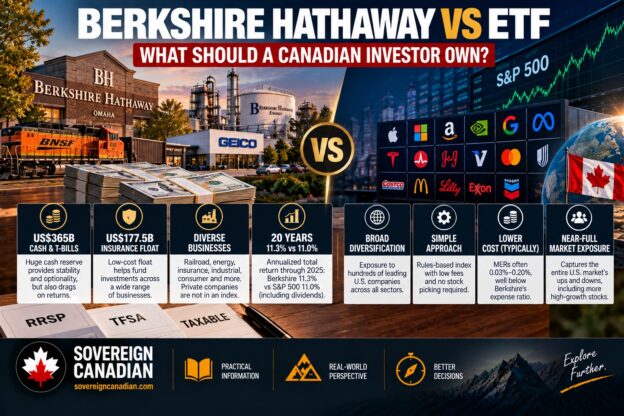
The case for hesitation is easy to state. Berkshire has one of the greatest investment records ever produced, but the Berkshire available in 2026 is not the one Warren Buffett built when it was small. Greg Abel has been CEO since January 1. Warren Buffett is no longer Chairman: on September 18, he became Chairman Emeritus and remained a director, while Howard G. Buffett became Chairman of the Board. The company is worth roughly US$1.1 trillion. At June 30, it held roughly US$365 billion in cash and Treasury bills. And over the 20 years through 2025, it returned about 11.3% a year against 11.0% for the S&P 500 total-return index.
That is essentially a tie.
So why own it instead of the index?
I started this research half expecting to defend the position. I finished with a narrower case for it. Berkshire is not obviously going to beat the market, and I no longer think that is the argument.
The argument is that it is a different kind of U.S. equity exposure, with a different compounding engine and a different set of risks, and that owning some of it alongside the market may be worth the added complexity.
Whether it beats the simplicity of an ETF is a closer call than most Berkshire admirers admit.
What You Actually Own
“Buffett’s stock portfolio” is the first shorthand to drop.
At June 30, 2026, according to Berkshire’s second-quarter 10-Q, the balance sheet held about US$323.8 billion of listed equities, with a cost of about US$106.5 billion. Cash and Treasury bills across Berkshire were roughly US$365 billion before adjusting for unsettled Treasury purchases.
Together, those financial assets are enormous relative to a market capitalization of roughly US$1.08 trillion. I calculate that market value from Berkshire’s share count and the October 2 BRK.B close of US$502.65.
Yet most of what Berkshire earns comes from the businesses it controls.
Berkshire’s second-quarter earnings release shows operating earnings of US$13.0 billion for the quarter, up from US$11.2 billion a year earlier, and US$24.3 billion for the first six months of 2026.
Full-year 2025 operating earnings were US$44.5 billion, according to Greg Abel’s first shareholder letter, down from US$47.4 billion in 2024 but above Berkshire’s five-year average of US$37.5 billion.
Using those figures, my trailing-twelve-month estimate is roughly US$48 billion.
First-half 2026 operating earnings broke down like this:
- US$3.45 billion from insurance underwriting
- US$5.74 billion from insurance investment income
- US$2.94 billion from BNSF
- US$2.01 billion from Berkshire Hathaway Energy
- US$7.67 billion from manufacturing, service and retailing
- US$2.53 billion from other operations and corporate items
So financial assets account for a very large share of Berkshire’s balance sheet and market value, while the controlled businesses generate most of its operating earnings.
You cannot turn that into a tidy sum of the parts. Debt, deferred taxes, insurance liabilities and the liquidity required to support the insurers all sit between those assets and what belongs economically to shareholders.
But it explains the unusual structure of the investment: a massive, conservative financial base attached to an operating conglomerate that does most of the earning.
Float
The structural feature an ETF cannot replicate is insurance float.
When GEICO or one of Berkshire’s reinsurers collects premiums today and pays claims later, Berkshire holds that money in the meantime and can invest it.
At June 30, 2026, Berkshire reported approximately US$177.5 billion of insurance float, up about US$1.1 billion from year-end.
If the insurers underwrite profitably, Berkshire is effectively being paid to hold that capital.
In 2025, Berkshire’s property-and-casualty businesses produced a combined ratio of 87.1%, against a five-year average of 90.7% and a ten-year average of 93.0%. A combined ratio below 100% means underwriting itself was profitable before counting the return Berkshire earned by investing the float.
That is the engine Berkshire was built around.
It is also cyclical. Berkshire’s 2025 letter says additional insurance capital was already pushing pricing lower in several important lines, and Berkshire expects headwinds in 2026 and potentially beyond. Second-quarter 2026 underwriting earnings fell to US$1.73 billion from US$1.99 billion a year earlier.
Float is an advantage, not an annuity.
The ETF Deserves Its Strongest Case
I own a lot of ETF exposure, and I like it, so the comparison has to be fair.
A broad-market ETF gives you extraordinary diversification: roughly 500 companies in an S&P 500 fund and thousands in a total-market fund. It costs almost nothing. Vanguard’s VOO and VTI both charge 0.03%, while Vanguard Canada’s VFV lists a 0.08% management fee and a 0.09% MER in its latest ETF Facts.
More importantly, the index owns the future winners automatically.
I do not have to identify the next Apple, Nvidia or Alphabet before everyone else does. I do not have to judge whether Greg Abel is a good capital allocator. There is no Berkshire-specific insurance risk, utility liability or governance problem to monitor.
And the fund stays invested.
Berkshire is a different proposition.
It can buy entire companies. Berkshire acquired OxyChem in January for roughly US$9.4 billion on the accounting reflected in its June 10-Q. In July, it completed the acquisition of Taylor Morrison for approximately US$6.8 billion of equity value, or US$8.5 billion of enterprise value.
It can buy public securities. In March, Berkshire’s National Indemnity agreed to invest about US$1.8 billion for a 2.49% stake in Tokio Marine as part of a broader strategic insurance partnership.
It can hold hundreds of billions of dollars in cash and Treasury bills for as long as management thinks opportunities are unattractive. It has no investors who can redeem and no mandate to remain fully invested.
It can act when others are forced sellers.
And it can move capital among its businesses without first distributing that money to outside shareholders and creating shareholder-level tax consequences.
Berkshire also charges no separate fund-management fee, although that is not the same as being costless. Corporate overhead and management costs are embedded in the company’s results.
Each of those advantages is valuable only if the person deciding where the capital goes is good at it.
A conglomerate with excellent capital allocation compounds beautifully.
One with mediocre capital allocation destroys value and calls it synergy.
An index fund cannot make that particular mistake because it makes no discretionary capital-allocation decisions at all.
| Berkshire (BRK.B) | S&P 500 / total-market ETF | |
|---|---|---|
| Diversification | One company; insurance, 51 non-insurance operating businesses and a concentrated stock portfolio | Roughly 500 to several thousand stocks |
| Cost | No separate fund-management fee | VOO/VTI 0.03%; VFV 0.08% management fee, 0.09% MER |
| Dividend | None | Roughly 1% currently |
| Cash | Roughly one-third of market value at June 30 | Essentially none |
| Private businesses | Yes | No |
| Insurance float | About US$177.5B at June 30 | No |
| Capital allocation | Discretionary | Rules-based |
| Key-person / manager risk | Yes | Minimal |
| Bull-market participation | Can be dampened by cash and business mix | Essentially full |
| Crisis optionality | Significant | Little |
| Canadian withholding | No shareholder dividend today | Depends on ETF domicile and account |
That last row deserves more attention.
A U.S.-listed ETF such as VOO held directly in an RRSP can benefit from the Canada-U.S. treaty treatment of qualifying retirement arrangements. A Canadian-listed wrapper such as VFV does not necessarily eliminate withholding inside the fund simply because the Canadian investor holds it in an RRSP.
I go through the mechanics more fully in Dividend Tax Treatment in Canada.
Berkshire owns many businesses, but it is not a substitute for owning the market simply because it is diversified internally.
It remains one company with one CEO making the ultimate capital-allocation decisions, a major insurance operation, significant utility and railroad exposure, and a stock portfolio whose five largest holdings — Alphabet, American Express, Apple, Bank of America and Coca-Cola — represented 66% of Berkshire’s listed-equity portfolio at June 30.
In 2025, Berkshire returned 10.9% while the S&P 500 returned 17.9% including dividends.
These are different investments.
The US$365 Billion Question
At June 30, 2026, Berkshire held roughly US$365 billion of cash and Treasury bills across the group before the small adjustment for unsettled Treasury purchases.
That is roughly one-third of its current market value.
The old story — that the cash pile simply grows because Berkshire cannot find anything to buy — is now incomplete.
During the first half of 2026, Berkshire bought US$39.4 billion of equity securities and sold US$27.8 billion. It therefore became a net buyer of stocks.
It also resumed buying its own shares.
Berkshire acquired US$4.8 billion of treasury stock in the first six months of 2026, most of it during the second quarter. And it has continued buying entire businesses.
The cash is being used.
Slowly.
I think the cash is two things at once.
It is a real strategic asset. An insurer needs enough liquidity to absorb very large claims without becoming a forced seller. The same balance sheet lets Berkshire move when capital markets seize up or an unusually attractive acquisition appears.
But cash is also low-return capital.
Berkshire’s first-half insurance investment income fell partly because short-term interest rates were lower. Hundreds of billions sitting in Treasury bills will not compound like an exceptional operating business if equities continue rising.
More important than that drag is what the cash says about Berkshire’s scale.
Size Is the Real Constraint
In his first letter as CEO, Abel put it plainly:
“At Berkshire’s scale, the math of compounding works against us.”
It sounds modest.
It is arithmetic.
My estimate of trailing operating earnings is about US$48 billion. Raising that by 5% requires roughly US$2.4 billion of additional annual after-tax profit. Raising it by 10% requires roughly US$4.8 billion.
If Berkshire bought those earnings at 10 times after-tax profit, adding 5% would require about US$24 billion of acquisitions. At 15 times earnings, it would take US$36 billion.
Adding 10% would require something on the order of US$48 billion to US$72 billion.
Those are my calculations, not Berkshire’s.
Acquisitions are not Berkshire’s only growth mechanism. Its subsidiaries can grow organically and reinvest. BNSF and Berkshire Hathaway Energy can deploy billions into their own networks. Berkshire’s investments can appreciate. Float can grow. Buybacks can increase the ownership represented by each remaining share.
But acquisitions face the size problem most visibly because there are very few businesses large enough to matter.
A US$10 billion transaction would transform most corporations.
At Berkshire, it is incremental.
Buffett has been warning about this for decades. In his 2023 shareholder letter, he wrote that only a handful of U.S. companies are capable of truly moving the needle at Berkshire and concluded that there was “no possibility of eye-popping performance.”
What the Record Says
The historical record is still astonishing.
Berkshire’s own 2025 performance table shows a 19.7% compound annual gain in Berkshire’s per-share market value from 1965 through 2025, compared with 10.5% for the S&P 500 including dividends.
But most of that extraordinary outperformance was created when Berkshire was much smaller.
I recalculated the periods below directly from Berkshire’s annual return series. All periods end December 31, 2025.
| Period through 2025 | Berkshire | S&P 500 total return | Difference |
|---|---|---|---|
| Since 1965 | 19.7% | 10.5% | +9.2 pts |
| 30 years | 11.1% | 10.4% | +0.7 |
| 20 years | 11.3% | 11.0% | +0.3 |
| 15 years | 13.0% | 14.1% | −1.1 |
| 10 years | 14.3% | 14.8% | −0.5 |
| 5 years | 16.8% | 14.4% | +2.4 |
| Since 2009 | 12.9% | 14.8% | −1.9 |
The pattern matters more than any one period.
The further the window moves from early Buffett toward giant Berkshire, the less extraordinary the relative performance becomes.
Twenty years — 11.3% against 11.0% — is effectively a tie.
Over 10 years, 15 years and since 2009, Berkshire lagged. Over five years and 30 years, it beat the index.
None of this means Berkshire has failed.
Compounding at roughly 11% for two decades while becoming one of the largest corporations on earth is exceptional.
But it changes what a buyer in 2026 should expect.
Nobody buying Berkshire at a roughly US$1.1 trillion valuation should be underwriting a 19.7% annual return.
Through October 2, BRK.B was roughly flat for 2026 while the S&P 500’s total return was roughly 14%. The latter is based on secondary total-return data rather than the S&P Dow Jones Indices series, so I would read it as “about 14%,” not attach importance to the second decimal place.
And I would not attach much importance to nine months of relative performance anyway.
Downside Protection: Real, but Narrower Than the Legend
Berkshire’s reputation is that it holds up better in bad markets.
Sometimes it does.
In 2000 through 2002, when the S&P 500 fell in all three calendar years, Berkshire rose in two and declined only 3.8% in 2002.
In 2008, Berkshire lost 31.8% against 37.0% for the index.
In 2022, Berkshire gained 4.0% while the S&P 500 lost 18.1%.
But calendar years can hide a lot.
Berkshire has suffered severe peak-to-trough declines of its own, including during the financial crisis, the COVID crash and the late-1990s period.
So I am comfortable saying Berkshire has sometimes provided meaningful downside protection.
I am not comfortable calling it a low-volatility or low-risk stock.
“Lower risk” needs a definition before it belongs in the thesis.
Succession Is Now a Capital-Allocation Question
This section changed while I was researching the article.
Greg Abel became Berkshire’s CEO on January 1, 2026.
Then, on September 18, Berkshire completed another part of the transition: Warren Buffett became Chairman Emeritus and remained a director, while his son Howard G. Buffett became Chairman of the Board. Susan Decker remains Lead Independent Director.
Warren described the division of responsibilities unusually clearly:
“Greg runs the company; Howard will guard its culture and values.”
That matters because the succession question is no longer theoretical.
Berkshire is already being run by Buffett’s successor.
Ajit Jain remains Vice Chairman responsible for insurance. Ted Weschler manages about 6% of Berkshire’s investments and plays a broader advisory role. Todd Combs, who managed part of the portfolio and also ran GEICO, left Berkshire to head JPMorgan’s Strategic Investment Group.
But the most important sentence comes from Abel’s own letter:
“At Berkshire, equity investments are fundamental to our capital allocation activities; responsibility ultimately resides with me as CEO.”
That is the real succession question.
Operating continuity looks relatively straightforward. Berkshire’s subsidiaries are deliberately decentralized.
Culture now has an explicit guardian in Howard Buffett.
But neither of those is where Berkshire can generate an advantage over an index fund.
The potential advantage is capital allocation.
Buffett’s rare skill was not running railroads or insurance companies. Berkshire has managers for that.
It was deciding where the next dollar should go.
Now Abel has to make those decisions with a trillion-dollar company.
The early evidence is encouraging but far too short to prove anything. Berkshire resumed buybacks, became a net buyer of equities, acquired OxyChem and Taylor Morrison, and entered the strategic investment and reinsurance partnership with Tokio Marine.
None of that tells me whether Abel will become a great capital allocator.
Six or nine months cannot.
And the September chair transition adds an interesting governance wrinkle. Berkshire’s current repurchase policy says the CEO may repurchase shares when, after consultation with the Chairman, he believes the price is below intrinsic value, conservatively determined.
When the June 10-Q was filed, the Chairman was Warren Buffett.
Today the Chairman is Howard Buffett.
The policy is written around the offices, not the names.
That makes the division of responsibilities clearer: Greg Abel runs the company and allocates the capital; Howard Buffett’s board role is primarily stewardship and culture; Warren remains available as Chairman Emeritus and a director.
The question this article keeps returning to therefore remains unanswered:
Can Greg Abel allocate a trillion-dollar company’s capital well enough to justify owning Berkshire instead of simply owning the index?
Dividends and Buybacks: The Same Logic
Berkshire has paid essentially no dividend in the modern era, and the reasoning has remained remarkably consistent.
The Berkshire Owner’s Manual says management tests retained earnings by asking whether each dollar retained creates at least a dollar of market value for shareholders.
And if Berkshire reaches the point where it cannot create additional value by retaining the money, the Owner’s Manual says it will pay the money out and let shareholders allocate it themselves.
Abel’s 2025 letter preserves the same framework:
“Berkshire will not pay dividends so long as more than one dollar of market value for shareholders is reasonably likely to be created by each dollar of retained earnings.”
The board reviews the policy annually.
In 2014, Berkshire shareholders also overwhelmingly rejected a proposal asking the board to consider paying a meaningful annual dividend. That tells us something about the shareholder base at the time, but I would not treat a 2014 vote as proof of what shareholders want in 2026.
The important point is the capital-allocation logic.
Berkshire retains the dollar while management believes it can create more than a dollar of value.
If that stops being true, Berkshire’s own philosophy supports returning it.
I therefore think a regular dividend is possible eventually.
I see no evidence that it is imminent.
And a US$365 billion cash pile does not by itself force one.
Buybacks Are More Flexible
Buybacks are the more interesting distribution mechanism.
Buffett’s rule was simple: repurchasing shares helps continuing shareholders only if Berkshire buys below intrinsic value.
The policy has evolved. Berkshire once used a book-value threshold. Today the 10-Q permits repurchases whenever the CEO, after consultation with the Chairman, believes the shares are below Berkshire’s conservatively determined intrinsic value.
Berkshire will not repurchase shares if doing so would reduce consolidated cash, cash equivalents and Treasury bills below US$30 billion.
The recent history is instructive:
| Year | Berkshire share repurchases |
|---|---|
| 2018 | US$1.3B |
| 2019 | US$4.9B |
| 2020 | US$24.7B |
| 2021 | US$27.1B |
| 2022 | US$7.9B |
| 2023 | US$9.2B |
| 2024 | US$2.9B |
| 2025 | US$0 |
| H1 2026 | US$4.8B acquired |
The first-half 2026 cash-flow statement shows about US$4.4 billion of cash spent because settlement timing differs from the US$4.8 billion of treasury stock acquired. Most of the repurchases occurred during the second quarter.
The zero in 2025 is as interesting as the restart in 2026.
Management is willing to buy when it believes the price clears its test.
It is willing to do nothing when it doesn’t.
I would not treat the 2026 buybacks as proof that Berkshire is cheap.
They tell me management believed repurchases were a sensible use of capital at those prices.
That’s useful.
It isn’t a price target.
Is Berkshire Cheap?
I’m wary of any article that hands you a precise fair value for Berkshire as though it were arithmetic.
The plain numbers are enough to show why.
BRK.B closed at US$502.65 on October 2. Using Berkshire’s latest share count gives a market capitalization of roughly US$1.08 trillion.
Shareholders’ equity at June 30 was about US$748 billion, putting the shares at roughly 1.44 times book value.
My trailing operating-earnings estimate of about US$48 billion implies a multiple around 22 times, but even that needs qualification. Berkshire’s operating earnings include billions of dollars of insurance investment income generated by the enormous Treasury and securities portfolio.
Book value has the opposite problem. Berkshire’s public securities are marked to market, while many controlled businesses sit on the balance sheet at accounting values that bear little relationship to what they would sell for.
Then there is float.
Then deferred tax.
Then debt at BNSF and Berkshire Hathaway Energy.
Then the question of how much of the cash is genuinely excess capital.
I built several rough sum-of-the-parts versions while researching this article. They were useful for me and not useful enough to publish as a “fair value.”
Changing the treatment of cash, deferred taxes, float and the operating-business multiple moves the answer by tens of billions of dollars without changing a single underlying business.
So my conclusion is deliberately less satisfying:
At around US$500, Berkshire does not look obviously cheap. It also does not look obviously expensive.
That matters because it removes one reason to buy.
I am not buying an obviously mispriced security.
The investment case depends on operating growth and what Abel does with the capital from here.
The Canadian Question: RRSP, TFSA or Taxable?
This is where Berkshire gets unusually interesting for Canadians.
The standard advice is that U.S. stocks belong in an RRSP because of dividend withholding.
That is directionally useful, but it is incomplete.
Under Article X of the Canada-U.S. tax treaty, ordinary U.S. dividends paid to a Canadian beneficial owner are generally subject to a maximum 15% U.S. withholding rate. Qualifying retirement arrangements such as RRSPs and RRIFs receive special treatment under Article XXI.
That distinction is why directly held U.S. dividend-paying securities can be particularly attractive inside an RRSP or RRIF.
I cover the broader mechanics in Dividend Tax Treatment in Canada.
But Berkshire pays no dividend.
So that particular RRSP advantage currently has nothing to act on.
It is worth zero today for BRK.A or BRK.B.
That does not make an RRSP a bad place to hold Berkshire.
And it definitely does not mean a TFSA automatically wins.
It means the account decision comes down to the other tax characteristics.
RRSP / RRIF
The RRSP gives you tax-deferred compounding, no T1135 reporting, and favourable treaty treatment if Berkshire eventually begins paying a dividend.
The trade-off is that RRSP and RRIF withdrawals are taxable income.
The capital-gains preference that applies in a taxable account does not survive inside the RRSP.
TFSA
The TFSA gives you tax-free growth and withdrawals, with no T1135 reporting.
Because Berkshire pays no dividend, there is currently no U.S. dividend withholding to lose.
If Berkshire eventually begins paying dividends, the situation changes. The Canada-U.S. treaty’s retirement-plan exemption does not extend to the TFSA, so U.S. dividend withholding would generally become a permanent leakage inside the account.
Taxable Account
A taxable account currently has an interesting feature for Berkshire: no dividend means no annual dividend tax from Berkshire itself.
Capital gains can remain deferred until I sell.
Under Canada’s current rules, 50% of a capital gain is included in taxable income. The proposed increase to two-thirds was ultimately abandoned; Finance Canada’s 2026 tax-expenditure report confirms the government did not proceed with the increase.
For the full Canadian capital-gains mechanics, see my Capital Gains Taxes in Canada deep dive.
The drawbacks are reporting and eventual tax.
T1135
CRA says shares of a non-resident corporation are specified foreign property.
If the aggregate cost, not market value, of all specified foreign property exceeds C$100,000 at any point during the year, Form T1135 can be required.
If the total cost remains below C$250,000 throughout the year, simplified Part A reporting is available. If it reaches C$250,000 or more at any time, detailed Part B reporting is required.
CRA explicitly excludes specified foreign property held inside RRSPs and TFSAs from T1135 reporting. Its broader guidance also excludes registered plans such as RRIFs.
The important point is that the C$100,000 test is based on aggregate foreign-property cost, not whether my Berkshire position alone crosses C$100,000.
Currency Can Create a Gain by Itself
CRA also requires foreign-currency capital transactions to be calculated in Canadian dollars.
The sale proceeds are translated at the exchange rate when I sell. The adjusted cost base is translated using the exchange rate when I acquired the investment.
That means currency alone can create a Canadian capital gain.
Suppose I buy 100 BRK.B shares at US$500 when USD/CAD is 1.25.
My cost is C$62,500.
I later sell at the exact same US$500 price when USD/CAD is 1.40.
My Canadian proceeds are C$70,000.
The stock went nowhere in U.S. dollars.
For Canadian tax purposes, I have a C$7,500 capital gain.
Why You Can’t Compare C$100,000 to C$100,000
This is the part of the account-location question that is easiest to get wrong.
Suppose Berkshire compounds at 8% annually for 20 years, pays no dividend and I make no trades.
C$100,000 grows to:
C$466,096.
The obvious comparison would be C$100,000 in a TFSA against C$100,000 in an RRSP.
That is not an economically fair comparison.
A TFSA contribution uses after-tax money.
An RRSP contribution generates a deduction.
If my marginal rate is 40%, putting C$100,000 into an RRSP does not have the same after-tax economic cost as putting C$100,000 into a TFSA.
So I rebuilt the comparison using the same C$100,000 after-tax economic cost in each case.
| RRSP deduction rate / eventual withdrawal rate | TFSA after 20 years | RRSP after withdrawal tax |
|---|---|---|
| 50% / 30% | C$466,096 | C$652,534 |
| 40% / 40% | C$466,096 | C$466,096 |
| 30% / 50% | C$466,096 | C$332,926 |
The result is exactly what the underlying tax mechanics suggest.
If the tax rate on the deduction and the tax rate on withdrawal are the same, RRSP and TFSA are mathematically equivalent under these assumptions.
If I deduct at 50% and eventually withdraw at 30%, the RRSP wins substantially.
If I deduct at 30% and eventually withdraw at 50%, the TFSA wins substantially.
That is why “TFSA is tax-free and RRSP is taxable” is not enough to compare them.
The RRSP deduction is part of the investment.
I make the same point from another angle in Mortgage Prepayment vs RRSP: the gross RRSP balance is not all spendable wealth, but ignoring the value of the deduction on the way in is equally misleading.
What About Taxable?
With the same C$100,000 starting amount, 8% return, 20-year holding period and a single sale at the end, I independently rebuilt the taxable result using the current 50% inclusion rate.
| Marginal tax rate when sold | After-tax value |
|---|---|
| 30% | C$411,181 |
| 40% | C$392,877 |
| 50% | C$374,572 |
That is roughly 80% to 88% of the TFSA result.
Taxable is worse than a TFSA under these assumptions.
But it is not destroyed by annual tax drag because Berkshire distributes no dividend. Most of the tax is deferred until the end, and only half the gain is included in taxable income.
That makes Berkshire unusually tax-efficient for a U.S. stock held outside a registered account.
What If Berkshire Starts Paying a Dividend?
Now change the same 8% return into:
- 6% annual price appreciation
- 2% dividend
The total pre-tax return is still 8%.
The RRSP result is unchanged under the model because qualifying U.S. dividends can receive the treaty exemption.
Inside a TFSA, assume 15% U.S. withholding on the dividend and reinvest what remains.
The C$466,096 terminal value falls to about:
C$440,874.
For the taxable account, I modelled the dividend as ordinary foreign income taxed at the investor’s marginal rate, with the U.S. withholding credited against Canadian tax where the foreign tax credit is fully usable. Reinvested after-tax dividends increase ACB, and the remaining capital gain gets the 50% inclusion treatment when sold.
The resulting terminal values are approximately:
| Marginal tax rate | Taxable account with 2% dividend |
|---|---|
| 30% | C$378,403 |
| 40% | C$351,412 |
| 50% | C$325,475 |
That is the effect the standard “U.S. stocks belong in an RRSP” advice is trying to capture.
But Berkshire currently does not pay the dividend that creates it.
So there is no universal best account for Berkshire today.
For my own holding, the real question is not simply:
“Is Berkshire American?”
It is:
What tax deduction did I get when the money entered my RRSP, what tax rate will I eventually pay when it comes out, and what would the alternative account have done?
That is a much better question.
U.S. Estate Tax: Filing Isn’t Tax
There is one more cross-border issue worth understanding.
Berkshire Hathaway is incorporated in Delaware.
The IRS says stock of corporations organized under U.S. law is generally U.S.-situated property for a nonresident who is not a U.S. citizen, regardless of where the physical certificate is held.
For directly held Berkshire shares, that brings U.S. estate-tax rules into the picture.
The headline threshold is surprisingly low.
If the date-of-death value of a nonresident non-citizen’s U.S.-situated assets, together with certain adjusted taxable gifts, exceeds US$60,000, the executor can have a Form 706-NA filing requirement.
That threshold is not indexed.
But this is the distinction that matters:
A filing obligation is not the same thing as owing estate tax.
For 2026, the U.S. basic estate-tax exclusion for U.S. citizens and domiciliaries is US$15 million, corresponding to a basic credit of US$5,945,800.
Canadians can access treaty relief through Article XXIX B of the Canada-U.S. treaty, including a pro-rata unified credit based broadly on the proportion of the worldwide estate represented by U.S.-situated assets.
A simplified example shows why the US$60,000 number is so easy to misunderstand.
Suppose a Canadian dies with:
- US$1 million of Berkshire
- US$4 million worldwide estate
The U.S. assets are 25% of the worldwide estate.
Twenty-five percent of the US$5,945,800 basic credit is about US$1.49 million.
The tentative U.S. estate tax on US$1 million before the treaty credit is about US$345,800.
The credit overwhelms the tax.
There can still be a filing obligation, but no U.S. estate tax payable in this simplified example.
Now make the worldwide estate US$20 million while leaving Berkshire at US$1 million.
The U.S. portion is only 5%.
Five percent of the basic credit is about US$297,290.
Against tentative tax of US$345,800, the simplified difference is roughly US$48,500 before deductions, marital provisions and other adjustments.
The IRS also says an executor claiming the treaty’s pro-rata unified credit on Form 706-NA should attach Form 8833 and a copy of the return filed with the treaty partner, or explain why no such foreign return was required.
I go deeper into the same treaty mechanics in US Real Estate Investing for Canadians, because U.S. real estate creates the same basic filing-versus-tax distinction.
One thing I am deliberately not asserting here is that the result is automatically identical when Berkshire is held through an RRSP, RRIF, TFSA or FHSA.
The IRS guidance clearly establishes the situs rule for stock of a U.S. corporation, but I have not found sufficiently authoritative guidance establishing how the ownership structure of every Canadian registered plan interacts with that rule.
That distinction matters too much to bluff through.
If your U.S. securities and worldwide estate are large enough for the estate-tax calculation to matter, this belongs with a qualified Canada-U.S. estate professional, not a rule of thumb from an investing article.
And if your estate planning is not current in the first place, start with Your Will Is Not Optional.
BRK.A or BRK.B?
For almost every ordinary Canadian investor, BRK.B.
Berkshire’s filings establish the relationship precisely:
- One Class A share has the economic rights of 1,500 Class B shares.
- One A share can be converted into 1,500 B shares.
- B shares cannot be converted back into A.
- Each B share carries 1/10,000 of the voting rights of one A share.
That means 1,500 B shares have the same economic interest as one A share but only about 15% of its voting power.
At a BRK.B price around US$503, the equivalent Class A value is roughly US$754,000.
For an ordinary investor who does not care about Berkshire voting power, there is no meaningful investment advantage to owning A shares.
BRK.B is the practical choice.
Why I Still Own It
I’m not defending the position so much as stating what survived the audit.
I own Berkshire for six reasons.
The balance sheet is stronger than almost any large company’s.
The insurance float has been cheap or better than free over long periods.
The operating businesses are durable.
Management has capital-allocation flexibility an index fund cannot have.
The cash creates crisis optionality.
And Berkshire can retain and redeploy capital without forcing shareholders to realize income every year.
What I am not doing anymore is holding Berkshire because I expect it to reproduce Buffett’s historical outperformance.
The last two decades do not support that assumption.
The size arithmetic argues against it.
The case I can defend is narrower: Berkshire can potentially produce attractive long-term compounding through a different mechanism and with a different set of risks from the index.
That is useful to me because I already own broad-market investments.
It is a weaker claim than saying Berkshire will beat the market.
I think it is a truer one.
What Would Make Me Sell?
I don’t want a generic risk list.
These are the things that would actually change my mind.
The first is a pattern of poor capital allocation under Abel: overpriced acquisitions, repeated weak equity investments or evidence that Berkshire is putting cash to work simply because the pile has become uncomfortable.
One mistake would not do it.
A pattern would.
The second is deteriorating underwriting discipline. Float is valuable because Berkshire has historically been willing to walk away from badly priced insurance business. Chasing premium volume to keep float growing would damage one of the central reasons I own the company.
The third is governance deterioration.
The September transition actually makes the structure clearer than it was when I started researching this article: Abel runs the company, Howard Buffett chairs the board and is explicitly charged with guarding the culture, Warren remains Chairman Emeritus and a director, and Susan Decker remains Lead Independent Director.
If that division begins to break down, I would pay attention.
The fourth is valuation.
If Berkshire traded materially above any defensible estimate of intrinsic value, I would be selling to someone paying for the Berkshire reputation.
I do not have a precise number.
I do not trust anyone who claims to have one.
The fifth is evidence that size has permanently impaired Berkshire’s ability to compound attractively: cash piling up year after year while management repeatedly says there is nowhere productive to deploy it.
The sixth is material deterioration in major operating businesses — BNSF, Berkshire Hathaway Energy, the manufacturing group — or a significant worsening of liabilities such as wildfire exposure at the utilities.
What is not on my list is relative underperformance for a year or two.
Berkshire is roughly flat this year against an index up about 14%.
That is not a thesis breaker.
If a short period of lagging the S&P 500 were enough to sell Berkshire, I would have sold it several times already.
So Would I Buy It Today?
If I were starting with cash today, would I still buy Berkshire?
Yes. But not instead of owning the market.
For a Canadian building a portfolio from scratch, the broad-market ETF comes first.
It is simpler.
It is vastly more diversified.
Its cost is almost irrelevant.
It automatically owns the future winners.
And it does not require me to decide whether Greg Abel is the next great capital allocator.
For an investor who already has that foundation and deliberately owns individual companies, Berkshire remains one of the more defensible concentrated positions I know of.
It combines insurance float, private operating businesses, enormous financial strength, permanent capital, crisis optionality and discretionary capital allocation in a way an index fund cannot replicate.
Would I replace my entire U.S. equity allocation with Berkshire?
No.
One company, however internally diversified, is not the market.
And the evidence no longer supports assuming that Berkshire ownership comes with automatic index outperformance. It has essentially matched the S&P 500 over 20 years and lagged it over 10 years, 15 years and since 2009.
A buyer today should expect something much closer to ordinary equity-like returns than Buffett’s historic 20% compounding.
At roughly US$1.1 trillion and about 1.4 times book, Berkshire is priced as the exceptional company it is, not as an obvious bargain.
With an ETF, I’m betting on American business.
With Berkshire, I’m betting on American business and on Greg Abel’s ability to allocate a trillion-dollar company’s capital.
Howard Buffett now has the job of guarding the culture.
Warren Buffett remains in the room.
But Greg Abel has the money.
That additional bet is the only reason Berkshire can add something the index does not.
It is also exactly the risk the index does not carry.
And for now, it is a risk I am still willing to take.
This article reflects my own investment research and how I think about my portfolio as a Canadian investor. It is not individualized investment, tax or legal advice. Cross-border tax and estate rules depend on personal circumstances and change over time; verify material decisions with the relevant tax or legal professional.