
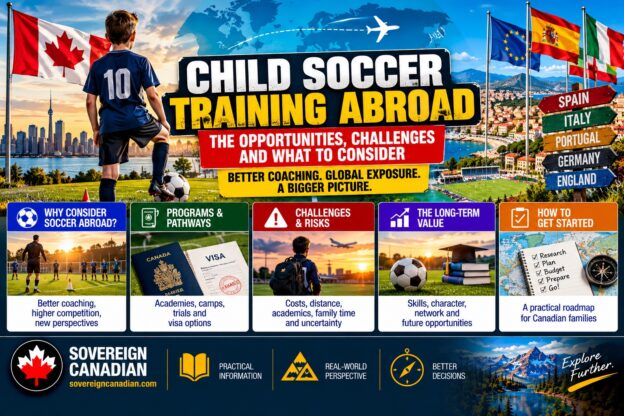
A year abroad can change a 10-year-old’s game, but FIFA’s rules for registering minors mean the paperwork, not the talent, decides how much of that year he spends playing matches.
Child soccer training abroad is one of the best reasons to take an expat year, and one of the easiest to get wrong.
Picture a Canadian family that lands in southern Europe in late summer. The apartment is rented, the school is sorted, and their 10-year-old has found a club that trains four evenings a week. He has played rep soccer in Ontario since he was seven and he cannot wait to start. Then the club asks for something the family has never heard of: FIFA approval to register a child who is not a national of that country. Weeks pass. He trains with the squad and plays friendlies, and he watches the official league fixtures from the sideline.
The details in that picture are illustrative, but the core of it is documented. A Canadian family that moved to Portugal with two soccer-playing sons wrote up their own experience. Their son trained and played friendlies but sat out nearly an entire official season while the registration worked through the system, even though the whole family held EU citizenship.
The soccer is the easy part. A 10-year-old who wants to train will find a pitch, a coach and a squad in almost any European city. The hard part is the legal frame around a child moving countries, and age 10 happens to be the exact point where FIFA’s process gets heavier. This post covers how that process works, what it does to the calendar of a one-year stay, how Portugal, Spain and the Netherlands compare, and what an Ontario family needs to protect at home. It builds on The Expat Year with Kids, which covers the age windows and the schooling models.
Why Age 10 Is Where the Rules Change
FIFA’s Regulations on the Status and Transfer of Players prohibit the international transfer of any player under 18, with a short list of exceptions. The one that matters for an expat family is the first: the player’s parents move to the country of the new club for reasons not linked to football. A family relocating for lifestyle, work or remote-work reasons fits that description on its face, but it has to be shown with documents. The operative wording is in Article 19, reproduced in the 2024 edition published by England’s Football Association.
Three further paragraphs decide how it works for a child like this. Paragraph 3 applies the same protection to a player who has never been registered with a club, is not a national of the country, and has not lived there continuously for at least five years. A child registered in Ontario therefore counts as an international transfer, and a child who has never been registered anywhere counts as a first registration by a non-national. Either way, Article 19 applies.
Paragraphs 4 and 5 set the age line. Where a minor is at least ten years old, FIFA’s Players’ Status Chamber must approve the transfer or first registration, and that approval has to come before any request for the transfer certificate or any first registration. For a player under ten, paragraph 6 leaves the check to the national association that will register him, with no application to FIFA. A 9-year-old and a 10-year-old can land in the same city on the same day and face two different procedures. If his birthday sits close to your arrival, ask the destination federation which procedure it will apply.
Paragraph 7 is the relief valve. A national association can ask FIFA for a limited minor exemption covering amateur players at purely amateur clubs, which lets the association handle the verification itself instead of sending each file to FIFA. The Dutch federation holds one. I could not confirm which other federations do, which makes it the first question to put to any club you are considering.
One caution on currency. FIFA says a revised set of its transfer regulations, approved in June 2026, takes effect on January 1, 2027, and the changes include new provisions concerning contracts of minor players. FIFA also published a new edition of its Guide to Submitting a Minor Application in February 2026. The Article 19 text I read is the 2024 edition, so read the wording in force on the date your club files.
What the Paperwork Looks Like in Practice
The family in Portugal describes the process in plain terms. The club, not the parents, files the case: it submits through the national federation, which passes it to FIFA. FIFA wants proof that the move is not about football, and the family lists work contracts, school enrolment and residency documents as the kind of evidence needed. They chose their club for its people and atmosphere, and only later learned their son was its first international transfer, which is why they tell other families to look for a club that has done it before. He could train and play friendlies throughout, but he could not play in the official youth league for nearly the whole season.
FIFA’s review is only one of the clocks. The Dutch federation says FIFA takes about two to four weeks to handle a minor’s file once it is in the system, and that the request to release the player from his previous federation can only be sent after FIFA approves. How long that release takes depends on the foreign club and the foreign federation. For a child registered in Ontario, that federation is Canada Soccer.
The calendar matters as much as the paperwork. For 2026/27 the KNVB lists men’s international transfer windows for Dutch clubs running from June 22 to September 2, 2026 and from January 4 to February 2, 2027, and it says a first registration can go through until the first Friday of March. A request filed after a window closes is treated as a dispensation request, and one filed after the first Friday of March can only be approved on the condition that the player does not play in the club’s binding matches that season. The women’s windows differ by a day or two, and other countries run their own calendars. Also, the Portugal family notes that club tryout timing often does not line up with North American schedules. The point carries everywhere: arrive and file with the registration window in mind, not just the school term.
One more rule to know. FIFA’s trial regulation, Article 19ter, limits minors to trials that begin in the season of their 16th birthday, or their 15th if both the player and the club are based in Europe. A trial week is not a plan for a 10-year-old. The Portugal account describes a child training and playing friendlies while he waited, so the practical question for any club is what a not-yet-cleared 10-year-old is allowed to do. Ask it before you land, not after.
Child Soccer Training Abroad: Portugal, Spain and the Netherlands
I narrowed this to three countries because their soccer systems are strong and I could verify how each federation handles a foreign minor. The table shows what I found, including the gaps.
| Portugal | Spain | Netherlands | |
|---|---|---|---|
| Who files with FIFA | The club, through the national federation, per one Canadian family’s account | The club works through its regional federation, which uploads the file to the national federation (RFEF) | The KNVB submits through FIFA’s system itself, and the club supplies the documents |
| Limited minor exemption | Not confirmed | Not confirmed | Held by the KNVB |
| Published timing | Nearly a full season lost in one family’s case | Not published in the sources I found | FIFA review of about two to four weeks per file, plus the release from the previous federation |
| Residence route for a lifestyle year | See the Portugal guide | See the Spain guide | No lifestyle category on the immigration authority’s list |
Portugal. This is where the best first-hand evidence for Canadians exists, which is why I trust it most and why it is also the cautionary tale. The family’s account says promotion and relegation apply in the youth leagues, so a club’s division decides the level of competition his son will face. One of their sons now plays for the first-division youth team of a Liga Portugal 2 club, so the route works once the registration clears. Benfica, Sporting CP and FC Porto all run academies, but for a family arriving on a lifestyle year I would treat a local club in a competitive division as the realistic target, not a place in a pro academy. Residence routes, costs and tax are covered in Living in Portugal as a Canadian.
Spain. Spain’s case rests on a reputation for technical, possession-based development, with Barcelona’s La Masia the best-known example. For a foreign minor, the RFEF’s own procedure manual says the club contacts its regional federation, which uploads the documents to the national system, and that either the RFEF or FIFA can ask for more before a licence is issued through the regional federation. The manual carries no date, so confirm the procedure is current. In plain terms, the club is your contact and its regional federation office is the real counterpart. Ask whether that office has handled a Canadian minor before. Residence, schools and costs are in Living in Spain as a Canadian.
The Netherlands. This is the best-documented process I found. The KNVB’s page says only the KNVB can submit a minor’s request to FIFA, the club must supply the documents, and the player is not eligible until the KNVB confirms in writing to the club. For players under ten, only a notification to the previous federation applies, with no FIFA approval, though one of the exceptions must still be met. The Dutch academies, Ajax and PSV being the best known, are long associated with structured, positional development.
The catch is entry. The Dutch Immigration and Naturalisation Service organizes its residence permits around family, work, study, au pair and exchange, EU residency and a few humanitarian categories, and I could not find a lifestyle, remote-work or retirement purpose on the list. Self-employed and start-up permits exist, so the Netherlands works when a parent has a genuine work or business basis there. Without one, it is the hardest of the three to enter.
Italy and Croatia. I have not verified the registration process for either country, so I am not making the soccer case for them here. The rest of the picture is in Living in Italy as a Canadian and Living in Croatia as a Canadian, and the wider series sits in the Expat Living for Canadians hub.
Schooling Has to Fit Around Training
The three schooling models in The Expat Year with Kids still apply: international school, local school, or online. Soccer adds two constraints.
First, school enrolment is part of the evidence FIFA wants in the Portugal account, so the school has to exist on paper before the club files. Second, paragraph 8 of Article 19 puts a duty of care on the registering club and requires it to make sure the minor has the opportunity to obtain an academic education, so expect the club to ask where he goes to school.
Then there is the plain logistics. A long commute to an international school can swallow the evening training slot. Ask the club for its schedule before you choose the school, not after.
The Canadian Side: Residency, Health Coverage and Coming Home
Tax residency. A year abroad does not automatically end Canadian tax residence. The CRA’s position in Income Tax Folio S5-F1-C1 is that unless you sever all significant residential ties, you remain a factual resident. A dwelling in Canada, a spouse and dependants will almost always count as significant ties, and the courts have generally treated a temporary absence, even an extended one, as insufficient to avoid Canadian residence. Leasing your home to an arm’s-length tenant can change how much weight the dwelling carries. The tax side of renting out your home is in Renting Out Your Primary Residence.
The destination country may also treat you as resident. Where both claim you, the treaty tie-breaker looks first at where you have a permanent home available, then at your centre of vital interests. The CRA suggests that people leaving temporarily consider filing Form NR73 for an opinion on residency status, though the folio says the opinion is not binding on the CRA. The way citizenship, foreign immigration status, Canadian tax residence and provincial health insurance move independently is covered in Snowbird vs Full Relocation. See also the residency flag post.
OHIP. For Ontario families, Ontario’s guidance says you can keep OHIP for up to two years while outside Canada for more than seven months in a 12-month period, provided you have a valid health card, keep Ontario as your primary home, and were in Ontario at least 153 days in each of the two 12-month periods immediately before you leave. Before you go, take your health card and proof of residency to a ServiceOntario centre. The page extends family coverage explicitly only for full-time study or work, so confirm with ServiceOntario how your children are treated on a lifestyle year. Other provinces set their own rules.
Coverage abroad is thin. OHIP pays up to CAD 50 per day for emergency outpatient hospital services and CAD 200 or CAD 400 per day for inpatient care, depending on the unit, and it does not pay to transfer you home. Ontario recommends private insurance. A 10-year-old playing competitive soccer in another country is a plausible candidate for a fracture or a knee injury, so private insurance that includes repatriation is part of the plan, not an extra.
Coming home. The paperwork runs both ways. Ontario Soccer says any player aged 10 or older who was last registered in another country needs an International Transfer Certificate before he can register in Ontario. For minors between 10 and 17 that means the player’s passport and birth certificate, both parents’ passports, proof that the parents live in Canada, and a parent and club declaration. Canada Soccer’s ITC guide applies the same logic to Canadian minors returning after playing abroad, who must complete a Minor ITC application.
What I’d Actually Do
If I were setting this up for a 10-year-old who wanted it badly, this is the order I would work in.
- Lock the residence route and the school first. The documents FIFA asks for, as the Portugal family describes them, come from the work contract, the school enrolment and the residency paperwork.
- Choose the arrival date from the federation’s registration windows, not from the school calendar alone. A spring arrival can mean a season without league matches.
- Pick the club on one question before any other: has it registered a foreign minor before? Ask for the name of the person who files the paperwork.
- Ask the federation in writing whether it holds a limited minor exemption for amateur minors, and which procedure applies at his exact age.
- Start the file before leaving. Passports, birth certificate, proof of residence and his current Ontario registration details are all documents someone will ask for.
- Treat training and friendlies as the baseline and league matches as the upside. If the year only works with a full league season, say so to the club in the first conversation and ask what is realistic.
- Before leaving Ontario, visit ServiceOntario with the health card and proof of residence, and buy private insurance that includes repatriation. Plan the return registration with the Ontario club at the same time, because the Minor ITC applies on the way back.
The Short Version
Age 10 is a good age for this year. He is old enough to absorb a different coaching culture and young enough that the transfer rules have not closed around him the way they do at 16. But the year is only as good as the registration behind it. A family that plans around the federation’s calendar, files early through an experienced club, and protects its Ontario ties gives a 10-year-old a season of real matches. A family that plans around the nicest city may give him a season of friendlies.
This article is general information for Canadian families researching soccer training and life abroad. It is not individualized legal, immigration, tax, insurance or sports-regulatory advice. FIFA’s regulations, national federation procedures, visa routes and provincial health rules change, and this article reflects sources checked in October 2026. Anyone planning to register a child with a club abroad should confirm the current process with the club, the destination federation, Canada Soccer or the provincial association, and qualified immigration and tax professionals before acting.