
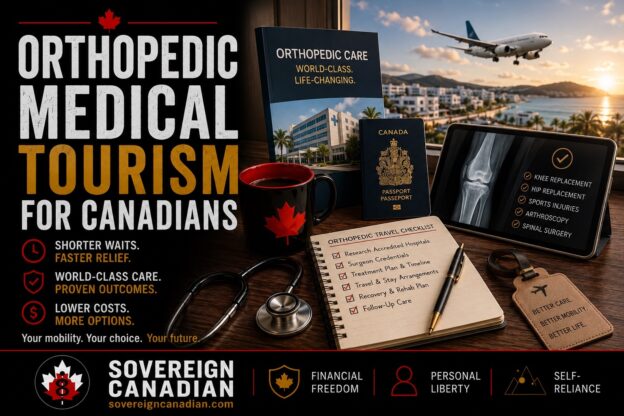
This is a deep dive in our medical tourism series, and it covers the procedure that pushes more Canadians onto a plane than almost any other. Orthopedic medical tourism is the queue-jumper’s category — the one where you already qualify for the surgery at home, the system agrees you need it, and the only thing standing between you and a working joint is a waitlist measured in seasons rather than weeks.
The math here is unusual. Unlike dental or cosmetic work, a hip or knee replacement is covered by your provincial plan. So the arbitrage isn’t really about money — it’s about time, and about the mobility you quietly lose while you wait for your name to come up. That changes how you should think about the whole decision. Let’s get into the numbers.
One thing up front, same as last time: I’m not a doctor, and this isn’t medical advice. It’s a framework.
Why Orthopedics Is the Queue-Jumper’s Category
Start with the wait, because the wait is the entire reason this category exists.
The Fraser Institute’s 2025 Waiting Your Turn survey put the median orthopedic wait — from GP referral all the way to treatment — at roughly 48.6 weeks nationally. That’s the median, and it’s an average of some genuinely alarming provincial numbers. In Alberta, the median wait for orthopedic surgery, including hip and knee replacements, hit 66.8 weeks last year. That’s not a typo. That’s a year and three months from the day your doctor agrees you need a new joint to the day you get it.
The official benchmark, for context, is 26 weeks. And even against that generous target, the system is slipping. According to CIHI, only 68% of hip-replacement patients and 61% of knee-replacement patients got their surgery inside the 26-week window in 2024 — both figures below pre-pandemic levels, despite hospitals doing more procedures than ever.
Here’s why that matters more for orthopedics than for almost anything else: a degenerating joint doesn’t wait politely for its appointment. Every month on the list is a month of lost mobility, muscle wastage from disuse, worsening cartilage, and pain management that too often means opioids. Some of that mobility you get back after surgery. Some of it you don’t. So the cost of the wait isn’t just discomfort — it’s a slow, permanent tax on your range of motion. That’s the queue-jumper’s actual calculation, and it’s why roughly 75,000 knee replacements a year in Canada aren’t enough to clear the backlog.
This post is about replacement — the surgical fix. Some patients facing a degenerating joint go looking for a way to delay or avoid it entirely, which usually leads them to regenerative options like stem cell injections. That’s a genuinely different market with a genuinely different risk profile, and it gets its own honest treatment in our stem cell therapy abroad deep dive. Here, we’re dealing with the joint that’s already past saving.
The Math: What a New Joint Actually Costs
If you wanted to skip the line inside Canada, you’d go private — and private orthopedic surgery in North America is expensive. A knee replacement purchased out-of-pocket runs $35,000 and up; hip replacements land in similar territory. That’s the number the rest of the world is competing against, and it’s what makes the orthopedic medical tourism math work.
Here’s roughly what the same surgery costs at internationally accredited hospitals abroad, in Canadian-relevant US-dollar terms. Treat these as directional — they move with the exchange rate, the implant brand, and your specific case complexity.
| Procedure | Canada (private) | India | Turkey | Malaysia | Cayman Islands |
|---|---|---|---|---|---|
| Total knee replacement | $35,000+ | $6,000–$9,000 | $8,500–$13,000 | $9,000–$13,000 | $18,000–$25,000 |
| Total hip replacement | $35,000+ | $7,000–$9,000 | $9,000–$14,000 | $9,500–$14,000 | $15,000–$20,000 |
| Spinal fusion / disc | $40,000+ | $8,000–$14,000 | $12,000–$20,000 | $12,000–$18,000 | Priced per case |
A few things jump out. India is the deep-value floor — knee replacements there can start around $6,000 at top-tier hospitals, roughly a sixth of the North American private price. Turkey and Malaysia sit in the mid-range, buying you a more polished patient experience for a few thousand dollars more. And the Cayman Islands look expensive on this table — because they are, relatively — but hold that thought, because for a Canadian the Cayman price includes something the others don’t: proximity.
The Destinations That Matter for Orthopedic Medical Tourism
Not every medical tourism destination is strong in orthopedics specifically. For orthopedic medical tourism, these five are the ones where the volume, the accreditation, and the joint-replacement track record actually line up.
India — the deep-value powerhouse
India is where you go when cost is the driver and you’re willing to travel far for it. The top hospital groups — Apollo, Fortis, and Max — hold JCI and NABH accreditation, and their surgeons operate at case volumes that dwarf anything in Canada. Chennai and Ahmedabad in particular are joint-replacement hubs. The trade-off is distance (the flight home is the problem — more on that below) and sharp quality variance the moment you step outside the accredited Tier-1 system. Stay inside it.
Turkey — infrastructure at a discount
Turkey processes roughly 1.8 million health tourists a year and hosts around 42 JCI-accredited hospitals, mostly clustered in Istanbul. The orthopedic pricing runs 50–70% below Western private rates, and the hospital infrastructure genuinely rivals the West. Turkey’s reputation has taken hits in the cosmetic and dental space — the “Turkey teeth” and hair-mill problem is real — but that’s a floor problem, not a ceiling problem. The top orthopedic centres are excellent; your job is to stay well clear of the bottom.
Malaysia — the regulated value play
Malaysia is the quietly sensible choice. It offers 60–80% savings, English as the default language in medical settings, over 70 internationally accredited facilities, and — unusually — a government agency, the Malaysia Healthcare Travel Council, that actively regulates the sector. Penang and Kuala Lumpur are the hubs. Less famous than Bangkok, frequently better value, and the regulatory backstop is worth real money in peace of mind.
Thailand — the polished experience
Thailand offers the most refined patient experience in the business, with Bangkok’s flagship hospitals running Western-or-better nursing ratios. Orthopedics is strong here, and recovery in Thailand is genuinely pleasant. The catch is the same one that dogs all of Asia for a Canadian: it’s a very long way home on a freshly operated leg.
Cayman Islands — the shortest-haul serious surgery
This is the one that changes the equation for Canadians, and it’s why the Cayman price on that table isn’t as steep as it looks. Health City Cayman Islands is a JCI-accredited tertiary hospital, built in 2014 by one of India’s most renowned surgeons and staffed largely by India-trained specialists — so you get the Indian volume-and-expertise model, but an hour’s flight from Miami and a direct hop from Toronto instead of a 20-hour haul across the planet.
It runs transparent bundled pricing — one number, quoted before you leave home, covering surgery, implant, hospital stay, and rehab — which is a meaningful contrast to the multi-bill American private model. One Canadian patient’s documented experience: hip surgery within hours of landing, discharge in three days, two weeks of island rehab, then home. For orthopedic medical tourism specifically, where the flight home is the single biggest risk, that geography is worth paying a premium for.
The DVT Problem Nobody Wants to Price In
Now the part the brochures skate past — and the single most important variable in orthopedic medical tourism when the procedure is a lower-limb joint.
You cannot safely get on a long-haul flight days after joint surgery. Both major lower-limb orthopedic surgery andprolonged flying independently raise your risk of deep vein thrombosis — a blood clot in the leg that can travel to your lungs and kill you. Combine the two too closely and you are stacking risk on risk. Studies estimate that 3–4% of hip-replacement patients develop a symptomatic clot within three months of surgery even without flying anywhere.
Here’s where the orthopedic medical tourism industry gets slippery. You’ll see “fly home in 10–14 days” quoted constantly, and 10–14 days does get most patients mobile and past the sharpest acute window. But that is not the same as cleared for a long-haul flight. Ask actual arthroplasty surgeons and the advice runs materially longer: many recommend avoiding flights over four hours for at least four to six weeks, and up to three months for higher-risk patients. The NHS default is to avoid long-haul flying for three months post-op unless your surgeon prescribes anticoagulants and signs off early. Some airlines will even ask for medical clearance and can refuse boarding without it.
This reshapes the whole cost model, and it’s why it belongs here and not buried in a footnote:
- The two-week trip is often a fantasy for long-haul destinations. If your surgeon wants you grounded for four-plus weeks and you’re in Chennai or Bangkok, you’re either booking a month-plus of accommodation or flying home earlier than is ideal and managing the risk with blood thinners and compression. Neither is free.
- This is the Cayman argument in one sentence. A three-and-a-half-hour flight from Grand Cayman to Toronto is a fundamentally different DVT proposition than a 20-hour multi-leg journey from Southeast Asia. Shorter haul, less time immobile, lower risk — which is exactly why proximity is worth paying for in this category specifically.
- Budget for the real timeline, not the marketing one. Compression stockings, prescribed anticoagulants through the flight, a bulkhead or extra-legroom seat, and pre-booked wheelchair assistance aren’t optional extras. They’re the standard of care.
Get your surgeon’s fit-to-fly assessment in writing before you book the return flight. Not the clinic’s coordinator — the surgeon.
The Diligence Checklist: Surgeon, Not Hospital
This is the part of orthopedic medical tourism that separates a good outcome from a bad one, and it’s almost entirely on you. Accreditation is your minimum filter, not your diligence. A JCI plaque tells you the building meets international protocols. It tells you nothing about whether your surgeon is any good. For orthopedics, drill into these:
- Surgeon-specific volume. How many of your exact procedure does this specific surgeon perform per year? High-volume joint surgeons have measurably better outcomes. You want hundreds, not dozens.
- The implant brand. Confirm you’re getting a current-generation implant from a recognized manufacturer (Zimmer Biomet, Stryker, DePuy, Smith+Nephew) — not an unbranded discount component. Get the make and model in writing.
- Revision-and-complication rates. Ask directly. A confident high-volume centre will have the numbers. Evasiveness is your answer.
- The records-home protocol. You need every operative note, imaging file, implant sticker, and discharge summary — in English — before you leave the country. If something goes wrong back in Ontario, the Canadian surgeon inheriting your case needs to know exactly what’s inside your leg.
Treat clinic marketing the way you’d treat a pre-construction condo brochure — the way we treat every glossy pitch in the real estate series. The Instagram testimonials are the account, not the audit.
Total Cost of Ownership
The sticker price is never the real price. Run the full model before you decide orthopedic medical tourism beats waiting:
- The procedure — the bundled quote, confirmed in writing.
- Extended in-country recovery — and for orthopedics, budget the real fit-to-fly window, which may be weeks longer than the brochure’s two.
- Flights for you and a companion — you will need help; this is not a solo trip.
- Specialized medical-travel insurance — your regular travel policy almost certainly excludes elective surgery and its complications.
- A 15–20% contingency — because the point of a contingency is that you can’t predict what it’s for.
Even loaded with all of that, the savings against a $35,000 private North American quote usually survive comfortably. But run your numbers, not the headline.
And keep every receipt. There’s a federal Medical Expense Tax Credit angle worth understanding: the CRA generally lets you claim eligible medical expenses paid outside Canada, provided a licensed practitioner performed the service at a licensed facility — and reasonable travel costs can qualify too. It’s a non-refundable credit, not a rebate, but on a five-figure surgery it takes a real edge off the net. Keep everything in English, with the provider’s licensing details attached.
When Orthopedic Medical Tourism Doesn’t Make Sense
Honesty cuts both ways, so here’s when to stay home and keep waiting:
- Complex revisions. A failed prior implant, significant bone loss, or a difficult revision is not the case to hand to a surgeon 8,000 km away who can’t see you for follow-up.
- Serious comorbidities. Poorly controlled diabetes, cardiac disease, a clotting disorder, or high BMI all raise your surgical and DVT risk. That flight home gets more dangerous, not less.
- No support system. If nobody can travel with you and stay through recovery, the logistics alone can turn a good decision into a bad one.
For a straightforward primary hip or knee replacement in an otherwise healthy patient facing a year on the list, orthopedic medical tourism is a strong trade. For anything complicated, the wait may genuinely be the safer buy.
The Verdict
Orthopedic medical tourism is the purest expression of the queue-jumper thesis: the surgery is covered, the system agrees you need it, and you’re paying out of pocket for one thing only — to get your mobility back this quarter instead of next year. Done well, it’s a knee replaced in month two instead of month fourteen, at a fraction of the private price, with a fit-to-fly clearance in writing and a companion beside you. Done badly, it’s a discount surgeon, an unbranded implant, and a blood clot at 38,000 feet because someone quoted you a ten-day recovery on a month-long procedure.
The difference between those two outcomes isn’t luck. It’s diligence — surgeon volume over hospital marketing, the real DVT timeline over the brochure’s, total cost of ownership over sticker price. Do that work, and for the right patient this is one of the most rational trades in medical tourism.
And before you book a joint replacement, it’s worth getting a clean read on what else is going on — which is its own argument for our diagnostic medical tourism deep dive, where an 18-week MRI wait becomes a two-day executive screen. Bariatric surgery and the destination deep dives are next up. If there’s a procedure or country you want moved up the queue, say so in the comments.
Disclaimer: This article is for general information only and is not medical, legal, or tax advice. Medical decisions should be made with qualified physicians, including your Canadian care team. Costs, wait times, and regulations cited are estimates as of mid-2026 and will change. Verify accreditation, credentials, and pricing directly before committing to any treatment abroad.