
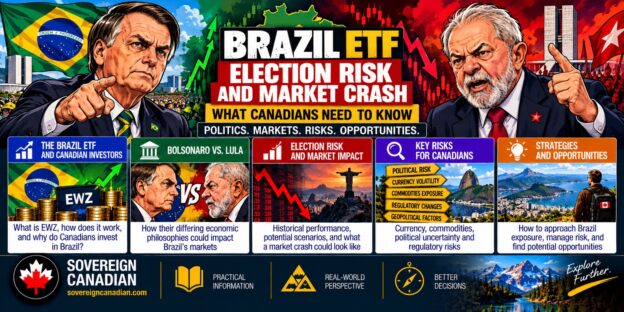
Brazilian markets just had one of their worst days in decades. Lula won a fourth term on Sunday, October 25. On Monday the Ibovespa closed down 13.9%, the real lost about 8.8% against the US dollar, and the iShares MSCI Brazil ETF (EWZ) fell 19.8%, its second-worst day since it launched in 2000.
So is the crash a reasonable entry point for a small Brazil ETF? My answer is a qualified yes, but not for the reason the headlines suggest. The selloff tells you more about positioning than about Brazil’s economy. That distinction changes how you should buy.
A quick note on timing: I’m writing this on Tuesday, October 27, and every figure below uses Monday’s close. Prices will keep moving, so check the live quote before you act.
What Happened in Brazil’s Election
Brazil votes in two rounds. On October 4, Senator Flavio Bolsonaro, son of former president Jair Bolsonaro, finished first with 47.03% of the vote. Lula took 45.16%. Nobody cleared 50%, so the two met in a runoff on October 25.
Markets loved the first round. The Ibovespa jumped 7.7% the next day and EWZ gained about 12%. Bolsonaro’s Liberal Party also had a big night in Congress. It lifted its Senate seats from 15 to 28 and won 121 lower house seats. Prediction markets moved with the mood, and before the runoff they priced Bolsonaro at roughly 80% to win.
Then Lula won. He took 51.79% to Bolsonaro’s 48.21%, a margin of about 4.4 million votes. He is the first candidate since Brazil returned to direct elections in 1989 to win a runoff after finishing second in the first round.
The night wasn’t clean. Voting was extended nationwide by two hours at Lula’s request because of transport problems in some cities. Bolsonaro cried foul and said he would seek to annul the result. His own party has since said it recognizes the result proclaimed by the electoral court. That doesn’t end the dispute, but it narrows it.
Why the Brazilian Stock Market Crashed
Here’s the part that looks odd at first. Lula is the incumbent, so his win means more of the same, not a new policy shock. Why would the Ibovespa fall as much as 17% in one session?
First, the market had bet the other way. Foreign money poured in after the first round. EWZ closed the prior Friday up about 34% for 2026, and investors had put roughly USD 4 billion into the fund in October alone. When the result landed, that trade unwound in a single session. An eToro strategist described it as investors reversing positions, not a sudden break in Brazil’s economy.
Second, the fiscal picture is ugly. Brazil’s consolidated public sector ran a nominal deficit of 9.99% of GDP in the 12 months to June. Interest costs alone were 8.80% of GDP, and gross debt is above 80%. Investors had hoped Bolsonaro would cut spending. Vontobel’s Thierry Larose expects Lula to attempt some consolidation, but says most investors doubt it will be enough to stabilize the debt.
Third, the plumbing buckled. The exchange, B3, halted trading for 30 minutes after a 10% drop, its first circuit breaker since March 2020. The index hit an intraday low of 169,516, down 17.34%, before closing at 176,608. BTG Pactual had warned before the vote that a Lula win could push the index to about 170,000, so the low landed almost exactly there.
The stress spread beyond stocks. Brazil’s Treasury cancelled its bond auctions scheduled for this week, and the 10-year government yield climbed above 15%. JPMorgan moved its view on the real and Brazilian bonds from overweight to neutral. Petrobras and Nu Holdings, the parent of Nubank, fell about 14% and 17% in New York.
For perspective, the Ibovespa is still up roughly 9.6% for 2026 and EWZ is up about 8.5%. The crash erased about three-quarters of EWZ’s 2026 gain. It did not erase the year.
The Currency Crash Matters More Than the Stocks
Before the vote, one US dollar bought just under 5.00 reais. By Monday’s close it bought about 5.41, and at the worst point it touched 5.60. Reuters said the real’s early slide ranked among the worst single-day drops in its history.
This matters because a weaker real pushes up import prices, which feeds inflation, which makes it harder for the central bank to cut rates. The Selic has fallen five times in a row since March, from 15% to 13.75%. The central bank’s own statements have flagged inflation expectations that are drifting loose. A Jubarte Capital economist warned before the vote that without a credible fiscal framework, the cutting cycle was more likely than not to stall.
For a Canadian buying EWZ, there are two currency layers. The fund’s holdings are priced in reais, the fund trades in US dollars, and your account is in Canadian dollars. A further slide in the real hurts you directly. However, nearly a quarter of EWZ sits in Vale and Petrobras, which earn much of their revenue in dollars, so a weaker real doesn’t hit the whole fund equally.
Is a Brazil ETF Actually Investable Right Now?
Yes, in the plain sense. It’s Latin America’s largest stock market, with deep liquidity and US-listed ETFs that make access easy. “Investable” doesn’t mean “cheap enough,” though. So here’s how I weigh it.
The case for Brazil starts with valuation. In May, the Ibovespa traded at about 8.4 times forward earnings against a long-run average near 10.5 times, according to Genial Investimentos. The rally since then narrowed that gap, and the crash reopened part of it. A clean post-election multiple isn’t available yet, so check before you buy. Congress also acts as a brake. With the right holding a stronger hand in both chambers, a spending spree is harder to pass.
The case against is the debt arithmetic. Brazilian government bonds yield more than 15%, so stocks have to clear a very high bar to compete. The US has also had a 25% tariff on many Brazilian goods since July, though beef and coffee are exempt. On top of that, Brazil now withholds 10% tax on dividends paid to non-residents, which trims the yield you’d have modelled a year ago.
History gives you two precedents, and they point in opposite directions. In 2002, Lula’s first election sent the real into free fall before he took office. He then signalled orthodoxy, kept the central bank credible, and Brazilian stocks ran for years. In 2014, Dilma Rousseff won a narrow re-election and EWZ sold off. Investors kept pulling money out, and Brazil went on to lose its investment-grade rating and sink into one of its deepest recessions.
Which one is 2026? Nobody knows yet. The tell will be whether Lula’s team signals fiscal credibility in its cabinet picks and its 2027 budget. 2002 worked because the government chose credibility. 2014 failed because policy kept drifting.
Brazil ETF Options for Canadians
The practical route for a Canadian is a US-listed ETF bought in US dollars. The two names that matter are EWZ and the Franklin FTSE Brazil ETF (FLBR). EWZ tracks the MSCI Brazil 25/50 index and charges 0.59%. FLBR charges about 0.19% and is far smaller, at roughly USD 200 million in assets.
Know what’s inside. EWZ holds around 58 stocks, and the top 10 make up about 57% of the fund. Vale is roughly 10%, Nu Holdings 9%, Itau 8%, and Petrobras about 13% across its two share classes. This is a bet on iron ore, oil and big banks, all at once. Broad emerging markets funds such as XEC already hold Brazil, but only as a small slice, so you may own a little already.
The tax side is worth a paragraph. Brazil’s 10% dividend withholding, effective January 1, 2026, is taken inside the fund, so you can’t reclaim it in any account. Interest on equity, another common way Brazilian companies pay shareholders, already carried a 15% withholding. After that, the US withholding on the fund’s distributions depends on where you hold it. In an RRSP it is generally waived under the treaty. In a TFSA it generally can’t be recovered. In a non-registered account you can generally claim it as a foreign tax credit using Form T2209, and gains are taxed at the 50% capital gains inclusion rate.
What I’d Actually Do
If I wanted Brazil exposure at all, this is the plan I’d run.
- Keep it a satellite. I’d cap Brazil at 2% to 3% of the equity portfolio. At that size, another 20% drop costs roughly 0.4% to 0.6% of the total portfolio, which I can live with.
- Buy in three tranches over about four months, not all at once. The first goes in now. The second waits until Lula’s cabinet and fiscal signals are clear. The third follows the December central bank meeting.
- Hold it in an RRSP if I have room, because the US withholding is waived there. Non-registered is the next choice. The TFSA comes last, because the withholding can’t be recovered.
- Skip the currency hedge. The real is part of the bet, and a recovery is how this trade pays. I’d accept the volatility instead of paying to remove it.
- Write the exit rules down now. If the 10-year yield keeps climbing, auctions keep failing and the fiscal framework gets abandoned, I’d stop adding and reassess instead of averaging down.
Verdict: Is the Crash a Reasonable Entry Point for a Brazil ETF?
A small Brazil ETF position is a reasonable idea at this level. The crash reflects a crowded trade unwinding more than new information about Brazil. EWZ gave back most of its 2026 gain, so you’re not chasing a rally. And Brazil is a liquid, accessible market.
A large position is a different question. The deficit is near 10% of GDP, local rates are still above 13%, and 2014 is a real precedent. The crash makes Brazil cheaper. It doesn’t make Brazil safe.
Three things would change my view:
- Lula names an economic team that signals a credible fiscal anchor, which would make the 2002 path more likely.
- Treasury auctions fail again or the 10-year yield keeps climbing, which would point toward 2014.
- The dispute over the runoff escalates beyond one candidate’s objections, which would add political risk the valuation doesn’t cover.
This article is general information for Canadian readers, not personalized investment, tax or legal advice. I’m not a licensed financial advisor. Foreign investments carry currency, political and liquidity risk, and you can lose money. Tax rules change and depend on your situation, so confirm the details with a qualified professional before you act.