
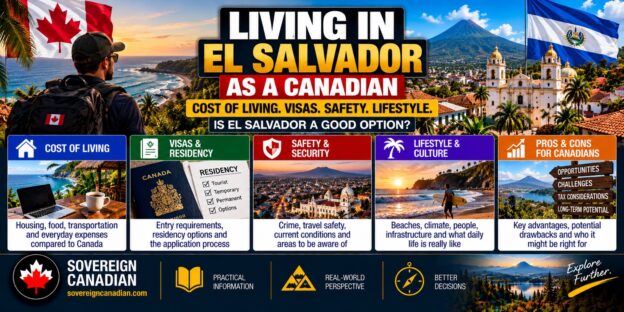
Picture a Saturday evening in Santa Tecla, a hillside suburb of San Salvador. A couple from Ontario sit on a restaurant terrace at nine o’clock, phones on the table, talking about whether to extend their stay from three weeks to three months. Ten years ago that scene would have been unthinkable. San Salvador was one of the most dangerous capitals on earth, and the street gangs ran whole neighbourhoods. Tonight the biggest worry at the table is the bill, which is lower than anything they would pay in Toronto, and the second biggest is a question neither of them can quite phrase: what exactly are we trusting here?
That question is the whole article.
El Salvador has gone from one of the highest homicide rates in the world to one of the lowest in the Americas, officially, in under a decade. It uses the US dollar, it sits about five hours from Toronto by air, it has surf breaks, volcanic lakes and colonial towns, and it is inexpensive by Canadian standards. It is also run by a president who has governed under a continuous state of exception since March 2022, who has detained more than 90,000 people, and who in 2025 changed the constitution to allow indefinite reelection.
Both halves of that paragraph are true. This article treats them as one country.
My thesis is simple. The safety improvement is real enough that a Canadian guest should take El Salvador seriously, and “cleaned up” holds for violence on the street. But the method behind it, the limits on legal checks, the official data nobody can independently verify, and the Canadian tax and benefits rules that apply the moment you spend real time there all point the same way. El Salvador works as a guest lifestyle base. It does not work as a tax escape or a sovereignty play, and it is not a place to build a life that depends on the rules staying friendly to foreigners.
All figures are in US dollars unless stated, since the dollar is the national currency. Canadian dollar conversions use a rate of about 1.42, which was close to the market in early October 2026. Everything here is current as of late October 2026, and El Salvador’s rules have been changing quickly.
Why El Salvador keeps coming up
Three things put El Salvador in front of Canadians who are thinking about living abroad.
The first is the security story. Social media is full of videos of empty-looking gang territory turned into night markets, and the headline number, 1.3 homicides per 100,000 people in 2025, is the hook. It would put El Salvador among the safer countries in the Americas on paper.
The second is the dollar. El Salvador has used US dollars as official currency since 2001. A Canadian does not take on peso risk, does not need to convert a pension into an unfamiliar currency, and can read every price tag at a glance. The flip side is that your Canadian income arrives in Canadian dollars, so you carry CAD to USD exchange risk in the other direction. At about 1.42, every USD 1,000 of Salvadoran spending costs CAD 1,420.
The third is the cost of a good life. A comfortable expat budget in San Salvador or Santa Tecla runs roughly USD 1,600 to 1,900 a month all in for one person, which is about CAD 2,300 to 2,700. I found no clean comparison with Costa Rica or Panama, so I do not claim one.
What does not keep coming up is how the safety was achieved, and what it means for a foreign guest. That is where most of this article lives.
What “cleaned up” actually means
Start with what is not in dispute. By almost every account, the homicide rate has collapsed, and ordinary Salvadorans describe a very different daily life. The Security Minister reported 82 intentional homicides in 2025, or 1.3 per 100,000. In 2026 an Attorney General task force counted 34 homicides from January to May, and about 79 percent of those came from family or social conflict rather than organized crime. That pattern, mostly domestic violence and personal disputes, looks like a country where the gangs have been dismantled or driven out.
Now the qualifiers, and there are four of them.
First, the decline did not start with the current president. Homicides peaked around 103 to 106 per 100,000 in 2015 and were already falling from 2016. The drop since 2022 is steeper and more complete, but the trend line existed before the current government.
Second, the data is not independently verifiable. Human Rights Watch says restricted access to data and changes in how deaths are counted make official claims hard to assess. The police daily tally recorded 67 homicides for 2025 while the minister reported 82, and the Attorney General’s counts have run higher than the police counts in earlier periods. I am not saying the numbers are false. I am saying the figure of 1.3 has a margin of uncertainty nobody outside the government can narrow. A claim of “under 8 per 100,000” that circulates on some travel sites is simply stale.
Third, a low homicide rate and a low crime rate are different things. The Canadian government’s travel advisory for El Salvador, as of late October 2026, asks travellers to exercise a high degree of caution. It still lists petty crime, violent crime on buses, and robberies by motorcycle riders as real risks. The advisory also names additional risks for 2SLGBTQI+ travellers.
Fourth, and most important for a foreign guest: the same advisory warns about the state itself. It cites arbitrary enforcement, detention of foreigners in a manner it describes as sometimes reportedly arbitrary, limited due process, delayed consular access, checkpoints, tattoos being read as gang signs, and arrests over social media posts. The US government, by comparison, listed El Salvador at Level 1, its lowest warning tier, in June 2026. The two governments are looking at the same country and weighing the street risk and the state risk differently.
My view: on the street, a Canadian in San Salvador, Santa Tecla or the coastal tourist towns is probably safer today than in most of the last forty years. The risk that has grown is not the gang risk. It is the risk of being on the wrong side of an enforcement system with very little room for appeal.
The state of exception and what it means for a guest
The state of exception began in March 2022 after a weekend of gang killings. It suspends several constitutional protections, including some rights around arrest, access to a lawyer and detention periods. The legislature has extended it more than 45 times. Human Rights Watch’s World Report 2026 counts more than 90,000 arrests, including more than 3,000 children, a prison population of about 118,000 (roughly 1.9 percent of the population), and at least 458 deaths in custody (a figure from the Salvadoran rights group Socorro Juridico Humanitario). HRW reports that no officers have been charged. AP puts the number detained at about 91,300 and reports that the president has acknowledged that some 8,000 of those arrested were innocent and released. In March 2026 an independent expert group (GIPES) said there were reasonable grounds to believe crimes against humanity had occurred. The government rejects all of this and argues the policy saved tens of thousands of lives.
Whatever you conclude about the policy, three practical points matter for a Canadian.
The system is built to be fast, not careful. If you were swept up by mistake, a foreign passport helps, but the advisory says consular help may be delayed, and the courts that would review your case operate inside the same exception.
Behaviour that is routine at home can carry weight here. Tattoos can be read as gang affiliation. Social media posts criticizing the government have led to arrests of Salvadorans. The constitution bars foreigners from political activity, so a Canadian who joins a protest or posts a sharp political video is taking a risk a tourist in Mexico would not.
The people who have paid the highest price are the ones with local ties and local enemies, not foreign visitors. A Canadian retiree who keeps to the standard expat routine, does not carry grudges, and does not post about politics has a low statistical chance of any contact with the system. Low, not zero, and the consequence if you are unlucky is much worse than a bad day in a Canadian court.
There is a second, quieter risk: the Foreign Agents Law, in force since mid 2025. It imposes a 30 percent tax on foreign funding received by organizations and individuals deemed foreign agents, and requires registration. By March 2026, 45 organizations and 3 individuals had registered. Commercial and foreign investment activity is exempt as long as it stays within its stated purpose, and the ministry has said it does not cover family remittances. Whether it could ever reach a retiree living on foreign pension income or a remote worker paid from abroad is unresolved. I did not find clear guidance, and a Salvadoran lawyer is the right person to ask before you move. Several civil society groups, including the human rights group Cristosal, have closed or left the country, and at least 140 defenders and journalists have fled. That is the environment the law was passed into.
A small section on politics: Bukele
Nayib Bukele is the reason most Canadians have heard of El Salvador, and any honest article has to deal with him briefly.
He is genuinely popular. Phone polls by the major Salvadoran pollsters put his approval between about 85 and 94 percent. A constitutional amendment in July 2025 allows indefinite reelection and lengthened the presidential term to six years. He was nominated for the next election in July 2026, with candidate registration open from 1 October to 19 November 2026. AP and other outlets put the vote in February 2027, though some sources give March or later, so confirm the date if it matters to your plans.
For a Canadian guest, the political point is narrow. A popular, durable leader is good for policy continuity: the dollar, the security posture, and the pro foreign investment message are unlikely to change soon. The cost of the same arrangement is that there are few institutional checks if a policy turns against foreigners, as the Foreign Agents Law and the 2026 residency changes show. Stability here means the stability of one person’s preferences. That is a very different asset from the stability of rules.
If you find the leader inspiring, enjoy the country. If you find him alarming, enjoy the country too, quietly. What you should not do is plan around either impression.
Getting in and staying: entry and residency after Decree 531
Canadians do not need a visa to visit. The Canadian advisory says up to 180 days visa free, but the practical limit is set by the CA-4 agreement among El Salvador, Guatemala, Honduras and Nicaragua, which gives a combined 90 day clock across the four countries. The immigration officer at first entry decides how many days you get. Under the migration law, a tourist stay is 90 days with a possible 90 day extension, so confirm the current approach with the General Directorate of Migration and Foreigners (DGME) before relying on any figure. If you want to stay longer, the usual route is to leave and re-enter, and the officer is not obliged to grant you a fresh period.
For people who want to stay, the Special Law on Migration and Foreigners (Decree 286 of 2019) sets up temporary and permanent residence. For retirees and investors the relevant categories are pensionado and rentista. Article 109 grants these as one year temporary residences. The thresholds, from secondary sources that I could not verify against the law text, are pensionado status at three monthly minimum wages of guaranteed income, rentista at four, and rentista with two or more dependants at six. With the minimum wage at USD 408.80 since 1 June 2025, that works out to about USD 1,226 a month (CAD 1,747) for a pensioner and USD 1,635 a month (CAD 2,330) for a rentista. Older guides that quote USD 1,095 and USD 1,460 use an outdated wage. The DGME’s own permanent residence form for rentistas and pensionadosconfirms that the income test comes from Articles 144 and 145 of the migration law, but it does not state the amounts.
The part that changed this spring is Decree 531, in force since 31 March 2026. Temporary residents must now be physically in El Salvador at least 90 days per year, consecutive or cumulative, with an exception for force majeure. The previous rule, per Article 49 of the law, caused loss of status after more than three consecutive or four cumulative months abroad. You will see guides and law firm pages claiming six, eight or nine months. They are wrong. The decree also provides for the automatic and irrevocable loss of naturalized nationality after a final conviction for an intentional crime, and recognizes the minor children of Salvadorans without residence.
After one year as a pensionado or rentista, or after three years for most other categories, you can apply for permanent residence. Naturalization takes five years, or one year of permanent residence for people born in Spain or in a Spanish-speaking country of the Americas. Canada permits dual citizenship, so naturalization would not cost you your Canadian passport. Becoming Salvadoran is a separate decision from living here, and the decree’s loss of nationality rule shows that naturalization comes with the exceptional rules attached.
A few other facts to know. Working or studying for more than 180 days requires you to apply for residence from inside the country. A Canadian driver’s licence is valid for 90 days, after which you need an apostilled copy to obtain a Salvadoran one. Children leaving the country after 12 months of residence need an exit permit. Bitcoin-based residency programs sometimes advertised as “Freedom Visas” (about USD 1 million in cryptocurrency) were not verifiable from official sources, and I would not rely on them. The investor residence threshold under the Investment Law was not something I confirmed.
For a reader skimming this section, the practical point is that El Salvador makes it easy to visit and fairly easy to stay on a modest retirement income, but you now need to physically be present at least a quarter of the year, which is a lighter requirement than a snowbird would worry about.
Salvadoran tax: territorial, with a hole
El Salvador taxes on a territorial basis, according to Deloitte’s 2026 tax highlights. Income from sources inside the country is taxed, and most income from outside is not. Personal rates run from zero on the first USD 6,600, then 10, 20 and 30 percent, with the top rate on income above USD 22,857. Capital gains are taxed at 10 percent. There is no wealth tax, no inheritance tax and no national property tax, though municipalities charge small asset-based fees. Transfers of real estate above about USD 28,571 pay a 3 percent transfer tax. VAT is 13 percent. There is no tax relief for tax paid in other countries, and the only income tax treaty is with Spain.
A 2024 reform specifically excluded certain foreign passive income, with an informational return for foreign instruments. That makes the country attractive for a retiree living off foreign pensions and investment income. The unresolved issue is the remote worker. The Income Tax Law treats services performed or used inside El Salvador as Salvadoran source income, even if the client is abroad and the payment arrives abroad. Whether a Canadian freelancer working from a Santa Tecla apartment falls inside that rule in practice is something I could not confirm from guidance or case examples. Treat the question as open, and get a local accountant’s written view before you rely on the territorial label. Deloitte ties Salvadoran tax residence to an uninterrupted stay of at least 200 days within a year.
A word of warning on data. Several aggregator sites list El Salvador as taxing worldwide income, and others as territorial. The accounting firm summaries from Deloitte and PwC, reviewed in early 2026, are the more reliable sources, and they say territorial.
None of that tells you what Canada will do, which is the next section and the one that matters more.
The Canadian side of the ledger
El Salvador has no income tax treaty with Canada, and no social security agreement. I checked both against the Finance Canada list of tax treaties in force and the Service Canada list of social security agreements. El Salvador is on neither. The same is true of Costa Rica, Guatemala, Honduras and Panama. Mexico and the Dominican Republic are on the treaty list. El Salvador is not.
That single fact sets the terms of everything else. Without a treaty, Canada and El Salvador have no tie-breaker rule to settle which country gets to treat you as resident, no agreed reduced withholding rates, and no mechanism that lets a Canadian “become a non-resident” by living in the treaty partner. Your Canadian tax status is decided entirely by Canadian law, which looks at your residential ties: a home available to you, a spouse or dependants, and personal and economic ties such as bank accounts, a driver’s licence, health coverage and memberships. If you keep a home, a spouse or children in Canada, the CRA will almost certainly treat you as a resident, no matter how many nights you sleep in San Salvador.
Here is what follows in each scenario.
You stay a Canadian tax resident. This is the default for a snowbird, a part-year guest or anyone who keeps a Canadian home and family. You pay Canadian tax on worldwide income. If El Salvador also taxes any of that income, for example Salvadoran-source income from work you perform there, you claim a foreign tax credit under the Income Tax Act, using Form T2209, not under a treaty. Capital gains stay at the 50 percent inclusion rate. Foreign property with a total cost above CAD 100,000 triggers Form T1135, though property you use personally is not counted. Your TFSA and RRSP keep working, and El Salvador does not recognize them as tax-sheltered, so if El Salvador ever taxes you on investment income it will not care that the account is registered.
You become a non-resident. This takes a real severing of ties, not a 183 day count (the residency ties guide lists the ties the CRA weighs). You trigger the departure tax (a deemed disposition of most assets, covered in the Canadian departure tax guide). TFSA contributions while non-resident attract a 1 percent monthly penalty tax and no new room accrues. Your RRSP stays, but withdrawals are subject to 25 percent withholding. Without a treaty, that 25 percent default rate is also what applies to Canadian pensions paid to you.
You live in between. This is the dangerous case, because the CRA looks at the facts and not at your intentions. Someone who spends eight months in El Salvador but keeps a Canadian house, a spouse in Canada and Canadian accounts is a Canadian resident, filing from abroad. The residency tie-breaker that rescues a Canadian in Portugal or Mexico does not exist here. If you also become a Salvadoran tax resident, you can end up with two countries claiming you, and no treaty to say which wins.
Canadian pensions and benefits
The CPP is payable anywhere in the world. It is the easy one.
Old Age Security works differently. To keep receiving OAS outside Canada, you need at least 20 years of Canadian residence after age 18. With fewer than 20 years, OAS payments stop after six months of living abroad, and the Guaranteed Income Supplement stops after six months regardless. If you immigrated to Canada, or if you spent your twenties abroad, check your residence years before you plan a retirement here. Confirm the details with Service Canada, because this is secondary-source guidance and the rules have exceptions.
Because there is no treaty, the default 25 percent non-resident withholding applies to CPP and OAS if you become a non-resident. You can file a section 217 election, which lets you choose to be taxed on certain Canadian-source income at resident rates. The qualifying income includes the OAS pension, CPP, most RRSP and RRIF income and most pension benefits. It can bring the tax down and get some of the withholding back, and for a retiree with modest other income it is often worth doing. Run the numbers with a cross-border accountant before you leave.
Provincial health coverage
Provincial plans have residence tests. In Ontario, you generally need to be in Ontario for 153 days in any 12 month period to keep OHIP, and an absence of more than 212 days may require you to reapply. Other provinces have different rules, and none of them will pay for a Salvadoran private hospital bill in full. You will want private travel or international health insurance, which brings us to healthcare.
What I could not confirm
I could not determine whether El Salvador exchanges bank account information automatically with Canada under the Common Reporting Standard. El Salvador has signed the multilateral convention, and it has been through peer review on information exchange, but I was unable to confirm its automatic exchange status from the OECD’s own list. Assume your Canadian accounts are fully visible to the CRA, as they are anyway. Do not assume your Salvadoran accounts are invisible.
What it actually costs
The cost of living data for El Salvador is thinner and more contradictory than for the larger expat destinations. These ranges combine Wise, Numbeo, Expat.com and nomads.com data and my own arithmetic, so treat them as estimates and pull live rental listings before you commit.
| Profile | Where | Monthly estimate (USD) | In CAD at 1.42 |
|---|---|---|---|
| Modest single | Santa Ana or a smaller city, one bedroom 300 to 500 | 900 to 1,250 | 1,280 to 1,780 |
| Comfortable single | Escalon, San Benito, Santa Tecla, one bedroom 600 to 900 | 1,400 to 1,900 | 2,000 to 2,700 |
| Family of four, expat zone | Escalon or Santa Tecla, rent 1,000 to 2,000, before school fees | 3,600 to 4,600 | 5,130 to 6,550 |
Some of the reference points behind those numbers. Wise puts a one bedroom in central San Salvador at USD 899 (CAD 1,281), a single person’s costs excluding rent at USD 745 (CAD 1,061), and a family of four excluding rent at USD 2,590 (CAD 3,690). Nomads.com puts a full expat lifestyle at USD 1,631 to 1,860 (CAD 2,324 to 2,650). Rents in the expat neighbourhoods of Escalon, Zona Rosa and San Benito range from about USD 600 to well over USD 2,000. Some low estimates you will find online, such as USD 340 for a one bedroom, look stale or modelled.
Remember two things. First, many items are priced in USD while your income is in CAD, so a weaker Canadian dollar quietly raises your budget by the same percentage. Second, imported goods, good private healthcare and international school fees are the items that can exceed Canadian prices.
Where to live
Most Canadians end up in one of four places.
San Salvador’s Escalon and San Benito districts are the established expat and professional neighbourhoods, with malls, private hospitals, restaurants and the best-developed English-speaking services. It is a big-city life with traffic, noise and a security-guard culture.
Santa Tecla is a smaller city on the volcano’s slope, ten to twenty minutes from the capital. It has a walkable centre, a calmer pace and, according to Ookla’s data, the fastest internet in the country. Antiguo Cuscatlan next door has the newer, more suburban feel.
The coast, including El Tunco, El Zonte and the surf towns, is where the foreign-friendly beach economy lives. Prices are higher than inland, the services thinner, and the nearest serious hospital is a long drive. It suits healthy people who surf or work remotely, and it suits fewer retirees.
The cooler highlands and small towns, including Santa Ana, the Ruta de las Flores and Suchitoto, offer colonial architecture, lower rents and a slower life. They are less convenient for healthcare and flights.
Internet speed claims vary widely between sources. Test any rental’s connection in person, and ask about backup power.
Schools
International schools are concentrated in the San Salvador area. The better known ones include the Escuela Americana (founded 1946), Colegio Internacional, the Lycee Francais in Santa Tecla, a British school and a German school. Published annual fees range from about USD 2,200 to more than USD 12,000, and the sources conflict, so ask each school for a current fee schedule, including enrolment and capital fees. For a Canadian family planning to return, check whether the curriculum and school calendar will slot back into the Canadian system.
Healthcare and the question after 65
The Canadian advisory is blunt that public healthcare is below Canadian standards, though free for foreigners. For most Canadians, the realistic option is the private system. The advisory names several of the better private hospitals, including Hospital de Diagnostico in Escalon, Santa Elena and Colonia Medica, and Hospital Centro Medico Escalon. Outside the major cities, hospitals commonly ask for deposits and cash before treatment, English is not widely spoken at the clinical level, and medical evacuation is expensive. Rabies treatment may be unavailable. Dengue, chikungunya, Zika and Chagas disease are real risks, particularly in rural and coastal areas in the rainy season.
I did not find reliable price data for private insurance, and the numbers quoted on insurer marketing pages are not trustworthy. Get written quotes for a policy that includes evacuation, and read the pre-existing condition language carefully.
For the question after 65, here is the honest state of my research. I could not find reliable information on aged care, assisted living or dementia care in El Salvador. That absence is itself the answer for planning purposes. A Canadian in their late seventies or eighties who develops a serious chronic condition should assume that the practical plan is a return to Canada, which means the safest approach is to keep provincial health eligibility intact for as long as you are going back and forth, to hold a travel policy that covers repatriation, and to have a named plan for where you would live in Canada if you needed full-time care.
Climate and the El Nino year
El Salvador has a rainy season from May to November, a hurricane season that overlaps it, and a standing earthquake and volcano risk. The dry season, from roughly December to April, is the comfortable one, and it lines up with the Canadian winter.
The current year is unusual. August 2026 was the driest in the country’s record since 1971, the government declared a red drought alert on 25 August 2026, and the environment ministry forecasts a very strong El Nino through early 2027. For a guest, the practical effects can include water shortages in some areas, higher food prices and higher heat. Ask a landlord how the building gets its water, and whether it has a cistern.
Banking, the dollar and Bitcoin
There is no standard national checklist for foreigners opening a bank account. Some banks decline non-residents, the process is usually in person, and the paperwork requirements vary by branch. I could not confirm whether Wise accounts work smoothly there. A Canadian dollar balance cannot be converted in El Salvador, so you will move CAD to USD before or at the border, through a bank, a transfer service or an ATM withdrawal from your Canadian account.
The macroeconomic picture is steadier than a decade ago. The IMF board completed two reviews on 1 October 2026, which released about USD 138 million (CAD 197 million). The IMF estimates growth at 3.9 percent for 2025 and projects 4.5 percent for 2026, puts inflation at 0.3 percent in 2025 with 2.7 percent projected for 2026, and puts gross nonfinancial public sector debt at 87.6 percent for 2025. Moody’s outlook was positive as of February 2026. One data point I would treat with caution: a news outlet reported a 92 percent fall in foreign direct investment in the second quarter. I could not confirm that figure from a primary source.
On Bitcoin: El Salvador made it legal tender in 2021, then in January 2025, under its IMF program, made acceptance voluntary. Control of the Chivo wallet moved out of state hands. The Canadian advisory warns about fraud involving Chivo and card use. For a Canadian guest, Bitcoin is a curiosity and not a plan. Everyday life runs on US dollars.
Buying property: a short paragraph
Foreigners are treated equally with Salvadorans under the Investment Law, there is no national property tax, and registry fees are about 0.63 percent plus notary charges. Global Property Guide estimates the round-trip cost of buying and selling at roughly 8.8 to 9.6 percent, which is high enough that a short holding period usually loses money. The shoreline is state land, which is a trap for beachfront buyers. The Canadian advisory tells buyers to get legal advice because disputes are slow and costly. Property you use personally is not reported on Form T1135, and a Salvadoran home could qualify for the principal residence exemption if it is designated properly, but there is no treaty to help with the sale tax. This article goes no further than that on property. For the general framework on owning real estate abroad, see foreign real estate investing for Canadians.
Daily life, culture and the constitution
Spanish is the working language outside the expat bubble in Escalon and the surf towns, and a Canadian who learns it will have a much better time. The country is socially conservative and religiously active. The constitution does not recognize same-sex marriage, and abortion is criminalized in all circumstances. Drug penalties are severe, and that includes cannabis, which a Canadian used to legal access should treat as strictly off-limits. The Canadian advisory flags risks for 2SLGBTQI+ travellers, so research a specific destination carefully before you commit.
Getting around, and getting home
Air Canada has operated a codeshare nonstop from Toronto to San Salvador (flight AC2959, flown by Avianca, about five hours), and Air Transat has flown from Montreal. Both have been seasonal, so check the current schedule. Inside the country, roads are decent between the main cities, buses are cheap and carry a street crime risk, and most expats use ride apps or a hired driver. Driving yourself is feasible, but be careful at night and at checkpoints.
How El Salvador compares
| Country | Tax treaty with Canada | The core trait |
|---|---|---|
| El Salvador | No | Safest streets in decades, unusually exposed to one government’s choices |
| Costa Rica | No | Mature expat infrastructure, well-trodden path, no treaty |
| Panama | No | Dollar economy, no treaty |
| Mexico | Yes | Closest, most varied, treaty protection, mixed security |
| Malaysia | Yes | Formalized temporariness: a durable legal stay without belonging |
| Thailand | Yes | Easy to visit, hard to stay on a permanent footing |
Against Costa Rica and Panama, El Salvador shares the missing treaty and offers a lower price and a more dramatic safety story. It lacks their institutional depth and longer track records with foreign retirees. Against Mexico, the biggest difference is the treaty, which gives Canadians a rulebook for tax residency and pension withholding that El Salvador does not. Against Malaysia and Thailand, El Salvador is shorter to fly, uses a familiar currency, and demands less cultural adjustment, but it offers less certainty about the rules a foreign resident will face in five years.
Life stages, 25 to 85
| Age | How El Salvador fits |
|---|---|
| 25 | Cheap, fun and workable for a remote worker, once the source-of-income question is answered by a local accountant. Surf towns suit this stage. |
| 35 | Good for a one to two year stint, with the career tax question and a plan for the Canadian ties you will keep. Less good with young children and no international school budget. |
| 45 | The family stage. Possible if you can afford the international school fees and are comfortable with the political environment. |
| 55 | A strong fit for early retirees with investment income and no dependants. The rentista category is accessible, and the territorial tax system favours passive income. |
| 65 | The best fit for a seasonal stay. CPP and OAS keep arriving, healthcare is manageable in Escalon, and the 90 day presence rule is easy to meet. |
| 75 | Workable only with a firm healthcare plan, a travel policy that covers evacuation, and strong local help. The distance from specialist care becomes the main consideration. |
| 85 | Not a place to depend on. Aged care is a gap in what I could find, so plan for Canada. |
Scorecard
| Dimension | Grade | Note |
|---|---|---|
| Street safety | A- | Homicide data strong but not independently verified |
| Rule-of-law protection for a foreigner | D | State of exception, arbitrary enforcement warnings |
| Cost of living | B | Moderate, with thin and conflicting data |
| Currency stability | A- | USD, but your income is in CAD |
| Tax treaty with Canada | F | None |
| Social security agreement | F | None |
| Residency ease | B | Rentista and pensionado accessible, 90 day presence rule |
| Healthcare for 65 and under | B- | Good private hospitals in the capital |
| Healthcare for 75 and over | D | Insufficient data on aged care |
| Climate resilience | C | Drought, El Nino, earthquake, hurricane |
| Banking access | C | Patchy, in person |
| Political predictability | C | Stable, personality-driven |
| Cultural and social freedoms | C- | Conservative laws, constitutional limits |
| Flight access from Canada | B | Seasonal nonstops |
Five Canadians, five verdicts
- The remote worker in their thirties. Qualified yes, for a defined stay of six to twelve months. The surf and city options are good and the cost is low. The open question is whether your remote income is Salvadoran-source under Article 16, so get an accountant’s written view first and keep your Canadian tax residency intact.
- The early retiree couple, 55 to 65. Yes, as a seasonal base. Living on investment income and a rentista residence is workable, the dollar removes currency friction, and the 90 day presence rule is light. Do not sever Canadian ties on the strength of El Salvador, because the lack of a treaty leaves you with no tie-breaker.
- The pensioner on CPP and OAS. Conditional yes, only if you have 20 years of Canadian residence after 18 for OAS. Otherwise OAS and GIS stop within six months of leaving. File the section 217 election if you become a non-resident. Keep a provincial health plan alive for the return trips.
- The family with school-age children. Cautious maybe. International schools are available, but fees reach the high end of the range, and political and legal exposure matters more with children. A one year trial in Santa Tecla with the Canadian home retained is the sensible test.
- The coastal buyer. No on first contact, and yes only after legal advice. Shoreline land is state property, round-trip transaction costs are close to 9 percent, and there is no treaty to help on the exit. Rent for a season first.
If a family had to pick one place for a year
Santa Tecla. It keeps you within reach of the Lycee Francais, the private hospitals in the capital, the airport and reliable internet, while avoiding the traffic of central San Salvador. A year there with the Canadian home retained is the lowest-regret way to find out whether the country fits.
If a couple had to pick one place to grow old in
Escalon, San Salvador, and only for a stage of life when you are healthy and mobile. The reason is the hospitals, which are the best in the country and sit within a few minutes of the neighbourhood’s apartments. Aging in place on the coast or in a highland town is a different bet, and I would not make it past your early seventies.
The thing that eventually makes a rational Canadian leave
For most Canadians who try El Salvador, it will not be crime. It will be one of three things: a health event that makes distance from Canadian specialists the dominant fact, a legal or political event that changes the rules for foreigners with little warning, or the slow accumulation of tax and benefits friction from having no treaty. All three share a cause. The country is a safe-feeling place run by a system with few checks, and its relationship with Canada has no legal scaffolding. When things go well, you will not notice. When they do not, you will notice immediately.
What I’d Actually Do
- Treat El Salvador as a guest base, not a tax move. Keep your Canadian residency and plan the stay around the 90 day presence rule rather than around leaving Canada. The snowbird versus full relocation guide sets out the trade-off.
- Start with a three week visit in the dry season. Stay in Santa Tecla and Escalon, and test the internet, the noise, the water supply and the feel of the place.
- Check your OAS residence years before making any plan. If you have fewer than 20 years of Canadian residence after 18, the benefit stops six months after you leave.
- Get a written opinion from a Salvadoran accountant on remote income. Ask specifically about Article 16 and the Foreign Agents Law.
- Keep your provincial health coverage and check its day limits. For Ontario that means 153 days in any 12 months, and be careful beyond 212 days.
- Buy a private international health policy with medical evacuation. Read the exclusions before you pay.
- Rent for a full season before anything else. Skip buying until you have lived through a rainy season and, ideally, a dry spell like this year’s.
- Stay out of Salvadoran politics, online and in person. Do not post about the government, and do not attend demonstrations.
- Keep your tattoos, documents and itinerary in order. Carry a copy of your passport, and know the number for the Canadian embassy.
- Revisit the plan every year. The residency rules changed in March 2026 and the foreign agents rules in 2025, and further changes cannot be ruled out.
Back to the terrace
The couple on that terrace in Santa Tecla are probably going to be fine. Most Canadians who come here, stay a season, follow the rules and leave are. The streets are calm, the dollar is familiar, the food is good, and the prices make a winter feel like a discount.
But the question they could not phrase is the right one. What are we trusting here? The honest answer is a government, not a framework. The homicide rate really is low, and the policy that produced it has real victims and a real shortage of independent checks. Canada has no tax treaty and no benefits agreement with this country, so there is nothing on the Canadian side to catch you if the rules shift. That is what a guest base looks like. It is a good place to visit, a reasonable place to winter, and a poor place to bet your life on.
This article is editorial analysis for tax-literate, high-income Canadians. It is not legal, tax, immigration, or investment advice. Rules, rates and programs change, particularly in El Salvador, where the migration law was amended in March 2026. Verify every figure against primary sources and consult a qualified cross-border tax professional and a Salvadoran lawyer before acting.