
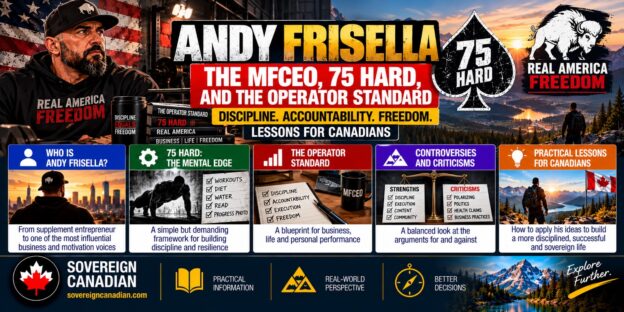
This series is personal documentation of people worth studying, not advice. Most profiles here lean toward geography and structure. This one leans toward execution, because structure only pays off for people who do the work.
Andy Frisella is one of the most influential business and motivation voices of the last decade, and I respect what he has built. He is an American entrepreneur, podcaster, author and the creator of 75 Hard. His books, his podcasts and his Operator Standard app form a practical toolkit for any success-minded Canadian who wants more discipline and a clearer business mindset. This post covers where he came from, what he has built, what is worth borrowing, and what to weigh before you do.
The thesis: execution is the scarce asset
Most people reading this site already know what they should be doing. They know to save, to build something of their own, to train, to read, and to get their finances and health in order. The gap is rarely information. It is follow-through.
That is the lane Andy Frisella occupies. He does not sell a secret. He sells a standard, then makes you prove you can meet it, one day at a time. For a Canadian working on personal sovereignty, that is useful, because independence of any kind is mostly built from boring, repeated decisions.
Where he came from
Frisella grew up in Missouri and opened his first store, a supplement shop in Springfield, Missouri, around 1999. By his own telling, he and a partner started with roughly USD 12,000 earned from striping parking lots, and he made no real money for the first three years. He has also described being stabbed in the face as one of the adversities he faced along the way. These accounts are his own, and I am reporting them as his.
By his account, around 2006 he opened a second store and acquired a failing business, which took the company from one store to six in about 30 days. The business that made his name came next. He co-founded 1st Phorm, a sports nutrition and supplement company, around 2008. Sources differ on whether it was 2008 or 2009, so I am using “around 2008”. His brother Sal Frisella is the company’s current CEO, which corrects a common assumption that Andy runs it day to day.
Frisella has also been involved in Phorm Energy, an energy drink brand with partners that have been publicly reported to include Anheuser-Busch and Dana White. He has made large claims about revenue and personal wealth over the years. I am not repeating figures here, because they are self-reported, they change, and estimates from third parties disagree widely. If a number matters to you, treat it as his claim until you see a primary source.
The MFCEO Project
The MFCEO Project was the podcast that turned Frisella from a founder into a media figure. It ran from about 2015 into 2019 and combined solo monologues, interviews and a blunt, high-intensity delivery. Its core message was simple: take ownership, stop making excuses, and treat your habits as the real business.
In 2019 he launched REAL AF, a second podcast with a more conversational and practical format. New MFCEO episodes now publish inside the paid Operator Standard app. That page says REAL AF and the original MFCEO episodes remain available free, though I could not confirm every platform where they live. The older episodes are worth searching for, and the ideas travel well.
75 Hard and Live Hard
75 Hard is the program that most people know him for. He introduced it in March 2019 as a 75-day mental toughness challenge, and the official program is free. The rules are strict. Every day for 75 days you follow a structured diet of your choosing with no cheat meals and no alcohol, complete two 45-minute workouts with one of them outdoors, drink one gallon of water, read ten pages of a nonfiction book, and take a progress photo. If you miss any single task on any day, you start again at day one.
That last rule is the point and also the controversy. The restart rule is what makes the program bite, and it is also what some health professionals criticize. CNN’s coverage quotes a fitness specialist and a clinical dietitian raising fair concerns about the lack of built-in recovery, the all-or-nothing restart rule, the gallon of water, and the risk for people with a history of disordered eating. Those concerns are reasonable. If any of them applies to you, talk to a qualified professional before you start.
75 Hard sits inside a broader framework Frisella calls Live Hard, which his site describes as a year-long program. 75 Hard is the first of four stages, followed by three 30-day phases that build on it.
Canadians have one practical point to plan for. An outdoor workout in an Ontario January takes more preparation than one in Florida, so clothing, conditions and personal safety matter. Plenty of Canadians can and do complete the program in winter with proper layers and a sensible plan. The official program requires following its rules as written, though. If you cannot safely meet them, choose an alternative or modified routine and call it a personal adaptation, not the official 75 Hard. If you need a simple movement base to build on, the older Fitness Plan for Canadians post is still sound on principles, though it is from 2013 and light on specifics.
The Book on Mental Toughness
Frisella’s main book is The Book on Mental Toughness. It includes the original 75 Hard book, along with his reasoning about discipline, identity and consistency. If you want a deeper explanation without committing to a subscription, the book is a straightforward way to explore his framework, and it can be read in a few sittings. He has also published a children’s book series, which is worth knowing about if you are raising kids and want the same values in a simpler form.
The Operator Standard
The Operator Standard is his paid app and community. Its listed features include a daily Power List, streaks and strikes, crews and leaderboards, an AI tool that builds daily tasks from your goals, a community, and the new MFCEO episodes. The pitch is that a daily system works better than occasional motivation.
Pricing and tiers change, so check them before you commit. The official website lists Pro subscriptions at 50 monthly or 500 annually, without clearly identifying the currency. Canadian App Store pricing differs, so check the current price, currency, taxes and renewal terms before subscribing.
Frisella has explained why it is not free: he argues that people value what they pay for, and that paying creates commitment. You do not have to agree with that. It is a fair business argument, and it is also a conversion tool. User reviews of the app are mixed, which is normal for a product that is both demanding and subscription-based. Some people credit it with changing their habits. Others find it repetitive or feel the price is steep for what they use.
What to weigh before you follow him
Respecting someone does not mean adopting all of them. Here is what I would weigh.
First, rigidity. His style works for people who respond to hard rules and fails for people who need flexibility. The restart rule in particular suits some personalities and harms others.
Second, the American frame. Much of his content assumes U.S. politics, U.S. culture and U.S. tax and legal structures. The mindset travels. The specifics often do not.
Third, a public controversy. On a September 2024 episode of his Real AF podcast, he said women should not be police officers and made remarks about officers who had pulled him over that a police union leader called violent fantasies. St. Louis-area police departments cut ties with his companies. He removed the remarks and posted an apology of about 12 minutes, though some police leaders called it insufficient. In October 2025, St. Louis County police announced they would rebuild ties with 1st Phorm. See Police1’s report and its follow-up.
Fourth, unverified claims. As with many motivation figures, some of the revenue, wealth and results claims are impossible to confirm from outside. That does not make the lessons wrong, but it is a reason to judge the advice by whether it works for you, not by the size of the stories.
What crosses the border
Much of the mindset crosses the border: ownership, daily discipline, and treating habits as a business. The business lessons cross too. He is a clear teacher of building an audience, a product ladder and a community. Free content brings people in, a low-cost book goes deeper, and the app and premium tiers serve those who want more. That is a value ladder, and it is worth studying if you are working on a side business.
What needs adapting is practical. Currency and duty on physical products, shipping times, App Store versus website pricing, and the legal and tax setup behind a Canadian business all differ. If you build something serious, the structure question matters too, and the HoldCo and OpCo post covers when a second corporation actually helps.
What I’d Actually Do
These are recommendations, not a record of what I have done.
- Start free. Read the official free 75 Hard rules, listen to the free podcast material that is available, and consider The Book on Mental Toughness before paying for an app subscription.
- Check your health first. If you have any medical condition, an injury, or a history of disordered eating, get professional advice first. A version with rest days is a personal adaptation, not the official 75 Hard.
- Decide whether you are attempting the official 75 Hard or adopting its principles. If winter makes the outdoor workout unsafe, use a modified routine and describe it honestly as your own version.
- Use the reading rule for your own business or finances. Ten pages a day of nonfiction adds up to dozens of books a year.
- Trial the Operator Standard only if you want the structure. Verify the CAD price in your app store and be clear on how to cancel.
- Pair the mindset with structure. Discipline builds the income. Corporate, tax and investment decisions still deserve proper advice.
Disclaimer
This post is for general information and personal documentation only. It is not financial, legal, tax, medical or fitness advice. Facts about third parties come from public sources and their own statements, and may change. Verify prices and details before acting, and speak with a qualified professional about your situation.