
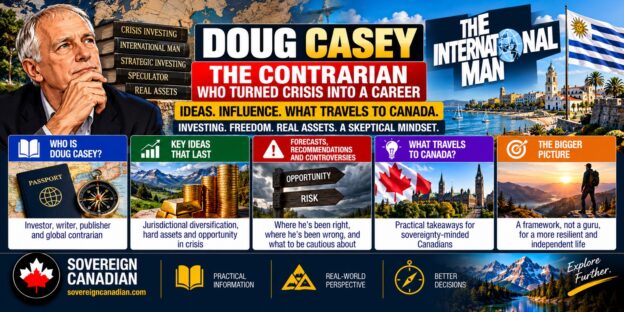
This profile is part of my Sovereignty Thought Leaders series: writers, investors and thinkers whose ideas a sovereignty-minded Canadian should know, with the useful parts separated from the parts that don’t travel.
Doug Casey turned 80 in May 2026, and his Substack is still posting almost daily alongside a regular podcast. Few people in personal finance have made the same core argument for as long: governments cause crises, crises wreck the conventional plan, and the individual who has spread their life and money across borders and holds some real assets comes out ahead. He built a bestseller and a publishing business on that argument, and he is publicly tied to an expat estate in Argentina.
My thesis is that Casey’s lasting influence is as a framework more than as a forecaster. Three of his ideas have held up and travel well to Canada: spread your life across jurisdictions, hold some money no government can print, and treat speculation as a small, deliberate part of a plan rather than the plan. His forecasts, his recommendations and the commercial products built around his name deserve the same independent testing as any other source you pay for, and that is the spirit in which I read him.
Personal sovereignty, as I describe it in Components of Personal Sovereignty, rests on thinking for yourself, food, finances and health. Casey’s contribution is mostly to the finance leg, and to the question of which government you are financially exposed to.
A word on method. I drew on Casey’s own sites and author bios, his Substack and podcast descriptions, regulators, reference works and press reporting, all as they stood between October 20 and October 23, 2026. The biography is largely Casey’s own account, as given in his author bios, and I attribute individual claims only where the source or a dispute matters. Where the only source for a claim is Casey’s own marketing, I say so. I did not find an independent audit of his newsletter’s recommendations.
Who Is Doug Casey?
Douglas Robert Casey was born in Chicago on May 5, 1946, the son of Eugene B. Casey, a multimillionaire real estate developer. He graduated from Georgetown University in 1968, the same year as Bill Clinton. He was raised Roman Catholic, later became an atheist, and describes himself as an anarcho-capitalist influenced by Ayn Rand. Rand wanted a minimal state. Casey wants none.
By his own author bios he has lived in about ten countries and visited well over a hundred, and his bios have listed homes in Argentina, Uruguay, New Zealand and Aspen, Colorado. More recent bios say he spends most of his time in Argentina and Uruguay. According to his biography, he also founded the Eris Society, a private gathering of thinkers that operated for roughly three decades.
The Career That Made His Name
Casey’s reputation starts with Crisis Investing, published around 1979 with the subtitle Opportunities and Profits in the Coming Great Depression. It arrived in the stagflation years, when gold was climbing and confidence in the dollar was thin, and it became a major bestseller, spending months on the New York Times bestseller list.
Strategic Investing followed in 1982 and, by his bio, reached number seven on the same list.
From there he built Casey Research, a publishing business whose newsletters, including The International Speculator and The Casey Report, covered resource stocks, macro and geopolitics. Its specialty was junior mining: small exploration companies that spend money for years before they find anything, or don’t.
His first book, The International Man (1978), was a guide to arranging your life and money across borders. His bio calls it reportedly the best-selling book in the history of Rhodesia. The International Man website carries the same name and the same message.
Casey’s wider significance is the combination he popularized: international diversification and personal sovereignty alongside hard assets and sound money, contrarian speculation, political and jurisdictional risk treated as an investment variable, and resource-sector research. Casey Research, and the writers and analysts who worked under its banner, helped build an audience for that mix. Marin Katusa, who now runs Katusa Research, spent years as a senior editor of Casey-branded energy publications, one example of how the operation fed the wider resource-newsletter world. I don’t credit Casey with inventing flag theory, but his work belongs to the same family of ideas.
What Doug Casey Believes
Strip away the style and five ideas carry most of the weight.
Government Is Institutionalized Coercion
This is the anarcho-capitalist core. Casey doesn’t argue that government is too big; he argues that a social order built on the threat of force is illegitimate, and that voluntary exchange would do the job better. He has called taxation robbery since at least the 1990s. You don’t have to accept the conclusion to see why the argument is clarifying: it forces you to ask what you actually get for the compulsion.
Crisis Is the Opportunity
Governments, in his account, distort money and markets until something breaks, and the break creates bargains for anyone who still has cash and nerve. That is the engine of Crisis Investing and of nearly everything he has published since. His rule follows from it: be a speculator, because working hard and saving no longer gets you ahead in a world of debased money.
Sound Money
Casey has recommended gold for his whole career, on the view that a currency resting on confidence alone is fragile. In a 2013 debate with Bitcoin advocate Jon Matonis he sided with gold, arguing that Bitcoin meets the tests of good money except that it has no use beyond exchange, while metals have industrial and chemical uses. That is a 2013 position, so check his current view before treating it as settled.
Internationalize Everything
The idea running through The International Man is that no single government should own your whole life. Hold residency in one place, assets in another, a business base in a third, and keep your options open. Flag theory later packaged the same logic, and my introduction to flag theory and the residency, business base and asset haven flags show how a Canadian applies it.
Against War and Empire
Casey has long opposed interventionist foreign policy, which makes him an equal-opportunity critic. His 2026 commentary with Matt Smith calls the U.S. action against Iran an unprovoked war, and compares the current administration’s equity stakes in companies to Mussolini’s economic model, which he calls fascism in the classic sense. Whatever you think of those judgments, they show his consistency: the state is the problem whoever runs it.
The Books: From The International Man to the High Ground Novels
His nonfiction runs from The International Man (1978) and Crisis Investing through Strategic Investing (1982) and Crisis Investing for the Rest of the 90s (1993), to the conversation-style Totally Incorrect (2012) and Right on the Money (2013, written with Louis James). The 1993 book is the one a review in Publishers Weekly describes as predicting a Greater Depression for the 1990s. His most recent book, The Preparation: How to Become Competent, Confident, and Dangerous, is co-written with Matt Smith and Smith’s son Maxim and is pitched as a four-year alternative to college.
The second era is fiction. With John Hunt, a physician who left academic medicine, Casey wrote the High Ground novels: Speculator (2016), Drug Lord (2017) and Assassin (2020). Speculator sends young Charles Knight to West Africa after an enormous gold discovery and works as a defence of the much-maligned speculator. Drug Lord takes on the FDA, the DEA and the pharmaceutical industry, and Assassin turns to corruption in Washington. They sit in the tradition of Rand and Heinlein, philosophy carried by a thriller. One Goodreads reviewer says the philosophy slows the action, which seems fair, and the cover endorsements come mostly from the libertarian and newsletter world.
Where to Follow Casey Now: The Podcast, the Newsletter and the Free Sites
Doug Casey’s Take is a podcast and YouTube show hosted with Matt Smith, a former serial entrepreneur who runs a regenerative-agriculture ranch in Uruguay. Smith picks a headline or a subscriber question and Casey responds. In January 2026 the episodes were dwelling on a run in gold and silver, with the episode notes citing silver above USD 100 an ounce and gold near USD 5,000. Recent subjects include the Iran war, oil prices, the dollar’s reserve-currency status and the U.S. government’s stakes in private companies.
The paid product is the Crisis Investing newsletter, which shares its name with his bestselling book. It is a Substack at crisisinvesting.com, published by Casey and Smith, and focused on resource stocks: gold, silver, uranium and junior miners. Subscribers get monthly issues and interim alerts plus access to a member community called the Phyle, and the top tier adds weekly calls and private placements, which a 2024 sales page describes as being for accredited investors. The Substack home page showed over 28,000 subscribers on October 23.
| Product | What it is | Cost | Best use |
|---|---|---|---|
| International Man (internationalman.com) | Free articles on internationalizing your life and money | Free | Learning the framework |
| Doug Casey’s Take | Podcast and YouTube show with Matt Smith | Free | Hearing his current views |
| Crisis Investing newsletter | Resource-stock advisory with monthly issues and alerts | USD 149 a month or USD 699 a year | Only if you will act on resource ideas |
| Crisis Investing VIP | Adds private placements and weekly calls | USD 1,497 a year | Only if you qualify and plan to invest |
| High Ground novels | Three thrillers carrying his worldview | Book prices | The easiest on-ramp to the ideas |
Prices are from the Crisis Investing About page on October 23, 2026, shown in dollars that I read as U.S. dollars; the page does not state the currency. Confirm before you subscribe.
Check who is writing the picks before you pay. Recent monthly issues carry John Hunt, MD as co-author with Casey, while the About page I read on October 23 lists Lau Vegys as senior analyst. Look at the masthead and the latest issue before paying for a named analyst.
Cafayate, Galt’s Gulch and the Enclave Dream
Casey is also publicly tied to a working version of the idea. La Estancia de Cafayate, a wine and residential sporting estate in Salta Province, Argentina, is associated with him, and a Libra Group release from August 2011 on the Grace Cafayate hotel, which it places within the Cafayate Estate, names him as one of the estate’s managers. It has been operating since at least the early 2010s, which already puts it ahead of most enclave plans. For a Canadian thinking about foreign property it raises the questions my foreign real estate guide and offshore real estate post touch on: who holds title, what you can actually sell for, and what you report to the CRA.
The enclave dream also has a cautionary tale that is often pinned on Casey and shouldn’t be. Galt’s Gulch Chile was a separate project near Curacavi, Chile, set up by Jeff Berwick, John Cobin, German Eyzaguirre and a fourth partner, and named after the refuge in Atlas Shrugged. It came apart in 2014 and 2015. A group of investors alleged fraud, put their losses at more than USD 10 million and filed a complaint in Chile, while the manager who ended up in control has denied wrongdoing. Casey was not a principal, and none of the press accounts I read names him as a participant. He appears only as a comparison: Berwick wrote in 2014 that he had been excited by what Casey created at Cafayate, and a timeline emailed to investors by a former staffer, later posted on a blog, likens the Chilean pitch to Casey’s Argentine project.
The lesson is about execution, not ideology. Enclaves need land, water, zoning, clean title and years, and the people selling the dream are usually selling lots. If the idea appeals, my post on Liberland for Canadians covers the micronation version.
Where I Push Back
The Forecast Record
The first Crisis Investing promised profits in the coming Great Depression, and the 1993 sequel, per that Publishers Weekly review, predicted a Greater Depression in the 1990s. Neither arrived in the form described, and the 1990s were among the strongest decades for equities in modern history. His core diagnosis, that debt and monetary debasement erode purchasing power, has aged better, and gold and silver ran to records in early 2026. The distinction matters: a structural warning can hold for decades while a specific forecast on timing is wrong. A long-term macroeconomic warning can also be useful and still be hard to turn into profitable investment decisions, because acting on it means choosing what to buy, when and how much. I haven’t seen verified performance data for his recommendations, so I don’t judge his investment record either way.
The Business Model and Incentives
The structure of the paid tiers is what a prospective subscriber should understand. A Crisis Investing sales page, last modified in August 2024, describes the sequence itself: VIP members get early access to private placements, which are often priced at a discount of 5% to 20% to the market and carry warrants, and, in the example the page gives, the stock was then recommended in the newsletter. In mid-October 2026 the publication was promoting a private placement of about CAD 1 million in a silver explorer, with the full post limited to VIP subscribers and the teaser saying Casey and Smith were taking part. The two posts date from October 18 and 19, they say only that the placement would not stay open long, and I could not confirm whether it is still open.
This is a disclosed and common structure in resource newsletters, and I am not alleging anything improper. The questions worth asking are practical ones. What financial interests do the publisher and contributors hold in a recommended company, and where are they disclosed? Do VIP subscribers get opportunities that ordinary subscribers don’t, and is each recommendation independently supported? Do you understand the liquidity and downside risks of a private placement? Anyone who invests before a recommendation is published is in a different position from a reader who buys after it, which is why disclosure matters, and the sales page itself says resource companies are inherently risky. The About page claims a record of 10-baggers and 20-baggers; that record is self-reported.
Rhetoric and Relevance
Casey is deliberately provocative, and the style can obscure the substance: good ideas about diversifying jurisdictions get dismissed because of how they are delivered. His commentary is also heavily American, so a Canadian reader gets a lot of U.S. politics for every idea they can act on. I read him for the macro and jurisdiction arguments and set the rest aside.
Can You Afford the Loss?
Casey’s background is part of his story: a developer father and a Georgetown education. It doesn’t discredit his philosophy, and his ideas stand or fall on their merits. The question that matters for a Canadian is personal. Recognizing an attractive speculation is different from having the financial ability to lose it. Before putting money into a junior mining or other speculative position, a mid-career Canadian with a mortgage and a family should ask whether they could absorb a total loss without changing their plans.
What Doug Casey Means for a Sovereignty-Minded Canadian
Flag Theory Travels
Canada taxes on residency, not citizenship, so the American conversation about renouncing to escape taxation mostly doesn’t apply. The rest of the toolkit does: a second citizenship (see my guide to the citizenship flag), residency options, and assets held outside one jurisdiction. The Canadian cost of leaving is the departure tax, so plan the exit before the destination. Estonia’s e-Residency and Liberland are modern versions of the same idea, and my posts on Estonian e-Residency for Canadians and Liberland assess them.
Resource Speculation Is Canada-Native but Rule-Bound
The world Casey writes about is largely a Canadian one. The TSX Venture Exchange is the junior market, and it matters most to mining and exploration companies, while many juniors also trade over the counter in the United States, where the rules and risks differ (see my guide to OTC stocks and ADRs). Three Canadian specifics matter before you act on any junior idea.
First, the accredited investor test under National Instrument 45-106 is a Canadian test. An individual qualifies on net income before taxes above CAD 200,000 (CAD 300,000 combined with a spouse) in each of the last two years, with the same expected this year; or on financial assets, held alone or with a spouse, above CAD 1 million before taxes and net of related liabilities, which excludes your principal residence; or on net assets (assets minus liabilities), held alone or with a spouse, of at least CAD 5 million, where real estate including your home can count. Private placements often rely on that exemption, and the Crisis Investing page doesn’t say which definition it means or whether placements are open to Canadian residents. Qualifying under the Canadian test doesn’t establish that a particular placement, especially one marketed from the United States, is available to you as a Canadian resident. Ask before you pay for the VIP tier.
Second, gains on these shares are capital gains, taxed at the 50% inclusion rate in 2026 (see my capital gains guide), and some Canadian junior financings use flow-through shares, which have their own tax rules to run past an accountant.
Third, a position in a company that can go to zero belongs in a small satellite sleeve, not in the plan.
Sound Money Is a Portfolio Decision
Gold exposure is a legitimate slice of a Canadian portfolio, and Casey’s case for it is the best-known one. If your sound-money instinct runs to Bitcoin instead, his 2013 debate shows he disagrees, and my post on Bitcoin ETFs in Canadacovers the Canadian wrappers.
What Doesn’t Travel
The full anarcho-capitalist package, and the sense that the United States is finished and you must leave now. Canada has its own problems, but the Casey template was written about American dollars, American politics and American taxes. I take the diversification and the scepticism and set aside the predictions of collapse.
What I’d Actually Do
If I were meeting Casey’s ideas for the first time and wanted the value without the volatility, this is the order I’d work in.
- Start with the free material. Read a dozen International Man articles and listen to a handful of Doug Casey’s Takeepisodes before spending money. Within a week you’ll know whether his voice is signal or noise for you.
- Read Crisis Investing as history. The original book shows how the worldview was assembled, and the High Ground novels give you the same ideas with less friction.
- Take the framework, not the forecast. Keep the jurisdictional diversification, the sound-money hedge and the contrarian discipline, and treat the collapse timing as colour.
- Do the Canadian homework before the exotic part. Residency and citizenship options, the departure tax and foreign property reporting matter more to your freedom than any stock pick, and the flag theory series maps them.
- Ring-fence any junior-mining exposure. If Casey’s world tempts you, size it as a small satellite you can afford to lose entirely, held in a Canadian brokerage account, and bought only after you’ve checked how the recommender is positioned.
- Test the paid product before paying for the top tier. If you subscribe at all, start with the standard tier, read the latest issue to see who writes it, get written confirmation that private placements are open to a Canadian resident, and only then consider VIP. Decide in advance what you’ll do when a position falls 50%.
Casey’s real gift isn’t a stock tip. It is the habit of treating your government, your currency and your single passport as choices rather than facts of life. Take the habit, and be more careful than his rhetoric suggests.
This article is general information and commentary on a public figure’s published views, not personalized investment, tax or legal advice. Figures are as reported on the dates shown and may have changed. Verify current prices, product terms and tax treatment before acting.