
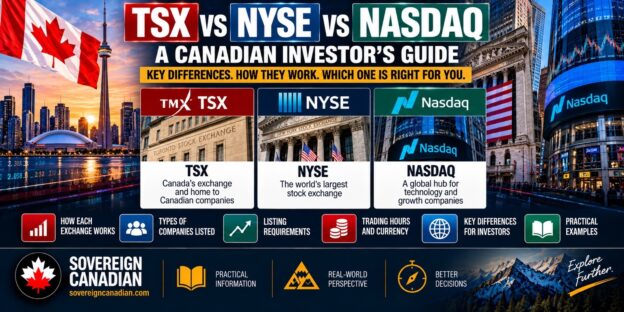
From a single self-directed brokerage account, a Canadian can buy Royal Bank, Berkshire Hathaway, Microsoft, Shopify or a small mining company in the same afternoon. Those securities sit on different exchanges, meet different listing standards and, in some cases, trade in different currencies. The investor sees a ticker and a buy button. Behind it sits a market structure most people never look at.
For the large, liquid companies that fill most portfolios, that structure matters less than most explainers imply. It isn’t irrelevant, though. Canadian stock exchanges and their American counterparts differ in which companies they list, how easily shares change hands, which currency a trade settles in and how much disclosure you can count on. This is the first article in a four-part series, Understanding Stock Markets. It covers where your stock is listed, what separates the major North American exchanges, and which differences deserve your attention.
What a Stock Exchange Actually Does
An exchange is a regulated marketplace that does two jobs. The first is listing: a company applies, meets the exchange’s financial, governance and disclosure standards, and its shares become eligible to trade under a ticker. The second is trading: buyers and sellers meet through an electronic order book, and prices form in public.
Most of what you do happens in the secondary market. When you buy 100 shares of a bank, you’re buying from another investor who wants out, not from the bank. The company is paid only when it issues new shares, in an initial public offering or a later equity offering. After that, its shares change hands without it.
Two distinctions are worth keeping straight. An exchange is not a brokerage: your broker takes your order and checks your funds, and an exchange is one of the places the order can be matched. And where a security is listed isn’t always where a trade executes. A company has a primary listing on one exchange and may add others, while a single listed security can trade on several competing venues.
The Major Canadian Stock Exchanges
The Toronto Stock Exchange (TSX) is Canada’s senior market. It lists the large banks, insurers, pipelines, utilities, railways and established technology companies that dominate the S&P/TSX Composite, among them Royal Bank, Fairfax Financial and Shopify. It isn’t limited to Canadian businesses: companies headquartered elsewhere, especially in mining, also list here. Senior means higher listing standards and more established issuers on average, not a guarantee about any one company.
The TSX Venture Exchange (TSXV) is the junior market, run by the same parent, and it exists to finance emerging businesses. It matters most to junior mining and exploration companies, which raise money for drilling long before they produce anything, and to early-stage technology and life sciences issuers. Small size, short operating histories and constant financing needs usually mean thinner trading and sharper swings. That’s a tendency, not a verdict: plenty of TSXV companies earn real revenue, and hundreds have graduated to the TSX.
The Canadian Securities Exchange (CSE) is a separate venue for entrepreneurial and emerging companies. Its issuer profile overlaps with the TSXV, but the two are different exchanges with different owners and rules. The CSE isn’t an over-the-counter market either. It’s a recognized Canadian exchange, and Finance Canada includes it on its list of designated stock exchanges.
Cboe Canada is the exchange formerly known as NEO. Cboe Global Markets bought it in 2022 and rebranded it in 2023. It lists ETFs, Canadian Depositary Receipts and a smaller group of operating companies, and it runs trading venues, including the NEO order books and the MATCHNow alternative trading system, that can trade securities listed elsewhere. One thing to watch: in April 2026 TMX Group, the TSX’s owner, agreed to buy Cboe Canada. TMX closed the Cboe Australia portion in August, but the Canadian portion remained subject to regulatory approvals as of mid-October 2026, so the ownership picture may change.
| Exchange | General issuer profile | Typical characteristics | Retail considerations |
|---|---|---|---|
| TSX | Large, established companies and ETFs; some non-Canadian issuers | Deeper trading and generally tighter spreads | Default home for most Canadian holdings; mostly CAD, with some USD lines |
| TSXV | Early-stage and junior companies, heavy in mining and exploration | Thinner trading, ongoing financing needs, wide quality range | Use limit orders; expect wider spreads and dilution risk |
| CSE | Entrepreneurial and emerging companies across several sectors | Early-stage profile; liquidity varies by issuer | Read each issuer’s disclosure closely |
| Cboe Canada | ETFs, CDRs and some operating companies; also trading venues | Product-focused listings | Ownership is in transition; the product matters more than the venue |
The Major US Exchanges
The New York Stock Exchange (NYSE) is the traditional home of large, mature companies, and it still lists many of them. Berkshire Hathaway, which I’ve analysed separately, trades there, and so does Royal Bank as a second listing. But a NYSE ticker isn’t a safety rating. It says the company met the exchange’s standards, not that the stock is cheap.
Nasdaq launched in 1971 as an electronic market and is now a full exchange. It’s associated with technology and growth companies for good reason: Microsoft, Apple and Nvidia all list there, and Shopify moved its US listing from the NYSE to Nasdaq in 2025. But Nasdaq also lists banks, biotech, consumer and industrial companies, and it isn’t inherently riskier than the NYSE. The risk sits in the business, not the venue.
Three smaller names are worth recognizing. NYSE American is the NYSE family’s exchange for smaller companies. NYSE Arca and Cboe BZX are major listing venues for ETFs and other exchange-traded products, which is why a US-listed fund so often shows one of them as its home. If you’re weighing the fund itself rather than where it lists, see our comparison of ETFs, mutual funds and individual stocks.
| Exchange | Typical role | Worth knowing |
|---|---|---|
| NYSE | Primary listing venue for large, established US and international companies | Many Canadian companies add a US listing alongside the TSX |
| Nasdaq | Electronic exchange with many technology and growth companies, plus other sectors | Same regular hours as the NYSE |
| NYSE American | Listing venue for smaller companies | Part of the NYSE group |
| NYSE Arca | Major ETF listing and trading venue | Fully electronic |
| Cboe BZX | ETF and equity listing and trading venue | One of several Cboe US exchanges |
What Actually Matters to Canadian Investors
Start with what an exchange really offers, which is a bar to clear. Each major exchange sets listing standards for new and ongoing issuers, and they’re tougher on senior boards than on venture ones. Exchanges aren’t the only safeguard. Canadian-listed companies file continuous disclosure with provincial securities regulators, US-listed companies file with the SEC, and Canadian investment dealers answer to CIRO. None of that makes any exchange safe. It means a major listing comes with baseline disclosure, and that baseline matters more as you move toward small, lightly followed companies.
Currency is the difference you’ll feel first. TSX and TSXV securities generally trade in Canadian dollars, though some also trade in US dollars. US-exchange securities trade in US dollars, so buying one with Canadian dollars means your broker converts the money, and that conversion can cost more than the trade commission. Trading currency isn’t economic exposure, though. Fairfax reports in US dollars but trades in Canadian dollars on the TSX, so its Toronto price carries US-dollar exposure. Royal Bank’s New York shares are priced in US dollars, yet it’s the same bank with the same earnings. A US listing doesn’t automatically give you US exposure.
Liquidity is how easily you can trade without moving the price, and the bid-ask spread is its most visible cost. You buy at the ask and sell at the bid, so the spread is what a round trip costs even if the price never moves. Take roughly CAD 10,000 in a heavily traded stock quoted at 40.00 bid and 40.01 ask. Buy 250 shares at 40.01, sell at 40.00, and you’ve given up CAD 2.50. Now take a thinly traded junior miner quoted at 0.95 bid and 1.00 ask. Buy 10,000 shares for CAD 10,000, sell at 0.95, and you get CAD 9,500 back. A CAD 500 toll. Spreads belong to the security, not the logo.
Dual listings make all of this concrete. Royal Bank trades on the TSX and the NYSE as RY. Shopify trades on the TSX and Nasdaq as SHOP. Each is the same company and the same class of shares, quoted in Canadian dollars in Toronto and US dollars in New York. After conversion the two prices stay close, though not identical, because any gap invites traders to buy on the cheap side and sell on the dear side. Liquidity can differ between the lines, so check both spreads, and if you hold Canadian dollars, buying the Toronto line avoids conversion altogether. Some investors use Norbert’s Gambit, which buys a dual-listed security in one currency, has the broker journal the shares to the other line and sells them there, to convert more cheaply. Not every broker offers journaling, and fees vary. That’s a currency technique, not an exchange topic.
Canadian self-directed brokerages generally give you the TSX, the TSXV and the major US exchanges from one account. Access to smaller exchanges, OTC securities and international markets varies by brokerage, as do fees, so check your broker’s documentation rather than assuming a ticker is tradable.
Regular sessions run 9:30 a.m. to 4:00 p.m. Eastern on both sides of the border, per the TSX and NYSE schedules, so the sessions line up. Extended hours are murkier. The TSX runs a post-close session from 4:15 to 5:00 p.m. where trades generally occur only at the last sale price, while US venues offer early and late sessions that vary by exchange and broker. Liquidity thins outside the core session and spreads widen. Holiday calendars differ too: Canadian exchanges close for Victoria Day and Canadian Thanksgiving, while the NYSE closes for Juneteenth. Nasdaq and NYSE Arca are pursuing longer trading sessions, including overnight trading, subject to regulatory approvals and implementation schedules. Check your broker’s current offering.
Finally, the exchange doesn’t decide tax treatment. That turns on the type of security, the issuer’s jurisdiction, the account it’s held in and the rules that apply. For registered accounts, eligibility depends on whether an investment is a qualified investment. Most securities listed on a designated stock exchange qualify, though security type still matters. Finance Canada’s list includes the TSX, TSXV, CSE, Cboe Canada, NYSE, NYSE American, NYSE Arca and Nasdaq. Also trading over the counter doesn’t disqualify a security listed on one of them, but trading only over the counter generally does unless another route applies. Withholding tax is covered in dividend tax treatment in Canada, and the account rules are in our TFSA deep dive. Confirm eligibility with your broker before putting an unfamiliar security in a registered account.
Stock Exchanges Are Not Stock Market Indices
An exchange is a marketplace. An index is a measurement. A fund that tracks an index is a product you can buy. Keeping those three apart clears up a lot of confusion, starting with the mistake of thinking you can buy an index directly.
The TSX is the exchange. The S&P/TSX Composite is an index that measures a large group of TSX-listed companies, and an ETF that follows it is something you can hold. Nasdaq is the exchange, the Nasdaq-100 is an index of 100 large non-financial companies listed on it, and again a fund can track the index. The S&P 500 and the Dow Jones Industrial Average are indices as well. Neither is an exchange: their constituents list mainly on the NYSE and Nasdaq, and when someone says the market is up, they usually mean an index moved. Article 2, Understanding Stock Market Indices, covers how those benchmarks are built and how they differ.
What About OTC Stocks, ADRs and Pink Sheets?
Not every security trades on a national exchange. Over-the-counter (OTC) securities trade through dealer networks and platforms instead, and some tiers, including the Pink market, can carry very limited disclosure. OTC doesn’t mean low quality. Legitimate, well-run foreign companies trade this way. But disclosure, liquidity and execution quality vary far more than they do among major exchange-listed names.
American Depositary Receipts, or ADRs, are often mistaken for a marketplace. They aren’t one. An ADR is a type of security: a receipt issued by a US depositary bank that represents shares of a non-US company held abroad, and it trades in US dollars. ADRs can be listed on a major US exchange or trade over the counter, and the lowest-tier programs trade only over the counter, as the SEC’s investor bulletin explains. Some foreign companies also trade their ordinary shares directly in North America. Article 3, OTC Stocks, ADRs and Pink Sheets, covers the mechanics and the risks.
Beyond North America
Canadian investors aren’t confined to North America. The London Stock Exchange, Tokyo Stock Exchange, Euronext, Hong Kong Stock Exchange and Frankfurt’s Xetra platform are among the major markets abroad. International exposure can arrive through shares on a foreign home exchange, North American listings of foreign companies, ADRs or ETFs, each with a different mix of currency, cost, access and disclosure. Whether buying directly on a home exchange beats a North American listing or an ADR is the question Article 4, Investing Directly in Global Stock Markets, takes up. For one country-level look at the practical trade-offs, see investing in Japan.
The Exchange Matters, but the Business Matters More
For most Canadians buying liquid, established companies on the TSX, NYSE or Nasdaq, the exchange is rarely the main investment decision. Royal Bank is the same bank whether you buy it in Toronto or New York, and a Nasdaq ticker doesn’t make a company better or worse than one listed on the NYSE. The business, its valuation and its financial strength do the heavy lifting.
That changes as you move outward. Smaller companies, thinly traded securities, foreign listings and OTC markets all put more weight on market structure: spreads, disclosure, currency, access and the rules of the venue. The further you are from the major boards, the more the exchange becomes part of the risk, and the more it’s worth understanding before you click buy.
Disclaimer: This article is for general informational and educational purposes only and does not constitute personalized financial, investment, tax or legal advice. Investors should conduct their own research and consult qualified professionals where appropriate.